
STATE BENEFITS FOR VETERANS · AZ
Arizona benefits for veterans
Quoted from the state's own law and agencies
What Arizona law and Arizona agencies say about property tax, vehicles and license plates, education and tuition, and other state benefits. Every row quotes its source and shows the day we read it.
See the benefitsFree · No account needed
Your Arizona benefits list, in your inbox
Email yourself every Arizona benefit on this page, with who qualifies in the source's words, each source and the day we read it.
Arizona
YOUR NEXT STEP
Keep your VA rating at hand.
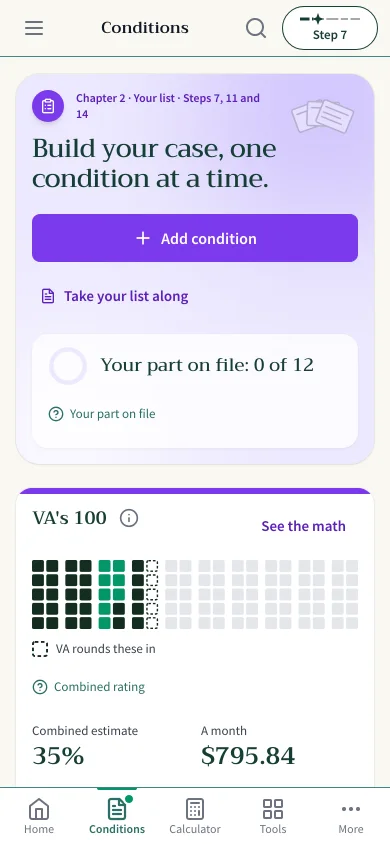
A free account keeps your conditions in one list and shows your combined rating as you add them. Have it ready when you ask the state about a benefit.

HOW TO READ THIS PAGE
Every row, in the source's own words.
Each benefit says what it is, who qualifies in the source's words, and where it comes from. Open a row to read the passage it quotes.
Find your kind of benefit
The benefits are grouped by kind. Start with the one you came for.
Read who qualifies
Each row quotes the source's own words on who qualifies.
Check with the state
Rules change. Ask the office named in the source before you count on a benefit.
Vetrify is not a state agency and not a law firm. This page points to each state's own words; the state decides who qualifies.
2 BENEFITS
Property tax
For tax years beginning after December 31, 2026: the primary residence of a veteran with a service-connected disability rated one hundred percent by VA, or with total disability based on individual unemployability, is fully exempt from property tax, and a home you own with your spouse counts as yours alone. A veteran with any other VA rating (service-connected under one hundred percent, or nonservice-connected) gets a partial exemption on property: a dollar amount that the department raises each year with any increase in the GDP price deflator, multiplied by your VA disability percentage. Your county assessor has the current amount. You must be an Arizona resident with a discharge under honorable conditions. You file an affidavit with the county assessor when you first claim it, and an exemption transfer form within sixty days of moving to a new primary residence. You may hold only one of this section's exemptions. Conveying the property to another owner ends it, and you must tell the county assessor in writing of any disqualifying event. For tax year 2026 the rule is narrower: the full exemption is only for a service-connected rating of one hundred percent (not individual unemployability), and an income limit applies to every veteran's exemption.
Who qualifies, in the source's wordsTied to a VA rating
“C. The primary residence of a veteran with a service-connected disability whose disability rating by the United States department of veterans affairs is one hundred percent or whose disability status is total disability based on individual unemployability is fully exempt from taxation. For the purposes of this subsection, a primary residence that is owned by a veteran who is eligible for the exemption under this subsection and the veteran's spouse shall be treated as if owned solely by the veteran. D. The property of a veteran with a nonservice-connected disability whose disability rating by the United States department of veterans affairs is one hundred percent or less or with a service-connected disability whose disability rating by the United States department of veterans affairs is less than one hundred percent”
What the source says
“A. The property of widows and widowers, of persons with total and permanent disabilities and of veterans with service or nonservice connected disabilities who are residents of this state is exempt from taxation as provided by article IX, section 2, Constitution of Arizona, and subject to the conditions and limits prescribed by this section. B. Pursuant to article IX, section 2, subsection F, Constitution of Arizona, the exemptions from taxation under this section are allowed as provided in subsections C, D, E, F and G of this section. C. The primary residence of a veteran with a service-connected disability whose disability rating by the United States department of veterans affairs is one hundred percent or whose disability status is total disability based on individual unemployability is fully exempt from taxation. For the purposes of this subsection, a primary residence that is owned by a veteran who is eligible for the exemption under this subsection and the veteran's spouse shall be treated as if owned solely by the veteran. D. The property of a veteran with a nonservice-connected disability whose disability rating by the United States department of veterans affairs is one hundred percent or less or with a service-connected disability whose disability rating by the United States department of veterans affairs is less than one hundred percent is exempt in the amount of $4,188. The limit under this subsection is further limited by multiplying the total exemption amount by the percentage of the veteran's disability, as rated by the United States department of veterans affairs. E. Except as provided in subsection F or G of this section, the property of a widow or widower or a person with a total and permanent disability whose income from all sources does not exceed the limits prescribed by subsection J of this section is exempt in the amount of: 1. $4,188 if the person's total assessment does not exceed the amount provided in paragraph 2 of this subsection. 2. No exemption if the person's total assessment exceeds $28,459. F. The primary residence of a widow or widower who is the surviving spouse of a veteran who was eligible for the exemption under subsection C of this section is fully exempt from taxation. G. The primary residence of a widow or widower who is the surviving spouse of a veteran who was eligible for the exemption under subsection D of this section is exempt in the amount of $4,188. The limit under this subsection is further limited by multiplying the total exemption amount by the percentage of that veteran's disability, as rated by the United States department of veterans affairs. H. On or before December 31 of each year, the department shall increase the following amounts: 1. The total allowable exemption amount under subsection D, subsection E, paragraph 1 and subsection G of this section based on the average annual percentage increase, if any, in the GDP price deflator in the two most recent complete state fiscal years. 2. Beginning in tax year 2026, the total assessment limit amount under subsection E, paragraph 2 of this section based on the average annual percentage increase, if any, in the federal house price index for the two most recent complete state fiscal years. 3. The total income limit amounts under subsection J, paragraphs 1 and 2 of this section based on the average annual percentage increase, if any, in the GDP price deflator in the two most recent complete state fiscal years. I. For the purpose of determining the amount of the allowable exemption pursuant to subsection E of this section, the person's total assessment shall not include the value of any vehicle that is taxed under title 28, chapter 16, article 3. J. Pursuant to article IX, section 2, subsection F, Constitution of Arizona, to qualify for the exemption prescribed in subsection E of this section, the total income from all sources of the claimant and the claimant's spouse and the income from all sources of all of the claimant's children who resided with the claimant in the claimant's residence in the year immediately preceding the year for which the claimant applies for the exemption shall not exceed: 1. $34,901 if none of the claimant's children under eighteen years of age resided with the claimant in the claimant's residence. 2. $41,870 if one or more of the claimant's children residing with the claimant in the claimant's residence either: (a) Were under eighteen years of age. (b) Had a total and permanent physical or mental disability, as certified by competent medical authority as provided by law. K. A person shall establish eligibility for exemption under this section by filing an affidavit with the county assessor under section 42-11152 when initially claiming the exemption and, if claiming the exemption under subsection F or G of this section, providing evidence of the veteran spouse's disability rating by the United States department of veterans affairs or total disability based on individual unemployability to the county assessor. Each year thereafter, the person who claims the exemption prescribed in subsection E of this section or the person's representative shall annually calculate income from the preceding year to ensure that the person still qualifies for the exemption. The person or the person's representative shall notify the county assessor in writing of any disqualifying event. Regardless of whether the person or the person's representative notifies the county assessor as required by this subsection, the property is subject to tax as provided by law from the date of the disqualifying event, including interest, penalties and proceedings for tax delinquencies. A disqualifying event includes: 1. The person's death. 2. The remarriage of a widow or widower. 3. For the exemption prescribed in subsection E of this section, the person's income from all sources exceeding the limits prescribed by subsection J of this section. 4. The conveyance of title to the property to another owner. L. In order for a subsequent primary residence of a person who claims any of the exemptions prescribed by this section to be eligible for exemption, within sixty days after the subsequent primary residence becomes the person's primary residence the person must file with the county assessor of the county in which the subsequent primary residence is located a fully completed exemption transfer form as prescribed by the department. M. Any dollar amount of exemption that is unused in a tax year against the limited property value of property and improvements owned by the individual may be applied for the tax year against the value of personal property subject to special property taxes, including the taxes collected pursuant to title 5, chapter 3, article 3 and title 28, chapter 16, article 3. N. The property tax exemptions prescribed in subsections C, D, E, F and G of this section are exclusive from each other, and an individual is not entitled to property tax exemptions under more than one subsection even if the individual is eligible for an exemption in more than one subsection. O. For the purposes of this section: 1. "Competent medical authority" means any of the following: (a) An individual licensed under title 32, chapter 8, 13, 14, 17, 19.1, 25 or 29 or a comparable law of another state. (b) A registered nurse practitioner as defined in section 32-1601. (c) The United States department of veterans affairs, as evidenced by a disability award letter. (d) The United States social security administration, as evidenced by a written determination letter. 2. "Federal house price index" means the average measure of movement of single-family house prices in the United States published by the federal housing finance agency, or its successor, for this state. 3. "GDP price deflator" means the average of the four implicit price deflators for the gross domestic product reported by the United States department of commerce or its successor for the four quarters of the state fiscal year. 4. "Income from all sources": (a) Means the sum of the following: (i) Adjusted gross income as defined by the department. (ii) The amount of capital gains excluded from adjusted gross income. (iii) Nontaxable strike benefits. (iv) Nontaxable interest that is received from the federal government or any of its instrumentalities. (v) Payments that are received from a retirement program and paid by this state or any political subdivision of this state or the United States through any of its agencies, instrumentalities or programs, except as provided in subdivision (b) of this paragraph. (vi) The gross amount of any pension or annuity that is not otherwise exempted. (b) Does not include monies received from: (i) Cash public assistance and relief. (ii) Railroad retirement benefits. (iii) Payments under the federal social security act (49 Stat. 620). (iv) Payments under the unemployment insurance laws of this state. (v) Payments from any veterans pensions. (vi) Workers' compensation payments. (vii) Loss of time insurance. (viii) Gifts from nongovernmental sources, surplus foods or other relief in kind supplied by a governmental agency. (iv) Veterans disability payments due to the disability rating or status of total disability based on individual unemployability. 5. "Person with a total and permanent disability" means a person who is unable to engage in any substantial gainful activity, for pay or profit, by reason of any physical or mental impairment that is expected to last for a continuous period of at least twelve months or result in death within twelve months as certified by a competent medical authority. 6. "Veteran" means an individual who has served in, and been discharged, separated or released under honorable conditions from, active or inactive service in the uniformed services of the United States, including: (a) All regular, reserve and national guard components of the United States army, navy, air force, marine corps and coast guard. (b) The commissioned corps of the national oceanic and atmospheric administration. (c) The commissioned corps of the United States public health service. (d) A nurse in the service of the American red cross or in the army and navy nurse corps. (e) Any other civilian service that is authorized by federal law to be considered active military duty for the purpose of laws administered by the United States secretary of veterans affairs.”
For tax years beginning after December 31, 2026: the primary residence of the widow or widower of a veteran who was eligible for the full exemption is fully exempt from property tax. For the widow or widower of a veteran who was eligible for the partial exemption, the primary residence is exempt by the same yearly amount multiplied by that veteran's VA disability percentage. When first claiming it, the surviving spouse files an affidavit with the county assessor and gives evidence of the veteran's VA rating or total disability based on individual unemployability. The surviving spouse must be an Arizona resident, and remarriage, or conveying the home to another owner, ends it. For tax year 2026 the rule is narrower: a surviving spouse keeps the full exemption only if the veteran's home was receiving it, and only while not remarried; an income limit applies; and the surviving spouse of a veteran rated below one hundred percent has only the general widow or widower exemption, with its limits.
Who qualifies, in the source's wordsOther rule
“F. The primary residence of a widow or widower who is the surviving spouse of a veteran who was eligible for the exemption under subsection C of this section is fully exempt from taxation. G. The primary residence of a widow or widower who is the surviving spouse of a veteran who was eligible for the exemption under subsection D of this section”
What the source says
“A. The property of widows and widowers, of persons with total and permanent disabilities and of veterans with service or nonservice connected disabilities who are residents of this state is exempt from taxation as provided by article IX, section 2, Constitution of Arizona, and subject to the conditions and limits prescribed by this section. B. Pursuant to article IX, section 2, subsection F, Constitution of Arizona, the exemptions from taxation under this section are allowed as provided in subsections C, D, E, F and G of this section. C. The primary residence of a veteran with a service-connected disability whose disability rating by the United States department of veterans affairs is one hundred percent or whose disability status is total disability based on individual unemployability is fully exempt from taxation. For the purposes of this subsection, a primary residence that is owned by a veteran who is eligible for the exemption under this subsection and the veteran's spouse shall be treated as if owned solely by the veteran. D. The property of a veteran with a nonservice-connected disability whose disability rating by the United States department of veterans affairs is one hundred percent or less or with a service-connected disability whose disability rating by the United States department of veterans affairs is less than one hundred percent is exempt in the amount of $4,188. The limit under this subsection is further limited by multiplying the total exemption amount by the percentage of the veteran's disability, as rated by the United States department of veterans affairs. E. Except as provided in subsection F or G of this section, the property of a widow or widower or a person with a total and permanent disability whose income from all sources does not exceed the limits prescribed by subsection J of this section is exempt in the amount of: 1. $4,188 if the person's total assessment does not exceed the amount provided in paragraph 2 of this subsection. 2. No exemption if the person's total assessment exceeds $28,459. F. The primary residence of a widow or widower who is the surviving spouse of a veteran who was eligible for the exemption under subsection C of this section is fully exempt from taxation. G. The primary residence of a widow or widower who is the surviving spouse of a veteran who was eligible for the exemption under subsection D of this section is exempt in the amount of $4,188. The limit under this subsection is further limited by multiplying the total exemption amount by the percentage of that veteran's disability, as rated by the United States department of veterans affairs. H. On or before December 31 of each year, the department shall increase the following amounts: 1. The total allowable exemption amount under subsection D, subsection E, paragraph 1 and subsection G of this section based on the average annual percentage increase, if any, in the GDP price deflator in the two most recent complete state fiscal years. 2. Beginning in tax year 2026, the total assessment limit amount under subsection E, paragraph 2 of this section based on the average annual percentage increase, if any, in the federal house price index for the two most recent complete state fiscal years. 3. The total income limit amounts under subsection J, paragraphs 1 and 2 of this section based on the average annual percentage increase, if any, in the GDP price deflator in the two most recent complete state fiscal years. I. For the purpose of determining the amount of the allowable exemption pursuant to subsection E of this section, the person's total assessment shall not include the value of any vehicle that is taxed under title 28, chapter 16, article 3. J. Pursuant to article IX, section 2, subsection F, Constitution of Arizona, to qualify for the exemption prescribed in subsection E of this section, the total income from all sources of the claimant and the claimant's spouse and the income from all sources of all of the claimant's children who resided with the claimant in the claimant's residence in the year immediately preceding the year for which the claimant applies for the exemption shall not exceed: 1. $34,901 if none of the claimant's children under eighteen years of age resided with the claimant in the claimant's residence. 2. $41,870 if one or more of the claimant's children residing with the claimant in the claimant's residence either: (a) Were under eighteen years of age. (b) Had a total and permanent physical or mental disability, as certified by competent medical authority as provided by law. K. A person shall establish eligibility for exemption under this section by filing an affidavit with the county assessor under section 42-11152 when initially claiming the exemption and, if claiming the exemption under subsection F or G of this section, providing evidence of the veteran spouse's disability rating by the United States department of veterans affairs or total disability based on individual unemployability to the county assessor. Each year thereafter, the person who claims the exemption prescribed in subsection E of this section or the person's representative shall annually calculate income from the preceding year to ensure that the person still qualifies for the exemption. The person or the person's representative shall notify the county assessor in writing of any disqualifying event. Regardless of whether the person or the person's representative notifies the county assessor as required by this subsection, the property is subject to tax as provided by law from the date of the disqualifying event, including interest, penalties and proceedings for tax delinquencies. A disqualifying event includes: 1. The person's death. 2. The remarriage of a widow or widower. 3. For the exemption prescribed in subsection E of this section, the person's income from all sources exceeding the limits prescribed by subsection J of this section. 4. The conveyance of title to the property to another owner. L. In order for a subsequent primary residence of a person who claims any of the exemptions prescribed by this section to be eligible for exemption, within sixty days after the subsequent primary residence becomes the person's primary residence the person must file with the county assessor of the county in which the subsequent primary residence is located a fully completed exemption transfer form as prescribed by the department. M. Any dollar amount of exemption that is unused in a tax year against the limited property value of property and improvements owned by the individual may be applied for the tax year against the value of personal property subject to special property taxes, including the taxes collected pursuant to title 5, chapter 3, article 3 and title 28, chapter 16, article 3. N. The property tax exemptions prescribed in subsections C, D, E, F and G of this section are exclusive from each other, and an individual is not entitled to property tax exemptions under more than one subsection even if the individual is eligible for an exemption in more than one subsection. O. For the purposes of this section: 1. "Competent medical authority" means any of the following: (a) An individual licensed under title 32, chapter 8, 13, 14, 17, 19.1, 25 or 29 or a comparable law of another state. (b) A registered nurse practitioner as defined in section 32-1601. (c) The United States department of veterans affairs, as evidenced by a disability award letter. (d) The United States social security administration, as evidenced by a written determination letter. 2. "Federal house price index" means the average measure of movement of single-family house prices in the United States published by the federal housing finance agency, or its successor, for this state. 3. "GDP price deflator" means the average of the four implicit price deflators for the gross domestic product reported by the United States department of commerce or its successor for the four quarters of the state fiscal year. 4. "Income from all sources": (a) Means the sum of the following: (i) Adjusted gross income as defined by the department. (ii) The amount of capital gains excluded from adjusted gross income. (iii) Nontaxable strike benefits. (iv) Nontaxable interest that is received from the federal government or any of its instrumentalities. (v) Payments that are received from a retirement program and paid by this state or any political subdivision of this state or the United States through any of its agencies, instrumentalities or programs, except as provided in subdivision (b) of this paragraph. (vi) The gross amount of any pension or annuity that is not otherwise exempted. (b) Does not include monies received from: (i) Cash public assistance and relief. (ii) Railroad retirement benefits. (iii) Payments under the federal social security act (49 Stat. 620). (iv) Payments under the unemployment insurance laws of this state. (v) Payments from any veterans pensions. (vi) Workers' compensation payments. (vii) Loss of time insurance. (viii) Gifts from nongovernmental sources, surplus foods or other relief in kind supplied by a governmental agency. (iv) Veterans disability payments due to the disability rating or status of total disability based on individual unemployability. 5. "Person with a total and permanent disability" means a person who is unable to engage in any substantial gainful activity, for pay or profit, by reason of any physical or mental impairment that is expected to last for a continuous period of at least twelve months or result in death within twelve months as certified by a competent medical authority. 6. "Veteran" means an individual who has served in, and been discharged, separated or released under honorable conditions from, active or inactive service in the uniformed services of the United States, including: (a) All regular, reserve and national guard components of the United States army, navy, air force, marine corps and coast guard. (b) The commissioned corps of the national oceanic and atmospheric administration. (c) The commissioned corps of the United States public health service. (d) A nurse in the service of the American red cross or in the army and navy nurse corps. (e) Any other civilian service that is authorized by federal law to be considered active military duty for the purpose of laws administered by the United States secretary of veterans affairs.”
3 BENEFITS
Vehicles and license plates
No vehicle license tax or registration fee for one personally owned vehicle, or its replacement, including one you own with another person. The exemption carries on for your surviving spouse, who may renew the registration on the same terms until the spouse remarries or dies. On first registration you show VA's certificate of your one hundred percent disability and your compensation.
Who qualifies, in the source's wordsTied to a VA rating
“A veteran for a personally owned vehicle or a veteran and another party owning a vehicle if the veteran is certified by the United States department of veterans affairs as having a one hundred percent disability and drawing compensation on that basis.”
What the source says
“A. Notwithstanding sections 28-2003 and 28-5801, the registering officer shall not collect a vehicle license tax or registration fee from: 1. A veteran residing in this state for a vehicle or any replacement of the vehicle acquired by financial aid from the United States department of veterans affairs pursuant to Public Laws 79-663, 85-56, 85-857, 90-77, 91-666 and 93-538; 38 United States Code sections 1901 through 1988. 2. A veteran for a personally owned vehicle or a veteran and another party owning a vehicle if the veteran is certified by the United States department of veterans affairs as having a one hundred percent disability and drawing compensation on that basis. The exemption provided by this paragraph applies to a surviving spouse of the veteran with a disability until the surviving spouse's remarriage or death. B. On initial registration of a vehicle a veteran claiming an exemption under subsection A of this section shall present satisfactory proof of the United States department of veterans affairs financial aid or government compensation and certificate on determination of one hundred percent disability, as applicable. The veteran may claim and be granted an exemption and the surviving spouse may renew the registration pursuant to the terms of the exemption provided to the veteran for only one vehicle or any replacement of the vehicle owned by the veteran or the surviving spouse until the surviving spouse's remarriage or death.”
Source: Arizona Revised Statutes 28-5802, Vehicle license tax exemption; veterans. Read .
No vehicle license tax or registration fee for one vehicle, or its replacement, acquired with financial aid from VA under the federal laws the section lists (38 United States Code sections 1901 through 1988, as the statute numbers them). On first registration you show proof of the VA financial aid.
Who qualifies, in the source's wordsOther rule
“A veteran residing in this state for a vehicle or any replacement of the vehicle acquired by financial aid from the United States department of veterans affairs pursuant to Public Laws 79-663, 85-56, 85-857, 90-77, 91-666 and 93-538; 38 United States Code sections 1901 through 1988.”
What the source says
“A. Notwithstanding sections 28-2003 and 28-5801, the registering officer shall not collect a vehicle license tax or registration fee from: 1. A veteran residing in this state for a vehicle or any replacement of the vehicle acquired by financial aid from the United States department of veterans affairs pursuant to Public Laws 79-663, 85-56, 85-857, 90-77, 91-666 and 93-538; 38 United States Code sections 1901 through 1988. 2. A veteran for a personally owned vehicle or a veteran and another party owning a vehicle if the veteran is certified by the United States department of veterans affairs as having a one hundred percent disability and drawing compensation on that basis. The exemption provided by this paragraph applies to a surviving spouse of the veteran with a disability until the surviving spouse's remarriage or death. B. On initial registration of a vehicle a veteran claiming an exemption under subsection A of this section shall present satisfactory proof of the United States department of veterans affairs financial aid or government compensation and certificate on determination of one hundred percent disability, as applicable. The veteran may claim and be granted an exemption and the surviving spouse may renew the registration pursuant to the terms of the exemption provided to the veteran for only one vehicle or any replacement of the vehicle owned by the veteran or the surviving spouse until the surviving spouse's remarriage or death.”
Source: Arizona Revised Statutes 28-5802, Vehicle license tax exemption; veterans. Read .
No vehicle license tax and registration fee for one personally owned vehicle, including one you own with another person. On first registration you give the department proof that you are a veteran, a bona fide Purple Heart recipient and honorably discharged.
Who qualifies, in the source's wordsOther rule
“1. The veteran is a bona fide purple heart medal recipient. 2. The veteran was honorably discharged from the United States military.”
What the source says
“C. Notwithstanding sections 28-2003 and 28-5801, the registering officer shall not collect a vehicle license tax and registration fee from a veteran for a personally owned vehicle or a veteran and another party owning a vehicle. The exemption allowed by this subsection applies only to one vehicle and only if all of the following apply: 1. The veteran is a bona fide purple heart medal recipient. 2. The veteran was honorably discharged from the United States military. 3. On initial registration of the vehicle, the veteran submits satisfactory proof to the department that the person is a veteran and a bona fide purple heart medal recipient and was honorably discharged as required by paragraph 2 of this subsection.”
Source: Arizona Revised Statutes 28-5802, Vehicle license tax exemption; veterans. Read .
7 BENEFITS
Education and tuition
A tuition waiver scholarship at any university under the Arizona Board of Regents, or at any community college of a community college district, once the Arizona Department of Veterans' Services verifies you qualify. You must otherwise meet the admission requirements. A conviction for a class 1, 2, 3, 4 or 5 felony makes you ineligible.
Who qualifies, in the source's wordsTied to a VA rating
“a member or former member of the United States armed forces who received a purple heart citation, who was a resident of the state of Arizona or was stationed in Arizona at the time of the injury that resulted in the purple heart citation and whose disability rating determined by the United States department of veterans affairs is fifty percent or more”
What the source says
“F. The Arizona board of regents, after verification by the Arizona department of veterans' services that a person is a member or former member of the United States armed forces who received a purple heart citation, who was a resident of the state of Arizona or was stationed in Arizona at the time of the injury that resulted in the purple heart citation and whose disability rating determined by the United States department of veterans affairs is fifty percent or more, shall provide the person who otherwise meets the qualifications for admission with a tuition waiver scholarship at any university under the jurisdiction of the board. A district as defined in section 15-1401, after verification by the Arizona department of veterans' services that a person is a member or former member of the United States armed forces who received a purple heart citation, who was a resident of the state of Arizona or was stationed in Arizona at the time of the injury that resulted in the purple heart citation and whose disability rating determined by the United States department of veterans affairs is fifty percent or more, shall provide the person who otherwise meets the qualifications for admission with a tuition waiver scholarship at any community college under the jurisdiction of the district. A person who is convicted of a class 1, 2, 3, 4 or 5 felony is ineligible for a tuition waiver scholarship as provided in this subsection.”
Source: Arizona Revised Statutes 15-1808, Tuition waiver scholarships; eligibility; definitions. Read .
A tuition waiver scholarship at any university under the Arizona Board of Regents, or at any community college of a community college district, after the adjutant general of the national guard or the Arizona Department of Veterans' Services verifies that the student is the child or spouse of a qualifying service member. It is limited to a child thirty years of age or younger, or a spouse who has not remarried, and to sixty-four credit hours at Arizona community colleges and, in all, the credits a baccalaureate degree needs for the student's first declared course of study. The student must otherwise meet the admission requirements.
Who qualifies, in the source's wordsOther rule
“a child or the spouse of a peace officer, correctional officer, firefighter, emergency paramedic, national guard member or member of the United States armed forces who was a resident of the state of Arizona or stationed in Arizona and who was killed in the line of duty or who died from injuries suffered in the line of duty while traveling to or from duty”
What the source says
“A. The Arizona board of regents, after verification by the Arizona peace officers memorial board, by the Arizona fallen firefighter memorial committee, by the adjutant general of the national guard or by the Arizona department of veterans' services that a person is a child or the spouse of a peace officer, correctional officer, firefighter, emergency paramedic, national guard member or member of the United States armed forces who was a resident of the state of Arizona or stationed in Arizona and who was killed in the line of duty or who died from injuries suffered in the line of duty while traveling to or from duty, shall provide the person who qualifies under subsection D of this section and who otherwise meets the qualifications for admission with a tuition waiver scholarship at any university under the jurisdiction of the Arizona board of regents. A district as defined in section 15-1401, after verification by the Arizona peace officers memorial board, by the Arizona fallen firefighter memorial committee, by the adjutant general of the national guard or by the Arizona department of veterans' services that a person is the child or the spouse of a peace officer, correctional officer, firefighter, emergency paramedic, national guard member or member of the United States armed forces who was a resident of Arizona or stationed in Arizona and who was killed in the line of duty or who died from injuries suffered in the line of duty while traveling to or from duty, shall provide the person who qualifies under subsection D of this section and who otherwise meets the qualifications for admission with a tuition waiver scholarship at any community college under the jurisdiction of the district. B. The Arizona board of regents, after verification by the Arizona peace officers memorial board, the Arizona fallen firefighter memorial committee or the department of veterans' services that a person is a child or the spouse of a person who meets the requirements prescribed in subsection C of this section, shall provide the person who qualifies under subsection D of this section and who otherwise meets the qualifications for admission with a tuition waiver scholarship at any university under the jurisdiction of the Arizona board of regents. A district as defined in section 15-1401, after verification by the Arizona peace officers memorial board, the Arizona fallen firefighter memorial committee or the department of veterans' services that a person is a child or the spouse of a person who meets the requirements prescribed in subsection C of this section, shall provide the person who qualifies under subsection D of this section and who otherwise meets the qualifications for admission with a tuition waiver scholarship at any community college under the jurisdiction of the district. Notwithstanding section 15-1809, if sufficient monies are available, the Arizona board of regents shall distribute surplus monies that were appropriated to the spouses of military veterans tuition scholarship fund established by section 15-1809 to each university under the jurisdiction of the Arizona board of regents for the costs associated with the tuition waiver scholarships provided pursuant to this subsection. C. To be eligible for a tuition waiver scholarship under subsection B of this section, the applicant must be the child or spouse of a person who meets all of the following criteria: 1. Was a veteran of the United States armed forces or was serving or previously served as a peace officer, a firefighter or a member of the United States armed forces at the time of the person's death. It is not a requirement for the purposes of this paragraph that the person was employed as a peace officer or firefighter or was serving on active duty as a member of the United States armed forces at the time of the person's death. 2. Was a resident of this state at the time of the person's death. 3. Suffered a post-traumatic stress injury in the line of duty. Documentation that the peace officer or firefighter at any point received a disability pension under section 38-844 for a post-traumatic stress injury or benefits under title 38, chapter 5, article 4.2 for a post-traumatic stress injury is prima facie evidence that the peace officer or firefighter met the requirements of this paragraph. A discharge or other document from the United States armed forces showing that the member or veteran of the United States armed forces was discharged because of or suffered from a post-traumatic stress injury, or documentation from the United States department of veterans affairs showing that the member or veteran suffered from a post-traumatic stress injury, is prima facie evidence that the member or veteran met the requirements of this paragraph. 4. Died by suicide. D. The tuition waiver scholarships shall be limited to children who are thirty years of age or younger or a spouse who has not remarried and shall be limited for a spouse or for any one child to not more than sixty-four credit hours at Arizona community colleges and a total number of credits including any transfer credits from an Arizona community college equal to the number of credits required for a baccalaureate degree at Arizona universities for that student's initially declared course of study.”
Source: Arizona Revised Statutes 15-1808, Tuition waiver scholarships; eligibility; definitions. Read .
A tuition waiver scholarship at any university under the Arizona Board of Regents, or at any community college of a community college district, after the Department of Veterans' Services verifies the applicant is the child or spouse of a veteran or service member who meets the law's four criteria. A discharge or other armed forces document, or a VA record, showing the post-traumatic stress injury is prima facie evidence of it. The same limits apply: a child thirty years of age or younger or a spouse who has not remarried, sixty-four credit hours at Arizona community colleges, and in all the credits a baccalaureate degree needs. The student must otherwise meet the admission requirements.
Who qualifies, in the source's wordsOther rule
“C. To be eligible for a tuition waiver scholarship under subsection B of this section, the applicant must be the child or spouse of a person who meets all of the following criteria: 1. Was a veteran of the United States armed forces or was serving or previously served as a peace officer, a firefighter or a member of the United States armed forces at the time of the person's death. It is not a requirement for the purposes of this paragraph that the person was employed as a peace officer or firefighter or was serving on active duty as a member of the United States armed forces at the time of the person's death. 2. Was a resident of this state at the time of the person's death. 3. Suffered a post-traumatic stress injury in the line of duty. Documentation that the peace officer or firefighter at any point received a disability pension under section 38-844 for a post-traumatic stress injury or benefits under title 38, chapter 5, article 4.2 for a post-traumatic stress injury is prima facie evidence that the peace officer or firefighter met the requirements of this paragraph. A discharge or other document from the United States armed forces showing that the member or veteran of the United States armed forces was discharged because of or suffered from a post-traumatic stress injury, or documentation from the United States department of veterans affairs showing that the member or veteran suffered from a post-traumatic stress injury, is prima facie evidence that the member or veteran met the requirements of this paragraph. 4. Died by suicide.”
What the source says
“B. The Arizona board of regents, after verification by the Arizona peace officers memorial board, the Arizona fallen firefighter memorial committee or the department of veterans' services that a person is a child or the spouse of a person who meets the requirements prescribed in subsection C of this section, shall provide the person who qualifies under subsection D of this section and who otherwise meets the qualifications for admission with a tuition waiver scholarship at any university under the jurisdiction of the Arizona board of regents. A district as defined in section 15-1401, after verification by the Arizona peace officers memorial board, the Arizona fallen firefighter memorial committee or the department of veterans' services that a person is a child or the spouse of a person who meets the requirements prescribed in subsection C of this section, shall provide the person who qualifies under subsection D of this section and who otherwise meets the qualifications for admission with a tuition waiver scholarship at any community college under the jurisdiction of the district. Notwithstanding section 15-1809, if sufficient monies are available, the Arizona board of regents shall distribute surplus monies that were appropriated to the spouses of military veterans tuition scholarship fund established by section 15-1809 to each university under the jurisdiction of the Arizona board of regents for the costs associated with the tuition waiver scholarships provided pursuant to this subsection. C. To be eligible for a tuition waiver scholarship under subsection B of this section, the applicant must be the child or spouse of a person who meets all of the following criteria: 1. Was a veteran of the United States armed forces or was serving or previously served as a peace officer, a firefighter or a member of the United States armed forces at the time of the person's death. It is not a requirement for the purposes of this paragraph that the person was employed as a peace officer or firefighter or was serving on active duty as a member of the United States armed forces at the time of the person's death. 2. Was a resident of this state at the time of the person's death. 3. Suffered a post-traumatic stress injury in the line of duty. Documentation that the peace officer or firefighter at any point received a disability pension under section 38-844 for a post-traumatic stress injury or benefits under title 38, chapter 5, article 4.2 for a post-traumatic stress injury is prima facie evidence that the peace officer or firefighter met the requirements of this paragraph. A discharge or other document from the United States armed forces showing that the member or veteran of the United States armed forces was discharged because of or suffered from a post-traumatic stress injury, or documentation from the United States department of veterans affairs showing that the member or veteran suffered from a post-traumatic stress injury, is prima facie evidence that the member or veteran met the requirements of this paragraph. 4. Died by suicide. D. The tuition waiver scholarships shall be limited to children who are thirty years of age or younger or a spouse who has not remarried and shall be limited for a spouse or for any one child to not more than sixty-four credit hours at Arizona community colleges and a total number of credits including any transfer credits from an Arizona community college equal to the number of credits required for a baccalaureate degree at Arizona universities for that student's initially declared course of study.”
Source: Arizona Revised Statutes 15-1808, Tuition waiver scholarships; eligibility; definitions. Read .
Eligible for a tuition waiver scholarship under this section of the law.
Who qualifies, in the source's wordsOther rule
“A member of the Arizona national guard who received a purple heart citation on or after September 11, 2001 or a former member of the Arizona national guard who was medically discharged from the Arizona national guard due to an injury or disability suffered during status under title 10, United States Code, in weekend training status, in annual training status or in response to a state of emergency declared by the governor”
What the source says
“E. A member of the Arizona national guard who received a purple heart citation on or after September 11, 2001 or a former member of the Arizona national guard who was medically discharged from the Arizona national guard due to an injury or disability suffered during status under title 10, United States Code, in weekend training status, in annual training status or in response to a state of emergency declared by the governor is eligible for a tuition waiver scholarship provided for in this section.”
Source: Arizona Revised Statutes 15-1808, Tuition waiver scholarships; eligibility; definitions. Read .
Immediate classification as an in-state student at a university under the Arizona Board of Regents or a community college of a community college district, and you do not lose it, once you show objective evidence of intent to be an Arizona resident: at least one of voter registration in Arizona, an Arizona driver license, Arizona vehicle registration, employment history in Arizona, moving major banking services to Arizona, a change of permanent address on all pertinent records, or other materials relevant to domicile or residency.
Who qualifies, in the source's wordsOther rule
“1. The person is a veteran as defined in title 38 of the United States Code who, while using educational assistance under 38 United States Code chapter 30, 31, 33 or 35, enrolls in a university under the jurisdiction of the Arizona board of regents or a community college under the jurisdiction of a community college district governing board after the veteran's discharge from active duty service of ninety or more days.”
What the source says
“H. A person who meets any of the requirements prescribed in subsection L of this section shall be granted immediate classification as an in-state student and does not lose in-state student classification if the person has demonstrated objective evidence of intent to be a resident of this state that, for the purposes of this section, includes at least one of the following: 1. Registration to vote in this state. 2. An Arizona driver license. 3. Arizona motor vehicle registration. 4. Employment history in Arizona. 5. Transfer of major banking services to Arizona. 6. Change of permanent address on all pertinent records. 7. Other materials of whatever kind or source relevant to domicile or residency status. I. A person who is a member of an Indian tribe recognized by the United States department of the interior whose reservation land lies in this state and extends into another state and who is a resident of the reservation is entitled to classification as an in-state student. J. A person who has participated in the AmeriCorps program or the volunteers in service to America program for at least one year in this state is entitled to classification as an in-state student. K. A person who is a contracted cadet participating in a reserve officer training corps program in this state is entitled to classification as an in-state student. L. A person who meets any of the following requirements is entitled to immediate classification as an in-state student if that person has demonstrated objective evidence of intent to be a resident of this state as prescribed in subsection H of this section: 1. The person is a veteran as defined in title 38 of the United States Code who, while using educational assistance under 38 United States Code chapter 30, 31, 33 or 35, enrolls in a university under the jurisdiction of the Arizona board of regents or a community college under the jurisdiction of a community college district governing board after the veteran's discharge from active duty service of ninety or more days. 2. The person does not meet the requirements prescribed in paragraph 3 or 4 of this subsection and, while using educational assistance under 38 United States Code chapter 30, 31, 33 or 35, enrolls in a university under the jurisdiction of the Arizona board of regents or a community college under the jurisdiction of a community college district governing board after the veteran's discharge from active duty service of ninety or more days. 3. The person, while using benefits under the Marine Gunnery Sergeant John David Fry Scholarship prescribed in 38 United States Code section 3311(b)(9), enrolls in a university under the jurisdiction of the Arizona board of regents or a community college under the jurisdiction of a community college district governing board. 4. The person, while using transferred Post/911 G.I. Bill benefits pursuant to 38 United States Code section 3319 during a time in which the transferor is a member of the uniformed services serving on active duty, enrolls in a university under the jurisdiction of the Arizona board of regents or a community college under the jurisdiction of a community college district governing board. 5. The person is otherwise described in 38 United States Code section 3679(c).”
Source: Arizona Revised Statutes 15-1802, In-state student status (subsections H and L). Read .
Immediate classification as an in-state student, kept while you stay continuously enrolled, once you show objective evidence of intent to be an Arizona resident: at least one of voter registration in Arizona, an Arizona driver license, Arizona vehicle registration, employment history in Arizona, moving major banking services to Arizona, a change of permanent address on all pertinent records, or other materials relevant to domicile or residency.
Who qualifies, in the source's wordsOther rule
“A person holding an honorable discharge from the uniformed services of the United States from either active duty or reserve or national guard status, or who has retired from active duty or reserve or national guard status”
What the source says
“G. A person holding an honorable discharge from the uniformed services of the United States from either active duty or reserve or national guard status, or who has retired from active duty or reserve or national guard status, shall be granted immediate classification as an in-state student and, while continuously enrolled, does not lose in-state student classification if the person has demonstrated objective evidence of intent to be a resident of Arizona that, for the purposes of this section, includes at least one of the following: 1. Registration to vote in this state. 2. An Arizona driver license. 3. Arizona motor vehicle registration. 4. Employment history in Arizona. 5. Transfer of major banking services to Arizona. 6. Change of permanent address on all pertinent records. 7. Other materials of whatever kind or source relevant to domicile or residency status.”
Source: Arizona Revised Statutes 15-1802, In-state student status (subsection G). Read .
For the spouse of an honorably discharged veteran, subject to available money and first come, first served: a tuition scholarship equal to tuition and mandatory fees at a university under the Arizona Board of Regents or an Arizona community college, less any federal aid scholarships, public grants and other financial gifts, grants or aid. It covers no more than four academic years or eight semesters, only for a certificate, an associate degree or a baccalaureate degree. You apply to the Arizona Board of Regents.
Who qualifies, in the source's wordsOther rule
“1. Enrolls in a university under the jurisdiction of the Arizona board of regents or in a community college as defined in section 15-1401. 2. Is the spouse of an honorably discharged veteran of the armed forces of the United States. For the purposes of proving that the person's spouse is an honorably discharged veteran of the armed forces of the United States as required by this paragraph: (a) The person shall submit proof of the honorable discharge or general discharge under honorable conditions of the person's spouse. (b) The department of veterans' services shall verify that the person is the spouse of an honorably discharged veteran. 3. Is entitled to classification as an in-state student under section 15-1802. 4. Is a resident of this state at the time of applying for a tuition scholarship and continues to be a resident of this state while receiving a tuition scholarship under this section. 5. Completes and submits the free application for federal student aid for each year that the person receives a tuition scholarship under this section. 6. Complies with the standards of satisfactory academic progress as established by the university or community college in which the person enrolls. 7. Completes a family educational rights and privacy act of 1974 (P.L. 93-380; 88 Stat. 571) release form for each university or community college in which the person is enrolled to authorize the release of personally identifiable information required to determine continued tuition scholarship eligibility under this section.”
What the source says
“A. The spouses of military veterans tuition scholarship fund is established consisting of legislative appropriations. The Arizona board of regents shall administer the fund. Monies in the fund are continuously appropriated and are exempt from the provisions of section 35-190 relating to lapsing of appropriations. On notice from the Arizona board of regents, the state treasurer shall invest and divest monies in the fund as provided by section 35-313, and monies earned from investment shall be credited to the fund. Subject to available monies, the Arizona board of regents shall use the monies in the fund to award tuition scholarships to any person who meets all of the following requirements: 1. Enrolls in a university under the jurisdiction of the Arizona board of regents or in a community college as defined in section 15-1401. 2. Is the spouse of an honorably discharged veteran of the armed forces of the United States. For the purposes of proving that the person's spouse is an honorably discharged veteran of the armed forces of the United States as required by this paragraph: (a) The person shall submit proof of the honorable discharge or general discharge under honorable conditions of the person's spouse. (b) The department of veterans' services shall verify that the person is the spouse of an honorably discharged veteran. 3. Is entitled to classification as an in-state student under section 15-1802. 4. Is a resident of this state at the time of applying for a tuition scholarship and continues to be a resident of this state while receiving a tuition scholarship under this section. 5. Completes and submits the free application for federal student aid for each year that the person receives a tuition scholarship under this section. 6. Complies with the standards of satisfactory academic progress as established by the university or community college in which the person enrolls. 7. Completes a family educational rights and privacy act of 1974 (P.L. 93-380; 88 Stat. 571) release form for each university or community college in which the person is enrolled to authorize the release of personally identifiable information required to determine continued tuition scholarship eligibility under this section. B. A person who meets the requirements prescribed in subsection A of this section may apply to the Arizona board of regents for a tuition scholarship from the fund in a manner prescribed by the Arizona board of regents. Subject to available monies, the Arizona board of regents shall award an eligible person a tuition scholarship that is equal to the amount of tuition and mandatory fees charged by the university or community college in which the person is enrolled, reduced by the amount of any federal aid scholarships or public grants and any other financial gifts, grants or aid received by that person. The Arizona board of regents shall verify that the person satisfies the requirements prescribed in subsection A of this section before awarding a tuition scholarship. If the Arizona board of regents determines that a person no longer satisfies the requirements prescribed in subsection A of this section, the Arizona board of regents may not award a subsequent tuition scholarship from the fund until the person submits documentation showing that the person satisfies all requirements prescribed in subsection A of this section. C. A tuition scholarship provided pursuant to this section shall be: 1. Limited to not more than four academic years or eight semesters. 2. Used only for a certificate, an associate degree or a baccalaureate degree. 3. Used only to pay tuition and mandatory fees at a university under the jurisdiction of the Arizona board of regents or at a community college as defined in section 15-1401. D. Tuition scholarships under this section shall be awarded on a first-come, first-served basis. If there are insufficient monies in the fund, the Arizona board of regents may not award a tuition scholarship to an eligible person under this section.”
Source: Arizona Revised Statutes 15-1809, Spouses of military veterans tuition scholarship fund. Read .
1 BENEFIT
Other state benefits
Arizona's game and fish commission may issue a complimentary (free) license to a veteran whose permanent service-connected disability is rated one hundred percent disabling, a license at up to twenty-five percent less than the full fee to a veteran with a service-connected disability, and a license at half the full fee to a veteran who is a bona fide Purple Heart recipient. Each needs one year or more of Arizona residence just before applying. The commission sets its license classifications and fees by rule.
Who qualifies, in the source's wordsTied to a VA rating
“2. A complimentary license to a veteran of the armed forces of the United States who has been a resident of this state for one year or more immediately before applying for the license and who receives compensation from the United States government for a permanent service-connected disability rated as one hundred percent disabling. 3. A license for a reduced fee of up to twenty-five percent less than the full license fee to a veteran of the United States armed forces who has been a resident of this state for one year or more immediately before applying for the license and who receives compensation from the United States government for a service-connected disability. 4. A license for a reduced fee that is one-half of the full license fee to a person who has been a resident of this state for one year or more immediately before applying for the license and who submits satisfactory proof to the department that the person is a veteran and a bona fide purple heart medal recipient.”
What the source says
“A. The commission shall prescribe by rule license classifications that are valid for the taking or handling of wildlife, fees for licenses, permits, tags and stamps and application fees. B. The commission may temporarily reduce or waive any fee prescribed by rule under this title on the recommendation of the director. C. The commission may reduce the fees for licenses and issue complimentary licenses, including the following: 1. A complimentary license to a pioneer who is at least seventy years of age and who has been a resident of this state for twenty-five or more consecutive years immediately before applying for the license. The pioneer license is valid for the licensee's lifetime, and the commission may not require renewal of the license. 2. A complimentary license to a veteran of the armed forces of the United States who has been a resident of this state for one year or more immediately before applying for the license and who receives compensation from the United States government for a permanent service-connected disability rated as one hundred percent disabling. 3. A license for a reduced fee of up to twenty-five percent less than the full license fee to a veteran of the United States armed forces who has been a resident of this state for one year or more immediately before applying for the license and who receives compensation from the United States government for a service-connected disability. 4. A license for a reduced fee that is one-half of the full license fee to a person who has been a resident of this state for one year or more immediately before applying for the license and who submits satisfactory proof to the department that the person is a veteran and a bona fide purple heart medal recipient.”
Source: Arizona Revised Statutes 17-333, License classifications; fees; reduced fee and complimentary licenses. Read .
Not covered on this page yet
These have no row here yet, so the page is not a full list. Ask the Arizona Department of Veterans' Services about them.
- The Arizona Department of Veterans' Services' and Department of Transportation's own pages: both refused automated reading on 2026-11-25, so every row rests on the law itself.
- This year's property tax exemption amounts: the department raises them each year, so no row gives one.

On the App Store
Your combined rating and what it pays, on your phone.
VA Calc combines your ratings with VA's whole-person formula and shows what that rating pays at VA's official rates.
Official sources
- Arizona Revised Statutes 42-11111, Exemption for property; veterans with a disability (as amended by Laws 2026, chapter 140, for tax years beginning from and after December 31, 2026), www.azleg.gov
- Arizona Revised Statutes 28-5802, Vehicle license tax exemption; veterans, www.azleg.gov
- Arizona Revised Statutes 15-1808, Tuition waiver scholarships; eligibility; definitions, www.azleg.gov
- Arizona Revised Statutes 15-1802, In-state student status (subsections H and L), www.azleg.gov
- Arizona Revised Statutes 15-1809, Spouses of military veterans tuition scholarship fund, www.azleg.gov
- Arizona Revised Statutes 17-333, License classifications; fees; reduced fee and complimentary licenses, www.azleg.gov