
STATE BENEFITS FOR VETERANS · VA
Virginia benefits for veterans
Quoted from the state's own law and agencies
What Virginia law and Virginia agencies say about property tax, vehicles and license plates, education and tuition, and other state benefits. Every row quotes its source and shows the day we read it.
See the benefitsFree · No account needed
Your Virginia benefits list, in your inbox
Email yourself every Virginia benefit on this page, with who qualifies in the source's words, each source and the day we read it.
Virginia
YOUR NEXT STEP
Keep your VA rating at hand.
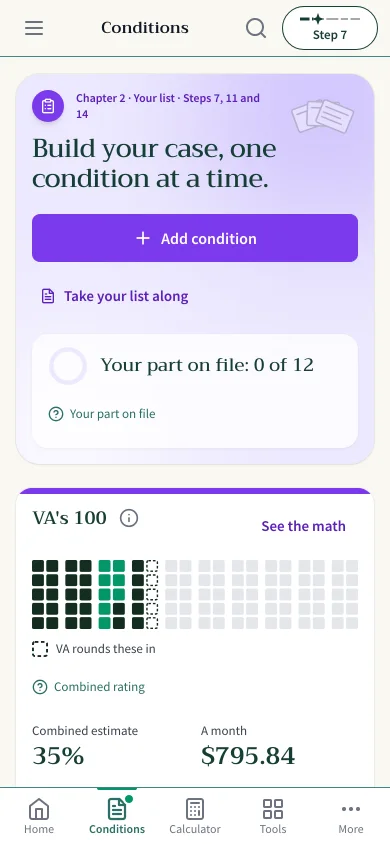
A free account keeps your conditions in one list and shows your combined rating as you add them. Have it ready when you ask the state about a benefit.

HOW TO READ THIS PAGE
Every row, in the source's own words.
Each benefit says what it is, who qualifies in the source's words, and where it comes from. Open a row to read the passage it quotes.
Find your kind of benefit
The benefits are grouped by kind. Start with the one you came for.
Read who qualifies
Each row quotes the source's own words on who qualifies.
Check with the state
Rules change. Ask the office named in the source before you count on a benefit.
Vetrify is not a state agency and not a law firm. This page points to each state's own words; the state decides who qualifies.
5 BENEFITS
Property tax
Your home is exempt from real property tax if VA has rated you with a 100 percent service-connected, permanent, and total disability and you occupy it as your principal place of residence; this includes the joint real property of married individuals. The exemption covers the dwelling and the land it sits on up to one acre, or more acres where the locality exempts or defers more under its other relief. A house or manufactured home you own is exempt even if you do not own the land, but then the land is not exempt. Another improvement on that land is exempt too if its principal use is to house or cover vehicles or household goods and personal effects, and not for business. Property held by the veteran (alone or with a spouse) as a tenant for life or joint lives, or in the revocable or irrevocable trusts the law describes, counts as the veteran's; an interest held under a leasehold or term of years does not. When people who do not qualify also own the home, the exemption is prorated: by the qualifying owners' percentage of ownership, or, for life-estate and trust holdings, by the number of qualifying people out of all the owners entitled to occupy it.
Who qualifies, in the source's wordsPermanent and total
“any veteran who has been rated by the U.S. Department of Veterans Affairs or its successor agency pursuant to federal law to have a 100 percent service-connected, permanent, and total disability, and who occupies the real property as his principal place of residence”
What the source says
“A. Pursuant to subdivision (a) of Section 6-A of Article X of the Constitution of Virginia, and for tax years beginning on or after January 1, 2011, the General Assembly hereby exempts from taxation the real property, including the joint real property of married individuals, of any veteran who has been rated by the U.S. Department of Veterans Affairs or its successor agency pursuant to federal law to have a 100 percent service-connected, permanent, and total disability, and who occupies the real property as his principal place of residence. If the veteran's disability rating occurs after January 1, 2011, and he has a qualified primary residence on the date of the rating, then the exemption for him under this section begins on the date of such rating. However, no county, city, or town shall be liable for any interest on any refund due to the veteran for taxes paid prior to the veteran's filing of the affidavit or written statement required by § 58.1-3219.6. If the qualified veteran acquires the property after January 1, 2011, then the exemption shall begin on the date of acquisition, and the previous owner may be entitled to a refund for a pro rata portion of real property taxes paid pursuant to § 58.1-3360. B. The surviving spouse of a veteran eligible for the exemption set forth in this article shall also qualify for the exemption, so long as the death of the veteran occurs on or after January 1, 2011, and the surviving spouse does not remarry. The exemption applies without any restriction on the spouse's moving to a different principal place of residence. C. A county, city, or town shall provide for the exemption from real property taxes the qualifying dwelling pursuant to this section and shall provide for the exemption from real property taxes the land, not exceeding one acre, upon which it is situated. However, if a county, city, or town provides for an exemption from or deferral of real property taxes of more than one acre of land pursuant to Article 2 (§ 58.1-3210 et seq.), then the county, city, or town shall also provide an exemption for the same number of acres pursuant to this section. If the veteran owns a house that is his residence, including a manufactured home as defined in § 46.2-100 whether or not the wheels and other equipment previously used for mobility have been removed, such house or manufactured home shall be exempt even if the veteran does not own the land on which the house or manufactured home is located. If such land is not owned by the veteran, then the land is not exempt. A real property improvement other than a dwelling, including the land upon which such improvement is situated, made to such one acre or greater number of acres exempt from taxation pursuant to this subsection shall also be exempt from taxation so long as the principal use of the improvement is (i) to house or cover motor vehicles or household goods and personal effects as classified in subdivision A 14 of § 58.1-3503 and as listed in § 58.1-3504 and (ii) for other than a business purpose. D. For purposes of this exemption, real property of any veteran includes real property (i) held by a veteran alone or in conjunction with the veteran's spouse as tenant or tenants for life or joint lives, (ii) held in a revocable inter vivos trust over which the veteran or the veteran and his spouse hold the power of revocation, or (iii) held in an irrevocable trust under which a veteran alone or in conjunction with his spouse possesses a life estate or an estate for joint lives or enjoys a continuing right of use or support. The term does not include any interest held under a leasehold or term of years. The exemption for a surviving spouse under subsection B includes real property (a) held by the veteran's spouse as tenant for life, (b) held in a revocable inter vivos trust over which the surviving spouse holds the power of revocation, or (c) held in an irrevocable trust under which the surviving spouse possesses a life estate or enjoys a continuing right of use or support. The exemption does not apply to any interest held under a leasehold or term of years. E. 1. In the event that (i) a person is entitled to an exemption under this section by virtue of holding the property in any of the three ways set forth in subsection D and (ii) one or more other persons have an ownership interest in the property that permits them to occupy the property, then the tax exemption for the property that otherwise would have been provided shall be prorated by multiplying the amount of the exemption by a fraction that has as a numerator the number of people who are qualified for the exemption pursuant to this section and has as a denominator the total number of all people having an ownership interest that permits them to occupy the property. 2. In the event that the primary residence is jointly owned by two or more individuals, not all of whom qualify for the exemption pursuant to subsection A or B, and no person is entitled to the exemption under this section by virtue of holding the property in any of the three ways set forth in subsection D, then the exemption shall be prorated by multiplying the amount of the exemption by a fraction that has as a numerator the percentage of ownership interest in the dwelling held by all such joint owners who qualify for the exemption pursuant to subsections A and B, and as a denominator, 100 percent.”
Source: Code of Virginia § 58.1-3219.5, Exemption from taxes on property for disabled veterans. Read .
The surviving spouse of a veteran eligible for this exemption also qualifies, if the veteran died on or after January 1, 2011, and the spouse does not remarry. The spouse keeps it after moving to a different principal place of residence.
Who qualifies, in the source's wordsOther rule
“The surviving spouse of a veteran eligible for the exemption set forth in this article shall also qualify for the exemption, so long as the death of the veteran occurs on or after January 1, 2011, and the surviving spouse does not remarry.”
What the source says
“B. The surviving spouse of a veteran eligible for the exemption set forth in this article shall also qualify for the exemption, so long as the death of the veteran occurs on or after January 1, 2011, and the surviving spouse does not remarry. The exemption applies without any restriction on the spouse's moving to a different principal place of residence.”
Source: Code of Virginia § 58.1-3219.5, Exemption from taxes on property for disabled veterans (subsection B). Read .
To claim it, file an affidavit or written statement, on the locality's forms, with the commissioner of the revenue (or the officer the locality names), with VA documentation of the 100 percent service-connected, permanent, and total disability. Refile only if your principal place of residence changes. A surviving spouse also shows that the veteran died on or after January 1, 2011. You may apply before buying a home by adding the purchase agreement; the locality must answer within 20 business days, and the exemption takes effect once you own the home.
Who qualifies, in the source's wordsOther rule
“The veteran or surviving spouse claiming the exemption under this article”
What the source says
“A. The veteran or surviving spouse claiming the exemption under this article shall file with the commissioner of the revenue of the county, city, or town or such other officer as may be designated by the governing body in which the real property is located, on forms to be supplied by the county, city, or town, an affidavit or written statement (i) setting forth the name of the disabled veteran and the name of the spouse, if any, also occupying the real property, (ii) indicating whether the real property is jointly owned by married individuals, and (iii) certifying that the real property is occupied as the veteran's principal place of residence. The veteran shall also provide documentation from the U.S. Department of Veterans Affairs or its successor agency indicating that the veteran has a 100 percent service-connected, permanent, and total disability. The veteran shall be required to refile the information required by this section only if the veteran's principal place of residence changes. In the event of a surviving spouse of a veteran claiming the exemption, the surviving spouse shall also provide documentation that the veteran's death occurred on or after January 1, 2011. B. The veteran or surviving spouse may claim the exemption under this article prior to purchasing the qualifying dwelling by filing the documentation as required by subsection A and valid documentation of the purchase agreement for the qualifying dwelling. The commissioner of the revenue of the county, city, or town, or such other officer as may be designated by the governing body in which the real property is located, shall, within 20 business days following receipt of such documentation, process the application and send the veteran a letter stating whether the application is approved or denied. If the application is approved, the letter shall also include the amount of the tax exemption for the qualifying property the veteran intends to purchase. However, the exemption described in such a letter shall become effective only after the veteran becomes the owner of the property.”
Source: Code of Virginia § 58.1-3219.6, Application for exemption. Read .
The surviving spouse of a member of the armed forces who died in the line of duty, with a Line of Duty determination from the Department of Defense (including a death that was the result of suicide), is exempt from real property tax on the home occupied as a principal place of residence: in full for a dwelling assessed at or below the locality's average assessed value for a single-family dwelling, and on the value up to that average for a dwelling worth more. Land up to one acre (or more where the locality exempts more) is included, except land the spouse does not own. The spouse keeps it while not remarried, even after moving. Property held by the spouse as a tenant for life, or in the revocable or irrevocable trusts the law describes, counts; an interest held under a leasehold or term of years does not. When others also own the home, the exemption is prorated: by the surviving spouse's percentage of ownership, or, for life-estate and trust holdings, by one divided by the number of all the owners entitled to occupy it.
Who qualifies, in the source's wordsOther rule
“of any member of the armed forces of the United States who died in the line of duty with a Line of Duty determination from the U.S. Department of Defense, including the death of any such member that was the result of suicide, and (ii) who occupies the real property as his principal place of residence”
What the source says
“A. Pursuant to subdivision (b) of § 6-A of Article X of the Constitution of Virginia, and for tax years beginning on or after January 1, 2015, the General Assembly hereby exempts from taxation the real property described in subsection B of the surviving spouse (i) of any member of the armed forces of the United States who died in the line of duty with a Line of Duty determination from the U.S. Department of Defense, including the death of any such member that was the result of suicide, and (ii) who occupies the real property as his principal place of residence. However, no county, city, or town shall be liable for any interest on any refund due to the surviving spouse for taxes paid prior to the surviving spouse's filing of the affidavit or written statement required by § 58.1-3219.10. If the surviving spouse acquires the property after January 1, 2015, then the exemption shall begin on the date of acquisition, and the previous owner may be entitled to a refund for a pro rata portion of real property taxes paid pursuant to § 58.1-3360. B. Those dwellings in the locality with assessed values in the most recently ended tax year that are not in excess of the average assessed value for such year of a dwelling situated on property that is zoned as single family residential shall qualify for a total exemption from real property taxes under this article. If the value of a dwelling is in excess of the average assessed value as described in this subsection, then only that portion of the assessed value in excess of the average assessed value shall be subject to real property taxes, and the portion of the assessed value that is not in excess of the average assessed value shall be exempt from real property taxes. Single family homes, condominiums, town homes, manufactured homes as defined in § 46.2-100 whether or not the wheels and other equipment previously used for mobility have been removed, and other types of dwellings of surviving spouses, whether or not the land on which the single family home, condominium, town home, manufactured home, or other type of dwelling of a surviving spouse is located is owned by someone other than the surviving spouse, that (i) meet this requirement and (ii) are occupied by such persons as their principal place of residence shall qualify for the real property tax exemption. If the land on which the single family home, condominium, town home, manufactured home, or other type of dwelling is located is not owned by the surviving spouse, then the land is not exempt. For purposes of determining whether a dwelling, or a portion of its value, is exempt from county and town real property taxes, the average assessed value shall be such average for all dwellings located within the county that are situated on property zoned as single family residential. C. The surviving spouse of a member of the armed forces who died in the line of duty shall qualify for the exemption so long as the surviving spouse does not remarry. The exemption applies without any restriction on the spouse's moving to a different principal place of residence. D. A county, city, or town shall provide for the exemption from real property taxes (i) the qualifying dwelling, or the portion of the value of such dwelling and land that qualifies for the exemption pursuant to subsection B, and (ii) except land not owned by the surviving spouse, the land, not exceeding one acre, upon which it is situated. However, if a county, city, or town provides for an exemption from or deferral of real property taxes of more than one acre of land pursuant to Article 2 (§ 58.1-3210 et seq.), then the county, city, or town shall also provide an exemption for the same number of acres pursuant to this section. A real property improvement other than a dwelling, including the land upon which such improvement is situated, made to such one acre or greater number of acres exempt from taxation pursuant to this subsection shall also be exempt from taxation so long as the principal use of the improvement is (i) to house or cover motor vehicles or household goods and personal effects as classified in subdivision A 14 of § 58.1-3503 and as listed in § 58.1-3504 and (ii) for other than a business purpose. E. For purposes of this exemption, real property of any surviving spouse of a member of the armed forces who died in the line of duty includes real property (i) held by a surviving spouse as a tenant for life, (ii) held in a revocable inter vivos trust over which the surviving spouse holds the power of revocation, or (iii) held in an irrevocable trust under which the surviving spouse possesses a life estate or enjoys a continuing right of use or support. The term does not include any interest held under a leasehold or term of years. F. 1. In the event that (i) a surviving spouse is entitled to an exemption under this section by virtue of holding the property in any of the three ways set forth in subsection E and (ii) one or more other persons have an ownership interest in the property that permits them to occupy the property, then the tax exemption for the property that otherwise would have been provided shall be prorated by multiplying the amount of the exemption by a fraction that has 1 as a numerator and has as a denominator the total number of all people having an ownership interest that permits them to occupy the property. 2. In the event that the principal residence is jointly owned by two or more individuals including the surviving spouse, and no person is entitled to the exemption under this section by virtue of holding the property in any of the three ways set forth in subsection E, then the exemption shall be prorated by multiplying the amount of the exemption by a fraction that has as a numerator the percentage of ownership interest in the dwelling held by the surviving spouse, and as a denominator, 100 percent.”
One motor vehicle owned and used primarily by or for a veteran VA has rated with a 100 percent service-connected, permanent, and total disability is exempt from taxation. It must be a passenger car or a pickup or panel truck registered for personal use. A married couple's vehicle may qualify if either spouse is such a veteran. The exemption ends at the veteran's death and is not available to the surviving spouse.
Who qualifies, in the source's wordsPermanent and total
“a veteran of the Armed Forces of the United States or the Virginia National Guard who has been rated by the U.S. Department of Veterans Affairs or its successor agency pursuant to federal law with a 100 percent service-connected, permanent, and total disability”
What the source says
“A. As used in this section, "motor vehicle" means only a passenger car or a pickup or panel truck, as those terms are defined in § 46.2-100, that is registered for personal use. B. Pursuant to subdivision (a)(8) of Article X, Section 6 of the Constitution of Virginia, one motor vehicle owned and used primarily by or for a veteran of the Armed Forces of the United States or the Virginia National Guard who has been rated by the U.S. Department of Veterans Affairs or its successor agency pursuant to federal law with a 100 percent service-connected, permanent, and total disability shall be exempt from taxation. Any such motor vehicle owned by a married person may qualify if either spouse is a veteran who is rated as 100 percent disabled. Any locality may establish procedures for a veteran to apply for the exemption and may enact any ordinance necessary for administration of the exemption. C. This exemption shall be applicable beginning on the date the motor vehicle is acquired or January 1, 2021, whichever is later, and shall not be applicable for any period of time prior to January 1, 2021. The exemption shall expire on the date of the disabled veteran's death and shall not be available for his surviving spouse.”
Source: Code of Virginia § 58.1-3668, Motor vehicle of a disabled veteran. Read .
4 BENEFITS
Vehicles and license plates
Special permanent red, white, and blue license plates bearing the letters "DV" for a veteran VA has certified as having a service-connected disability, or for the unremarried surviving spouse of a disabled veteran as defined in § 46.2-100. A veteran's DV plate may be transferred at death to the unremarried surviving spouse. The application needs VA's certification that the disability is service-connected. These plates do not allow parking in spaces reserved for persons with disabilities that limit or impair their ability to walk.
Who qualifies, in the source's wordsTied to a VA rating
“veterans who have been certified by the U.S. Department of Veterans Affairs to have a service-connected disability or unremarried surviving spouses of disabled veterans as defined in § 46.2-100”
What the source says
“A. On receipt of an application, the Commissioner shall issue special license plates to applicants who are veterans who have been certified by the U.S. Department of Veterans Affairs to have a service-connected disability or unremarried surviving spouses of disabled veterans as defined in § 46.2-100. Any special license plate issued to a disabled veteran pursuant to this subsection may be transferred, upon his death, to his unremarried surviving spouse. These license plates shall be special permanent red, white, and blue license plates bearing the letters "DV." The application shall be accompanied by a certification from the U.S. Department of Veterans Affairs that the veteran's disability is service-connected. License plates issued under this subsection shall not permit the vehicles upon which they are displayed to use parking spaces reserved for persons with disabilities that limit or impair their ability to walk.”
Source: Code of Virginia § 46.2-739, Special license plates for certain disabled veterans; fees (subsection A). Read .
DV disabled parking license plates, showing the international symbol of access, for a veteran who is also a person with a disability that limits or impairs the ability to walk, with a certification signed by a licensed physician, podiatrist, chiropractor, advanced practice registered nurse, or physician assistant. These plates allow parking in spaces reserved for persons with such disabilities.
Who qualifies, in the source's wordsOther rule
“veterans who are also persons with disabilities that limit or impair their ability to walk as defined in § 46.2-100”
What the source says
“B. On receipt of an application, the Commissioner shall issue special DV disabled parking license plates displaying the international symbol of access in the same size as the numbers and letters on the plate and in a color that contrasts to the background to veterans who are also persons with disabilities that limit or impair their ability to walk as defined in § 46.2-100. The Commissioner shall require that such application be accompanied by a certification signed by a licensed physician, licensed podiatrist, licensed chiropractor, licensed advanced practice registered nurse, or licensed physician assistant to that effect. Special DV disabled parking license plates issued under this subsection shall authorize the vehicles upon which they are displayed to use parking spaces reserved for persons with disabilities that limit or impair their ability to walk.”
Source: Code of Virginia § 46.2-739, Special license plates for certain disabled veterans; fees (subsection B). Read .
No annual registration fee under § 46.2-694, and no annual fee under subdivision B 3 of § 46.2-725, for one motor vehicle owned and used personally by a disabled veteran as defined in § 46.2-100 who has given the certification that the disability is service related, or by that veteran's unremarried surviving spouse, as long as the vehicle displays these special plates or the standard passenger plate.
Who qualifies, in the source's wordsOther rule
“any disabled veteran as defined in § 46.2-100 who has provided certification that such disability is service related as required in subsection A or the unremarried surviving spouse of such disabled veteran”
What the source says
“C. No annual registration fee, as prescribed in § 46.2-694, and no annual fee, as set forth in subdivision B 3 of § 46.2-725, shall be required for any one motor vehicle owned and used personally by any disabled veteran as defined in § 46.2-100 who has provided certification that such disability is service related as required in subsection A or the unremarried surviving spouse of such disabled veteran, provided that such vehicle displays special license plates issued under this section or the Department's standard passenger license plate issued pursuant to Article 9 (§ 46.2-711 et seq.).”
Source: Code of Virginia § 46.2-739, Special license plates for certain disabled veterans; fees (subsection C). Read .
In Virginia's motor vehicle law, a disabled veteran is a veteran who has lost, or lost the use of, a leg, arm, or hand; is blind (as the definition sets out); or is permanently and totally disabled as certified by VA. This is the meaning used for the free registration and for a surviving spouse's DV plates.
Who qualifies, in the source's wordsPermanent and total
“a veteran who (i) has either lost, or lost the use of, a leg, arm, or hand; (ii) is blind; or (iii) is permanently and totally disabled as certified by the U.S. Department of Veterans Affairs”
What the source says
“"Disabled veteran" means a veteran who (i) has either lost, or lost the use of, a leg, arm, or hand; (ii) is blind; or (iii) is permanently and totally disabled as certified by the U.S. Department of Veterans Affairs. A veteran shall be considered blind if he has a permanent impairment of both eyes to the following extent: central visual acuity of 20/200 or less in the better eye, with corrective lenses, or central visual acuity of more than 20/200, if there is a field defect in which the peripheral field has contracted to such an extent that the widest diameter of visual field subtends an angular distance no greater than 20 degrees in the better eye.”
Source: Code of Virginia § 46.2-100, Definitions ("Disabled veteran"). Read .
4 BENEFITS
Education and tuition
The Virginia Military Survivors and Dependents Education Program waives tuition and mandatory fees at a public institution of higher education for the admitted spouse, or child between the ages of 16 and 29, of a veteran VA has rated, due to service, totally and permanently disabled or at least 90 percent permanently disabled, and who was discharged or released under conditions other than dishonorable. The veteran must meet one of the law's Virginia domicile or physical presence rules (such as domicile on entering active service, or domicile or physical presence in Virginia for at least five years immediately prior to the date the admission application was submitted), and the Commissioner of Veterans Services certifies eligibility. The Commissioner may certify a child over 29 when extenuating circumstances kept the child from using the benefit before 30.
Who qualifies, in the source's wordsTied to a VA rating
“(ii) of a veteran who served in the Armed Forces of the United States, Reserves of the Armed Forces of the United States, or Virginia National Guard and, due to such service, has been rated by the U.S. Department of Veterans Affairs as totally and permanently disabled or at least 90 percent permanently disabled and has been discharged or released under conditions other than dishonorable”
What the source says
“A. As used in this section, unless the context requires a different meaning: "Domicile" has the same meaning as provided in § 23.1-500. "Program" means the Virginia Military Survivors and Dependents Education Program. "Qualified survivors and dependents" means the spouse or a child between the ages of 16 and 29 (i) of a military service member who, while serving as an active duty member in the Armed Forces of the United States, Reserves of the Armed Forces of the United States, or Virginia National Guard, during military operations against terrorism, on a peacekeeping mission, as a result of a terrorist act, or in any armed conflict, was killed, became missing in action, or became a prisoner of war or (ii) of a veteran who served in the Armed Forces of the United States, Reserves of the Armed Forces of the United States, or Virginia National Guard and, due to such service, has been rated by the U.S. Department of Veterans Affairs as totally and permanently disabled or at least 90 percent permanently disabled and has been discharged or released under conditions other than dishonorable. However, the Commissioner of Veterans Services may certify dependents above the age of 29 in those cases in which extenuating circumstances prevented the dependent child from using his benefits before the age of 30. For purposes of this section, a child who is a stepchild of a deceased military service member described in this section shall receive all benefits described in this section as a child of such military service member if the military service member claimed the stepchild on his tax return or on his Defense Enrollment Eligibility Reporting System while serving on active duty. B. The Virginia Military Survivors and Dependents Education Program is established for the purpose of waiving tuition and mandatory fees at a public institution of higher education for qualified survivors and dependents who have been admitted to such institution and meet the requirements of subsection C, as certified by the Commissioner of Veterans Services. C. Admitted qualified survivors and dependents are eligible for a waiver of tuition and mandatory fees pursuant to this section if the military service member who was killed, became missing in action, became a prisoner of war, or is disabled (i) established domicile (a) at the time of entering such active military service or called to active duty as a member of the Reserves of the Armed Forces of the United States or Virginia National Guard; (b) at least five years immediately prior to, or had a physical presence in the Commonwealth for at least five years immediately prior to, the date on which the admission application was submitted by or on behalf of such qualified survivor or dependent for admission to such institution of higher education; or (c) on the date of his death and for at least five years immediately prior to his death or had a physical presence in the Commonwealth on the date of his death and had a physical presence in the Commonwealth for at least five years immediately prior to his death; (ii) in the case of a qualified child, is deceased and the surviving parent, at some time previous to marrying the deceased parent, established domicile for at least five years, or established domicile or had a physical presence in the Commonwealth for at least five years immediately prior to the date on which the admission application was submitted by or on behalf of such child; or (iii) in the case of a qualified spouse, is deceased and the surviving spouse, at some time previous to marrying the deceased spouse, established domicile for at least five years or had a physical presence in the Commonwealth for at least five years prior to the date on which the admission application was submitted by such qualified spouse. In any case under this subsection, the Commissioner of the Department of Veterans Services shall have the authority to consider the domicile or physical presence requirements under clause (i) (c) through the surviving spouse or under clause (iii) through the surviving student if the military service member or surviving spouse dies after having established physical presence within the Commonwealth but before such requirements can be met.”
Source: Code of Virginia § 23.1-608, Virginia Military Survivors and Dependents Education Program; tuition and fee waivers. Read .
The same program waives tuition and mandatory fees at a public institution of higher education for the admitted spouse, or child between the ages of 16 and 29, of a service member who, while serving on active duty in the Armed Forces, the Reserves, or the Virginia National Guard during military operations against terrorism, on a peacekeeping mission, as a result of a terrorist act, or in any armed conflict, was killed, became missing in action, or became a prisoner of war. The law's Virginia domicile or physical presence rules apply (for a deceased member, they can be met through the surviving spouse or parent as the law sets out), and the Commissioner of Veterans Services certifies eligibility.
Who qualifies, in the source's wordsOther rule
“(i) of a military service member who, while serving as an active duty member in the Armed Forces of the United States, Reserves of the Armed Forces of the United States, or Virginia National Guard, during military operations against terrorism, on a peacekeeping mission, as a result of a terrorist act, or in any armed conflict, was killed, became missing in action, or became a prisoner of war”
What the source says
“A. As used in this section, unless the context requires a different meaning: "Domicile" has the same meaning as provided in § 23.1-500. "Program" means the Virginia Military Survivors and Dependents Education Program. "Qualified survivors and dependents" means the spouse or a child between the ages of 16 and 29 (i) of a military service member who, while serving as an active duty member in the Armed Forces of the United States, Reserves of the Armed Forces of the United States, or Virginia National Guard, during military operations against terrorism, on a peacekeeping mission, as a result of a terrorist act, or in any armed conflict, was killed, became missing in action, or became a prisoner of war or (ii) of a veteran who served in the Armed Forces of the United States, Reserves of the Armed Forces of the United States, or Virginia National Guard and, due to such service, has been rated by the U.S. Department of Veterans Affairs as totally and permanently disabled or at least 90 percent permanently disabled and has been discharged or released under conditions other than dishonorable. However, the Commissioner of Veterans Services may certify dependents above the age of 29 in those cases in which extenuating circumstances prevented the dependent child from using his benefits before the age of 30. For purposes of this section, a child who is a stepchild of a deceased military service member described in this section shall receive all benefits described in this section as a child of such military service member if the military service member claimed the stepchild on his tax return or on his Defense Enrollment Eligibility Reporting System while serving on active duty. B. The Virginia Military Survivors and Dependents Education Program is established for the purpose of waiving tuition and mandatory fees at a public institution of higher education for qualified survivors and dependents who have been admitted to such institution and meet the requirements of subsection C, as certified by the Commissioner of Veterans Services. C. Admitted qualified survivors and dependents are eligible for a waiver of tuition and mandatory fees pursuant to this section if the military service member who was killed, became missing in action, became a prisoner of war, or is disabled (i) established domicile (a) at the time of entering such active military service or called to active duty as a member of the Reserves of the Armed Forces of the United States or Virginia National Guard; (b) at least five years immediately prior to, or had a physical presence in the Commonwealth for at least five years immediately prior to, the date on which the admission application was submitted by or on behalf of such qualified survivor or dependent for admission to such institution of higher education; or (c) on the date of his death and for at least five years immediately prior to his death or had a physical presence in the Commonwealth on the date of his death and had a physical presence in the Commonwealth for at least five years immediately prior to his death; (ii) in the case of a qualified child, is deceased and the surviving parent, at some time previous to marrying the deceased parent, established domicile for at least five years, or established domicile or had a physical presence in the Commonwealth for at least five years immediately prior to the date on which the admission application was submitted by or on behalf of such child; or (iii) in the case of a qualified spouse, is deceased and the surviving spouse, at some time previous to marrying the deceased spouse, established domicile for at least five years or had a physical presence in the Commonwealth for at least five years prior to the date on which the admission application was submitted by such qualified spouse. In any case under this subsection, the Commissioner of the Department of Veterans Services shall have the authority to consider the domicile or physical presence requirements under clause (i) (c) through the surviving spouse or under clause (iii) through the surviving student if the military service member or surviving spouse dies after having established physical presence within the Commonwealth but before such requirements can be met.”
Source: Code of Virginia § 23.1-608, Virginia Military Survivors and Dependents Education Program; tuition and fee waivers. Read .
Any veteran who resides in Virginia, and any surviving spouse who resides in Virginia, is eligible for in-state tuition charges regardless of domicile. The law gives veteran and surviving spouse their own meanings here, set out in the row on what those words mean.
Who qualifies, in the source's wordsOther rule
“4. Any veteran who resides in the Commonwealth. 5. Any surviving spouse who resides in the Commonwealth.”
What the source says
“A. Notwithstanding § 23.1-502 or any other provision of law to the contrary, the following students are eligible for in-state tuition charges regardless of domicile: 1. Any non-Virginia student who resides outside the Commonwealth and has been employed full time in the Commonwealth for at least one year immediately prior to the date of the alleged entitlement if such student has paid Virginia income taxes on all taxable income earned in the Commonwealth for the tax year prior to the date of the alleged entitlement. Such student shall continue to be eligible for in-state tuition charges for so long as the student is employed full time in the Commonwealth and the student pays Virginia income taxes on all taxable income earned in the Commonwealth. 2. Any non-Virginia student who resides outside the Commonwealth and is claimed as a dependent for federal and Virginia income tax purposes if the nonresident parent claiming the student as a dependent has been employed full time in the Commonwealth for at least one year immediately prior to the date of the alleged entitlement and paid Virginia income taxes on all taxable income earned in the Commonwealth for the tax year prior to the date of the alleged entitlement. Such student shall continue to be eligible for in-state tuition charges for so long as his qualifying parent is employed full time in the Commonwealth, pays Virginia income taxes on all taxable income earned in the Commonwealth, and claims the student as a dependent for Virginia and federal income tax purposes. 3. Any active duty member, activated guard or reserve member, or guard or reserve member mobilized or on temporary active orders for 180 days or more who resides in the Commonwealth. 4. Any veteran who resides in the Commonwealth. 5. Any surviving spouse who resides in the Commonwealth.”
Source: Code of Virginia § 23.1-506, Eligibility for in-state tuition; exception; certain out-of-state and high school students (subsection A). Read .
For in-state tuition, a veteran is someone who served on active duty in the Armed Forces and was discharged or released under conditions other than dishonorable. A surviving spouse is the spouse of a service member who, while on active duty in the Armed Forces, the Reserves, or the Virginia National Guard during military operations against terrorism, on a peacekeeping mission, as a result of a terrorist act, or in any armed conflict, was killed in action, became missing in action, or became a prisoner of war.
Who qualifies, in the source's wordsOther rule
“an individual who has served on active duty in the Armed Forces of the United States and who was discharged or released from such service under conditions other than dishonorable”
What the source says
“"Surviving spouse" means the spouse of a military service member who, while serving as an active duty member in the Armed Forces of the United States, Reserves of the Armed Forces of the United States, or Virginia National Guard, during military operations against terrorism, on a peacekeeping mission, or as a result of a terrorist act, or in any armed conflict, was killed in action, became missing in action, or became a prisoner of war. "Unemancipated minor" means a minor student who has not been emancipated pursuant to Article 15 (§ 16.1-331 et seq.) of Chapter 11 of Title 16.1 or the applicable laws of any other jurisdiction. "Veteran" means an individual who has served on active duty in the Armed Forces of the United States and who was discharged or released from such service under conditions other than dishonorable.”
Source: Code of Virginia § 23.1-500, Definitions (in-state tuition). Read .
2 BENEFITS
Other state benefits
Certain Virginia resident veterans who are disabled due to a service-connected disability may apply to the Department for a lifetime license, under 4VAC15-20-65, to hunt and freshwater fish, or to hunt only, or to freshwater fish only. The law sets the cost by VA rating: no cost if rated totally and permanently disabled; $50 if rated 70 percent or more but less than totally and permanently disabled; $75 if rated 50 percent or more but less than 70 percent; $100 if rated 30 percent or more but less than 50 percent. The list stops at 30 percent. The license does not cover fishing in designated waters stocked with trout by the Department or another public body.
Who qualifies, in the source's wordsTied to a VA rating
“Certain resident veterans who are disabled due to a service-connected disability”
What the source says
“A. Certain resident veterans who are disabled due to a service-connected disability may apply for and receive from the Department a nontransferable license pursuant to 4VAC15-20-65, valid for life, permitting the veteran to hunt and freshwater fish, or to hunt only or to freshwater fish only, depending on which license is purchased, on any property in the Commonwealth according to restrictions and regulations of law. However, this license shall not entitle the owner to fish in designated waters stocked with trout by the Department or other public body. B. The cost for a license under this section shall be: 1. For a resident veteran rated as totally and permanently disabled by the U.S. Department of Veterans Affairs, no cost; 2. For a resident veteran rated 70 percent or more disabled, but less than totally and permanently disabled, by the U.S. Department of Veterans Affairs, $50; 3. For a resident veteran rated 50 percent or more disabled, but less than 70 percent disabled, by the U.S. Department of Veterans Affairs, $75; and 4. For a resident veteran rated 30 percent or more disabled, but less than 50 percent disabled, by the U.S. Department of Veterans Affairs, $100.”
Source: Code of Virginia § 29.1-302, Special license for certain resident disabled veterans. Read .
For taxable years beginning on and after January 1, 2025, up to $40,000 of military benefits may be subtracted in computing Virginia taxable income, at any age, to the extent included in federal adjusted gross income. Military benefits here are military retirement income for service in the Armed Forces, qualified military benefits under § 134 of the Internal Revenue Code, Survivor Benefit Plan benefits paid to a veteran's surviving spouse, and military benefits paid to a veteran's surviving spouse. A Congressional Medal of Honor recipient may subtract all military retirement income. Income claimed under another credit, exemption, subtraction, or deduction cannot be subtracted again.
Who qualifies, in the source's wordsOther rule
“The subtraction allowed by subdivision c shall be allowed for military benefits received by an individual of any age.”
What the source says
“In computing Virginia taxable income pursuant to § 58.1-322, to the extent included in federal adjusted gross income, there shall be subtracted: 1. Income derived from obligations, or on the sale or exchange of obligations, of the United States and on obligations or securities of any authority, commission, or instrumentality of the United States to the extent exempt from state income taxes under the laws of the United States, including, but not limited to, stocks, bonds, treasury bills, and treasury notes but not including interest on refunds of federal taxes, interest on equipment purchase contracts, or interest on other normal business transactions. 2. Income derived from obligations, or on the sale or exchange of obligations, of the Commonwealth or of any political subdivision or instrumentality of the Commonwealth. 3. Benefits received under Title II of the Social Security Act and other benefits subject to federal income taxation solely pursuant to § 86 of the Internal Revenue Code. 4. Up to $20,000 of disability income, as defined in § 22(c)(2)(B)(iii) of the Internal Revenue Code; however, any person who claims a deduction under subdivision 5 of § 58.1-322.03 may not also claim a subtraction under this subdivision. 5. The amount of any refund or credit for overpayment of income taxes imposed by the Commonwealth or any other taxing jurisdiction. 6. The amount of wages or salaries eligible for the federal Work Opportunity Credit which was not deducted for federal purposes on account of the provisions of § 280C(a) of the Internal Revenue Code. 7. Any amount included therein less than $600 from a prize awarded by the Virginia Lottery. 8. The wages or salaries received by any person for active and inactive service in the National Guard of the Commonwealth of Virginia, (i) for taxable years beginning before January 1, 2023, not to exceed the amount of income derived from 39 calendar days of such service or $3,000, whichever amount is less; however, only those persons in the ranks of O3 and below shall be entitled to the subtractions specified in this clause, and (ii) for taxable years beginning on or after January 1, 2023, not to exceed the amount of income derived from 39 calendar days of such service or $5,500, whichever amount is less; however, only those persons in the ranks of O6 and below shall be entitled to the subtractions specified in this clause. 9. Amounts received by an individual, not to exceed $1,000 for taxable years beginning on or before December 31, 2019, and $5,000 for taxable years beginning on or after January 1, 2020, as a reward for information provided to a law-enforcement official or agency, or to a nonprofit corporation created exclusively to assist such law-enforcement official or agency, in the apprehension and conviction of perpetrators of crimes. This subdivision shall not apply to the following: an individual who is an employee of, or under contract with, a law-enforcement agency, a victim or the perpetrator of the crime for which the reward was paid, or any person who is compensated for the investigation of crimes or accidents. 10. The amount of "qualified research expenses" or "basic research expenses" eligible for deduction for federal purposes, but which were not deducted, on account of the provisions of § 280C(c) of the Internal Revenue Code and which shall be available to partners, shareholders of S corporations, and members of limited liability companies to the extent and in the same manner as other deductions may pass through to such partners, shareholders, and members. 11. Any income received during the taxable year derived from a qualified pension, profit-sharing, or stock bonus plan as described by § 401 of the Internal Revenue Code, an individual retirement account or annuity established under § 408 of the Internal Revenue Code, a deferred compensation plan as defined by § 457 of the Internal Revenue Code, or any federal government retirement program, the contributions to which were deductible from the taxpayer's federal adjusted gross income, but only to the extent the contributions to such plan or program were subject to taxation under the income tax in another state. 12. Any income attributable to a distribution of benefits or a refund from a prepaid tuition contract or savings trust account with the Commonwealth Savers Plan, created pursuant to Chapter 7 (§ 23.1-700 et seq.) of Title 23.1. The subtraction for any income attributable to a refund shall be limited to income attributable to a refund in the event of a beneficiary's death, disability, or receipt of a scholarship. 13. All military pay and allowances, to the extent included in federal adjusted gross income and not otherwise subtracted, deducted, or exempted under this section, earned by military personnel while serving by order of the President of the United States with the consent of Congress in a combat zone or qualified hazardous duty area that is treated as a combat zone for federal tax purposes pursuant to § 112 of the Internal Revenue Code. 14. For taxable years beginning before January 1, 2015, the gain derived from the sale or exchange of real property or the sale or exchange of an easement to real property which results in the real property or the easement thereto being devoted to open-space use, as that term is defined in § 58.1-3230, for a period of time not less than 30 years. To the extent that a subtraction is taken in accordance with this subdivision, no tax credit under this chapter for donating land for its preservation shall be allowed for three years following the year in which the subtraction is taken. 15. Fifteen thousand dollars of military basic pay for military service personnel on extended active duty for periods in excess of 90 days; however, the subtraction amount shall be reduced dollar-for-dollar by the amount by which the taxpayer's military basic pay exceeds $15,000 and shall be reduced to zero if such military basic pay amount is equal to or exceeds $30,000. 16. The first $15,000 of salary for each federal and state employee whose total annual salary from all employment for the taxable year is $15,000 or less. 17. Unemployment benefits taxable pursuant to § 85 of the Internal Revenue Code. 18. a. Any amount received as military retirement income by an individual awarded the Congressional Medal of Honor. b. For taxable years beginning on and after January 1, 2022, but before January 1, 2023, up to $10,000 of military benefits; and for taxable years beginning on and after January 1, 2023, but before January 1, 2024, up to $20,000 of military benefits. c. For taxable years beginning on and after January 1, 2024, but before January 1, 2025, up to $30,000 of military benefits; and for taxable years beginning on and after January 1, 2025, up to $40,000 of military benefits. d. For purposes of subdivisions b and c, "military benefits" means any (i) military retirement income received for service in the Armed Forces of the United States, (ii) qualified military benefits received pursuant to § 134 of the Internal Revenue Code, (iii) benefits paid to the surviving spouse of a veteran of the Armed Forces of the United States under the Survivor Benefit Plan program established by the U.S. Department of Defense, and (iv) military benefits paid to the surviving spouse of a veteran of the Armed Forces of the United States. The subtraction allowed by subdivision b shall be allowed only for military benefits received by an individual age 55 or older. The subtraction allowed by subdivision c shall be allowed for military benefits received by an individual of any age. No subtraction shall be allowed pursuant to subdivisions b and c if a credit, exemption, subtraction, or deduction is claimed for the same income pursuant to subdivision a or any other provision of Virginia or federal law.”
Source: Code of Virginia § 58.1-322.02, Virginia taxable income; subtractions (opening words through subdivision 18). Read .
Not covered on this page yet
These have no row here yet, so the page is not a full list. Ask the Virginia Department of Veterans Services about them.
- The Virginia Department of Veterans Services' own pages: its site refused automated reading on 2026-11-25, so no row quotes it.

On the App Store
Your combined rating and what it pays, on your phone.
VA Calc combines your ratings with VA's whole-person formula and shows what that rating pays at VA's official rates.
Official sources
- Code of Virginia § 58.1-3219.5, Exemption from taxes on property for disabled veterans, law.lis.virginia.gov
- Code of Virginia § 58.1-3219.6, Application for exemption, law.lis.virginia.gov
- Code of Virginia § 58.1-3219.9, Exemption from taxes on property of surviving spouses of members of the armed forces who died in the line of duty, law.lis.virginia.gov
- Code of Virginia § 58.1-3668, Motor vehicle of a disabled veteran, law.lis.virginia.gov
- Code of Virginia § 46.2-739, Special license plates for certain disabled veterans; fees (subsection A), law.lis.virginia.gov
- Code of Virginia § 46.2-100, Definitions ("Disabled veteran"), law.lis.virginia.gov
- Code of Virginia § 23.1-608, Virginia Military Survivors and Dependents Education Program; tuition and fee waivers, law.lis.virginia.gov
- Code of Virginia § 23.1-506, Eligibility for in-state tuition; exception; certain out-of-state and high school students (subsection A), law.lis.virginia.gov
- Code of Virginia § 23.1-500, Definitions (in-state tuition), law.lis.virginia.gov
- Code of Virginia § 29.1-302, Special license for certain resident disabled veterans, law.lis.virginia.gov
- Code of Virginia § 58.1-322.02, Virginia taxable income; subtractions (opening words through subdivision 18), law.lis.virginia.gov