
STATE BENEFITS FOR VETERANS · RI
Rhode Island benefits for veterans
Quoted from the state's own law and agencies
What Rhode Island law and Rhode Island agencies say about property tax, vehicles and license plates, education and tuition, and other state benefits. Every row quotes its source and shows the day we read it.
See the benefitsFree · No account needed
Your Rhode Island benefits list, in your inbox
Email yourself every Rhode Island benefit on this page, with who qualifies in the source's words, each source and the day we read it.
Rhode Island
YOUR NEXT STEP
Keep your VA rating at hand.
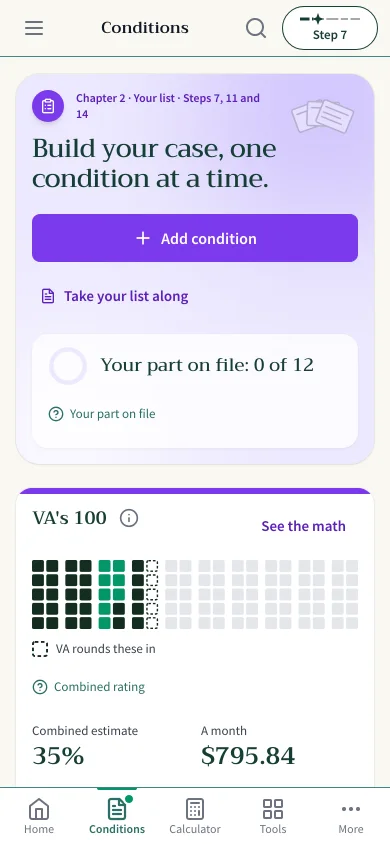
A free account keeps your conditions in one list and shows your combined rating as you add them. Have it ready when you ask the state about a benefit.

HOW TO READ THIS PAGE
Every row, in the source's own words.
Each benefit says what it is, who qualifies in the source's words, and where it comes from. Open a row to read the passage it quotes.
Find your kind of benefit
The benefits are grouped by kind. Start with the one you came for.
Read who qualifies
Each row quotes the source's own words on who qualifies.
Check with the state
Rules change. Ask the office named in the source before you count on a benefit.
Vetrify is not a state agency and not a law firm. This page points to each state's own words; the state decides who qualifies.
9 BENEFITS
Property tax
The property of a person who served in the military, National Guard or naval service in a war or conflict the law lists (among them World War II from December 7, 1941, to December 31, 1946; the Cold War from 1947 through 1991; Korea from June 27, 1950, to January 31, 1955; Vietnam from February 28, 1961, to May 7, 1975; actual service in the Grenada or Lebanon conflicts of 1983-1984, or in the Persian Gulf, Haitian, Somalian or Bosnian conflicts from August 2, 1990, to May 1, 1994; or any conflict or undeclared war), and who was honorably discharged, discharged under conditions other than dishonorable, or, if not discharged, served honorably, or of that person's unmarried widow or widower, is exempted from taxation to the amount of $1,000. Many cities and towns the law lists use a different amount or let their council set one by ordinance; the full list is in the law, so ask your local assessor. More conflicts are added by the next section of the law, and the residency and filing rules follow this paragraph (each its own row).
Who qualifies, in the source's wordsOther rule
“each person who served in the military, national guard, or naval service of the United States in the war of the rebellion, the Spanish-American war, the insurrection in the Philippines, the China-relief expedition, or World War I, and the property of each person who served in the military, national guard, or naval service of the United States in World War II at any time during the period beginning December 7, 1941, and ending on December 31, 1946, and members who served in uniform during the Cold War between 1947 through 1991, including those members who did not serve in a declared war or conflict and the property of each person who served in the military, national guard, or naval services of the United States in the Korean conflict at any time during the period beginning June 27, 1950, and ending January 31, 1955, or in the Vietnam conflict at any time during the period beginning February 28, 1961, and ending May 7, 1975, or who actually served in the Grenada or Lebanon conflicts of 1983-1984, or the Persian Gulf conflict, the Haitian conflict, the Somalian conflict, and the Bosnian conflict, at any time during the period beginning August 2, 1990, and ending May 1, 1994, or in any conflict or undeclared war and who was honorably discharged from the service, or who was discharged under conditions other than dishonorable, or who, if not discharged, served honorably, or the property of the unmarried widow or widower of that person”
What the source says
“§ 44-3-4. Veterans' exemptions. (a)(1) The property of each person who served in the military, national guard, or naval service of the United States in the war of the rebellion, the Spanish-American war, the insurrection in the Philippines, the China-relief expedition, or World War I, and the property of each person who served in the military, national guard, or naval service of the United States in World War II at any time during the period beginning December 7, 1941, and ending on December 31, 1946, and members who served in uniform during the Cold War between 1947 through 1991, including those members who did not serve in a declared war or conflict and the property of each person who served in the military, national guard, or naval services of the United States in the Korean conflict at any time during the period beginning June 27, 1950, and ending January 31, 1955, or in the Vietnam conflict at any time during the period beginning February 28, 1961, and ending May 7, 1975, or who actually served in the Grenada or Lebanon conflicts of 1983-1984, or the Persian Gulf conflict, the Haitian conflict, the Somalian conflict, and the Bosnian conflict, at any time during the period beginning August 2, 1990, and ending May 1, 1994, or in any conflict or undeclared war and who was honorably discharged from the service, or who was discharged under conditions other than dishonorable, or who, if not discharged, served honorably, or the property of the unmarried widow or widower of that person, is exempted from taxation to the amount of one thousand dollars ($1,000), except in:”
Source: R.I. Gen. Laws § 44-3-4(a)(1), Veterans' exemptions. Read .
The veterans exemption is applied first to property in the city or town where you live; any balance may be claimed in another city or town where you own property. It is not allowed for anyone who is not a legal resident of Rhode Island, and you must give the assessors evidence that you qualify by the last day for filing sworn statements for that year (in South Kingstown, at least five days before the tax roll is certified). The evidence stands while your legal residence stays the same. Where it applies, it is applied in full to the total value of your real and tangible personal property in that city or town.
Who qualifies, in the source's wordsOther rule
“provided, that the exemption is not allowed in favor of any person who is not a legal resident of the state, or unless the person entitled to the exemption has presented to the assessors, on or before the last day on which sworn statements may be filed with the assessors for the year for which exemption is claimed, evidence that the person is entitled, which evidence shall stand so long as the person's legal residence remains unchanged”
What the source says
“(2) The exemption is applied to the property in the municipality where the person resides, and if there is not sufficient property to exhaust the exemption, the person may claim the balance in any other city or town where the person may own property; provided, that the exemption is not allowed in favor of any person who is not a legal resident of the state, or unless the person entitled to the exemption has presented to the assessors, on or before the last day on which sworn statements may be filed with the assessors for the year for which exemption is claimed, evidence that the person is entitled, which evidence shall stand so long as the person's legal residence remains unchanged; provided, however, that in the town of South Kingstown, the person entitled to the exemption shall present to the assessors, at least five (5) days prior to the certification of the tax roll, evidence that he or she is entitled to the exemption; and, provided, further, that the exemption provided for in this subdivision to the extent that it applies in any city or town, shall be applied in full to the total value of the person's real and tangible personal property located in the city or town;”
Source: R.I. Gen. Laws § 44-3-4(a)(2), Veterans' exemptions: residence and evidence. Read .
Rhode Island law adds a further exemption from taxation, in the amount of $1,000, for the property of an honorably discharged veteran of the wars and conflicts the law lists (World War I or II, Korea or Vietnam, Grenada or Lebanon, or the Persian Gulf, Haitian, Somalian or Bosnian conflicts from August 2, 1990, to May 1, 1994, or any conflict or undeclared war) whom VA has determined to be totally disabled through service-connected disability, and who gives the assessors a VA certificate of total disability; the certificate stays in effect while the total disability continues. The law lists cities and towns with a different amount or a council option (the full list is in the law), so ask your local assessor. It sits in the same paragraph as the residency and filing rules (the row above).
Who qualifies, in the source's wordsTied to a VA rating
“every honorably discharged veteran of World War I or World War II, Korean or Vietnam, Grenada or Lebanon conflicts, the Persian Gulf conflict, the Haitian conflict, the Somalian conflict and the Bosnian conflict at any time during the period beginning August 2, 1990, and ending May 1, 1994, or in any conflict or undeclared war who is determined by the Veterans Administration of the United States of America to be totally disabled through service-connected disability and who presents to the assessors a certificate from the veterans administration that the person is totally disabled, which certificate remains effectual so long as the total disability continues”
What the source says
“and, provided, that there is an additional exemption from taxation in the amount of one thousand dollars ($1,000), except in: (i) Central Falls, where the city council may, by ordinance, provide for an exemption of a maximum of seven thousand five hundred dollars ($7,500); (ii) Cranston, where the exemption shall be calculated as a tax credit not to exceed one hundred eighty-two dollars and ninety cents ($182.90) per annum, which shall be adjusted every three (3) years immediately following revaluation of property, with any such increase not to exceed the consumer price index (CPI) and shall be reviewable by the administration; (iii) Cumberland, where the town council may, by ordinance, provide for an exemption of a maximum of twenty-two thousand five hundred dollars ($22,500); (iv) Lincoln, where the exemption shall not exceed ten thousand dollars ($10,000); (v) Newport, where the exemption is four thousand dollars ($4,000); (vi) New Shoreham, where the town council may, by ordinance, provide for an exemption of a maximum of thirty-six thousand four hundred fifty dollars ($36,450); (vii) New Shoreham, where the town council may, by ordinance, provide for an exemption of a maximum of five thousand dollars ($5,000); (viii) Smithfield, where the exemption is four thousand dollars ($4,000); (ix) Warren, where the exemption shall not exceed eleven thousand dollars ($11,000); (x) Barrington, where the town council may, by ordinance, provide for an exemption of six thousand dollars ($6,000) for real property; of the property of every honorably discharged veteran of World War I or World War II, Korean or Vietnam, Grenada or Lebanon conflicts, the Persian Gulf conflict, the Haitian conflict, the Somalian conflict and the Bosnian conflict at any time during the period beginning August 2, 1990, and ending May 1, 1994, or in any conflict or undeclared war who is determined by the Veterans Administration of the United States of America to be totally disabled through service-connected disability and who presents to the assessors a certificate from the veterans administration that the person is totally disabled, which certificate remains effectual so long as the total disability continues;”
Source: R.I. Gen. Laws § 44-3-4(a)(2), Veterans' exemptions: additional exemption for totally disabled veterans. Read .
On top of the basic veterans exemption, there is a $10,000 exemption from local taxation on real property for a veteran whom VA has determined to be totally disabled through service-connected disability and who, because of the disability, received VA assistance in acquiring specially adapted housing, and for the unmarried widow or widower of such a deceased veteran. The home must be the person's domicile; in a house designed for more than one family, the exemption covers only the value of the part the person occupies; and you must give the assessors satisfactory evidence of the assistance. Some cities and towns the law lists use a different amount or a tax credit; ask your local assessor.
Who qualifies, in the source's wordsTied to a VA rating
“any veteran and the unmarried widow or widower of a deceased veteran of the military or naval service of the United States who is determined, under applicable federal law by the Veterans Administration of the United States, to be totally disabled through service-connected disability and who, by reason of the disability, has received assistance in acquiring "specially adapted housing" under laws administered by the veterans' administration; provided, that the real estate is occupied as his or her domicile by the person”
What the source says
“(b) In addition to the exemption provided in subsection (a) of this section, there is a ten-thousand dollar ($10,000) exemption from local taxation on real property for any veteran and the unmarried widow or widower of a deceased veteran of the military or naval service of the United States who is determined, under applicable federal law by the Veterans Administration of the United States, to be totally disabled through service-connected disability and who, by reason of the disability, has received assistance in acquiring "specially adapted housing" under laws administered by the veterans' administration; provided, that the real estate is occupied as his or her domicile by the person; and, provided, that if the property is designed for occupancy by more than one family, then only that value of so much of the house as is occupied by the person as his or her domicile is exempted; and, provided, that satisfactory evidence of receipt of the assistance is furnished to the assessors except in:”
Source: R.I. Gen. Laws § 44-3-4(b), Veterans' exemptions: specially adapted housing. Read .
Where the city or town has passed an ordinance, a veteran whom VA has determined to be totally disabled through service-connected disability may receive a further $10,000 exemption from local taxation on real or personal property, and a veteran who owns real property may be exempt from taxation by a fire or lighting district. Some towns the law names set other amounts (Cranston, for example, up to $250,000, extended to the unmarried widow or widower); ask your local assessor.
Who qualifies, in the source's wordsTied to a VA rating
“any veteran of the military or naval service of the United States who is determined, under applicable federal law by the Veterans' Administration of the United States to be totally disabled through service-connected disability”
What the source says
“(c) In addition to the previously provided exemptions, any veteran of the military or naval service of the United States who is determined, under applicable federal law by the Veterans' Administration of the United States to be totally disabled through service-connected disability may, by ordinance, passed in the city or town where the veteran's property is assessed, receive a ten thousand dollar ($10,000) exemption from local taxation on his or her property whether real or personal and if the veteran owns real property may be exempt from taxation by any fire and/or lighting district; provided, that in the town of: North Kingstown, where the amount of the exemption shall be eleven thousand dollars ($11,000) commencing with the December 31, 2002, assessment; and for the town of Westerly, where the amount of the exemption shall be thirty-nine thousand dollars ($39,000) commencing with the December 31, 2005, assessment; and in the town of Cumberland, where the amount of the exemption shall not exceed forty-seven thousand five hundred forty-four dollars ($47,544); and the town of Narragansett, where the amount of the exemption shall not exceed twenty thousand dollars ($20,000) from the assessed value of real property or twelve thousand dollars ($12,000) from the assessed value of a motor vehicle; and in the city of Cranston, commencing with the December 31, 2016, assessment, where the exemption will not exceed two hundred fifty thousand dollars ($250,000) and be extended to the unmarried widow or widower of such veteran, and in the town of Tiverton, where, by ordinance, a tax credit of four hundred dollars ($400) or greater shall be applied to the qualified veteran's property assessment tax bill and be extended to the unmarried widow or widower of such veteran; and in the town of Exeter, where the amount of the exemption shall be in the amount of five thousand dollars ($5,000), commencing with the December 31, 2026, assessment.”
Source: R.I. Gen. Laws § 44-3-4(c), Veterans' exemptions: totally disabled veterans. Read .
Where the city or town has passed an ordinance, a veteran whom VA has classified or determined to be a former prisoner of war, or the unmarried widow or widower of one, may receive an additional $15,000 exemption from local taxation on real and personal property; several towns the law lists set other amounts or a tax credit. For all the veterans exemptions in this section, a widow or widower whose remarriage is void, ended by death, or annulled or dissolved by a court still counts as a widow or widower.
Who qualifies, in the source's wordsOther rule
“any veteran of military or naval service of the United States or the unmarried widow or widower of person who has been or shall be classified as, or determined to be, a prisoner of war by the Veterans' Administration of the United States”
What the source says
“(d) In determining whether or not a person is the widow or widower of a veteran for the purposes of this section, the remarriage of the widow or widower shall not bar the furnishing of the benefits of the section if the remarriage is void, has been terminated by death, or has been annulled or dissolved by a court of competent jurisdiction. (e) In addition to the previously provided exemptions, there may by ordinance passed in the city or town where the person's property is assessed, be an additional fifteen thousand dollars ($15,000) exemption from local taxation on real and personal property for any veteran of military or naval service of the United States or the unmarried widow or widower of person who has been or shall be classified as, or determined to be, a prisoner of war by the Veterans' Administration of the United States, except in: (1) Westerly, where the town council may, by ordinance, provide for an exemption of a maximum of sixty-eight thousand dollars ($68,000); (2) Cumberland, where the town council may by ordinance provide for an exemption of a maximum of forty-seven thousand five hundred forty-four dollars ($47,544); (3) Narragansett, where the town council may, by ordinance, provide for an exemption of a maximum of forty thousand dollars ($40,000); (4) Tiverton, where the town council may, by ordinance, provide for a tax credit of six hundred dollars ($600) or greater; (5) Jamestown, where the town council may, by ordinance, provide for an exemption greater than fifteen thousand dollars ($15,000) of value or a tax credit that would offer an equivalent relief or benefit; (6) North Smithfield, where the town council may, by ordinance, as may be amended from time to time, provide for a tax dollar credit reduction of three hundred and fifty dollars ($350) or greater; and (7) Middletown, where the town council may, by ordinance, provide for an exemption greater than twenty-five thousand dollars ($25,000) of value or a tax credit that would offer an equivalent relief or benefit.”
Source: R.I. Gen. Laws § 44-3-4(d) and (e), Veterans' exemptions: prisoners of war, and remarriage. Read .
A veteran discharged under conditions other than dishonorable (or an officer honorably separated) whom VA has determined to be totally and permanently disabled through a service-connected disability, and who owns a specially adapted homestead acquired or modified with a VA special adaptive housing grant (and meeting VA and Americans with Disabilities Act adaptive housing guidelines), or acquired or modified with the proceeds from selling an earlier grant-assisted homestead, is exempt from all taxation on the homestead; so is the veteran's surviving spouse. In Westerly the exemption is $46,500.
Who qualifies, in the source's wordsPermanent and total
“any veteran who is discharged from the military or naval service of the United States under conditions other than dishonorable, or an officer who is honorably separated from military or naval service, who is determined, under applicable federal law by the Veterans Administration of the United States to be totally and permanently disabled through a service-connected disability, who owns a specially adapted homestead that has been acquired or modified with the assistance of a special adaptive housing grant from the Veteran's Administration and that meets Veteran's Administration and Americans with disability act guidelines from adaptive housing or that has been acquired or modified using proceeds from the sale of any previous homestead that was acquired with the assistance of a special adaptive housing grant from the veteran's administration”
What the source says
“(i) In addition to the previously provided exemption, any veteran who is discharged from the military or naval service of the United States under conditions other than dishonorable, or an officer who is honorably separated from military or naval service, who is determined, under applicable federal law by the Veterans Administration of the United States to be totally and permanently disabled through a service-connected disability, who owns a specially adapted homestead that has been acquired or modified with the assistance of a special adaptive housing grant from the Veteran's Administration and that meets Veteran's Administration and Americans with disability act guidelines from adaptive housing or that has been acquired or modified using proceeds from the sale of any previous homestead that was acquired with the assistance of a special adaptive housing grant from the veteran's administration, the person or the person's surviving spouse is exempt from all taxation on the homestead. Provided, that in the town of Westerly where the amount of the above referenced exemption shall be forty-six thousand five hundred dollars ($46,500).”
Source: R.I. Gen. Laws § 44-3-4(i), Veterans' exemptions: specially adapted homestead. Read .
Besides the wars and conflicts in § 44-3-4, these also qualify for the veterans exemptions: service in the military or naval service in the places and periods this section lists (from Berlin, May 9, 1945, to Kosova, March 24, 1999, among many others); service in Operation Noble Eagle, Operation Enduring Freedom or Operation Iraqi Freedom from September 12, 2001, onward; and service with the Global War Expeditionary Medal and the Global War on Terrorism Medal.
Who qualifies, in the source's wordsOther rule
“(b) Persons who served in the military or naval service of the United States "Operation Noble Eagle", "Operation Enduring Freedom", "Operation Iraqi Freedom"; September 12, 2001 — ongoing are entitled to the veteran exemptions in § 44-3-4. (c) Persons who served in the military or naval service of the United States and have received the "Global War Expeditionary Medal" and the "Global War on Terrorism Medal" are entitled to the veteran exemptions in § 44-3-4.”
What the source says
“§ 44-3-4.2. Conflicts eligible for veterans' property tax relief. (a) In addition to those wars and conflicts listed in subsection 44-3-4(a)(1), any person who served in the military or naval service of the United States in the following places shall be entitled to the veteran exemptions in § 44-3-4: (1) Berlin: May 9, 1945 to October 2, 1990. Cold War/Show of Strength. (2) Korea: June 27, 1950 to November 8, 1950. President Orders Intervention. (3) Quemay and Matsu: August 23, 1956 to June 1, 1963. Show of Force and Escort. (4) Lebanon: July 1, 1958 to November 1, 1958. Operation Bluebat, Peacekeeping. (5) Vietnam: July 1, 1958 to July 3, 1965. Advisory/U.S. Troops Ordered to Undertake Offensive Position. (6) Taiwan Straits: August 23, 1958 to January 1, 1959. Show of Force. (7) Congo (Zaire): July 14, 1960 to September 1, 1962. Operation Newtape, U.N. Peacekeeping. (8) Laos: April 19, 1961 to October 7, 1962. Counter Insurgency. (9) Berlin: August 14, 1961 to June 1, 1963. Show of Strength. (10) Cuba: October 24, 1962 to June 1, 1963. Missile Crisis. (11) Congo: November 23-27, 1964. Operation Dragon, Red & Black Rescue. (12) Vietnam Conflict & RVNCM: July 3, 1965 to March 8, 1973. U.S. Troops Ordered to Offensive Position. (13) Dominican Republic: April 28, 1965 to September 21, 1966. Evacuation and Peacekeeping. (14) Korea: October 1, 1966 to June 30, 1974. Treaty Commitment. (15) Cambodia Thailand: March 29, 1973 to August 15, 1973. Bombing Campaign. (16) Cambodia: April 11-13, 1975. Operation Eagle Pull, Evacuation. (17) Vietnam: April 29-30, 1975. Operation Frequent Wind, Evacuation. (18) Cambodia: May 5, 1975. Mayaguez Hostage Rescue. (19) Sinai, Egypt: August 3, 1981 to present. Peacekeeping. (20) Lebanon: June 1, 1983 to December 1, 1987. Peacekeeping. (21) Grenada: October 23, 1983 to November 21, 1983. Operation Urgent Fury, Evacuation. (22) Libya: April 12-17, 1986. Operation Eldorado Canyon. (23) Persian Gulf: July 24, 1987 to August 1, 1990. Operation Earnest Will, Naval Escort. (24) Panama: December 20, 1989 to January 31, 1990. Operation Just Cause. (25) Persian Gulf: August 2, 1990 to November 30, 1995. Operation Desert Shield & Desert Storm. (26) Operation Sharp Edge: August 5-25, 1990. Humanitarian, Liberia. (27) Combined Task Force "Provide Comfort": April 5, 1991 to July 31, 1993. Humanitarian-Northern Iraq & Turkey. (28) Combined Task Force "Provide Comfort": December 1, 1995 to December 31, 1996. Northern Iraq & Incirlik Air Base, Turkey. (29) Joint Task Force Guantanamo Bay: November 22, 1991 to June 30, 1992. Humanitarian, Guantanamo Bay. (30) Operation "Provide Hope": February 1, 1992 to April 30, 1993. Humanitarian, Russia. (31) Joint Task Force "Provide Relief": August 18, 1992 to December 4, 1992. Humanitarian, Kenya & Somalia. (32) Somalia: December 5, 1992 to March 31, 1995. Operation Restore Hope & United Shield. (33) Joint Task Force "Provide Refuge": February 11, 1993 to March 11, 1993. Humanitarian, Kwazalern, Republic of Marshall Islands. (34) Joint Task Force 160 Operation "Sea Signal": May 20, 1994 to April 15, 1996. Humanitarian, Guantanamo Bay. (35) Joint Task Force "Distant Haven": August 19, 1994 to October 31, 1994. Humanitarian, Surname. (36) Joint Task Force "Safe Haven": August 26, 1994 to March 3, 1995. Humanitarian, Panama. (37) Joint Task Force 180, 190 & MNF Operations "Uphold and Restore Democracy": September 10, 1994 to March 31, 1995. Humanitarian, Haiti. (38) Joint Task Force "Support Hope": July 20, 1994 to October 7, 1994. Humanitarian, Rwanda. (39) Haiti: September 16, 1994 to March 31, 1995. Operation Uphold Democracy. (40) El Salvador: January 1, 1981 to February 1, 1992. Advisory raining. (41) Former Republic of Yugoslavia: November 20, 1995 to December 19, 1996 and December 20, 1996 to June 20, 1998. Operation Joint Endeavor & Guard. (42) Wake Island, Mid-Pacific Joint Task Force "Prompt Return": July 12, 1995 to August 10, 1995. Humanitarian, Wake Island, Mid-Pacific. (43) Southwest Asia: December, 1995 ongoing. Operation Southern Watch, Maritime Intercept Operation, Operation Vigilant Sentinel, Operation Northern Watch, Operation Desert Thunder, Operation Desert Fox, Exercise Intrinsic Action, Exercise Iris Gold, Operation Desert Spring. (44) Former Republic of Yugoslavia: December 20, 1995 — ongoing. Operation Joint Endeavor, Joint Guard and Force. (45) Haiti: April 1, 1995 to January 31, 2000. Operation: UNMHI, U.S. For Haiti, USSPTG-Haiti. (46) Liberia Joint Task Force "Assured Response": April 8, 1996 to August 12, 1996. Humanitarian, Liberia. (47) Kosova: March 24, 1999 — ongoing. Operation Allied Force, Joint Guardian. (b) Persons who served in the military or naval service of the United States "Operation Noble Eagle", "Operation Enduring Freedom", "Operation Iraqi Freedom"; September 12, 2001 — ongoing are entitled to the veteran exemptions in § 44-3-4. (c) Persons who served in the military or naval service of the United States and have received the "Global War Expeditionary Medal" and the "Global War on Terrorism Medal" are entitled to the veteran exemptions in § 44-3-4.”
Source: R.I. Gen. Laws § 44-3-4.2, Conflicts eligible for veterans' property tax relief. Read .
A parent whose son or daughter served in the U.S. armed forces and lost his or her life as a result of that service, where the death was determined to be in the line of duty, has property exempted from taxation to the amount of $3,000, under rules like those of the veterans exemption; only one exemption is granted when both parents are living. Several cities and towns the law lists may set other amounts by ordinance; ask your local assessor.
Who qualifies, in the source's wordsOther rule
“every person whose son or daughter has served with the armed forces of the United States of America and has lost his or her life as a result of his or her service with the armed forces of the United States of America, providing the death was determined to be in the line of duty”
What the source says
“§ 44-3-5. Gold star parents' exemption. (a) The property of every person whose son or daughter has served with the armed forces of the United States of America and has lost his or her life as a result of his or her service with the armed forces of the United States of America, providing the death was determined to be in the line of duty, shall be exempted from taxation to the amount of three thousand dollars ($3,000) in accordance with similar provisions of § 44-3-4 applying to honorably discharged veterans of the armed forces; provided, that there shall be but one exemption granted where both parents of the deceased son or daughter are living; provided:”
Source: R.I. Gen. Laws § 44-3-5, Gold star parents' exemption. Read .
5 BENEFITS
Vehicles and license plates
A veteran honorably discharged from the U.S. armed forces or Merchant Marine in any of the wars or campaigns the United States has been engaged in, who also lost (by amputation), or lost the use of (by other permanent injury), one or both arms, hands, feet or legs while engaged in or as a result of that war or campaign; or was granted a motor vehicle under the 1946 federal law the section names; or has VA documentation of a combined service-connected rating of 100%, or of 70% at age 75 or older, or of individual unemployability, is exempt from paying any fee for the annual registration of, and a license to operate, that motor vehicle. The Division of Motor Vehicles issues "Disabled Veteran" plates for an automobile or a commercial vehicle of 12,000 lbs. or less gross weight once VA certification or other satisfactory proof is shown. If the veteran can no longer drive, the plates may move to the spouse; after the veteran's death, to the surviving spouse for life or until the spouse remarries.
Who qualifies, in the source's wordsOther rule
“Any veteran who has been honorably discharged from the service of the armed forces or the Merchant Marine of the United States in any of the wars or campaigns in which the United States has been engaged and who, while engaged in these wars or campaigns or as a result of engagement in these wars or campaigns, by reason of amputation, has lost one or both of the veteran's arms, hands, feet, or legs, or who, by reason of other permanent injury, has lost the use of one or both of the veteran's arms, hands, feet, or legs, or to whom has been granted a motor vehicle under chapter 870-2D, United States Public Laws 663, enacted 1946, 79th Congress, or has suitable documentation from the U.S. Department of Veterans Affairs to establish that the veteran: (1) Has a combined service connected disability rating of one hundred percent (100%); (2) Is seventy-five (75) years of age or older with a combined service connected disability rating of seventy percent (70%); or (3) Is considered "individually unemployable" due to the veteran's service-connected disability”
What the source says
“§ 31-6-8. Disabled veterans. (a) Any veteran who has been honorably discharged from the service of the armed forces or the Merchant Marine of the United States in any of the wars or campaigns in which the United States has been engaged and who, while engaged in these wars or campaigns or as a result of engagement in these wars or campaigns, by reason of amputation, has lost one or both of the veteran's arms, hands, feet, or legs, or who, by reason of other permanent injury, has lost the use of one or both of the veteran's arms, hands, feet, or legs, or to whom has been granted a motor vehicle under chapter 870-2D, United States Public Laws 663, enacted 1946, 79th Congress, or has suitable documentation from the U.S. Department of Veterans Affairs to establish that the veteran: (1) Has a combined service connected disability rating of one hundred percent (100%); (2) Is seventy-five (75) years of age or older with a combined service connected disability rating of seventy percent (70%); or (3) Is considered "individually unemployable" due to the veteran's service-connected disability, shall be exempt from the payment of any fee for the annual registration of and a license to operate that motor vehicle. (b) The administrator for the division of motor vehicles shall issue to an eligible veteran for use on an automobile, or on a commercial vehicle having a gross weight of twelve thousand pounds (12,000 lbs.) or less, registration plates designated "Disabled Veteran." Provided that: (1) Upon certification that the veteran is no longer able to operate a vehicle, the "Disabled Veteran" plates may be transferred, during their lifetime, to the veteran's spouse; and (2) Upon the death of the initial registrant of the "Disabled Veteran" plates, the plates may be transferred to the veteran's surviving spouse for the spouse's lifetime or until the spouse remarries. (3) "Disabled Veteran" plates shall be issued to an eligible veteran or their spouse as provided for in subsection (b)(1) of this section only after certification of eligibility from the Veterans' Administration or other satisfactory documentation of eligibility is presented.”
Source: R.I. Gen. Laws § 31-6-8, Disabled veterans. Read .
A veteran honorably discharged from the U.S. armed forces or Merchant Marine in any war, declared or undeclared, who became totally blind by reason of that service is exempt from paying any fee for the annual registration of a pleasure motor vehicle owned by the veteran and operated for his or her pleasure and convenience, and may display the special plates the Division of Motor Vehicles issues.
Who qualifies, in the source's wordsOther rule
“Any veteran who has been honorably discharged from service with the armed forces or the merchant marine of the United States in any of the wars, declared or undeclared, in which the United States has been engaged and who, by reason of that service, has become totally blind”
What the source says
“§ 31-6-9. Blind veterans. Any veteran who has been honorably discharged from service with the armed forces or the merchant marine of the United States in any of the wars, declared or undeclared, in which the United States has been engaged and who, by reason of that service, has become totally blind, shall be further exempt from the payment of any fee for the annual registration of a pleasure motor vehicle owned by the veteran and operated for his or her pleasure and convenience. The veteran shall be entitled to display on that vehicle the special registration plates as shall be issued by the division of motor vehicles.”
Source: R.I. Gen. Laws § 31-6-9, Blind veterans. Read .
The Division of Motor Vehicles may make up to two sets of "combat wounded" Purple Heart plates available to a Purple Heart recipient, for an automobile or a commercial vehicle of 12,000 lbs. or less gross weight. The applicant does not pay a registration fee or service charge for the plates. After the holder's death, the plates go to the surviving spouse for life until the spouse remarries; if there is no surviving spouse, a family member may keep one plate but not display it.
Who qualifies, in the source's wordsOther rule
“The administrator of the division of motor vehicles is empowered to make available to recipients of the Purple Heart Medal up to two (2) sets of special motor vehicle registration plates”
What the source says
“§ 31-3-48. Plates for recipients of Purple Heart. (a) The administrator of the division of motor vehicles is empowered to make available to recipients of the Purple Heart Medal up to two (2) sets of special motor vehicle registration plates for any motor vehicle eligible for registration as an automobile or commercial vehicle having a gross weight of twelve thousand pounds (12,000 lbs.) or less, indicating the owner as a recipient of the Purple Heart. (b) The plate shall contain the words "combat wounded" across the top of the plate and shall have an insignia for the Purple Heart and be followed by the letters "P H", followed by a numeral or numerals. The Purple Heart insignia may be reproduced on the plate in the color purple. (c) Upon the death of the holder of any Purple Heart plates, the plates shall be transferred to the holder's surviving spouse for the spouse's lifetime until the spouse remarries. (d) The applicant is not required to pay a registration fee or service charge for the plates. (e) Upon the death of the holder of any Purple Heart plates, if there is no surviving spouse, a family member of the recipient may retain one of the special motor vehicle registration plates in the family member's own keeping, provided the family member does not display the plate upon any motor vehicle or any other form of transportation owned or operated by the family member. The other Purple Heart plate must be returned to the division of motor vehicles.”
Source: R.I. Gen. Laws § 31-3-48, Plates for recipients of Purple Heart. Read .
The registrar must issue "Veteran" plates, on application, for an automobile, a motorcycle, or a commercial vehicle of 12,000 lbs. or less, to a veteran: anyone who served on active duty in the U.S. armed forces, or a National Guard or Reserve member called to active duty by the President or the Secretary of Defense or with 20 years of service and a record of separation, who was honorably discharged (a medical or general discharge counts as honorable). A "War Veteran" decal is added for a veteran who earned a campaign ribbon or expeditionary medal, as shown on the DD-214. There is no service or transfer charge; you may get a plate for each vehicle you own, plus one for a vehicle owned by a Rhode Island business you own; a commercial vehicle still pays its commercial registration fee. After the holder's death the plates go to the surviving spouse for life until the spouse remarries.
Who qualifies, in the source's wordsOther rule
“a "veteran" shall be defined as any person who has served on active duty in the armed forces of the United States. The term "veteran" shall also include members of the National Guard and Reserves: (i) Called to active duty authorized by the President of the United States or the Secretary of Defense; or (ii) Who have twenty (20) years of service with a letter and record of separation of service. (2) For the purposes of this section, "War Veteran" shall be defined as any veteran of any conflict or undeclared war who has earned a campaign ribbon or expeditionary medal for service in either a declared or undeclared war as noted on the war veteran's DD-214. Upon the death of the holder of any veteran plates, the plates shall be transferred to the surviving spouse for the spouse's lifetime until the spouse remarries. (g) The "veteran" or "war veteran" described in subdivisions (f)(1)(i) or (ii) and (f)(2) must have been honorably discharged from the armed forces of this nation in order to receive plates pursuant to this section and, for purposes of this section, a medical discharge or a general discharge shall be deemed an honorable discharge”
What the source says
“§ 31-3-53. Veterans' plates. (a) The registrar of motor vehicles shall issue for any motor vehicle eligible for registration as an automobile, or for any motorcycle eligible for registration as a motorcycle, or for a commercial vehicle having a gross weight of twelve thousand pounds (12,000 lbs.) or less, plates designated as "Veteran" upon application on proper forms furnished by the administrator of the division of motor vehicles to veterans. (b) The special plate designated "Veteran" shall be designed as follows: (1) Letters and numbers shall be blue in a white background with the words "Rhode Island" clearly visible at the top center of the plate and the word "Veteran" visible at the bottom center of the plate. (2) The background will be a red, white, and blue waving American Flag. (3) On the top right corner will be a decal with the military branch of the service in which the Veteran served (Army, Navy, Air Force, Marines, Coast Guard, Space Force, and Merchant Marines). (4) For war veterans, a white decal with blue letters with the words "War Veteran" placed under the military branch decal on the right side of the plate above the validation sticker. (c) The applicant shall not be required to pay a service charge or a transfer charge for each plate. (d)(1) The applicant shall be entitled to a plate for each vehicle owned by the applicant. (2) The applicant shall also be entitled to a plate for one vehicle owned by an entity the applicant owns. The entity must be registered and authorized to conduct business in the state of Rhode Island. The applicant must provide to the division of motor vehicles documentation demonstrating the applicant's ownership of the entity. (e) The owner of a motor vehicle eligible for registration as a commercial vehicle and having a gross weight of twelve thousand pounds (12,000 lbs.) or less who is issued veteran plates shall continue to pay the appropriate commercial registration fee for those plates. (f)(1) For the purposes of this section, a "veteran" shall be defined as any person who has served on active duty in the armed forces of the United States. The term "veteran" shall also include members of the National Guard and Reserves: (i) Called to active duty authorized by the President of the United States or the Secretary of Defense; or (ii) Who have twenty (20) years of service with a letter and record of separation of service. (2) For the purposes of this section, "War Veteran" shall be defined as any veteran of any conflict or undeclared war who has earned a campaign ribbon or expeditionary medal for service in either a declared or undeclared war as noted on the war veteran's DD-214. Upon the death of the holder of any veteran plates, the plates shall be transferred to the surviving spouse for the spouse's lifetime until the spouse remarries. (g) The "veteran" or "war veteran" described in subdivisions (f)(1)(i) or (ii) and (f)(2) must have been honorably discharged from the armed forces of this nation in order to receive plates pursuant to this section and, for purposes of this section, a medical discharge or a general discharge shall be deemed an honorable discharge. (h) [Deleted by P.L. 2021, ch. 119, § 1 and P.L. 2021, ch. 120, § 1.] (i) A person shall be eligible for a veterans' plate if the person's deceased spouse was eligible for a veterans' plate, notwithstanding the fact that the eligible, deceased spouse died prior to the enactment of this section in 1988.”
Source: R.I. Gen. Laws § 31-3-53 (Veterans' plates). Read .
The Division of Motor Vehicles must issue a Gold Star Family plate to a person eligible to receive a Gold Star lapel button under federal law, where the death was determined to be in the line of duty. One set per eligible family member, after satisfactory documentation; no service or transfer charge. A commercial vehicle of 12,000 lbs. or less still pays its commercial registration fee, and one of 6,300 to 12,000 lbs. needs an affidavit that it is for personal use only.
Who qualifies, in the source's wordsOther rule
“"Gold Star Family" means a person eligible to receive a gold star lapel button as defined in 10 U.S.C. § 1126; provided, the death was determined to be in the line of duty”
What the source says
“§ 31-3-111. Gold Star Families. (a) The administrator of the division of motor vehicles is authorized and directed to issue a special registration plate for the motor vehicles of all eligible members of a Gold Star Family. (b) For the purpose of this section, "Gold Star Family" means a person eligible to receive a gold star lapel button as defined in 10 U.S.C. § 1126; provided, the death was determined to be in the line of duty. (c) The Gold Star Family motor vehicle plates shall be the same size as regular motor vehicle plates, and shall be designed by Gold Star Family members who are Rhode Island residents in conjunction with the division of motor vehicles, with design approval by the Rhode Island state police. (1) [Deleted by P.L. 2017, ch. 190, § 1 and P.L. 2017, ch. 248, § 1.] (2) [Deleted by P.L. 2017, ch. 190, § 1 and P.L. 2017, ch. 248, § 1.] (3) [Deleted by P.L. 2017, ch. 190, § 1 and P.L. 2017, ch. 248, § 1.] (d) The applicant shall not be required to pay a service charge or a transfer charge for each plate. (e) Only one set of "Gold Star Family" plates shall be issued to an eligible family member and only after satisfactory documentation of eligibility is presented. (f) The owner of a motor vehicle eligible for registration as a commercial vehicle and having a gross weight of twelve thousand pounds (12,000 lbs.) or less who is issued Gold Star Family plates shall continue to pay the appropriate commercial registration fee for those plates. The owner of a motor vehicle eligible for registration as a commercial vehicle having a gross weight of six thousand three hundred pounds (6,300 lbs.), but not more than twelve thousand pounds (12,000 lbs.), shall sign an affidavit at the time of application for said plates stating that the vehicle is to be used for personal use only.”
Source: R.I. Gen. Laws § 31-3-111, Gold Star Families. Read .
3 BENEFITS
Education and tuition
A veteran who is a permanent resident of Rhode Island and shows a VA disability rating of 10% to 100% from military service is entitled to take courses at any Rhode Island public college or university without paying tuition; other fees and charges are not covered. If the school finds you eligible for financial aid, you must apply for it, and any aid goes toward the tuition. Register at the start of open registration; the waiver does not change the admission rules of competitive programs.
Who qualifies, in the source's wordsTied to a VA rating
“Any veteran who is a permanent resident of this state who submits proof sufficient to establish a veterans' rated ten percent (10%) to one hundred percent (100%) disability by the department of veterans' affairs as a result of military service”
What the source says
“§ 30-30.1-1. Educational benefits for disabled American veterans. Any veteran who is a permanent resident of this state who submits proof sufficient to establish a veterans' rated ten percent (10%) to one hundred percent (100%) disability by the department of veterans' affairs as a result of military service shall be entitled to take courses at any public institution of higher education in the state without the payment of tuition, exclusive of other fees and charges; provided, however, that any person eligible for financial aid as determined by the institution of higher education shall apply for such financial aid. Any financial aid award received by the applicant shall be applied towards the full amount of tuition that would otherwise have been charged by the public institution of higher education. Students using the tuition waivers for courses and competitive programs shall register at the start of open registration for the applicable semester in accordance with each institution's registration policies. This includes priority registration where granted to students with disability status. Use of this waiver for competitive programs does not supersede any existing academic criteria for admission into those programs.”
Source: R.I. Gen. Laws § 30-30.1-1, Educational benefits for disabled American veterans. Read .
Rhode Island's dependents' education fund, which the General Assembly funds each year, pays all or part of the tuition and books of the sons, daughters and surviving spouses of veterans who died as the result of hostile action or of a service-connected disability from active service, or who died from any cause while such a disability existed, and of service members missing in action or prisoners of war (the law says "serving in the far east") who had a legal residence in Rhode Island when they entered service. It covers the University of Rhode Island, Rhode Island College, or any institution of higher education or technical or professional learning, up to the in-state tuition plus average cost of books at the University of Rhode Island that year. A child must enter between the ages of 16 and 26 and may use it for the normal length of the course, no more than 4 years. A surviving spouse must use it within 10 years of being found eligible or of the death. Children of those serving in the far east who were not Rhode Island residents at entry qualify after living in Rhode Island continuously for 5 years, if otherwise eligible. For a missing or captured service member, the benefit holds only while the next of kin has not been told the person was released or is no longer missing in action. Awards also depend on income guidelines and academic performance criteria set by rule (its own row).
Who qualifies, in the source's wordsOther rule
“the sons, daughters, and surviving spouses of veterans who died as the result of hostile action or a service-connected disability arising out of active service in the armed forces, or who died from any cause while such a disability was in existence, or of those who are serving in the far east and had a legal residence in this state at the time they were commissioned, warranted, enlisted, or inducted into the military or naval service of the United States and were either missing in action or are prisoners of war, provided that the next of kin has not been advised by the armed forces that the serviceperson has been released or is no longer classified as missing in action. The benefits shall be extended to dependents who are attending, or may attend, the university of Rhode Island, Rhode Island college, or any institution of higher education or technical/professional learning. The maximum aid granted shall not exceed the in-state tuition cost plus average cost of books of attending the university of Rhode Island in that year, the costs to be yearly certified by the Board of Education to the administering agency; provided, any child dependent shall enter the institution while between the ages of sixteen (16) and twenty-six (26); and provided, further, that the aid herein granted shall be available to that child for such period of time as shall equal the normal time for completing the courses regularly offered by the institution, but in no case more than four (4) years; and provided, further, that this chapter shall apply also to the children of those who are serving in the far east, but did not have legal residence in this state at the time those persons were commissioned, warranted, enlisted, or inducted into the military or naval service of the United States; provided that those children have resided in this state continuously for five (5) years and are otherwise eligible, upon the presentation to the proper administering authority of sufficient evidence that the parent qualifies the child to receive the benefits under this section; and provided, further, that, as to surviving spouses, the benefits must be utilized within a period of ten (10) years from the date eligibility is found or from the date of death of the spouse from whom eligibility is derived”
What the source says
“§ 30-30-1. Appropriations — Purposes. The general assembly shall annually appropriate such a sum as may be necessary, out of any money in the treasury not otherwise appropriated, for the purpose of creating and maintaining a "dependents' education fund" from which shall be paid in whole or in part the charges for the tuition and books of such of the sons, daughters, and surviving spouses of veterans who died as the result of hostile action or a service-connected disability arising out of active service in the armed forces, or who died from any cause while such a disability was in existence, or of those who are serving in the far east and had a legal residence in this state at the time they were commissioned, warranted, enlisted, or inducted into the military or naval service of the United States and were either missing in action or are prisoners of war, provided that the next of kin has not been advised by the armed forces that the serviceperson has been released or is no longer classified as missing in action. The benefits shall be extended to dependents who are attending, or may attend, the university of Rhode Island, Rhode Island college, or any institution of higher education or technical/professional learning. The maximum aid granted shall not exceed the in-state tuition cost plus average cost of books of attending the university of Rhode Island in that year, the costs to be yearly certified by the Board of Education to the administering agency; provided, any child dependent shall enter the institution while between the ages of sixteen (16) and twenty-six (26); and provided, further, that the aid herein granted shall be available to that child for such period of time as shall equal the normal time for completing the courses regularly offered by the institution, but in no case more than four (4) years; and provided, further, that this chapter shall apply also to the children of those who are serving in the far east, but did not have legal residence in this state at the time those persons were commissioned, warranted, enlisted, or inducted into the military or naval service of the United States; provided that those children have resided in this state continuously for five (5) years and are otherwise eligible, upon the presentation to the proper administering authority of sufficient evidence that the parent qualifies the child to receive the benefits under this section; and provided, further, that, as to surviving spouses, the benefits must be utilized within a period of ten (10) years from the date eligibility is found or from the date of death of the spouse from whom eligibility is derived.”
Source: R.I. Gen. Laws § 30-30-1, Dependents' education fund. Read .
The dependents' education fund (the row above) is run under rules that must include income guidelines and academic performance criteria, and no money is awarded until those rules are in place. The law names the division of higher education assistance as the administering authority. Ask the office that administers the fund for its current income and academic rules.
Who qualifies, in the source's wordsOther rule
“The regulations and procedures shall include, but not be limited to, the establishment of income guidelines and academic performance criteria. No funds shall be awarded under this chapter until these regulatory and administrative measures are established.”
What the source says
“§ 30-30-2. Administration. The division of higher education assistance shall be designated as the administering authority for this chapter and shall, no later than August 30, 1987, establish rules, regulations, procedures, and safeguards for the implementation of this chapter. The regulations and procedures shall include, but not be limited to, the establishment of income guidelines and academic performance criteria. No funds shall be awarded under this chapter until these regulatory and administrative measures are established.”
Source: R.I. Gen. Laws § 30-30-2, Dependents' education fund: administration. Read .
2 BENEFITS
Other state benefits
A person who served in the U.S. armed forces and is now a 100% disabled veteran is entitled to receive a license to hunt or fish or both, and, on showing military discharge identification or disability papers as the Department of Environmental Management prescribes, shall, at the licensing authority's discretion, receive without a license fee a continuing special license for as long as the person wishes. After applying once, the person need not appear again to show papers.
Who qualifies, in the source's wordsTied to a VA rating
“Every person who was a part of the armed forces of the United States government and is now a one hundred percent (100%) disabled veteran”
What the source says
“(c) Every person who was a part of the armed forces of the United States government and is now a one hundred percent (100%) disabled veteran, and any person who is one hundred percent (100%) permanently disabled, is entitled, subject to the provisions of this title, to receive a license to hunt or fish or both in this state; and upon the presentation of their necessary military discharge identification or disability papers or both, as prescribed by the department of environmental management, shall, at the discretion of the licensing authority, receive, without the payment of any license fee, a continuing special form of license authorizing the person to hunt or fish or both in this state in accordance with the provisions of this title and regulations issued pursuant to this title for so long as the person so desires; provided, however, that the person, having once made application for this license, shall not again be required to appear before the licensing authority to present their papers.”
Source: R.I. Gen. Laws § 20-2-31(c), Hunting and fishing licenses: exceptions. Read .
For the tax years beginning on January 1, 2023, a taxpayer may subtract the military service pension benefits included in federal adjusted gross income when figuring Rhode Island income (the section covers the Rhode Island income of a resident individual). "Military service" has the meaning in 20 C.F.R. § 212.2. The subtraction, alone or together with the retirement income subtraction in the same section, may not exceed the military service pension received that tax year.
Who qualifies, in the source's wordsOther rule
“For the tax years beginning on January 1, 2023, a taxpayer may subtract from federal adjusted gross income the taxpayer's military service pension benefits included in federal adjusted gross income”
What the source says
“(11) Modification for military service pensions. (i) For purposes of a taxpayer's state tax liability, a modification to income shall be allowed as follows: (A) For the tax years beginning on January 1, 2023, a taxpayer may subtract from federal adjusted gross income the taxpayer's military service pension benefits included in federal adjusted gross income; (ii) As used in this subsection, the term "military service" shall have the same meaning as set forth in 20 C.F.R. § 212.2; (iii) At no time shall the modification allowed under this subsection alone or in conjunction with subsection (c)(9) exceed the amount of the military service pension received in the tax year for which the modification is claimed;”
Source: R.I. Gen. Laws § 44-30-12(c)(11), Rhode Island income of a resident individual: military service pensions. Read .
Not covered on this page yet
These have no row here yet, so the page is not a full list. Ask the Rhode Island Office of Veterans Services about them.
- Each city and town's own veterans exemption amount: the law lists dozens of local figures and options, so ask your local assessor.
- What the Office of Veterans Services lists itself: its site refused automated reading on the day we read.
- Plates for Bronze Star recipients and the National Guard plate: in the law but not yet listed here.
- Veterans' preference in state hiring and the state veterans' assistance fund: not yet read.

On the App Store
Your combined rating and what it pays, on your phone.
VA Calc combines your ratings with VA's whole-person formula and shows what that rating pays at VA's official rates.
Official sources
- R.I. Gen. Laws § 44-3-4(a)(1), Veterans' exemptions, webserver.rilegislature.gov
- R.I. Gen. Laws § 44-3-4.2, Conflicts eligible for veterans' property tax relief, webserver.rilegislature.gov
- R.I. Gen. Laws § 44-3-5, Gold star parents' exemption, webserver.rilegislature.gov
- R.I. Gen. Laws § 31-6-8, Disabled veterans, webserver.rilegislature.gov
- R.I. Gen. Laws § 31-6-9, Blind veterans, webserver.rilegislature.gov
- R.I. Gen. Laws § 31-3-48, Plates for recipients of Purple Heart, webserver.rilegislature.gov
- R.I. Gen. Laws § 31-3-53 (Veterans' plates), webserver.rilegislature.gov
- R.I. Gen. Laws § 31-3-111, Gold Star Families, webserver.rilegislature.gov
- R.I. Gen. Laws § 30-30.1-1, Educational benefits for disabled American veterans, webserver.rilegislature.gov
- R.I. Gen. Laws § 30-30-1, Dependents' education fund, webserver.rilegislature.gov
- R.I. Gen. Laws § 30-30-2, Dependents' education fund: administration, webserver.rilegislature.gov
- R.I. Gen. Laws § 20-2-31(c), Hunting and fishing licenses: exceptions, webserver.rilegislature.gov
- R.I. Gen. Laws § 44-30-12(c)(11), Rhode Island income of a resident individual: military service pensions, webserver.rilegislature.gov