
STATE BENEFITS FOR VETERANS · DE
Delaware benefits for veterans
Quoted from the state's own law and agencies
What Delaware law and Delaware agencies say about property tax, vehicles and license plates, education and tuition, and other state benefits. Every row quotes its source and shows the day we read it.
See the benefitsFree · No account needed
Your Delaware benefits list, in your inbox
Email yourself every Delaware benefit on this page, with who qualifies in the source's words, each source and the day we read it.
Delaware
YOUR NEXT STEP
Keep your VA rating at hand.
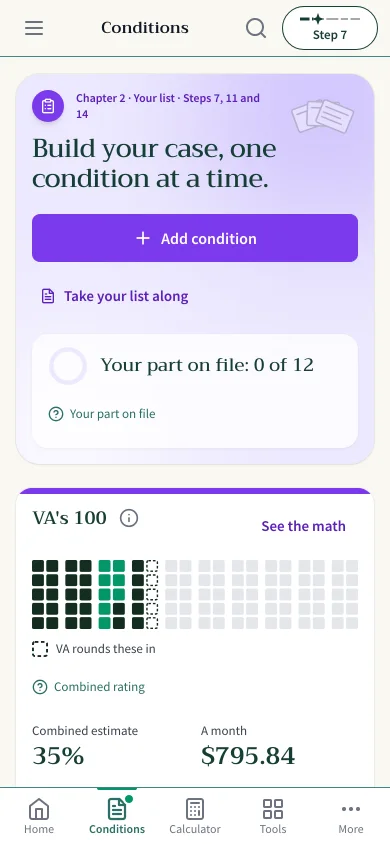
A free account keeps your conditions in one list and shows your combined rating as you add them. Have it ready when you ask the state about a benefit.

HOW TO READ THIS PAGE
Every row, in the source's own words.
Each benefit says what it is, who qualifies in the source's words, and where it comes from. Open a row to read the passage it quotes.
Find your kind of benefit
The benefits are grouped by kind. Start with the one you came for.
Read who qualifies
Each row quotes the source's own words on who qualifies.
Check with the state
Rules change. Ask the office named in the source before you count on a benefit.
Vetrify is not a state agency and not a law firm. This page points to each state's own words; the state decides who qualifies.
2 BENEFITS
Property tax
Only where the local school board has authorized it by a majority vote of the whole board: a credit for the full amount of the local school tax (the tax this chapter of the Delaware Code imposes) on a home that a qualified veteran owns and occupies as their principal residence. A qualified veteran receives 100% disability compensation from VA for a service-connected, permanent and total disability, based on individual unemployability or a 100% rating, and has been legally domiciled in Delaware for at least 3 consecutive years; seasonal or temporary residence does not count, and 12 months away is evidence of giving up domicile. File the Secretary of Finance's application with the receiver of taxes or county treasurer no later than April 30 before the tax year (the Secretary of Finance may waive that date for a person who cannot manage their own finances because of a medically determinable physical or mental impairment expected to result in death or to last at least 12 months (not one caused by voluntary alcohol use or unlawful drug use), unless a spouse, guardian or other person is authorized to act for them in financial matters). Where the home is co-owned, the credit covers only your share, and no more than 1 full credit per property in a year; property owned by a married couple as tenants by the entirety counts as wholly owned by each. If the tax bill is not paid in full by the end of a tax year, the credit is withdrawn for the next year until the taxes and penalties are paid. Ask your county whether your school district has authorized the credit.
Who qualifies, in the source's wordsPermanent and total
“a "qualified person" means a veteran who satisfies both the following: 1. Receives from the United States Department of Veterans Affairs, or its successor agency, 100% disability compensation due to a service-connected, permanent and total disability based on individual unemployability or a 100% disability rating. 2. Is legally domiciled in this State for a period of at least 3 consecutive years.”
What the source says
“(d) (1) a. If authorized by majority vote of the whole school board of the local school district under § 6102(r) of Title 29, there will be allowed a credit against taxation in the full amount of tax liability imposed by this chapter on the valuation of any qualified property. b. For purposes of this subsection, "qualified property" means property owned and occupied as a dwelling by and as the principal residence of a qualified person. c. For purposes of this subsection, a "qualified person" means a veteran who satisfies both the following: 1. Receives from the United States Department of Veterans Affairs, or its successor agency, 100% disability compensation due to a service-connected, permanent and total disability based on individual unemployability or a 100% disability rating. 2. Is legally domiciled in this State for a period of at least 3 consecutive years. Mere seasonal or temporary residence within this State, of whatever duration, does not constitute domicile within this State for the purposes of this subsection. Absence from this State for a period of 12 months is prima facie evidence of abandonment of domicile in this State. d. If a local school board has authorized the tax credit under paragraph (d)(1)a. of this section, then the credit must be allowed for a surviving spouse of a deceased qualified person if all of the following apply: 1. The deceased qualified person, immediately before death, was both claiming the credit and had not had the right to claim the credit withdrawn. 2. The surviving spouse was a titled owner of the qualified property before the deceased qualified person's death. 3. The surviving spouse has not remarried. 4. The surviving spouse owns and occupies the qualified property as their principal residence. e. A surviving spouse is no longer eligible for the credit if they do any of the following: 1. Remarry. 2. Stop being a titled owner of the qualified property. 3. Stop occupying the qualified property as their principal residence. f. The burden of establishing that the claimant meets the definition of "qualified person" or is an eligible surviving spouse is on the claimant. g. The receiver of taxes and county treasurer shall apply such credit after any change to the current expense tax rate pursuant to § 6102 of Title 29. (2) a. A credit against taxation on the valuation of real property as provided in this subsection may not be allowed except in accordance with a form of written application prescribed by the Secretary of Finance in consultation with the receiver of taxes and county treasurer and provided by the receiver of taxes and county treasurer for use by the claimants under this subsection. Such application must be filed with and received by the receiver of taxes or county treasurer no later than April 30 immediately before the beginning of that tax year. b. Notwithstanding the application deadline in paragraph (d)(2)a. of this section, the Secretary of Finance, in consultation with the receiver of taxes and country treasurer, shall establish a process for the receiver of taxes and county treasurer to use to verify the eligibility of a surviving spouse of a deceased qualified person and to maintain the credit for an eligible surviving spouse without disruption occasioned by the death of the qualified person. (3) The Secretary of Finance shall have the authority to waive the date of application in the case that an individual is financially disabled defined herein as unable to manage such individual financial affairs by reason of a medically determinable physical or mental impairment (excluding impairment caused by voluntary use of alcohol or unlawful use of a controlled substance as defined in Chapter 47, Title 16) which can be expected to result in death or which has lasted or can be expected to last for a continuous period of not less than 12 months, but shall not include individuals for whom an individual's spouse, guardian, or any other person is authorized to act on behalf of such individual in financial matters. (4) a. Where title to property on which a credit is claimed is held by claimant and another or others, either as tenants in common or as joint tenants, the claimant is not allowed a credit against that claimant's interest in the property in excess of the assessed valuation of that claimant's proportionate share in the property. For the purposes of this subsection, the claimant's proportional share is deemed to be equal to that of each of the other tenants unless it is shown that the interests in question are not equal, in which event claimant's proportionate share must be as shown. b. Nothing in this subsection shall preclude more than 1 tenant, whether title be held in common or joint tenancy, from claiming a credit against the property so held, but no more than the equivalent of 1 full credit in regard to such property shall be allowed in any year, and in any case in which the claimants cannot agree as to the apportionment thereof, the credit shall be apportioned between or among them in proportion to their interests. Property held by husband and wife as tenants by the entirety shall be deemed wholly owned by each tenant, but not more than 1 credit in regard to such property shall be allowed in any year. c. Right to claim a credit under this subsection shall extend to property the title to which is held by a partnership to the extent of the claimant's interest as a partner therein, or by a guardian, trustee, committee, conservator or other fiduciary for any person who would otherwise be entitled to claim a credit under this subsection, but not to property the title to which is held by a corporation. d. Right to claim credit under this subsection will be withdrawn for the subsequent tax year from any taxpayer who has not paid in full such taxpayer's property tax bill by the end of the tax year for which a credit was reported for that taxpayer to the Secretary of Finance by the receiver of taxes and county treasurer. Taxpayers who fail to pay in full their property tax bill by the end of the tax year for which a credit was reported for that taxpayer to the Secretary of Finance by the receiver of taxes and county treasurer may qualify for credits under this subsection in subsequent tax years upon the payment in full of property taxes and penalties owed before the beginning of the subsequent tax year.”
Source: 14 Del. C. § 1917(d), Collection and deposit of school taxes: credit for veterans with a total disability. Read .
Where the local school board has authorized the veterans school tax credit, it must be allowed for the surviving spouse of a qualified veteran who was claiming the credit (and had not had it withdrawn) immediately before death, if the spouse was a titled owner of the home before the death, has not remarried, and owns and occupies the home as their principal residence. The spouse loses the credit on remarrying, ceasing to be a titled owner, or ceasing to live there. The Secretary of Finance must set up a way to keep the credit going for an eligible surviving spouse without a break. As for the veteran, if the property tax bill is not paid in full by the end of a tax year, the credit is withdrawn for the next year until the taxes and penalties are paid.
Who qualifies, in the source's wordsOther rule
“If a local school board has authorized the tax credit under paragraph (d)(1)a. of this section, then the credit must be allowed for a surviving spouse of a deceased qualified person if all of the following apply: 1. The deceased qualified person, immediately before death, was both claiming the credit and had not had the right to claim the credit withdrawn. 2. The surviving spouse was a titled owner of the qualified property before the deceased qualified person's death. 3. The surviving spouse has not remarried. 4. The surviving spouse owns and occupies the qualified property as their principal residence.”
What the source says
“(d) (1) a. If authorized by majority vote of the whole school board of the local school district under § 6102(r) of Title 29, there will be allowed a credit against taxation in the full amount of tax liability imposed by this chapter on the valuation of any qualified property. b. For purposes of this subsection, "qualified property" means property owned and occupied as a dwelling by and as the principal residence of a qualified person. c. For purposes of this subsection, a "qualified person" means a veteran who satisfies both the following: 1. Receives from the United States Department of Veterans Affairs, or its successor agency, 100% disability compensation due to a service-connected, permanent and total disability based on individual unemployability or a 100% disability rating. 2. Is legally domiciled in this State for a period of at least 3 consecutive years. Mere seasonal or temporary residence within this State, of whatever duration, does not constitute domicile within this State for the purposes of this subsection. Absence from this State for a period of 12 months is prima facie evidence of abandonment of domicile in this State. d. If a local school board has authorized the tax credit under paragraph (d)(1)a. of this section, then the credit must be allowed for a surviving spouse of a deceased qualified person if all of the following apply: 1. The deceased qualified person, immediately before death, was both claiming the credit and had not had the right to claim the credit withdrawn. 2. The surviving spouse was a titled owner of the qualified property before the deceased qualified person's death. 3. The surviving spouse has not remarried. 4. The surviving spouse owns and occupies the qualified property as their principal residence. e. A surviving spouse is no longer eligible for the credit if they do any of the following: 1. Remarry. 2. Stop being a titled owner of the qualified property. 3. Stop occupying the qualified property as their principal residence. f. The burden of establishing that the claimant meets the definition of "qualified person" or is an eligible surviving spouse is on the claimant. g. The receiver of taxes and county treasurer shall apply such credit after any change to the current expense tax rate pursuant to § 6102 of Title 29. (2) a. A credit against taxation on the valuation of real property as provided in this subsection may not be allowed except in accordance with a form of written application prescribed by the Secretary of Finance in consultation with the receiver of taxes and county treasurer and provided by the receiver of taxes and county treasurer for use by the claimants under this subsection. Such application must be filed with and received by the receiver of taxes or county treasurer no later than April 30 immediately before the beginning of that tax year. b. Notwithstanding the application deadline in paragraph (d)(2)a. of this section, the Secretary of Finance, in consultation with the receiver of taxes and country treasurer, shall establish a process for the receiver of taxes and county treasurer to use to verify the eligibility of a surviving spouse of a deceased qualified person and to maintain the credit for an eligible surviving spouse without disruption occasioned by the death of the qualified person. (3) The Secretary of Finance shall have the authority to waive the date of application in the case that an individual is financially disabled defined herein as unable to manage such individual financial affairs by reason of a medically determinable physical or mental impairment (excluding impairment caused by voluntary use of alcohol or unlawful use of a controlled substance as defined in Chapter 47, Title 16) which can be expected to result in death or which has lasted or can be expected to last for a continuous period of not less than 12 months, but shall not include individuals for whom an individual's spouse, guardian, or any other person is authorized to act on behalf of such individual in financial matters. (4) a. Where title to property on which a credit is claimed is held by claimant and another or others, either as tenants in common or as joint tenants, the claimant is not allowed a credit against that claimant's interest in the property in excess of the assessed valuation of that claimant's proportionate share in the property. For the purposes of this subsection, the claimant's proportional share is deemed to be equal to that of each of the other tenants unless it is shown that the interests in question are not equal, in which event claimant's proportionate share must be as shown. b. Nothing in this subsection shall preclude more than 1 tenant, whether title be held in common or joint tenancy, from claiming a credit against the property so held, but no more than the equivalent of 1 full credit in regard to such property shall be allowed in any year, and in any case in which the claimants cannot agree as to the apportionment thereof, the credit shall be apportioned between or among them in proportion to their interests. Property held by husband and wife as tenants by the entirety shall be deemed wholly owned by each tenant, but not more than 1 credit in regard to such property shall be allowed in any year. c. Right to claim a credit under this subsection shall extend to property the title to which is held by a partnership to the extent of the claimant's interest as a partner therein, or by a guardian, trustee, committee, conservator or other fiduciary for any person who would otherwise be entitled to claim a credit under this subsection, but not to property the title to which is held by a corporation. d. Right to claim credit under this subsection will be withdrawn for the subsequent tax year from any taxpayer who has not paid in full such taxpayer's property tax bill by the end of the tax year for which a credit was reported for that taxpayer to the Secretary of Finance by the receiver of taxes and county treasurer. Taxpayers who fail to pay in full their property tax bill by the end of the tax year for which a credit was reported for that taxpayer to the Secretary of Finance by the receiver of taxes and county treasurer may qualify for credits under this subsection in subsequent tax years upon the payment in full of property taxes and penalties owed before the beginning of the subsequent tax year.”
Source: 14 Del. C. § 1917(d), Collection and deposit of school taxes: credit for surviving spouses. Read .
4 BENEFITS
Vehicles and license plates
A veteran with a service-connected disability (as VA certifies), or a veteran with a disability from a war or other military conflict on foreign soil in which U.S. armed forces were formally engaged in battle (as the Department of Defense certifies), may get a disabled veteran ("DAV") plate for a private passenger vehicle or a truck of 3/4-ton or smaller rated capacity. There is no fee beyond the annual registration fee, except a $10 administrative fee on the first application. If you or a household member also qualifies for a disability parking plate, the plate can carry the wheelchair symbol and count as that plate. After the veteran's death, the surviving spouse may move the plate to the spouse's own qualifying vehicle.
Who qualifies, in the source's wordsOther rule
“Special registration may be issued under this section only if: (1) The applicant states that: a. The applicant is a veteran with a disability of any war, the Korean conflict, the Viet Nam conflict, Operation Desert Storm or other military conflict on foreign soil in which United States armed forces were formally engaged in battle; or b. It has been determined by the United States Department of Veterans Affairs that the applicant meets the qualifications of being a veteran with a service-connected disability; and (2) a. The United States Department of Defense certifies that the applicant sustained a disabling injury in any war, the Korean conflict, the Viet Nam conflict, Operation Desert Storm or other military conflict on foreign soil in which United States armed forces were formally engaged in battle; or b. The United States Department of Veterans Affairs certifies that the applicant meets the qualifications of being a veteran with a service-connected disability”
What the source says
“§ 2138. Special license plates for veterans with disabilities. (a) The owner of any vehicle described in subsection (b) of this section may apply to the Department for the assignment to that vehicle of a special disabled veteran number. (b) This section applies only to: (1) A private passenger vehicle; or (2) A truck with a 3/4-ton or smaller manufacturer's rated capacity. (c) Special registration may be issued under this section only if: (1) The applicant states that: a. The applicant is a veteran with a disability of any war, the Korean conflict, the Viet Nam conflict, Operation Desert Storm or other military conflict on foreign soil in which United States armed forces were formally engaged in battle; or b. It has been determined by the United States Department of Veterans Affairs that the applicant meets the qualifications of being a veteran with a service-connected disability; and (2) a. The United States Department of Defense certifies that the applicant sustained a disabling injury in any war, the Korean conflict, the Viet Nam conflict, Operation Desert Storm or other military conflict on foreign soil in which United States armed forces were formally engaged in battle; or b. The United States Department of Veterans Affairs certifies that the applicant meets the qualifications of being a veteran with a service-connected disability. (3) Upon receipt by the Department of information that the individual to whom the special plate has been issued is deceased, the surviving spouse may transfer the plate to a vehicle owned by the spouse that meets the requirements of subsection (b) of this section as a valid registration plate. No fee in addition to the annual registration fee otherwise required by this title is required for registration. (d) (1) Any applicant who applies for the assignment of a special plate under this section who also submits proof satisfactory to the Department that the applicant or a household member has a disability that would permit issuance of a special license plate under § 2134 of this title may be issued a special plate for veterans with disabilities that will be considered in all respects as a special license plate for persons with disabilities issued under § 2134 of this title. (2) A special license plate issued pursuant to this subsection must, in addition to the special disabled veteran number, display the internationally recognized wheelchair symbol of access on the plate. (3) The Department may adopt rules and regulations that are reasonable or necessary for the implementation of this subsection. (e) No fee in addition to the annual registration fee required by this title is required for registration under this section; however, the original application under this section shall be subject to a $10 administrative fee. (f) The Department shall reserve sufficient license plates including the letters "DAV" and numbered consecutively beginning with the numeral "1" as are required for this section.”
Source: 21 Del. C. § 2138, Special license plates for veterans with disabilities. Read .
A former prisoner of war (as the applicant states and the Department of Defense certifies) may get a "POW" plate for a private passenger vehicle or a truck of 3/4-ton or less rated capacity. There is no fee beyond the annual registration fee, except a $10 administrative fee on the first application. After the veteran's death, the surviving spouse may move the plate to the spouse's own qualifying vehicle.
Who qualifies, in the source's wordsOther rule
“The United States Department of Defense certifies that the applicant was a former prisoner of war in any war, the Korean conflict, the Viet Nam conflict, Operation Desert Storm or other military conflict on foreign soil in which United States armed forces were formally engaged in battle.”
What the source says
“§ 2137. Special license plates for former prisoners of war. (a) (1) The owner of any vehicle described in paragraph (a)(2) of this section may apply to the Department for the assignment to that vehicle of a special prisoner-of-war registration number. (2) This section applies only to: a. A private passenger vehicle; or b. A truck with a 3/4-ton or less manufacturer's rated capacity. (b) Special registration may be issued under this section only if: (1) The applicant states that the applicant is a former prisoner of war in any war, the Korean conflict, the Viet Nam conflict, Operation Desert Storm or other military conflict on foreign soil in which United States armed forces were formally engaged in battle; and (2) The United States Department of Defense certifies that the applicant was a former prisoner of war in any war, the Korean conflict, the Viet Nam conflict, Operation Desert Storm or other military conflict on foreign soil in which United States armed forces were formally engaged in battle. (3) Upon receipt by the Department of information that the individual to whom the special plate has been issued is deceased, the surviving spouse may transfer the plate to a vehicle owned by the spouse that meets the requirements of paragraph (a)(2) of this section as a valid registration plate. No fee in addition to the annual registration fee otherwise required by this title is required for registration. (c) No fee in addition to the annual registration fee otherwise required by this title is required for registration under this section; provided, however, that an original application under this section shall be subject to a $10 administrative fee. (d) [Repealed.] (e) The Department shall reserve sufficient special license plates including the letters "POW" and numbered consecutively beginning with the numeral 1 as are necessary to implement this section.”
Source: 21 Del. C. § 2137, Special license plates for former prisoners of war. Read .
A Purple Heart recipient with official documentation, whom the Department of Defense certifies as a veteran of World War I, World War II, the Korean Conflict, the Vietnam Conflict, Operation Desert Storm or another military conflict on foreign soil in which U.S. armed forces were formally engaged in battle, may get a "PH" plate for a private passenger vehicle or a truck of 3/4-ton or less rated capacity. There is no fee beyond the annual registration fee, except a $10 administrative fee on the first application. After the recipient's death, the surviving spouse may move the plate to the spouse's own qualifying vehicle, but must return it within 90 days of remarrying.
Who qualifies, in the source's wordsOther rule
“the owner of the vehicle must possess official documentation which indicates that such owner is the recipient of the Purple Heart medal. (2) This section applies only to: a. A private passenger vehicle; or b. A truck with a 3/4-ton or less manufacturer's rated capacity. (b) Special registration may be issued by the Department under this section if the United States Department of Defense certifies that the applicant is a veteran of World War I, World War II, the Korean Conflict, Vietnam Conflict, Operation Desert Storm or other military conflict on foreign soil in which United States armed forces were formally engaged in battle.”
What the source says
“§ 2139B. Special license plates for recipients of the Purple Heart. (a) (1) The owner of any vehicle described in paragraph (a)(2) of this section may apply to the Department for assignment to that vehicle of a special Purple Heart registration number; provided however, that the owner of the vehicle must possess official documentation which indicates that such owner is the recipient of the Purple Heart medal. (2) This section applies only to: a. A private passenger vehicle; or b. A truck with a 3/4-ton or less manufacturer's rated capacity. (b) Special registration may be issued by the Department under this section if the United States Department of Defense certifies that the applicant is a veteran of World War I, World War II, the Korean Conflict, Vietnam Conflict, Operation Desert Storm or other military conflict on foreign soil in which United States armed forces were formally engaged in battle. (c) No fee in addition to the annual registration fee otherwise required by this title is required for registration under this section; provided however, that an original application under this section shall be subject to a $10 administrative fee. (d) The Department shall reserve sufficient special license plates including the letters "PH" and numbered consecutively beginning with the numeral "1" as are necessary to implement this section. (e) Upon receipt by the Department of information that the individual to whom the special plate has been issued has died, the surviving spouse may transfer the plate to a vehicle owned by the spouse that meets the requirements of paragraph (a)(2) of this section as a valid registration plate. No fee in addition to the annual registration fee otherwise required by this title is required for registration. In the event the surviving spouse remarries, the plate must be returned to the Department within 90 days.”
Source: 21 Del. C. § 2139B, Special license plates for recipients of the Purple Heart. Read .
A person awarded a Gold Star lapel button by the Department of Defense for a close relative's death while serving in the military may get a "Gold Star Family" plate for a private passenger vehicle or a truck of 3/4-ton or less rated capacity. There is no fee beyond the annual registration fee. After the holder's death, the surviving spouse may move the plate to the spouse's own qualifying vehicle.
Who qualifies, in the source's wordsOther rule
“the applicant provides sufficient official documentation of being awarded a Gold Star lapel button by the United States Department of Defense in recognition of a close relative's death while serving in the military”
What the source says
“§ 2139I. Special license plates for holders of Gold Star lapel buttons. (a) (1) The owner of any vehicle described in subsection (b) of this section may apply to the Department for assignment to that vehicle of a special Gold Star family registration number; provided, however, that the owner of the vehicle qualifies under paragraph (a)(2) of this section. (2) Special registration may be issued by the Department under this section if the applicant provides sufficient official documentation of being awarded a Gold Star lapel button by the United States Department of Defense in recognition of a close relative's death while serving in the military. (b) This section applies only to: (1) A private passenger vehicle; or (2) A truck with a 3/4-ton or less manufacturer's rated capacity. (c) No fee in addition to the annual registration fee otherwise required by this title is required for registration under this section. (d) The Department shall reserve sufficient special license plates including the letters "GS" and numbered consecutively beginning with the numeral "1" as are necessary to implement this section. In addition, any special license plate issued pursuant to this section shall include a gold star and the phrase "Gold Star Family". (e) Upon receipt by the Department of information that the individual to whom the special plate has been issued has died, the surviving spouse may transfer the plate to a vehicle owned by the spouse that meets the requirements of subsection (b) of this section as a valid registration plate. No fee in addition to the annual registration fee otherwise required by this title is required for registration. If no spouse exists, the Department shall write to the representative of that person's estate, requesting that such plate be returned to the Department within 90 days.”
Source: 21 Del. C. § 2139I, Special license plates for holders of Gold Star lapel buttons. Read .
1 BENEFIT
Education and tuition
A child of a member of the armed forces who was killed while on active duty or died from disease, wounds, injuries or disabilities arising from performance of duty, who is or was held as a prisoner of war, or who was officially declared missing in action, may receive tuition and fees for education beyond high school, for up to 4 years. The child must be at least 16 and no more than 24 when applying, a Delaware resident for at least 3 years before applying, and attending or admitted to a program of no more than 4 years. The parent must have been a Delaware resident when killed or when later dying from the duty-related cause, or be a Delaware resident who is or was missing in action or a prisoner of war. The benefit covers full tuition and fees at a state-supported institution, or at a Delaware private institution if the major is not offered at one, or out of state if no Delaware institution offers it; choosing out of that order caps the benefit at the average Delaware public (or private) tuition and fees for the major.
Who qualifies, in the source's wordsOther rule
“an applicant shall be: (1) The child of: a. A member of the armed forces who was killed while on active duty or who died from disease, wounds, injuries or disabilities arising or resulting from performance of duty; b. A member of the armed forces who is being held or who was held as a prisoner of war; c. A member of the armed forces officially declared missing in action; or d. A state police officer who was killed in the line of duty or who died from disease, wounds or disabilities arising or resulting from pursuit of the officer's official duties; e. An employee of the Department of Transportation routinely employed in job-related activities upon the state highway system, such as toll operators, construction inspectors, equipment operators, bridge inspectors and maintenance staff, and survey crews, who was killed in the line of duty or who died from disease, wounds, or disabilities arising or resulting from pursuit of the employee's official duties. (2) A person who at the time of application for benefits is at least 16 years of age, but not more than 24 years of age, and who shall have been a resident of the State for at least 3 years prior to the date of application; and (3) Attending or admitted for attendance at an educational institution beyond the high school level in a program not to exceed 4 years in duration. (b) No child of a member of the armed forces shall receive educational benefits in accordance with this subchapter unless such child qualifies under subsection (a) of this section, and: (1) A parent of such child is a resident of the State and is or was missing in action or held as a prisoner of war; or (2) A parent of such child was a resident of the State at the time such parent was killed or later died from disease, wounds, injuries or disabilities arising or resulting from performance of duty.”
What the source says
“§ 3452. Requirements to receive benefits. (a) In order to qualify for the benefits of this subchapter, an applicant shall be: (1) The child of: a. A member of the armed forces who was killed while on active duty or who died from disease, wounds, injuries or disabilities arising or resulting from performance of duty; b. A member of the armed forces who is being held or who was held as a prisoner of war; c. A member of the armed forces officially declared missing in action; or d. A state police officer who was killed in the line of duty or who died from disease, wounds or disabilities arising or resulting from pursuit of the officer's official duties; e. An employee of the Department of Transportation routinely employed in job-related activities upon the state highway system, such as toll operators, construction inspectors, equipment operators, bridge inspectors and maintenance staff, and survey crews, who was killed in the line of duty or who died from disease, wounds, or disabilities arising or resulting from pursuit of the employee's official duties. (2) A person who at the time of application for benefits is at least 16 years of age, but not more than 24 years of age, and who shall have been a resident of the State for at least 3 years prior to the date of application; and (3) Attending or admitted for attendance at an educational institution beyond the high school level in a program not to exceed 4 years in duration. (b) No child of a member of the armed forces shall receive educational benefits in accordance with this subchapter unless such child qualifies under subsection (a) of this section, and: (1) A parent of such child is a resident of the State and is or was missing in action or held as a prisoner of war; or (2) A parent of such child was a resident of the State at the time such parent was killed or later died from disease, wounds, injuries or disabilities arising or resulting from performance of duty. 59 Del. Laws, c. 333, § 1; 66 Del. Laws, c. 137, § 1; 70 Del. Laws, c. 186, § 1; 73 Del. Laws, c. 188, § 1; 74 Del. Laws, c. 396, § 2; § 3453. Vested rights. Any person found to be qualified for the benefits of this subchapter as the child of a deceased or missing veteran shall not be divested of the benefits upon the return of the veteran who was a prisoner of war, missing in action or mistakenly listed as deceased. 59 Del. Laws, c. 333, § 1; 73 Del. Laws, c. 188, § 1; § 3454. Eligible institutions. Benefits authorized in this subchapter may be utilized for attendance at: (1) An institution financially supported by the State; (2) If the desired major or training is not available in such an institution, then at a private institution in Delaware; (3) If there is no institution in Delaware offering such major or training, at a public or private institution in another state; or (4) If an eligible student chooses to attend an institution out of the sequence described herein, the value of the benefit will be reduced as described in this subchapter. 59 Del. Laws, c. 333, § 1; 67 Del. Laws, c. 401, § 1; 73 Del. Laws, c. 188, § 1; § 3455. Extent of benefit. (a) The per student benefits granted under this subchapter may not exceed the amount of tuition and fees per academic year. (b) Benefits shall be limited to 4 years of training or education. (c) If the student attends an institution according to the priority sequence outlined above, the benefit shall be equal to the amount of tuition and fees. If the student chooses to attend a Delaware private institution when that student's major is offered at a Delaware public institution, or if the student chooses to attend an out-of-state institution when that student's major is offered at a Delaware public institution and/or a Delaware private institution, the amount of the benefit shall be equal to the tuition and fees of: (1) The average tuition and fees of the Delaware public institutions which offer the major; or (2) The average tuition and fees of the Delaware private institutions which offer the major, if it is not offered at a Delaware public institution.”
Source: 14 Del. C. §§ 3452 to 3455, Educational benefits for children of deceased veterans and others. Read .
4 BENEFITS
Other state benefits
A person honorably discharged from the U.S. armed forces whom VA has certified as having at least a 60% service-connected disability may be issued a license exemption to hunt, trap and fish in Delaware without charge, once the Department of Natural Resources and Environmental Control receives a written statement from VA certifying the honorable discharge and the service-connected disability.
Who qualifies, in the source's wordsTied to a VA rating
“Persons who have been honorably discharged from the armed forces of the United States and certified by the Veterans Administration as having at least a 60% service-connected disability”
What the source says
“(h) Persons who have been honorably discharged from the armed forces of the United States and certified by the Veterans Administration as having at least a 60% service-connected disability may be issued a license exemption to hunt, trap, and fish in this State without charge, upon receipt by the Department of a written statement from the Veterans Administration certifying the person's honorable discharge and service-connected disability.”
Source: 7 Del. C. § 502(h), Exceptions to requirements for license. Read .
A Delaware resident who served honorably for 90 or more consecutive days on active duty (including in the Delaware National Guard) in military actions in Southwest Asia associated with Operation Iraqi Freedom or Operation Enduring Freedom may be issued a license to hunt or fish, or both, without charge for the first 12 months after being honorably discharged or removed from active status.
Who qualifies, in the source's wordsOther rule
“Any resident who has served honorably for 90 or more consecutive days on active duty in the Armed Forces of the United States, including service as member of the Delaware National Guard, in military actions in Southwest Asia associated with Operation Iraqi Freedom or Operation Enduring Freedom may, for the first 12 months following the date the resident was honorably discharged or removed from active status, be issued a license to hunt and/or fish in this State without charge.”
What the source says
“(l) Any resident who has served honorably for 90 or more consecutive days on active duty in the Armed Forces of the United States, including service as member of the Delaware National Guard, in military actions in Southwest Asia associated with Operation Iraqi Freedom or Operation Enduring Freedom may, for the first 12 months following the date the resident was honorably discharged or removed from active status, be issued a license to hunt and/or fish in this State without charge.”
Source: 7 Del. C. § 502(l), Exceptions to requirements for license: Operation Iraqi Freedom and Operation Enduring Freedom veterans. Read .
A Delaware resident who served honorably for 90 or more consecutive days on active duty (including in the Delaware National Guard) in military actions in Southwest Asia associated with Operation Iraqi Freedom or Operation Enduring Freedom may receive a pass for free admission to any state park for the first 12 months after being honorably discharged or removed from active status. Any other Delaware resident who has honorably served, or is honorably serving, in the U.S. armed forces (including the Delaware National Guard) and owns a Delaware-registered vehicle may pay 1/2 of the resident annual park fee for each such vehicle, for entry to any state park or recreation area that calendar year. Bring proof of service, vehicle ownership and registration.
Who qualifies, in the source's wordsOther rule
“Any resident who has served honorably for 90 or more consecutive days on active duty in the armed forces of the United States, including service as member of the Delaware National Guard, in military actions in Southwest Asia associated with Operation Iraqi Freedom or Operation Enduring Freedom may, for the first 12 months following the date the resident was honorably discharged or removed from active status, receive a pass granting the resident free admission to any state park in this State without charge. e. Any resident, who does not qualify for free admission under paragraph (a)(5)d. of this section, who has honorably served or is honorably serving in the armed forces of the United States, including service as a member of the Delaware National Guard, and who owns a motor vehicle validly registered in Delaware may pay an annual fee of 1/2 of the annual fee established for Delaware residents”
What the source says
“d. Any resident who has served honorably for 90 or more consecutive days on active duty in the armed forces of the United States, including service as member of the Delaware National Guard, in military actions in Southwest Asia associated with Operation Iraqi Freedom or Operation Enduring Freedom may, for the first 12 months following the date the resident was honorably discharged or removed from active status, receive a pass granting the resident free admission to any state park in this State without charge. e. Any resident, who does not qualify for free admission under paragraph (a)(5)d. of this section, who has honorably served or is honorably serving in the armed forces of the United States, including service as a member of the Delaware National Guard, and who owns a motor vehicle validly registered in Delaware may pay an annual fee of 1/2 of the annual fee established for Delaware residents under paragraph (a)(5)a. of this section for each such registered motor vehicle which shall permit such vehicle entrance to any state park or recreation area during the calendar year for which the fee was paid. Each applicant under this paragraph shall furnish proof of service in the armed forces of the United States, vehicle ownership, and vehicle registration at the time such application is made.”
Source: 7 Del. C. § 4701(a)(5)d. and e., State park entrance fees for veterans. Read .
Delaware income tax, for resident individuals (this section sits in the Code's subchapter on resident individuals): part of a U.S. military pension (from service in the Army, Navy, Air Force, Marine Corps, Space Force, Coast Guard, the NOAA or Public Health Service commissioned corps, or the National Guard) is subtracted from income. For taxable years beginning on January 1, 2022, and ending before January 1, 2027, a person under age 60 subtracts the greater of up to $2,000 of pensions or up to $12,500 of a U.S. military pension; a person 60 or older subtracts up to $12,500 of pensions or eligible retirement income. For the taxable year beginning on January 1, 2027, the military pension limit is $15,000 (for under 60, and as an alternative for 60 or older); for 2028, $20,000; for taxable years beginning on or after January 1, 2029, $25,000. On a joint return the limits apply to each spouse receiving a military pension. A person 60 or older qualifies only after being legally domiciled in Delaware for at least 3 years (if domiciled before January 1, 2027) or 5 years (if domiciled on or after that date).
Who qualifies, in the source's wordsOther rule
“"United States military pension" means a pension received as a result of an individual's service in the Army, Navy, Air Force, Marine Corps, Space Force, Coast Guard, the commissioned corps of the National Oceanic and Atmospheric Administration, the commissioned corps of the Public Health Service, or the National Guard. 3. The dollar limits of the subtraction modifications specified in this paragraph (b)(3) apply individually to each spouse who is receiving a United States military pension on a joint return. The total subtraction modification may not exceed twice the relevant limit. 4. A. A person who is age 60 or older is eligible for the subtraction under this paragraph (b)(3) only if 1 of the following applies: I. For a person who is age 60 or older and legally domiciled in this State before January 1, 2027, the person is legally domiciled in this State for at least 3 years. II. For a person who is age 60 or older and legally domiciled in this State on or after January 1, 2027, the person is legally domiciled in this State for at least 5 years.”
What the source says
“(3) a. For taxable years beginning before January 1, 2022: 1. Amounts received, not to exceed $2,000, by persons under age 60 as pensions from employers, the United States, this State, or any subdivision of this State; or 2. Amounts received, not to exceed $12,500, by persons age 60 or older as pensions from employers, the United States, this State, or any subdivision of this State, or as eligible retirement income. b. For taxable years beginning on January 1, 2022, and ending before January 1, 2027: 1. For persons under age 60, the greater of: A. Amounts received, not to exceed $2,000, as pensions from employers, the United States, this State, or any subdivision of this State; or B. Amounts received, not to exceed $12,500, as a United States military pension. 2. For persons age 60 or older, amounts received, not to exceed $12,500, as pensions from employers, the United States, this State, or any subdivision of this State, or as eligible retirement income. c. For the taxable year beginning on January 1, 2027: 1. For persons under age 60, the greater of: A. Amounts received, not to exceed $2,000, as pensions from employers, the United States, this State, or any subdivision of this State; or B. Amounts received, not to exceed $15,000, as a United States military pension. 2. For persons age 60 or older, the greater of: A. Amounts received, not to exceed $12,500, as pensions from employers, the United States, this State, or any subdivision of this State, or as eligible retirement income; or B. Amounts received, not to exceed $15,000, as a United States military pension. d. For the taxable year beginning on January 1, 2028: 1. For persons under age 60, the greater of: A. Amounts received, not to exceed $2,000, as pensions from employers, the United States, this State, or any subdivision of this State; or B. Amounts received, not to exceed $20,000, as a United States military pension. 2. For persons age 60 or older, the greater of: A. Amounts received, not to exceed $12,500, as pensions from employers, the United States, this State, or any subdivision of this State, or as eligible retirement income; or B. Amounts received, not to exceed $20,000, as a United States military pension. e. For taxable years beginning on or after January 1, 2029: 1. For persons under age 60, the greater of: A. Amounts received, not to exceed $2,000, as pensions from employers, the United States, this State, or any subdivision of this State; or B. Amounts received, not to exceed $25,000, as a United States military pension. 2. For persons age 60 or older, the greater of: A. Amounts received, not to exceed $12,500, as pensions from employers, the United States, this State, or any subdivision of this State, or as eligible retirement income; or B. Amounts received, not to exceed $25,000, as a United States military pension. f. For the purposes of this paragraph (b)(3): 1. A. "Eligible retirement income" includes distributions received from "qualified retirement plans" defined in § 4974 of the federal Internal Revenue Code ("IRC") (26 U.S.C. § 4974) or a successor provision, cash or deferred arrangements described in IRC § 401(k) (26 U.S.C. § 401(k)) or a successor provision, government deferred compensation plans described in IRC § 457 (26 U.S.C. § 457) or a successor provision, dividends, capital gains, interest, and rental income from real property less deductible rental expenses. B. For purposes of this paragraph (b)(3)f., eligible retirement income received by spouses as joint tenants with right of survivorship or as tenants by the entirety is deemed to have been received ½ by each. 2. "United States military pension" means a pension received as a result of an individual's service in the Army, Navy, Air Force, Marine Corps, Space Force, Coast Guard, the commissioned corps of the National Oceanic and Atmospheric Administration, the commissioned corps of the Public Health Service, or the National Guard. 3. The dollar limits of the subtraction modifications specified in this paragraph (b)(3) apply individually to each spouse who is receiving a United States military pension on a joint return. The total subtraction modification may not exceed twice the relevant limit. 4. A. A person who is age 60 or older is eligible for the subtraction under this paragraph (b)(3) only if 1 of the following applies: I. For a person who is age 60 or older and legally domiciled in this State before January 1, 2027, the person is legally domiciled in this State for at least 3 years. II. For a person who is age 60 or older and legally domiciled in this State on or after January 1, 2027, the person is legally domiciled in this State for at least 5 years. B. For purposes of this paragraph (b)(3)f.4. of this section, a person is legally domiciled in this State if the person is a "resident individual" under § 1103 of this title.”
Source: 30 Del. C. § 1106(b)(3), Modifications: pensions and United States military pensions. Read .
Not covered on this page yet
These have no row here yet, so the page is not a full list. Ask the Delaware Office of Veterans Services about them.
- Which school districts have adopted the veterans school tax credit: each school board decides, so ask your county.
- Delaware's other veteran and service license plates, and the Division of Motor Vehicles' own pages: not yet read.
- Delaware National Guard education benefits: for serving members, not veterans, so not listed.
- Veterans' preference in state hiring and the veterans trust fund: not yet read.

On the App Store
Your combined rating and what it pays, on your phone.
VA Calc combines your ratings with VA's whole-person formula and shows what that rating pays at VA's official rates.
Official sources
- 14 Del. C. § 1917(d), Collection and deposit of school taxes: credit for veterans with a total disability, delcode.delaware.gov
- 21 Del. C. § 2138, Special license plates for veterans with disabilities, delcode.delaware.gov
- 14 Del. C. §§ 3452 to 3455, Educational benefits for children of deceased veterans and others, delcode.delaware.gov
- 7 Del. C. § 502(h), Exceptions to requirements for license, delcode.delaware.gov
- 7 Del. C. § 4701(a)(5)d. and e., State park entrance fees for veterans, delcode.delaware.gov
- 30 Del. C. § 1106(b)(3), Modifications: pensions and United States military pensions, delcode.delaware.gov