
STATE BENEFITS FOR VETERANS · MD
Maryland benefits for veterans
Quoted from the state's own law and agencies
What Maryland law and Maryland agencies say about property tax, vehicles and license plates, education and tuition, and other state benefits. Every row quotes its source and shows the day we read it.
See the benefitsFree · No account needed
Your Maryland benefits list, in your inbox
Email yourself every Maryland benefit on this page, with who qualifies in the source's words, each source and the day we read it.
Maryland
YOUR NEXT STEP
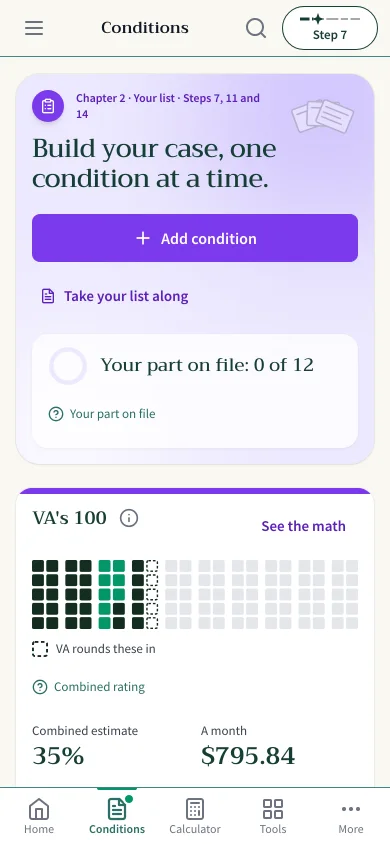
Keep your VA rating at hand.
A free account keeps your conditions in one list and shows your combined rating as you add them. Have it ready when you ask the state about a benefit.

HOW TO READ THIS PAGE
Every row, in the source's own words.
Each benefit says what it is, who qualifies in the source's words, and where it comes from. Open a row to read the passage it quotes.
Find your kind of benefit
The benefits are grouped by kind. Start with the one you came for.
Read who qualifies
Each row quotes the source's own words on who qualifies.
Check with the state
Rules change. Ask the office named in the source before you count on a benefit.
Vetrify is not a state agency and not a law firm. This page points to each state's own words; the state decides who qualifies.
4 BENEFITS
Property tax
A dwelling house owned by a disabled veteran is exempt from property tax once you apply as the law requires (see the row on applying). A disabled veteran here is a veteran whom VA has declared to have a permanent 100% service connected disability, from blindness or another disabling cause, that is reasonably certain to continue for the veteran's life and was not caused or incurred by the veteran's misconduct; it includes someone who qualifies for the 100% rating after death. The dwelling house is the veteran's legal residence, occupied by not more than 2 families, including the lot or curtilage and the structures needed to use it as a residence. The exemption is granted in addition to any other exemption, except that you may have this one or the exemption under section 7-207 of the same subtitle, not both. A disabled active duty service member with a service connected physical disability that is reasonably certain to last for life, not caused by misconduct, qualifies too.
Who qualifies, in the source's wordsPermanent and total
“(3) (i) “Disabled veteran” means an individual who: 1. is a veteran; and 2. has been declared by the U.S. Department of Veterans Affairs to have a permanent 100% service connected disability that results from blindness or other disabling cause that: A. is reasonably certain to continue for the life of the veteran; and B. was not caused or incurred by misconduct of the veteran. (ii) “Disabled veteran” includes an individual who qualifies posthumously for a 100% service connected disability.”
What the source says
“§7–208. (a) (1) In this section the following words have the meanings indicated. (2) “Disabled active duty service member” means an individual in active military, naval, air, or space service who has a service connected physical disability that: (i) is reasonably certain to continue for the life of the service member; and (ii) was not caused or incurred by misconduct of the service member. (3) (i) “Disabled veteran” means an individual who: 1. is a veteran; and 2. has been declared by the U.S. Department of Veterans Affairs to have a permanent 100% service connected disability that results from blindness or other disabling cause that: A. is reasonably certain to continue for the life of the veteran; and B. was not caused or incurred by misconduct of the veteran. (ii) “Disabled veteran” includes an individual who qualifies posthumously for a 100% service connected disability. (4) “Dwelling house”: (i) means real property that is: 1. the legal residence of a disabled active duty service member, disabled veteran, or surviving spouse; and 2. occupied by not more than 2 families; and (ii) includes the lot or curtilage and structures necessary to use the real property as a residence. (5) “Individual who died in the line of duty” means an individual who died while in the active military, naval, air, or space service as a result of an injury or disease that is deemed under 38 U.S.C. § 105 to have been incurred in the line of duty. (6) “Surviving spouse” means an individual who has not remarried and who: (i) is the surviving spouse of a disabled veteran; (ii) is the surviving spouse of an individual who died in the line of duty; or (iii) receives Dependency and Indemnity Compensation from the U.S. Department of Veterans Affairs. (b) Except as provided in subsection (e) of this section, a dwelling house is exempt from property tax if: (1) the dwelling house is owned by: (i) a disabled active duty service member; (ii) a disabled veteran; (iii) a surviving spouse of an individual who died in the line of duty, if: 1. the dwelling house was owned by the individual at the time of the individual’s death; 2. the dwelling house was acquired by the surviving spouse within 2 years of the individual’s death, if the individual or the surviving spouse was domiciled in the State as of the date of the individual’s death; or 3. the dwelling house was acquired after the surviving spouse qualified for exemption for a former dwelling house under item 1 or 2 of this item, to the extent of the previous exemption; or (iv) a surviving spouse of a disabled veteran who meets the requirements of subsection (c) of this section; and (2) the application requirements of subsection (d) of this section are met. (c) Except as provided in subsections (d) and (e) of this section, after a disabled veteran dies, the surviving spouse of the disabled veteran shall receive a disabled veteran’s property tax exemption: (1) for the dwelling house that was formerly owned by the disabled veteran: (i) if the dwelling house received an exemption under this section; and (ii) if the surviving spouse owns and resides in the dwelling house; (2) for the dwelling house that was formerly occupied by the disabled veteran: (i) if the dwelling house did not receive an exemption under this section; (ii) if the disabled veteran was domiciled in the State at death; and (iii) if the surviving spouse owns and resides in the dwelling house; and (3) for a dwelling house subsequently acquired by the surviving spouse, equal to the exemption for the former dwelling house when the dwelling house owned by the surviving spouse was transferred by the surviving spouse: (i) if the surviving spouse owns and resides in the subsequently acquired dwelling house; and (ii) if the surviving spouse has qualified under item (1) or (2) of this subsection. (d) (1) A disabled veteran or a surviving spouse of a disabled veteran shall apply for an exemption under this section by providing to the supervisor: (i) a copy of the disabled veteran’s discharge certificate from active military, naval, air, or space service; and (ii) 1. on the form provided by the Department, a certification of the disabled veteran’s disability from the U.S. Department of Veterans Affairs; or 2. a rating decision of the disabled veteran’s disability from the U.S. Department of Veterans Affairs that includes the effective date of the rating decision. (2) The disabled veteran’s certificate of disability or rating decision may not be inspected by individuals other than: (i) the disabled veteran; or (ii) appropriate employees of the State, a county, or a municipal corporation. (3) A disabled active duty service member shall apply for an exemption under this section by providing to the supervisor, on the form provided by the Department, a certification of the service member’s disability from a physician licensed to practice medicine in the State or from the U.S. Department of Veterans Affairs. (4) A surviving spouse of an individual who died in the line of duty shall apply for an exemption under this section by providing to the supervisor certification that the individual died while in active service as a result of an injury or disease incurred in the line of duty. (5) (i) An individual may submit, and the Department shall accept, an application for the exemption under this section for a specific dwelling house the individual intends to purchase before the individual purchases the dwelling house. (ii) The Department, within 15 business days following receipt of an application submitted under subparagraph (i) of this paragraph, shall process the application and send the applicant a letter stating: 1. that the application is preliminarily approved or preliminarily denied; and 2. if the application is preliminarily approved, the amount of the tax exemption for the dwelling the individual intends to purchase. (iii) An individual who is issued a letter preliminarily approving the exemption shall receive the exemption for the dwelling referenced in the letter after becoming the owner of the dwelling without having to file another application. (e) (1) Except as provided in paragraph (2) of this subsection, an exemption under this section shall be granted in addition to any other exemption authorized by law. (2) An individual may receive an exemption under this section or under § 7–207 of this subtitle but not under both. (f) (1) An exemption under this section is prorated by the supervisor for any part of a taxable year that remains after the date in the year when the disabled active duty service member, disabled veteran, or surviving spouse applies for the exemption. (2) (i) Notwithstanding any other provision of this article and except as provided in subparagraph (ii) of this paragraph, if a dwelling is transferred to a disabled active duty service member, disabled veteran, or surviving spouse who qualifies for an exemption under this section, the exemption applies and the property tax is abated from the date of settlement for the purchase of the property, if the transferee applies for the exemption within 30 days after the settlement for the purchase of the property. (ii) Notwithstanding § 7–104 of this title and for any taxable year beginning on or after July 1, 2018, the governing body of Montgomery County may authorize, by law, an abatement of any overdue property tax: 1. on a dwelling transferred to a disabled active duty service member, disabled veteran, or surviving spouse who applies for and qualifies for an exemption under this section; and 2. for which the transferee is liable. (3) The Department shall adopt regulations to administer the provisions of paragraph (2)(i) of this subsection. (g) (1) Subject to paragraphs (2) and (3) of this subsection, in the taxable years in which an exemption under this section was authorized but not granted, the State, a county, or a municipal corporation shall pay a refund to an individual described below who receives an exemption under this section: (i) to a disabled active duty service member, disabled veteran, or surviving spouse for any State property tax paid; (ii) to a disabled active duty service member, disabled veteran, or surviving spouse for any county property tax paid; or (iii) to a disabled active duty service member or disabled veteran for any municipal corporation property tax paid. (2) A disabled active duty service member or disabled veteran may apply for a refund of State, county, and municipal corporation property tax paid on the dwelling house while the exemption was available only if the disabled active duty service member or disabled veteran applies for the exemption during the 3–year period beginning with the calendar year in which the disabled active duty service member or disabled veteran initially became eligible for an exemption under this section. (3) A surviving spouse may apply for a refund of State, county, and municipal corporation property tax paid on the dwelling house while the exemption was available, only if the surviving spouse applies for the exemption during the 3–year period beginning with the calendar year in which the surviving spouse initially became eligible for an exemption under this section. (h) (1) For the purposes of subsections (f) and (g) of this section, the State, a county, or a municipal corporation shall pay to a disabled active duty service member, disabled veteran, or surviving spouse interest on the amount of a refund if: (i) the disabled active duty service member, disabled veteran, or surviving spouse is eligible and has applied for the refund; and (ii) the State, county, or municipal corporation fails to make the refund within 60 days after the eligible disabled active duty service member, disabled veteran, or surviving spouse has applied for the refund. (2) If interest is payable under this subsection: (i) the State shall pay interest at the rate the State charges on overdue taxes; (ii) the county or municipal corporation shall pay interest at the rate the county or municipal corporation charges on overdue taxes; and (iii) interest shall accrue from the date the refund application is filed with the State, county, or municipal corporation. (i) Each county shall include information on the property tax bill about the availability of the property tax exemption for disabled active duty service members, disabled veterans, and surviving spouses authorized under this section.”
Source: Annotated Code of Maryland, Tax - Property § 7-208 (disabled veterans, disabled active duty service members, and surviving spouses). Read .
After a disabled veteran dies, the surviving spouse, while not remarried, receives the exemption: on the home the veteran owned that already had the exemption, if the spouse owns and lives in it; on the home the veteran occupied that did not have it, if the veteran was domiciled in Maryland at death and the spouse owns and lives in it; and on a home the spouse later acquires, equal to the exemption on the former home, if the spouse owns and lives in it and qualified on one of those first two homes. A disabled veteran here is a veteran VA declared to have a permanent 100% service connected disability, and includes an individual who qualifies posthumously for a 100% service connected disability. The home must be the spouse's legal residence, occupied by not more than 2 families. The spouse must apply with the papers the law lists (the veteran's discharge certificate and VA's certification or rating decision), and may have this exemption or the one under section 7-207, not both. The law's meaning of surviving spouse also names a spouse who receives Dependency and Indemnity Compensation; the exemption itself goes to the surviving spouse of a disabled veteran (this row) or of an individual who died in the line of duty (the next row).
Who qualifies, in the source's wordsOther rule
“(6) “Surviving spouse” means an individual who has not remarried and who: (i) is the surviving spouse of a disabled veteran; (ii) is the surviving spouse of an individual who died in the line of duty; or (iii) receives Dependency and Indemnity Compensation from the U.S. Department of Veterans Affairs. (b) Except as provided in subsection (e) of this section, a dwelling house is exempt from property tax if: (1) the dwelling house is owned by: (i) a disabled active duty service member; (ii) a disabled veteran; (iii) a surviving spouse of an individual who died in the line of duty, if: 1. the dwelling house was owned by the individual at the time of the individual’s death; 2. the dwelling house was acquired by the surviving spouse within 2 years of the individual’s death, if the individual or the surviving spouse was domiciled in the State as of the date of the individual’s death; or 3. the dwelling house was acquired after the surviving spouse qualified for exemption for a former dwelling house under item 1 or 2 of this item, to the extent of the previous exemption; or (iv) a surviving spouse of a disabled veteran who meets the requirements of subsection (c) of this section; and (2) the application requirements of subsection (d) of this section are met. (c) Except as provided in subsections (d) and (e) of this section, after a disabled veteran dies, the surviving spouse of the disabled veteran shall receive a disabled veteran’s property tax exemption: (1) for the dwelling house that was formerly owned by the disabled veteran: (i) if the dwelling house received an exemption under this section; and (ii) if the surviving spouse owns and resides in the dwelling house; (2) for the dwelling house that was formerly occupied by the disabled veteran: (i) if the dwelling house did not receive an exemption under this section; (ii) if the disabled veteran was domiciled in the State at death; and (iii) if the surviving spouse owns and resides in the dwelling house; and (3) for a dwelling house subsequently acquired by the surviving spouse, equal to the exemption for the former dwelling house when the dwelling house owned by the surviving spouse was transferred by the surviving spouse: (i) if the surviving spouse owns and resides in the subsequently acquired dwelling house; and (ii) if the surviving spouse has qualified under item (1) or (2) of this subsection.”
What the source says
“§7–208. (a) (1) In this section the following words have the meanings indicated. (2) “Disabled active duty service member” means an individual in active military, naval, air, or space service who has a service connected physical disability that: (i) is reasonably certain to continue for the life of the service member; and (ii) was not caused or incurred by misconduct of the service member. (3) (i) “Disabled veteran” means an individual who: 1. is a veteran; and 2. has been declared by the U.S. Department of Veterans Affairs to have a permanent 100% service connected disability that results from blindness or other disabling cause that: A. is reasonably certain to continue for the life of the veteran; and B. was not caused or incurred by misconduct of the veteran. (ii) “Disabled veteran” includes an individual who qualifies posthumously for a 100% service connected disability. (4) “Dwelling house”: (i) means real property that is: 1. the legal residence of a disabled active duty service member, disabled veteran, or surviving spouse; and 2. occupied by not more than 2 families; and (ii) includes the lot or curtilage and structures necessary to use the real property as a residence. (5) “Individual who died in the line of duty” means an individual who died while in the active military, naval, air, or space service as a result of an injury or disease that is deemed under 38 U.S.C. § 105 to have been incurred in the line of duty. (6) “Surviving spouse” means an individual who has not remarried and who: (i) is the surviving spouse of a disabled veteran; (ii) is the surviving spouse of an individual who died in the line of duty; or (iii) receives Dependency and Indemnity Compensation from the U.S. Department of Veterans Affairs. (b) Except as provided in subsection (e) of this section, a dwelling house is exempt from property tax if: (1) the dwelling house is owned by: (i) a disabled active duty service member; (ii) a disabled veteran; (iii) a surviving spouse of an individual who died in the line of duty, if: 1. the dwelling house was owned by the individual at the time of the individual’s death; 2. the dwelling house was acquired by the surviving spouse within 2 years of the individual’s death, if the individual or the surviving spouse was domiciled in the State as of the date of the individual’s death; or 3. the dwelling house was acquired after the surviving spouse qualified for exemption for a former dwelling house under item 1 or 2 of this item, to the extent of the previous exemption; or (iv) a surviving spouse of a disabled veteran who meets the requirements of subsection (c) of this section; and (2) the application requirements of subsection (d) of this section are met. (c) Except as provided in subsections (d) and (e) of this section, after a disabled veteran dies, the surviving spouse of the disabled veteran shall receive a disabled veteran’s property tax exemption: (1) for the dwelling house that was formerly owned by the disabled veteran: (i) if the dwelling house received an exemption under this section; and (ii) if the surviving spouse owns and resides in the dwelling house; (2) for the dwelling house that was formerly occupied by the disabled veteran: (i) if the dwelling house did not receive an exemption under this section; (ii) if the disabled veteran was domiciled in the State at death; and (iii) if the surviving spouse owns and resides in the dwelling house; and (3) for a dwelling house subsequently acquired by the surviving spouse, equal to the exemption for the former dwelling house when the dwelling house owned by the surviving spouse was transferred by the surviving spouse: (i) if the surviving spouse owns and resides in the subsequently acquired dwelling house; and (ii) if the surviving spouse has qualified under item (1) or (2) of this subsection. (d) (1) A disabled veteran or a surviving spouse of a disabled veteran shall apply for an exemption under this section by providing to the supervisor: (i) a copy of the disabled veteran’s discharge certificate from active military, naval, air, or space service; and (ii) 1. on the form provided by the Department, a certification of the disabled veteran’s disability from the U.S. Department of Veterans Affairs; or 2. a rating decision of the disabled veteran’s disability from the U.S. Department of Veterans Affairs that includes the effective date of the rating decision. (2) The disabled veteran’s certificate of disability or rating decision may not be inspected by individuals other than: (i) the disabled veteran; or (ii) appropriate employees of the State, a county, or a municipal corporation. (3) A disabled active duty service member shall apply for an exemption under this section by providing to the supervisor, on the form provided by the Department, a certification of the service member’s disability from a physician licensed to practice medicine in the State or from the U.S. Department of Veterans Affairs. (4) A surviving spouse of an individual who died in the line of duty shall apply for an exemption under this section by providing to the supervisor certification that the individual died while in active service as a result of an injury or disease incurred in the line of duty. (5) (i) An individual may submit, and the Department shall accept, an application for the exemption under this section for a specific dwelling house the individual intends to purchase before the individual purchases the dwelling house. (ii) The Department, within 15 business days following receipt of an application submitted under subparagraph (i) of this paragraph, shall process the application and send the applicant a letter stating: 1. that the application is preliminarily approved or preliminarily denied; and 2. if the application is preliminarily approved, the amount of the tax exemption for the dwelling the individual intends to purchase. (iii) An individual who is issued a letter preliminarily approving the exemption shall receive the exemption for the dwelling referenced in the letter after becoming the owner of the dwelling without having to file another application. (e) (1) Except as provided in paragraph (2) of this subsection, an exemption under this section shall be granted in addition to any other exemption authorized by law. (2) An individual may receive an exemption under this section or under § 7–207 of this subtitle but not under both. (f) (1) An exemption under this section is prorated by the supervisor for any part of a taxable year that remains after the date in the year when the disabled active duty service member, disabled veteran, or surviving spouse applies for the exemption. (2) (i) Notwithstanding any other provision of this article and except as provided in subparagraph (ii) of this paragraph, if a dwelling is transferred to a disabled active duty service member, disabled veteran, or surviving spouse who qualifies for an exemption under this section, the exemption applies and the property tax is abated from the date of settlement for the purchase of the property, if the transferee applies for the exemption within 30 days after the settlement for the purchase of the property. (ii) Notwithstanding § 7–104 of this title and for any taxable year beginning on or after July 1, 2018, the governing body of Montgomery County may authorize, by law, an abatement of any overdue property tax: 1. on a dwelling transferred to a disabled active duty service member, disabled veteran, or surviving spouse who applies for and qualifies for an exemption under this section; and 2. for which the transferee is liable. (3) The Department shall adopt regulations to administer the provisions of paragraph (2)(i) of this subsection. (g) (1) Subject to paragraphs (2) and (3) of this subsection, in the taxable years in which an exemption under this section was authorized but not granted, the State, a county, or a municipal corporation shall pay a refund to an individual described below who receives an exemption under this section: (i) to a disabled active duty service member, disabled veteran, or surviving spouse for any State property tax paid; (ii) to a disabled active duty service member, disabled veteran, or surviving spouse for any county property tax paid; or (iii) to a disabled active duty service member or disabled veteran for any municipal corporation property tax paid. (2) A disabled active duty service member or disabled veteran may apply for a refund of State, county, and municipal corporation property tax paid on the dwelling house while the exemption was available only if the disabled active duty service member or disabled veteran applies for the exemption during the 3–year period beginning with the calendar year in which the disabled active duty service member or disabled veteran initially became eligible for an exemption under this section. (3) A surviving spouse may apply for a refund of State, county, and municipal corporation property tax paid on the dwelling house while the exemption was available, only if the surviving spouse applies for the exemption during the 3–year period beginning with the calendar year in which the surviving spouse initially became eligible for an exemption under this section. (h) (1) For the purposes of subsections (f) and (g) of this section, the State, a county, or a municipal corporation shall pay to a disabled active duty service member, disabled veteran, or surviving spouse interest on the amount of a refund if: (i) the disabled active duty service member, disabled veteran, or surviving spouse is eligible and has applied for the refund; and (ii) the State, county, or municipal corporation fails to make the refund within 60 days after the eligible disabled active duty service member, disabled veteran, or surviving spouse has applied for the refund. (2) If interest is payable under this subsection: (i) the State shall pay interest at the rate the State charges on overdue taxes; (ii) the county or municipal corporation shall pay interest at the rate the county or municipal corporation charges on overdue taxes; and (iii) interest shall accrue from the date the refund application is filed with the State, county, or municipal corporation. (i) Each county shall include information on the property tax bill about the availability of the property tax exemption for disabled active duty service members, disabled veterans, and surviving spouses authorized under this section.”
Source: Annotated Code of Maryland, Tax - Property § 7-208 (surviving spouse of a disabled veteran). Read .
A dwelling house owned by the surviving spouse (not remarried) of an individual who died while in the active military, naval, air, or space service as a result of an injury or disease deemed under 38 U.S.C. § 105 to have been incurred in the line of duty is exempt from property tax, if: the individual owned the home at death; or the spouse acquired it within 2 years of the death, with the individual or the spouse domiciled in Maryland on the date of death; or the spouse acquired it after qualifying for a former home under those rules, to the extent of the previous exemption. The home must be the spouse's legal residence, occupied by not more than 2 families, including the lot or curtilage and the structures needed to use it as a residence. The spouse applies with certification that the individual died in active service as a result of an injury or disease incurred in the line of duty, and may have this exemption or the one under section 7-207, not both.
Who qualifies, in the source's wordsOther rule
“(5) “Individual who died in the line of duty” means an individual who died while in the active military, naval, air, or space service as a result of an injury or disease that is deemed under 38 U.S.C. § 105 to have been incurred in the line of duty. (6) “Surviving spouse” means an individual who has not remarried and who: (i) is the surviving spouse of a disabled veteran; (ii) is the surviving spouse of an individual who died in the line of duty; or (iii) receives Dependency and Indemnity Compensation from the U.S. Department of Veterans Affairs. (b) Except as provided in subsection (e) of this section, a dwelling house is exempt from property tax if: (1) the dwelling house is owned by: (i) a disabled active duty service member; (ii) a disabled veteran; (iii) a surviving spouse of an individual who died in the line of duty, if: 1. the dwelling house was owned by the individual at the time of the individual’s death; 2. the dwelling house was acquired by the surviving spouse within 2 years of the individual’s death, if the individual or the surviving spouse was domiciled in the State as of the date of the individual’s death; or 3. the dwelling house was acquired after the surviving spouse qualified for exemption for a former dwelling house under item 1 or 2 of this item, to the extent of the previous exemption”
What the source says
“§7–208. (a) (1) In this section the following words have the meanings indicated. (2) “Disabled active duty service member” means an individual in active military, naval, air, or space service who has a service connected physical disability that: (i) is reasonably certain to continue for the life of the service member; and (ii) was not caused or incurred by misconduct of the service member. (3) (i) “Disabled veteran” means an individual who: 1. is a veteran; and 2. has been declared by the U.S. Department of Veterans Affairs to have a permanent 100% service connected disability that results from blindness or other disabling cause that: A. is reasonably certain to continue for the life of the veteran; and B. was not caused or incurred by misconduct of the veteran. (ii) “Disabled veteran” includes an individual who qualifies posthumously for a 100% service connected disability. (4) “Dwelling house”: (i) means real property that is: 1. the legal residence of a disabled active duty service member, disabled veteran, or surviving spouse; and 2. occupied by not more than 2 families; and (ii) includes the lot or curtilage and structures necessary to use the real property as a residence. (5) “Individual who died in the line of duty” means an individual who died while in the active military, naval, air, or space service as a result of an injury or disease that is deemed under 38 U.S.C. § 105 to have been incurred in the line of duty. (6) “Surviving spouse” means an individual who has not remarried and who: (i) is the surviving spouse of a disabled veteran; (ii) is the surviving spouse of an individual who died in the line of duty; or (iii) receives Dependency and Indemnity Compensation from the U.S. Department of Veterans Affairs. (b) Except as provided in subsection (e) of this section, a dwelling house is exempt from property tax if: (1) the dwelling house is owned by: (i) a disabled active duty service member; (ii) a disabled veteran; (iii) a surviving spouse of an individual who died in the line of duty, if: 1. the dwelling house was owned by the individual at the time of the individual’s death; 2. the dwelling house was acquired by the surviving spouse within 2 years of the individual’s death, if the individual or the surviving spouse was domiciled in the State as of the date of the individual’s death; or 3. the dwelling house was acquired after the surviving spouse qualified for exemption for a former dwelling house under item 1 or 2 of this item, to the extent of the previous exemption; or (iv) a surviving spouse of a disabled veteran who meets the requirements of subsection (c) of this section; and (2) the application requirements of subsection (d) of this section are met. (c) Except as provided in subsections (d) and (e) of this section, after a disabled veteran dies, the surviving spouse of the disabled veteran shall receive a disabled veteran’s property tax exemption: (1) for the dwelling house that was formerly owned by the disabled veteran: (i) if the dwelling house received an exemption under this section; and (ii) if the surviving spouse owns and resides in the dwelling house; (2) for the dwelling house that was formerly occupied by the disabled veteran: (i) if the dwelling house did not receive an exemption under this section; (ii) if the disabled veteran was domiciled in the State at death; and (iii) if the surviving spouse owns and resides in the dwelling house; and (3) for a dwelling house subsequently acquired by the surviving spouse, equal to the exemption for the former dwelling house when the dwelling house owned by the surviving spouse was transferred by the surviving spouse: (i) if the surviving spouse owns and resides in the subsequently acquired dwelling house; and (ii) if the surviving spouse has qualified under item (1) or (2) of this subsection. (d) (1) A disabled veteran or a surviving spouse of a disabled veteran shall apply for an exemption under this section by providing to the supervisor: (i) a copy of the disabled veteran’s discharge certificate from active military, naval, air, or space service; and (ii) 1. on the form provided by the Department, a certification of the disabled veteran’s disability from the U.S. Department of Veterans Affairs; or 2. a rating decision of the disabled veteran’s disability from the U.S. Department of Veterans Affairs that includes the effective date of the rating decision. (2) The disabled veteran’s certificate of disability or rating decision may not be inspected by individuals other than: (i) the disabled veteran; or (ii) appropriate employees of the State, a county, or a municipal corporation. (3) A disabled active duty service member shall apply for an exemption under this section by providing to the supervisor, on the form provided by the Department, a certification of the service member’s disability from a physician licensed to practice medicine in the State or from the U.S. Department of Veterans Affairs. (4) A surviving spouse of an individual who died in the line of duty shall apply for an exemption under this section by providing to the supervisor certification that the individual died while in active service as a result of an injury or disease incurred in the line of duty. (5) (i) An individual may submit, and the Department shall accept, an application for the exemption under this section for a specific dwelling house the individual intends to purchase before the individual purchases the dwelling house. (ii) The Department, within 15 business days following receipt of an application submitted under subparagraph (i) of this paragraph, shall process the application and send the applicant a letter stating: 1. that the application is preliminarily approved or preliminarily denied; and 2. if the application is preliminarily approved, the amount of the tax exemption for the dwelling the individual intends to purchase. (iii) An individual who is issued a letter preliminarily approving the exemption shall receive the exemption for the dwelling referenced in the letter after becoming the owner of the dwelling without having to file another application. (e) (1) Except as provided in paragraph (2) of this subsection, an exemption under this section shall be granted in addition to any other exemption authorized by law. (2) An individual may receive an exemption under this section or under § 7–207 of this subtitle but not under both. (f) (1) An exemption under this section is prorated by the supervisor for any part of a taxable year that remains after the date in the year when the disabled active duty service member, disabled veteran, or surviving spouse applies for the exemption. (2) (i) Notwithstanding any other provision of this article and except as provided in subparagraph (ii) of this paragraph, if a dwelling is transferred to a disabled active duty service member, disabled veteran, or surviving spouse who qualifies for an exemption under this section, the exemption applies and the property tax is abated from the date of settlement for the purchase of the property, if the transferee applies for the exemption within 30 days after the settlement for the purchase of the property. (ii) Notwithstanding § 7–104 of this title and for any taxable year beginning on or after July 1, 2018, the governing body of Montgomery County may authorize, by law, an abatement of any overdue property tax: 1. on a dwelling transferred to a disabled active duty service member, disabled veteran, or surviving spouse who applies for and qualifies for an exemption under this section; and 2. for which the transferee is liable. (3) The Department shall adopt regulations to administer the provisions of paragraph (2)(i) of this subsection. (g) (1) Subject to paragraphs (2) and (3) of this subsection, in the taxable years in which an exemption under this section was authorized but not granted, the State, a county, or a municipal corporation shall pay a refund to an individual described below who receives an exemption under this section: (i) to a disabled active duty service member, disabled veteran, or surviving spouse for any State property tax paid; (ii) to a disabled active duty service member, disabled veteran, or surviving spouse for any county property tax paid; or (iii) to a disabled active duty service member or disabled veteran for any municipal corporation property tax paid. (2) A disabled active duty service member or disabled veteran may apply for a refund of State, county, and municipal corporation property tax paid on the dwelling house while the exemption was available only if the disabled active duty service member or disabled veteran applies for the exemption during the 3–year period beginning with the calendar year in which the disabled active duty service member or disabled veteran initially became eligible for an exemption under this section. (3) A surviving spouse may apply for a refund of State, county, and municipal corporation property tax paid on the dwelling house while the exemption was available, only if the surviving spouse applies for the exemption during the 3–year period beginning with the calendar year in which the surviving spouse initially became eligible for an exemption under this section. (h) (1) For the purposes of subsections (f) and (g) of this section, the State, a county, or a municipal corporation shall pay to a disabled active duty service member, disabled veteran, or surviving spouse interest on the amount of a refund if: (i) the disabled active duty service member, disabled veteran, or surviving spouse is eligible and has applied for the refund; and (ii) the State, county, or municipal corporation fails to make the refund within 60 days after the eligible disabled active duty service member, disabled veteran, or surviving spouse has applied for the refund. (2) If interest is payable under this subsection: (i) the State shall pay interest at the rate the State charges on overdue taxes; (ii) the county or municipal corporation shall pay interest at the rate the county or municipal corporation charges on overdue taxes; and (iii) interest shall accrue from the date the refund application is filed with the State, county, or municipal corporation. (i) Each county shall include information on the property tax bill about the availability of the property tax exemption for disabled active duty service members, disabled veterans, and surviving spouses authorized under this section.”
Source: Annotated Code of Maryland, Tax - Property § 7-208 (surviving spouse of an individual who died in the line of duty). Read .
A disabled veteran or the veteran's surviving spouse applies to the supervisor of assessments with a copy of the veteran's discharge certificate and either VA's certification of the disability on the Department's form or a VA rating decision that includes its effective date. You may apply for a home you intend to buy: the Department must answer within 15 business days, and a preliminary approval applies once you own the home without another application. The exemption is prorated from the date in the year you apply; if a home is transferred to you and you apply within 30 days after settlement, it applies from the date of settlement. For years when the exemption was authorized but not granted, the State and county (and, for the veteran, the municipal corporation) refund the property tax paid, if you apply during the 3-year period beginning with the calendar year you first became eligible, with interest if the refund is not made within 60 days after you apply for it.
Who qualifies, in the source's wordsOther rule
“(d) (1) A disabled veteran or a surviving spouse of a disabled veteran shall apply for an exemption under this section by providing to the supervisor: (i) a copy of the disabled veteran’s discharge certificate from active military, naval, air, or space service; and (ii) 1. on the form provided by the Department, a certification of the disabled veteran’s disability from the U.S. Department of Veterans Affairs; or 2. a rating decision of the disabled veteran’s disability from the U.S. Department of Veterans Affairs that includes the effective date of the rating decision.”
What the source says
“§7–208. (a) (1) In this section the following words have the meanings indicated. (2) “Disabled active duty service member” means an individual in active military, naval, air, or space service who has a service connected physical disability that: (i) is reasonably certain to continue for the life of the service member; and (ii) was not caused or incurred by misconduct of the service member. (3) (i) “Disabled veteran” means an individual who: 1. is a veteran; and 2. has been declared by the U.S. Department of Veterans Affairs to have a permanent 100% service connected disability that results from blindness or other disabling cause that: A. is reasonably certain to continue for the life of the veteran; and B. was not caused or incurred by misconduct of the veteran. (ii) “Disabled veteran” includes an individual who qualifies posthumously for a 100% service connected disability. (4) “Dwelling house”: (i) means real property that is: 1. the legal residence of a disabled active duty service member, disabled veteran, or surviving spouse; and 2. occupied by not more than 2 families; and (ii) includes the lot or curtilage and structures necessary to use the real property as a residence. (5) “Individual who died in the line of duty” means an individual who died while in the active military, naval, air, or space service as a result of an injury or disease that is deemed under 38 U.S.C. § 105 to have been incurred in the line of duty. (6) “Surviving spouse” means an individual who has not remarried and who: (i) is the surviving spouse of a disabled veteran; (ii) is the surviving spouse of an individual who died in the line of duty; or (iii) receives Dependency and Indemnity Compensation from the U.S. Department of Veterans Affairs. (b) Except as provided in subsection (e) of this section, a dwelling house is exempt from property tax if: (1) the dwelling house is owned by: (i) a disabled active duty service member; (ii) a disabled veteran; (iii) a surviving spouse of an individual who died in the line of duty, if: 1. the dwelling house was owned by the individual at the time of the individual’s death; 2. the dwelling house was acquired by the surviving spouse within 2 years of the individual’s death, if the individual or the surviving spouse was domiciled in the State as of the date of the individual’s death; or 3. the dwelling house was acquired after the surviving spouse qualified for exemption for a former dwelling house under item 1 or 2 of this item, to the extent of the previous exemption; or (iv) a surviving spouse of a disabled veteran who meets the requirements of subsection (c) of this section; and (2) the application requirements of subsection (d) of this section are met. (c) Except as provided in subsections (d) and (e) of this section, after a disabled veteran dies, the surviving spouse of the disabled veteran shall receive a disabled veteran’s property tax exemption: (1) for the dwelling house that was formerly owned by the disabled veteran: (i) if the dwelling house received an exemption under this section; and (ii) if the surviving spouse owns and resides in the dwelling house; (2) for the dwelling house that was formerly occupied by the disabled veteran: (i) if the dwelling house did not receive an exemption under this section; (ii) if the disabled veteran was domiciled in the State at death; and (iii) if the surviving spouse owns and resides in the dwelling house; and (3) for a dwelling house subsequently acquired by the surviving spouse, equal to the exemption for the former dwelling house when the dwelling house owned by the surviving spouse was transferred by the surviving spouse: (i) if the surviving spouse owns and resides in the subsequently acquired dwelling house; and (ii) if the surviving spouse has qualified under item (1) or (2) of this subsection. (d) (1) A disabled veteran or a surviving spouse of a disabled veteran shall apply for an exemption under this section by providing to the supervisor: (i) a copy of the disabled veteran’s discharge certificate from active military, naval, air, or space service; and (ii) 1. on the form provided by the Department, a certification of the disabled veteran’s disability from the U.S. Department of Veterans Affairs; or 2. a rating decision of the disabled veteran’s disability from the U.S. Department of Veterans Affairs that includes the effective date of the rating decision. (2) The disabled veteran’s certificate of disability or rating decision may not be inspected by individuals other than: (i) the disabled veteran; or (ii) appropriate employees of the State, a county, or a municipal corporation. (3) A disabled active duty service member shall apply for an exemption under this section by providing to the supervisor, on the form provided by the Department, a certification of the service member’s disability from a physician licensed to practice medicine in the State or from the U.S. Department of Veterans Affairs. (4) A surviving spouse of an individual who died in the line of duty shall apply for an exemption under this section by providing to the supervisor certification that the individual died while in active service as a result of an injury or disease incurred in the line of duty. (5) (i) An individual may submit, and the Department shall accept, an application for the exemption under this section for a specific dwelling house the individual intends to purchase before the individual purchases the dwelling house. (ii) The Department, within 15 business days following receipt of an application submitted under subparagraph (i) of this paragraph, shall process the application and send the applicant a letter stating: 1. that the application is preliminarily approved or preliminarily denied; and 2. if the application is preliminarily approved, the amount of the tax exemption for the dwelling the individual intends to purchase. (iii) An individual who is issued a letter preliminarily approving the exemption shall receive the exemption for the dwelling referenced in the letter after becoming the owner of the dwelling without having to file another application. (e) (1) Except as provided in paragraph (2) of this subsection, an exemption under this section shall be granted in addition to any other exemption authorized by law. (2) An individual may receive an exemption under this section or under § 7–207 of this subtitle but not under both. (f) (1) An exemption under this section is prorated by the supervisor for any part of a taxable year that remains after the date in the year when the disabled active duty service member, disabled veteran, or surviving spouse applies for the exemption. (2) (i) Notwithstanding any other provision of this article and except as provided in subparagraph (ii) of this paragraph, if a dwelling is transferred to a disabled active duty service member, disabled veteran, or surviving spouse who qualifies for an exemption under this section, the exemption applies and the property tax is abated from the date of settlement for the purchase of the property, if the transferee applies for the exemption within 30 days after the settlement for the purchase of the property. (ii) Notwithstanding § 7–104 of this title and for any taxable year beginning on or after July 1, 2018, the governing body of Montgomery County may authorize, by law, an abatement of any overdue property tax: 1. on a dwelling transferred to a disabled active duty service member, disabled veteran, or surviving spouse who applies for and qualifies for an exemption under this section; and 2. for which the transferee is liable. (3) The Department shall adopt regulations to administer the provisions of paragraph (2)(i) of this subsection. (g) (1) Subject to paragraphs (2) and (3) of this subsection, in the taxable years in which an exemption under this section was authorized but not granted, the State, a county, or a municipal corporation shall pay a refund to an individual described below who receives an exemption under this section: (i) to a disabled active duty service member, disabled veteran, or surviving spouse for any State property tax paid; (ii) to a disabled active duty service member, disabled veteran, or surviving spouse for any county property tax paid; or (iii) to a disabled active duty service member or disabled veteran for any municipal corporation property tax paid. (2) A disabled active duty service member or disabled veteran may apply for a refund of State, county, and municipal corporation property tax paid on the dwelling house while the exemption was available only if the disabled active duty service member or disabled veteran applies for the exemption during the 3–year period beginning with the calendar year in which the disabled active duty service member or disabled veteran initially became eligible for an exemption under this section. (3) A surviving spouse may apply for a refund of State, county, and municipal corporation property tax paid on the dwelling house while the exemption was available, only if the surviving spouse applies for the exemption during the 3–year period beginning with the calendar year in which the surviving spouse initially became eligible for an exemption under this section. (h) (1) For the purposes of subsections (f) and (g) of this section, the State, a county, or a municipal corporation shall pay to a disabled active duty service member, disabled veteran, or surviving spouse interest on the amount of a refund if: (i) the disabled active duty service member, disabled veteran, or surviving spouse is eligible and has applied for the refund; and (ii) the State, county, or municipal corporation fails to make the refund within 60 days after the eligible disabled active duty service member, disabled veteran, or surviving spouse has applied for the refund. (2) If interest is payable under this subsection: (i) the State shall pay interest at the rate the State charges on overdue taxes; (ii) the county or municipal corporation shall pay interest at the rate the county or municipal corporation charges on overdue taxes; and (iii) interest shall accrue from the date the refund application is filed with the State, county, or municipal corporation. (i) Each county shall include information on the property tax bill about the availability of the property tax exemption for disabled active duty service members, disabled veterans, and surviving spouses authorized under this section.”
Source: Annotated Code of Maryland, Tax - Property § 7-208 (applying, proration, and refunds). Read .
3 BENEFITS
Vehicles and license plates
Disabled veteran license plates are issued in recognition of a resident's uniformed service-related injuries. A veteran rated at 100% disabled can receive the plates free of charge. They come with or without the wheelchair, the universal symbol for disability.
Who qualifies, in the source's wordsTied to a VA rating
“If you are a veteran who is rated at 100% disabled, you can receive your license plates free of charge.”
What the source says
“Disabled veterans license plates 100% Disabled Veterans Disabled veteran license plates are issued in recognition of a resident’s uniformed service-related injuries. If you are a veteran who is rated at 100% disabled, you can receive your license plates free of charge. The license plates are printed in two formats: with or without a wheelchair, the universal symbol for disability.”
Source: Maryland Motor Vehicle Administration, Military & Veteran License Plates (100% Disabled Veterans). Read .
Disabled veterans with a service-connected disability rating or unemployability rating of 50-99% are issued Disabled Veteran license plates free of charge, but still pay the annual registration fees and surcharge. These plates have no wheelchair symbol and carry the words "Disabled Veteran" at the bottom.
Who qualifies, in the source's wordsTied to a VA rating
“Disabled veterans who have a service-connected disability rating or unemployability rating of 50-99% are issued license plates in recognition of their uniformed service-related injuries.”
What the source says
“Disabled veterans who have a service-connected disability rating or unemployability rating of 50-99% are issued license plates in recognition of their uniformed service-related injuries. If you are a veteran who is rated at 50-99% disabled, you can receive your license plates free of charge but will still pay the annual registration fees and surcharge. The license plates are printed without the wheelchair, the universal symbol for disability, and have the words "Disabled Veteran" at the bottom.”
Source: Maryland Motor Vehicle Administration, Military & Veteran License Plates (50-99% Disabled Veterans). Read .
Make an appointment online with myMVA and bring proof of your disability rating from VA. A veteran rated at 100% disability pays no other fees and is eligible for permanent registration. A veteran rated 50-99% gets the plates free but still pays the annual registration fees and surcharge. If you want a vanity, organizational, or other background plate, you pay those plate fees and are not eligible for permanent registration, but registration fees are not charged.
Who qualifies, in the source's wordsTied to a VA rating
“If you are a veteran who is rated at 100% disability, no other fees are required. You are eligible to receive permanent registration.”
What the source says
“How to get Disabled Veteran plates Make an appointment online with myMVA. Gather your documents. Make sure to bring proof of your disability rating from the Department of Veterans Affairs, along with any other required documents. At your appointment, you will only need to pay applicable fees: If you are a veteran who is rated at 100% disability, no other fees are required. You are eligible to receive permanent registration. If you are a veteran who is rated at 50-99% disabled, you can receive your license plates free of charge but will still pay the annual registration fees and surcharge. If you want a vanity, organizational plate or other background plate, you will need to pay those applicable fees (and are not eligible for permanent registration), but registration fees will not be charged. Depending on the plates, you will receive them and the stickers at your appointment or by mail.”
Source: Maryland Motor Vehicle Administration, Military & Veteran License Plates (How to get Disabled Veteran plates). Read .
3 BENEFITS
Education and tuition
An honorably discharged veteran attending a Maryland public institution of higher education is exempt from paying nonresident tuition if the veteran presents documentation of an honorable discharge from the uniformed services and of residing, or being domiciled, in Maryland. Each public institution must also comply with federal law on nonresident tuition for veterans and veterans' dependents.
Who qualifies, in the source's wordsOther rule
“(3) The honorably discharged veteran presents documentation that the individual: (i) Was honorably discharged from the uniformed services; and (ii) 1. Resides in this State; or 2. Is domiciled in this State”
What the source says
“§15–106.4. (a) This section applies to the following individuals: (1) An active service member; (2) The spouse of an active service member; (3) A financially dependent child of an active service member; (4) An honorably discharged veteran; or (5) A member of the National Guard as defined in § 13–405(a)(3) of the Public Safety Article. (b) Notwithstanding any other provision of this article, an individual described in subsection (a) of this section who attends a public institution of higher education in the State is exempt from paying nonresident tuition at a public institution of higher education in this State if: (1) The active service member: (i) Is stationed in this State; (ii) Resides in this State; or (iii) Is domiciled in this State; (2) The spouse or financially dependent child of an active service member presents documentation that, during the time period in which the active service member met the requirements of item (1) of this subsection, the individual: (i) Enrolled as an entering student in a public institution of higher education in the State; or (ii) Was accepted to attend a public institution of higher education in the State; (3) The honorably discharged veteran presents documentation that the individual: (i) Was honorably discharged from the uniformed services; and (ii) 1. Resides in this State; or 2. Is domiciled in this State; or (4) The National Guard member is a member of the Maryland National Guard and joined or subsequently serves in the Maryland National Guard to: (i) Provide a Critical Military Occupational Skill; or (ii) Be a member of the Air Force Critical Specialty Code as determined by the National Guard. (c) Notwithstanding any other provision of this article, a spouse or financially dependent child of an active duty member who is exempt from paying nonresident tuition under subsection (b) of this section shall continue to be exempt from paying nonresident tuition: (1) If the spouse or financially dependent child: (i) Enrolls as an entering student in a public institution of higher education in the State; (ii) Remains continuously enrolled at the public institution of higher education; and (iii) Remains domiciled in the State during enrollment; and (2) Regardless of whether the active duty member still meets the requirements of subsection (b)(1) of this section. (d) Each public institution of higher education shall comply with federal law relating to nonresident tuition for veterans and veterans’ dependents. (e) The Commission shall adopt regulations in accordance with Title 10, Subtitle 1 of the State Government Article to implement the provisions of this section.”
Source: Annotated Code of Maryland, Education § 15-106.4 (nonresident tuition exemption for service members, veterans, and National Guard). Read .
The Edward T. and Mary A. Conroy Memorial Scholarship is open to the son, daughter, stepson, stepdaughter, or surviving spouse (one who has not remarried) of a member of the uniformed services who died as a result of service after December 7, 1941; suffered a service connected 100% permanent disability after December 7, 1941; or was declared a prisoner of war or missing in action on or after January 1, 1960, as a result of the Vietnam conflict (a child must have been born before or while the parent was a prisoner of war or missing in action). The applicant must be a Maryland resident at the time of application or at the time of the disabling or fatal event, be at least 16 years old, and be accepted or enrolled at an eligible institution (a regular undergraduate, graduate, or professional program, a 2-year certificate program whose course work transfers toward a bachelor's degree, or a private career school). The scholarship may be used for tuition and mandatory fees; it may not exceed the resident tuition and mandatory fees of the University System of Maryland's highest-cost 4-year campus (other than the two the law excludes), and may not be less than the lesser of $3,000 or the resident tuition and mandatory fees where the recipient attends. Each institution decides eligibility and may make awards to eligible students subject to the allocation of funds from the Commission, which allocates them subject to the State budget. An award may be held for 5 years of full-time or 8 years of part-time study.
Who qualifies, in the source's wordsOther rule
“(2) To apply for a scholarship under this section, the following persons are required to be a resident of Maryland at the time of application or at the time of the disabling or fatal event: (i) A son, daughter, stepson, stepdaughter, or the surviving spouse of a member of the uniformed services who: 1. Died as a result of service after December 7, 1941; 2. Suffered a service connected 100% permanent disability after December 7, 1941; or 3. Was declared to be a prisoner of war or missing in action, if that occurred on or after January 1, 1960, as a result of the Vietnam conflict, and if the child was born prior to or while the parent was a prisoner of war or missing in action”
What the source says
“(a) (1) In this section the following words have the meanings indicated. (2) “Disabled public safety employee” means a State or local public safety employee who sustains an injury in the line of duty that: (i) Precludes the individual from continuing to serve or be employed as a State or local public safety employee; and (ii) In the case of a volunteer member of a fire department or ambulance or rescue company or squad, precludes the member from continuing to be employed in the nonpublic safety occupation in which the member is engaged at the time of the injury. (3) “Fund” means the Edward T. Conroy and Jean B. Cryor Scholarship Fund. (4) “School employee” includes an employee of a public or nonpublic school in the State. (5) “State or local public safety employee” means a person who is employed in the State as: (i) A career or volunteer member of a: 1. Fire department; 2. Ambulance company or squad; or 3. Rescue company or squad; (ii) A law enforcement officer; (iii) A correctional officer; or (iv) A member of the Maryland National Guard who was a resident of this State at the time of death. (6) “Surviving spouse” means a person who has not remarried. (7) “Victim of the September 11, 2001, terrorist attacks” means a Maryland resident who was killed as a result of the attacks on the World Trade Center in New York City, the attack on the Pentagon in Virginia, or the crash of United Airlines Flight 93 in Pennsylvania. (b) There is a program of scholarships that are awarded by eligible postsecondary institutions under this section. (c) (1) The program for uniformed services and public safety personnel and their eligible dependents is the Edward T. and Mary A. Conroy Memorial Scholarship Program. (2) The program for eligible dependents of public and nonpublic school employees is the Jean B. Cryor Memorial Scholarship Program. (d) (1) A person may apply to an eligible postsecondary institution for a scholarship under this section if the person: (i) 1. Is accepted for admission or enrolled in the regular undergraduate, graduate or professional program at an eligible institution; 2. Is enrolled in a 2–year terminal certificate program in which the course work is acceptable for transfer credit for an accredited baccalaureate program in an eligible institution; or 3. Is enrolled in a private career school; (ii) Is at least 16 years old; and (iii) Meets the other eligibility criteria specified in this section. (2) To apply for a scholarship under this section, the following persons are required to be a resident of Maryland at the time of application or at the time of the disabling or fatal event: (i) A son, daughter, stepson, stepdaughter, or the surviving spouse of a member of the uniformed services who: 1. Died as a result of service after December 7, 1941; 2. Suffered a service connected 100% permanent disability after December 7, 1941; or 3. Was declared to be a prisoner of war or missing in action, if that occurred on or after January 1, 1960, as a result of the Vietnam conflict, and if the child was born prior to or while the parent was a prisoner of war or missing in action; (ii) A prisoner of war or missing in action, if that occurred on or after January 1, 1960, as a result of the Vietnam conflict and was a resident of this State at the time the person was declared to be a prisoner of war or missing in action; (iii) A veteran who: 1. Suffers a service connected disability of 25% or greater; and 2. Has exhausted or is no longer eligible for federal veterans’ educational benefits; (iv) A son, daughter, stepson, or stepdaughter of or the surviving spouse of a victim of the September 11, 2001, terrorist attacks; (v) A son, daughter, stepson, or stepdaughter of a school employee who, as a result of an act of violence: 1. Died in the line of duty; or 2. Sustained an injury in the line of duty that rendered the school employee 100% disabled; or (vi) The surviving spouse of a school employee who, as a result of an act of violence: 1. Died in the line of duty; or 2. Sustained an injury in the line of duty that rendered the school employee 100% disabled. (3) To apply for a scholarship under this section, the following persons are not required to be a resident of Maryland at the time of application or at the time of the disabling or fatal event: (i) 1. A son, daughter, stepson, or stepdaughter of any State or local public safety employee killed in the line of duty; or 2. The surviving spouse of any State or local public safety employee killed in the line of duty; or (ii) 1. A disabled public safety employee; 2. A son, daughter, stepson, or stepdaughter of a disabled public safety employee who sustains an injury in the line of duty that renders the public safety employee 100% disabled; or 3. The surviving spouse of a disabled public safety employee who sustains an injury in the line of duty that renders the public safety employee 100% disabled. (e) A scholarship awarded under this section: (1) May be used for the tuition and mandatory fees at any eligible institution; and (2) May not: (i) Exceed the equivalent annual tuition and mandatory fees of a resident undergraduate student at the 4–year public institution of higher education within the University System of Maryland, other than the University of Maryland Global Campus and University of Maryland, Baltimore Campus, with the highest annual expenses for a full–time resident undergraduate; and (ii) Be less than the lesser of: 1. $3,000; or 2. The equivalent annual tuition and mandatory fees of a resident of the institution attended by the recipient of the scholarship. (f) (1) Each postsecondary institution shall determine the eligibility of persons who apply to the institution for the Edward T. and Mary A. Conroy Memorial Scholarship Program and the Jean B. Cryor Memorial Scholarship Program. (2) Funds for the Edward T. and Mary A. Conroy Memorial Scholarship Program and the Jean B. Cryor Memorial Scholarship Program shall be allocated by the Commission to each postsecondary institution based on a formula determined by the Commission, which may include prior year enrollment, eligible recipients, and institutional tuition and fees. (3) In October and February of each year, each postsecondary institution shall report to the Commission the number of eligible recipients attending the institution. (4) (i) The Commission shall allocate funds for awards to postsecondary institutions subject to the availability of funds as provided in the State budget. (ii) Each postsecondary institution may make awards to eligible students subject to the allocation of funds from the Commission under subparagraph (i) of this paragraph. (5) The Commission shall adopt guidelines to implement this subsection. (g) (1) Each recipient of a scholarship under this section may hold the award for 5 years of full–time study or 8 years of part–time study. (2) The number of eligible recipients under subsection (d)(2)(iii) of this section shall be limited to 15 each year. (3) An award provided under subsection (d)(2)(iv) of this section may not exceed the amount specified in subsection (e)(2) of this section when combined with any other scholarship received by a student based on the student’s status as a child or spouse of a victim of the September 11, 2001, terrorist attacks. (4) Subject to a recipient’s continued eligibility under subsection (d) of this section and the availability of funds under subsection (f) of this section, an awarding authority shall give priority to a recipient of a scholarship before awarding funds to new applicants.”
Source: Annotated Code of Maryland, Education § 18-601 (Edward T. and Mary A. Conroy Memorial Scholarship Program). Read .
A veteran who suffers a service connected disability of 25% or greater and has exhausted, or is no longer eligible for, federal veterans' educational benefits may also apply for the Conroy scholarship, if a Maryland resident at the time of application or at the time of the disabling event. The veteran must be at least 16 years old and be accepted for admission or enrolled in a regular undergraduate, graduate, or professional program at an eligible institution, enrolled in a 2-year terminal certificate program whose course work transfers toward an accredited bachelor's program, or enrolled in a private career school. The law limits these veteran recipients to 15 each year. The same award rules apply: tuition and mandatory fees within the law's cap and floor; each institution decides eligibility and may make awards to eligible students subject to the allocation of funds from the Commission.
Who qualifies, in the source's wordsTied to a VA rating
“(2) To apply for a scholarship under this section, the following persons are required to be a resident of Maryland at the time of application or at the time of the disabling or fatal event: (i) A son, daughter, stepson, stepdaughter, or the surviving spouse of a member of the uniformed services who: 1. Died as a result of service after December 7, 1941; 2. Suffered a service connected 100% permanent disability after December 7, 1941; or 3. Was declared to be a prisoner of war or missing in action, if that occurred on or after January 1, 1960, as a result of the Vietnam conflict, and if the child was born prior to or while the parent was a prisoner of war or missing in action; (ii) A prisoner of war or missing in action, if that occurred on or after January 1, 1960, as a result of the Vietnam conflict and was a resident of this State at the time the person was declared to be a prisoner of war or missing in action; (iii) A veteran who: 1. Suffers a service connected disability of 25% or greater; and 2. Has exhausted or is no longer eligible for federal veterans’ educational benefits”
What the source says
“(a) (1) In this section the following words have the meanings indicated. (2) “Disabled public safety employee” means a State or local public safety employee who sustains an injury in the line of duty that: (i) Precludes the individual from continuing to serve or be employed as a State or local public safety employee; and (ii) In the case of a volunteer member of a fire department or ambulance or rescue company or squad, precludes the member from continuing to be employed in the nonpublic safety occupation in which the member is engaged at the time of the injury. (3) “Fund” means the Edward T. Conroy and Jean B. Cryor Scholarship Fund. (4) “School employee” includes an employee of a public or nonpublic school in the State. (5) “State or local public safety employee” means a person who is employed in the State as: (i) A career or volunteer member of a: 1. Fire department; 2. Ambulance company or squad; or 3. Rescue company or squad; (ii) A law enforcement officer; (iii) A correctional officer; or (iv) A member of the Maryland National Guard who was a resident of this State at the time of death. (6) “Surviving spouse” means a person who has not remarried. (7) “Victim of the September 11, 2001, terrorist attacks” means a Maryland resident who was killed as a result of the attacks on the World Trade Center in New York City, the attack on the Pentagon in Virginia, or the crash of United Airlines Flight 93 in Pennsylvania. (b) There is a program of scholarships that are awarded by eligible postsecondary institutions under this section. (c) (1) The program for uniformed services and public safety personnel and their eligible dependents is the Edward T. and Mary A. Conroy Memorial Scholarship Program. (2) The program for eligible dependents of public and nonpublic school employees is the Jean B. Cryor Memorial Scholarship Program. (d) (1) A person may apply to an eligible postsecondary institution for a scholarship under this section if the person: (i) 1. Is accepted for admission or enrolled in the regular undergraduate, graduate or professional program at an eligible institution; 2. Is enrolled in a 2–year terminal certificate program in which the course work is acceptable for transfer credit for an accredited baccalaureate program in an eligible institution; or 3. Is enrolled in a private career school; (ii) Is at least 16 years old; and (iii) Meets the other eligibility criteria specified in this section. (2) To apply for a scholarship under this section, the following persons are required to be a resident of Maryland at the time of application or at the time of the disabling or fatal event: (i) A son, daughter, stepson, stepdaughter, or the surviving spouse of a member of the uniformed services who: 1. Died as a result of service after December 7, 1941; 2. Suffered a service connected 100% permanent disability after December 7, 1941; or 3. Was declared to be a prisoner of war or missing in action, if that occurred on or after January 1, 1960, as a result of the Vietnam conflict, and if the child was born prior to or while the parent was a prisoner of war or missing in action; (ii) A prisoner of war or missing in action, if that occurred on or after January 1, 1960, as a result of the Vietnam conflict and was a resident of this State at the time the person was declared to be a prisoner of war or missing in action; (iii) A veteran who: 1. Suffers a service connected disability of 25% or greater; and 2. Has exhausted or is no longer eligible for federal veterans’ educational benefits; (iv) A son, daughter, stepson, or stepdaughter of or the surviving spouse of a victim of the September 11, 2001, terrorist attacks; (v) A son, daughter, stepson, or stepdaughter of a school employee who, as a result of an act of violence: 1. Died in the line of duty; or 2. Sustained an injury in the line of duty that rendered the school employee 100% disabled; or (vi) The surviving spouse of a school employee who, as a result of an act of violence: 1. Died in the line of duty; or 2. Sustained an injury in the line of duty that rendered the school employee 100% disabled. (3) To apply for a scholarship under this section, the following persons are not required to be a resident of Maryland at the time of application or at the time of the disabling or fatal event: (i) 1. A son, daughter, stepson, or stepdaughter of any State or local public safety employee killed in the line of duty; or 2. The surviving spouse of any State or local public safety employee killed in the line of duty; or (ii) 1. A disabled public safety employee; 2. A son, daughter, stepson, or stepdaughter of a disabled public safety employee who sustains an injury in the line of duty that renders the public safety employee 100% disabled; or 3. The surviving spouse of a disabled public safety employee who sustains an injury in the line of duty that renders the public safety employee 100% disabled. (e) A scholarship awarded under this section: (1) May be used for the tuition and mandatory fees at any eligible institution; and (2) May not: (i) Exceed the equivalent annual tuition and mandatory fees of a resident undergraduate student at the 4–year public institution of higher education within the University System of Maryland, other than the University of Maryland Global Campus and University of Maryland, Baltimore Campus, with the highest annual expenses for a full–time resident undergraduate; and (ii) Be less than the lesser of: 1. $3,000; or 2. The equivalent annual tuition and mandatory fees of a resident of the institution attended by the recipient of the scholarship. (f) (1) Each postsecondary institution shall determine the eligibility of persons who apply to the institution for the Edward T. and Mary A. Conroy Memorial Scholarship Program and the Jean B. Cryor Memorial Scholarship Program. (2) Funds for the Edward T. and Mary A. Conroy Memorial Scholarship Program and the Jean B. Cryor Memorial Scholarship Program shall be allocated by the Commission to each postsecondary institution based on a formula determined by the Commission, which may include prior year enrollment, eligible recipients, and institutional tuition and fees. (3) In October and February of each year, each postsecondary institution shall report to the Commission the number of eligible recipients attending the institution. (4) (i) The Commission shall allocate funds for awards to postsecondary institutions subject to the availability of funds as provided in the State budget. (ii) Each postsecondary institution may make awards to eligible students subject to the allocation of funds from the Commission under subparagraph (i) of this paragraph. (5) The Commission shall adopt guidelines to implement this subsection. (g) (1) Each recipient of a scholarship under this section may hold the award for 5 years of full–time study or 8 years of part–time study. (2) The number of eligible recipients under subsection (d)(2)(iii) of this section shall be limited to 15 each year. (3) An award provided under subsection (d)(2)(iv) of this section may not exceed the amount specified in subsection (e)(2) of this section when combined with any other scholarship received by a student based on the student’s status as a child or spouse of a victim of the September 11, 2001, terrorist attacks. (4) Subject to a recipient’s continued eligibility under subsection (d) of this section and the availability of funds under subsection (f) of this section, an awarding authority shall give priority to a recipient of a scholarship before awarding funds to new applicants.”
Source: Annotated Code of Maryland, Education § 18-601 (Edward T. and Mary A. Conroy Memorial Scholarship Program). Read .
5 BENEFITS
Other state benefits
For a Maryland resident, to the extent the income is included in federal adjusted gross income, the subtraction from federal adjusted gross income (to determine Maryland adjusted gross income) includes the first $12,500 of military retirement income received during the taxable year if you are under the age of 55 on the last day of the taxable year, or the first $20,000 if you are at least 55. Military retirement income is retirement income, including death benefits, received as a result of military service: service in the armed forces (active or reserve component, or induction for training and service), or active duty with the commissioned corps of the Public Health Service, the National Oceanic and Atmospheric Administration, or the Coast and Geodetic Survey.
Who qualifies, in the source's wordsOther rule
““Military retirement income” means retirement income, including death benefits, received as a result of military service.”
What the source says
“§10–207. (a) To the extent included in federal adjusted gross income, the amounts under this section are subtracted from the federal adjusted gross income of a resident to determine Maryland adjusted gross income. (b) The subtraction under subsection (a) of this section includes a distribution, to a beneficiary, of accumulated income on which a fiduciary has paid the income tax. (c) The subtraction under subsection (a) of this section includes interest or dividends attributable to an obligation of the United States or an authority, commission, instrumentality, possession, or territory of the United States. (c–1) (1) (i) In this subsection the following words have the meanings indicated. (ii) “Mutual fund” means a regulated investment company as defined under § 851 of the Internal Revenue Code. (iii) “United States government obligation” means an obligation of the United States or an authority, commission, instrumentality, possession, or territory of the United States. (2) The subtraction under subsection (a) of this section includes a distribution or dividend by a mutual fund of interest or dividends attributable to a United States government obligation. (d) The subtraction under subsection (a) of this section includes income attributable to an employer–provided official vehicle used in accordance with law by a member of a State, county, or local: (1) police force; or (2) fire department. (e) The subtraction under subsection (a) of this section includes a payment from a pension system to an individual for a disability or injury that arose out of and in the course of the individual’s employment as a policeman or fire fighter. (e–1) (1) In this subsection, “law enforcement officer” means a law enforcement officer as defined in § 1–101 of the Public Safety Article or other sworn law enforcement officer of the United States, a state, or a political subdivision of a state. (2) The subtraction under subsection (a) of this section includes: (i) a payment from a pension system to the surviving spouse or other beneficiary of a law enforcement officer or fire fighter whose death arises out of or in the course of employment as a law enforcement officer or fire fighter; and (ii) a payment of a death benefit under a collective bargaining agreement from a county or municpality in the State to the surviving spouse or other beneficiary of a law enforcement officer or fire fighter whose death arises out of or in the course of employment as a law enforcement officer or fire fighter. (f) The subtraction under subsection (a) of this section includes income that: (1) is received by withdrawing money from a retirement account known as a Keogh Plan and established under Subchapter D of the Internal Revenue Code; and (2) is attributable to: (i) money contributed by an individual before 1967 for which the individual was not allowed a deduction at the time of contribution to the account; or (ii) interest or dividends paid on the account on which a State tax on income was paid at the time that the interest or dividends accumulated in the account. (g) The subtraction under subsection (a) of this section includes a payment received under a fire, rescue, or ambulance personnel length of service award program that is funded by any county or municipal corporation of the State. (h) Repealed. (i) The subtraction under subsection (a) of this section includes profit realized from the sale or exchange of a bond issued by the State or a political subdivision of the State. (j) The subtraction under subsection (a) of this section includes a payment received: (1) under Title II of the Social Security Act; or (2) as a benefit under the Railroad Retirement Act. (k) The subtraction under subsection (a) of this section includes payment for relocation and assistance under Title 12, Subtitle 2 of the Real Property Article. (l) The subtraction under subsection (a) of this section includes that portion of an annuity received by a retiree of a retirement or pension system: (1) for which pickup contributions were made under § 21–313 of the State Personnel and Pensions Article; and (2) that is included in federal adjusted gross income under § 414(h)(2) of the Internal Revenue Code. (m) The subtraction under subsection (a) of this section includes a refund of tax on income received from a state or a political subdivision of a state. (n) The subtraction under subsection (a) of this section includes any income that federal law or treaty exempts from a state but not federal tax on income. (o) (1) In this subsection, “remaindermen” includes a person whose remainder interest is vested, contingent, or vested subject to divestment. (2) The subtraction under subsection (a) of this section includes: (i) income derived from intangible personal property that is held in trust for the benefit of a nonresident or a corporation not doing business in the State; and (ii) to the extent not included under item (i) of this paragraph, capital gain income derived from the sale or other disposition of intangible personal property that is held in trust, if the proceeds thereof are added to the principal of the trust, and if all the remaindermen in being are: 1. nonresidents during the entire taxable year; or 2. corporations not doing business in the State. (3) The subtraction allowed under paragraph (2)(ii) of this subsection does not apply if there are no remaindermen of the trust in being. (p) (1) (i) In this subsection the following words have the meanings indicated. (ii) “Military pay” means pay received as a result of military service. (iii) “Military service” has the meaning stated in subsection (q)(1) of this section. (2) The subtraction under subsection (a) of this section includes the first $15,000 of military pay that is: (i) received by an individual who is in active military service; and (ii) attributable to military service of the individual outside the United States. (3) The amount of the subtraction under paragraph (2) of this subsection: (i) is reduced dollar for dollar in the amount by which military pay received by the individual exceeds $15,000; and (ii) is reduced to zero if the amount of military pay received by the individual exceeds $30,000. (q) (1) (i) In this subsection the following words have the meanings indicated. (ii) “Armed forces” has the meaning stated in § 9–901 of the State Government Article. (iii) “Military retirement income” means retirement income, including death benefits, received as a result of military service. (iv) “Military service” means: 1. induction into the armed forces for training and service under the Selective Training and Service Act of 1940 or a subsequent act of a similar nature; 2. membership in a reserve component; 3. membership in an active component of the armed forces; or 4. active duty with the commissioned corps of the Public Health Service, the National Oceanic and Atmospheric Administration, or the Coast and Geodetic Survey. (2) The subtraction under subsection (a) of this section includes: (i) if, on the last day of the taxable year, the individual is under the age of 55 years, the first $12,500 of military retirement income received by an individual during the taxable year; and (ii) if, on the last day of the taxable year, the individual is at least 55 years old, the first $20,000 of military retirement income received by an individual during the taxable year.”
Source: Annotated Code of Maryland, Tax - General § 10-207 (subtractions from federal adjusted gross income; subsection (q), military retirement income). Read .
Maryland state parks waive all applicable day-use entrance charges year-round for all veterans, resident or out-of-state. The waiver covers the veteran only, not others in the same vehicle, unless a per-vehicle charge is in effect, in which case the per-vehicle fee is waived.
Who qualifies, in the source's wordsOther rule
“All applicable day-use entrance charges are waived year-round for all veterans.”
What the source says
“Day-Use Waiver for Veterans - All applicable day-use entrance charges are waived year-round for all veterans. The waiver applies to both resident and out-of-state veterans. This waiver is applicable to the veteran only and not others in the same vehicle, unless a per-vehicle charge is in effect at the time. In that case, the per-vehicle fee is waived.”
Source: Maryland Department of Natural Resources, Military One-Stop Shop (Day-Use Waiver for Veterans). Read .
A complimentary lifetime hunting license is available to Maryland residents who are 100% service-connected disabled veterans, former prisoners of war, or deemed unemployable by VA. Apply with a letter of disability or certification from VA and a signed Hunting License Application, at a Department of Natural Resources Licensing and Registration Service Center. It includes the bow stamp, muzzleloader stamp, sika deer stamp, and furbearer permit; the Maryland Migratory Game Bird Stamp, the Federal Migratory Bird Hunting and Conservation Stamp, and the Big Game Harvest Record are still required each year. The Department of Veterans and Military Families' pages word this rule two ways (100% service-connected on one page, permanent and total on another), so confirm with the Department of Natural Resources before you apply.
Who qualifies, in the source's wordsTied to a VA rating
“Maryland residents who are 100% service-connected disabled veterans or former prisoners of war or who are deemed unemployable by the US Department of Veterans Affairs”
What the source says
“Complimentary POW/DAV Hunting Licenses A complimentary lifetime license is available to Maryland residents who are 100% service-connected disabled veterans or former prisoners of war or who are deemed unemployable by the US Department of Veterans Affairs. Applicants must furnish a letter of disability or a letter of certification from the Veterans Administration, along with a completed/signed Hunting License Application. These documents can be scanned/faxed over to one of our Licensing & Registration Service Centers. The lifetime license is available only at the department's Licensing and Registration Service Centers and includes the bow stamp, muzzleloader stamp, sika deer stamp and furbearer permit. The Maryland Migratory Game Bird Stamp is not part of the Complimentary License. The Migratory Game Bird Stamp, Federal Migratory Bird Hunting and Conservation Stamp, and the Big Game Harvest Record are required for each year and can be obtained from a Licensing and Registration Service Center, a sport license agent, or online at: https://mdoutdoors.maryland.gov/login.”
Source: Maryland Department of Natural Resources, Military One-Stop Shop (Complimentary POW/DAV Hunting Licenses). Read .
A complimentary lifetime fishing license is available to Maryland residents who are 100% service-connected disabled veterans, former prisoners of war, or deemed unemployable by VA. It includes the non-tidal angler's license, trout stamp, Chesapeake Bay sport fishing license, and recreational oyster license. Send a letter of disability or certification from VA with a signed Fishing License Application to a Licensing and Registration Service Center. The Department of Veterans and Military Families' list of benefits for service-connected veterans says the complimentary lifetime fishing license is for permanent and total disability, so confirm with the Department of Natural Resources before you apply.
Who qualifies, in the source's wordsTied to a VA rating
“Maryland residents who are 100% service-connected disabled veterans or former prisoners of war or are deemed unemployable by the US Department of Veterans Affairs”
What the source says
“A complimentary lifetime license is available to Maryland residents who are 100% service-connected disabled veterans or former prisoners of war or are deemed unemployable by the US Department of Veterans Affairs. The license incorporates the non-tidal angler’s license, trout stamp, Chesapeake Bay sport fishing license and recreational oyster license. Applicants must furnish a letter of disability or a letter of certification from the Veterans Administration, along with a completed/signed Fishing License Application. These documents can be scanned/faxed over to one of our Licensing & Registration Service Centers.”
Source: Maryland Department of Natural Resources, Military One-Stop Shop (Fishing in Maryland, DAV/POW). Read .
Any Maryland veteran who received a Purple Heart for injuries sustained defending the nation qualifies for a 50 percent discount on Maryland hunting and fishing licenses.
Who qualifies, in the source's wordsOther rule
“Any Maryland veteran who has received a Purple Heart for injuries sustained defending our nation”
What the source says
“Discounted Fishing and Hunting Licenses for Purple Heart Recipients Any Maryland veteran who has received a Purple Heart for injuries sustained defending our nation now qualifies for a 50 percent discount on Maryland hunting and fishing licenses.”
Source: Maryland Department of Natural Resources, Military One-Stop Shop (Discounted Fishing and Hunting Licenses for Purple Heart Recipients). Read .
Not covered on this page yet
These have no row here yet, so the page is not a full list. Ask the Maryland Department of Veterans and Military Families about them.
- Local property tax credits for veterans: each county sets its own, so the page does not list them.
- The Douglas J.J. Peters scholarship for veterans of the Afghanistan and Iraq conflicts and their families: its terms were not read on the Higher Education Commission's site.

On the App Store
Your combined rating and what it pays, on your phone.
VA Calc combines your ratings with VA's whole-person formula and shows what that rating pays at VA's official rates.
Official sources
- Annotated Code of Maryland, Tax - Property § 7-208 (disabled veterans, disabled active duty service members, and surviving spouses), mgaleg.maryland.gov
- Maryland Motor Vehicle Administration, Military & Veteran License Plates (100% Disabled Veterans), mva.maryland.gov
- Annotated Code of Maryland, Education § 15-106.4 (nonresident tuition exemption for service members, veterans, and National Guard), mgaleg.maryland.gov
- Annotated Code of Maryland, Education § 18-601 (Edward T. and Mary A. Conroy Memorial Scholarship Program), mgaleg.maryland.gov
- Annotated Code of Maryland, Tax - General § 10-207 (subtractions from federal adjusted gross income; subsection (q), military retirement income), mgaleg.maryland.gov
- Maryland Department of Natural Resources, Military One-Stop Shop (Day-Use Waiver for Veterans), dnr.maryland.gov