
STATE BENEFITS FOR VETERANS · OR
Oregon benefits for veterans
Quoted from the state's own law and agencies
What Oregon law and Oregon agencies say about property tax, vehicles and license plates, education and tuition, and other state benefits. Every row quotes its source and shows the day we read it.
See the benefitsFree · No account needed
Your Oregon benefits list, in your inbox
Email yourself every Oregon benefit on this page, with who qualifies in the source's words, each source and the day we read it.
Oregon
YOUR NEXT STEP
Keep your VA rating at hand.
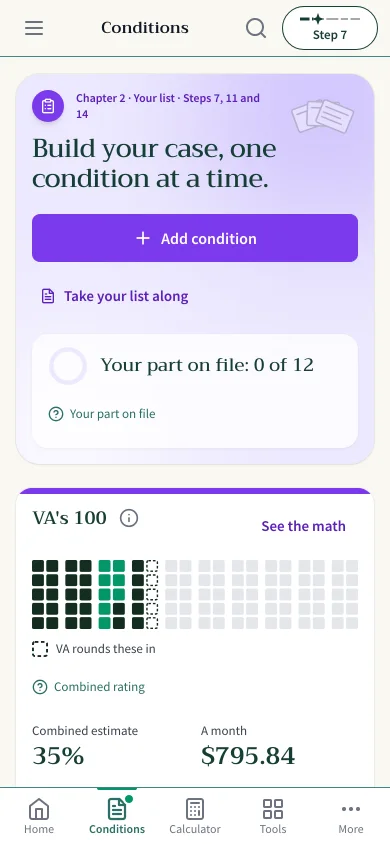
A free account keeps your conditions in one list and shows your combined rating as you add them. Have it ready when you ask the state about a benefit.

HOW TO READ THIS PAGE
Every row, in the source's own words.
Each benefit says what it is, who qualifies in the source's words, and where it comes from. Open a row to read the passage it quotes.
Find your kind of benefit
The benefits are grouped by kind. Start with the one you came for.
Read who qualifies
Each row quotes the source's own words on who qualifies.
Check with the state
Rules change. Ask the office named in the source before you count on a benefit.
Vetrify is not a state agency and not a law firm. This page points to each state's own words; the state decides who qualifies.
6 BENEFITS
Property tax
Once a claim is filed, part of the assessed value of the homestead or personal property of an Oregon resident veteran whom VA or any branch of the Armed Forces has officially certified as having service-connected disabilities of 40 percent or more is exempt from taxation, up to the larger of the law's two exemption amounts. (The smaller amount is for a veteran certified with disabilities of 40 percent or more that the law does not say must be service-connected, a veteran rated 40 percent or more by a physician who meets an income limit, and the unmarried surviving spouse of any veteran.) Each year the amount equals 103 percent of the prior year's amount; the county assessor gives this year's figure. The dollar amounts in the law's text are its starting amounts; they rise every year, so this year's are higher. "Veteran" has the meaning given in ORS 408.225 (its own row). The Department of Revenue's publication on this exemption words the rules differently: it says you must be a U.S. citizen and must own and live on your homestead property, and it covers a surviving registered domestic partner. Confirm with your county assessor.
Who qualifies, in the source's wordsTied to a VA rating
“residents of this state: (a) Any veteran who is officially certified by the United States Department of Veterans Affairs or any branch of the Armed Forces of the United States as having service-connected disabilities of 40 percent or more.”
What the source says
“Property of veterans or surviving spouses. (1) As used in this section and ORS 307.260, 307.262 and 307.270, “veteran” has the meaning given that term in ORS 408.225. (2) Upon compliance with ORS 307.260, there shall be exempt from taxation not to exceed $15,000 of the assessed value of the homestead or personal property of any of the following residents of this state other than those described in subsection (3) of this section: (a) Any veteran who is officially certified by the United States Department of Veterans Affairs or any branch of the Armed Forces of the United States as having disabilities of 40 percent or more. (b) Any veteran having served with the United States Armed Forces who, as certified by one duly licensed physician or naturopathic physician, is rated as having disabilities of 40 percent or more. However, a veteran shall be entitled to the exemption granted under this paragraph only if the veteran during the calendar year immediately preceding the assessment year for which the exemption is claimed had total gross income, including pensions, disability compensation or retirement pay, or any combination of such payments from the United States Government on account of such service, of not more than 185 percent of federal poverty guidelines. (c) The surviving spouse remaining unmarried of a veteran, but the exemption shall apply only to the period preceding the date of the first remarriage of the surviving spouse. (3) Upon compliance with ORS 307.260, there shall be exempt from taxation not to exceed $18,000 of the assessed value of the homestead or personal property of any of the following residents of this state: (a) Any veteran who is officially certified by the United States Department of Veterans Affairs or any branch of the Armed Forces of the United States as having service-connected disabilities of 40 percent or more. (b) The surviving spouse remaining unmarried of a veteran, if the veteran died as a result of service-connected injury or illness or if the veteran received at least one year of the maximum exemption from taxation allowed under paragraph (a) of this subsection after 1981 for a veteran certified as having service-connected disabilities of 40 percent or more. (4) The amount of the exemption allowed under subsection (2) or (3) of this section shall equal 103 percent of the amount of the exemption for the prior tax year.”
Source: ORS 307.250, Property of veterans or surviving spouses. Read .
The smaller of the law's two exemption amounts applies to the homestead or personal property of an Oregon resident veteran (other than one who gets the larger amount, which is for service-connected disabilities of 40 percent or more) whom VA or any branch of the Armed Forces has officially certified as having disabilities of 40 percent or more, or who served in the Armed Forces and is rated by one licensed physician or naturopathic physician as having disabilities of 40 percent or more. The physician route has an income limit: in the calendar year before the assessment year, total gross income, including pensions, disability compensation or retirement pay from the United States Government on account of that service, may be no more than 185 percent of federal poverty guidelines. Each year the amount equals 103 percent of the prior year's amount; the county assessor gives this year's figure. The dollar amounts in the law's text are its starting amounts; they rise every year, so this year's are higher. The Department of Revenue's publication on this exemption words the rules differently: it says you must be a U.S. citizen and must own and live on your homestead property, and it covers a surviving registered domestic partner. Confirm with your county assessor.
Who qualifies, in the source's wordsTied to a VA rating
“residents of this state other than those described in subsection (3) of this section: (a) Any veteran who is officially certified by the United States Department of Veterans Affairs or any branch of the Armed Forces of the United States as having disabilities of 40 percent or more. (b) Any veteran having served with the United States Armed Forces who, as certified by one duly licensed physician or naturopathic physician, is rated as having disabilities of 40 percent or more. However, a veteran shall be entitled to the exemption granted under this paragraph only if the veteran during the calendar year immediately preceding the assessment year for which the exemption is claimed had total gross income, including pensions, disability compensation or retirement pay, or any combination of such payments from the United States Government on account of such service, of not more than 185 percent of federal poverty guidelines.”
What the source says
“Property of veterans or surviving spouses. (1) As used in this section and ORS 307.260, 307.262 and 307.270, “veteran” has the meaning given that term in ORS 408.225. (2) Upon compliance with ORS 307.260, there shall be exempt from taxation not to exceed $15,000 of the assessed value of the homestead or personal property of any of the following residents of this state other than those described in subsection (3) of this section: (a) Any veteran who is officially certified by the United States Department of Veterans Affairs or any branch of the Armed Forces of the United States as having disabilities of 40 percent or more. (b) Any veteran having served with the United States Armed Forces who, as certified by one duly licensed physician or naturopathic physician, is rated as having disabilities of 40 percent or more. However, a veteran shall be entitled to the exemption granted under this paragraph only if the veteran during the calendar year immediately preceding the assessment year for which the exemption is claimed had total gross income, including pensions, disability compensation or retirement pay, or any combination of such payments from the United States Government on account of such service, of not more than 185 percent of federal poverty guidelines. (c) The surviving spouse remaining unmarried of a veteran, but the exemption shall apply only to the period preceding the date of the first remarriage of the surviving spouse. (3) Upon compliance with ORS 307.260, there shall be exempt from taxation not to exceed $18,000 of the assessed value of the homestead or personal property of any of the following residents of this state: (a) Any veteran who is officially certified by the United States Department of Veterans Affairs or any branch of the Armed Forces of the United States as having service-connected disabilities of 40 percent or more. (b) The surviving spouse remaining unmarried of a veteran, if the veteran died as a result of service-connected injury or illness or if the veteran received at least one year of the maximum exemption from taxation allowed under paragraph (a) of this subsection after 1981 for a veteran certified as having service-connected disabilities of 40 percent or more. (4) The amount of the exemption allowed under subsection (2) or (3) of this section shall equal 103 percent of the amount of the exemption for the prior tax year.”
Source: ORS 307.250, Property of veterans or surviving spouses. Read .
An Oregon resident surviving spouse remaining unmarried of a veteran may claim the smaller of the law's two exemption amounts, but only for the period before the first remarriage. The larger amount is for an Oregon resident unmarried surviving spouse of a veteran who died as a result of service-connected injury or illness, or who received at least one year of the maximum exemption for service-connected disabilities of 40 percent or more after 1981. Each year the amounts equal 103 percent of the prior year's amounts. The dollar amounts in the law's text are its starting amounts; they rise every year, so this year's are higher. The Department of Revenue's publication on this exemption words the rules differently: it says you must be a U.S. citizen and must own and live on your homestead property, and it covers a surviving registered domestic partner. Confirm with your county assessor.
Who qualifies, in the source's wordsOther rule
“residents of this state other than those described in subsection (3) of this section: (a) Any veteran who is officially certified by the United States Department of Veterans Affairs or any branch of the Armed Forces of the United States as having disabilities of 40 percent or more. (b) Any veteran having served with the United States Armed Forces who, as certified by one duly licensed physician or naturopathic physician, is rated as having disabilities of 40 percent or more. However, a veteran shall be entitled to the exemption granted under this paragraph only if the veteran during the calendar year immediately preceding the assessment year for which the exemption is claimed had total gross income, including pensions, disability compensation or retirement pay, or any combination of such payments from the United States Government on account of such service, of not more than 185 percent of federal poverty guidelines. (c) The surviving spouse remaining unmarried of a veteran, but the exemption shall apply only to the period preceding the date of the first remarriage of the surviving spouse.”
What the source says
“Property of veterans or surviving spouses. (1) As used in this section and ORS 307.260, 307.262 and 307.270, “veteran” has the meaning given that term in ORS 408.225. (2) Upon compliance with ORS 307.260, there shall be exempt from taxation not to exceed $15,000 of the assessed value of the homestead or personal property of any of the following residents of this state other than those described in subsection (3) of this section: (a) Any veteran who is officially certified by the United States Department of Veterans Affairs or any branch of the Armed Forces of the United States as having disabilities of 40 percent or more. (b) Any veteran having served with the United States Armed Forces who, as certified by one duly licensed physician or naturopathic physician, is rated as having disabilities of 40 percent or more. However, a veteran shall be entitled to the exemption granted under this paragraph only if the veteran during the calendar year immediately preceding the assessment year for which the exemption is claimed had total gross income, including pensions, disability compensation or retirement pay, or any combination of such payments from the United States Government on account of such service, of not more than 185 percent of federal poverty guidelines. (c) The surviving spouse remaining unmarried of a veteran, but the exemption shall apply only to the period preceding the date of the first remarriage of the surviving spouse. (3) Upon compliance with ORS 307.260, there shall be exempt from taxation not to exceed $18,000 of the assessed value of the homestead or personal property of any of the following residents of this state: (a) Any veteran who is officially certified by the United States Department of Veterans Affairs or any branch of the Armed Forces of the United States as having service-connected disabilities of 40 percent or more. (b) The surviving spouse remaining unmarried of a veteran, if the veteran died as a result of service-connected injury or illness or if the veteran received at least one year of the maximum exemption from taxation allowed under paragraph (a) of this subsection after 1981 for a veteran certified as having service-connected disabilities of 40 percent or more. (4) The amount of the exemption allowed under subsection (2) or (3) of this section shall equal 103 percent of the amount of the exemption for the prior tax year.”
Source: ORS 307.250, Property of veterans or surviving spouses. Read .
File a written claim with the county assessor, on the assessor's forms, on or before April 1 of the assessment year (within 30 days after acquiring the property if it was acquired after March 1 but before July 1). A veteran certified by VA or the Armed Forces, or a qualifying surviving spouse, need not refile if the exemption was allowed the year before and ownership, use and all other qualifying conditions are unchanged; a veteran certified by a physician must file every year. Attach VA's or the Armed Forces' latest certificate of the disability rate, dated within three years before the claim (or a physician's certificate dated within one year, plus a sworn statement of total gross income), unless you filed the certificate after age 65 or it certifies a disability rating that under federal law is permanent and cannot be changed. A surviving spouse may continue the exemption without filing a new claim if the veteran died during the previous tax year, or if the homestead was acquired after March 1 but before July 1 of the assessment year and the veteran died within 30 days of acquiring it. The surviving spouse must notify the county assessor of the election, and the assessor continues the exemption only if the surviving spouse meets all the other eligibility requirements for it.
Who qualifies, in the source's wordsOther rule
“Each veteran or surviving spouse qualifying for the exemption under ORS 307.250”
What the source says
“(1)(a) Each veteran or surviving spouse qualifying for the exemption under ORS 307.250 shall file with the county assessor, on forms supplied by the assessor, a claim therefor in writing on or before April 1 of the assessment year for which the exemption is claimed, except that when the property designated is acquired after March 1 but prior to July 1 the claim shall be filed within 30 days after the date of acquisition. (b) A claim need not be filed under this section in order to be allowed the exemption described in ORS 307.250 if: (A) The homestead or personal property of the veteran or surviving spouse was allowed the exemption under ORS 307.250 for the preceding tax year; (B) The individual claiming the exemption is a veteran described in ORS 307.250 (2)(a) or (3)(a) or a surviving spouse who meets the requirements of ORS 307.250 (2)(c) or (3)(b); and (C) As of the filing date for the current tax year, the ownership and use of the homestead or personal property and all other qualifying conditions for the homestead or personal property to be allowed the exemption remain unchanged. (c)(A) If the individual claiming the exemption is a veteran described in ORS 307.250 (2)(b), the claimant shall file a claim annually that satisfies the requirements of subsection (2) of this section on or before the date required in paragraph (a) of this subsection. (B) If the county assessor has not received a claim filed under this paragraph on or before April 1 of the current year, not later than April 10 of each year, the county assessor shall notify the veteran in the county who secured an exemption under ORS 307.250 (2)(b) in the preceding year but who did not make application therefor on or before April 1 of the current year. The county assessor may provide the notification on an unsealed postal card. A veteran so notified may secure the exemption, if still qualified, by making application therefor to the county assessor not later than May 1 of the current year, accompanied by a late-filing fee of $10, which shall be deposited in the general fund of the county for general governmental expenses. If the claim for any tax year is not filed within the time specified, the exemption may not be allowed on the assessment roll for that year. (2)(a) The claim shall set out the basis of the claim and designate the property to which the exemption may apply. Except as provided in subsection (3) of this section, claims for exemptions under ORS 307.250 (2)(a) and (3)(a) shall have affixed thereto the certificate last issued by United States Department of Veterans Affairs or the branch of the Armed Forces of the United States, as the case may be, but dated within three years prior to the date of the claim for exemption, certifying the rate of disability of the claimant. (b) Claims for exemption under ORS 307.250 (2)(b) shall, except as provided in subsection (3) of this section, have affixed thereto, in addition to the certificate last issued by a licensed physician or naturopathic physician and dated within one year prior to the date of the claim for exemption, certifying the rate of disability of the claimant, a statement by the claimant under oath or affirmation setting forth the total gross income received by the claimant from all sources during the last calendar year. (c) There also shall be affixed to each claim the affidavit or affirmation of the claimant that the statements contained therein are true. (3) The provisions of subsection (2) of this section that require a veteran to affix to the claim certificates of the United States Department of Veterans Affairs, a branch of the Armed Forces of the United States or a licensed physician or naturopathic physician do not apply to a veteran who has filed the required certificate after attaining the age of 65 years or to a veteran who has filed, on or after September 27, 1987, a certificate certifying a disability rating that, under federal law, is permanent and cannot be changed. (4)(a) Notwithstanding subsection (1) of this section, a surviving spouse may elect, at any time during the tax year, to continue the exemption under ORS 307.250 without filing a new claim if: (A) The veteran died during the previous tax year; or (B) The property designated as the homestead was acquired after March 1 but prior to July 1 of the assessment year and the veteran died within 30 days of the date the property was acquired. (b) The surviving spouse of a veteran must notify the county assessor of the election. (c) Upon receipt of the notice, the county assessor shall continue the exemption if the surviving spouse meets all of the eligibility requirements for an exemption under ORS 307.250 other than the timely filing of a claim under subsection (1) of this section.”
Source: ORS 307.260, Claiming exemption; surviving spouse's election to continue exemption (subsections 1 to 4(c)). Read .
If VA or a branch of the Armed Forces certifies that a veteran has disabilities of 40 percent or more as of an earlier date, the veteran may get the exemption for each tax year after that date by filing a claim with the county assessor within six months of the notice, but not for a tax year more than three tax years before the year the claim is filed. Taxes paid on the exempt amount for those years are refunded with interest.
Who qualifies, in the source's wordsTied to a VA rating
“if a veteran receives notice of certification from the United States Department of Veterans Affairs or any branch of the Armed Forces of the United States that the veteran has disabilities of 40 percent or more as of a date set forth in the certification”
What the source says
“(1) Notwithstanding ORS 307.260, if a veteran receives notice of certification from the United States Department of Veterans Affairs or any branch of the Armed Forces of the United States that the veteran has disabilities of 40 percent or more as of a date set forth in the certification, the veteran may obtain the exemption set forth in ORS 307.250 for each tax year following the date of certified disability. (2) A veteran seeking to obtain an exemption under ORS 307.250 pursuant to this section must file a claim for exemption with the county assessor within six months of the date the federal government agency notifies the veteran of the certified disability. (3) Notwithstanding subsection (1) of this section, a veteran may not receive an exemption under ORS 307.250 for a tax year that is more than three tax years prior to the tax year in which a claim is filed under this section. (4) If the county assessor determines that a veteran who has filed a claim under this section meets the requirements of ORS 307.250 for a tax year prior to the current tax year, property taxes collected on the exempt amount for the prior tax year, together with interest at the rate set forth in ORS 311.812, shall be refunded to the veteran. Refunds shall be made from the refund reserve account established under ORS 311.807.”
Source: ORS 307.262, Tax years for which exemption may be claimed upon receipt of federal certification of disability. Read .
The exemption applies to property the veteran or surviving spouse owns or holds under a recorded contract of purchase, first to the homestead and then to personal property. The spouse's property counts as the veteran's homestead if they live together there. Claims in two or more counties together may not exceed the maximum exemption, and each veteran or surviving spouse may have only one homestead claim in any one assessment year.
Who qualifies, in the source's wordsOther rule
“property a veteran or surviving spouse owns or has in possession under a recorded contract of purchase”
What the source says
“(1) The exemption under ORS 307.250 applies to property a veteran or surviving spouse owns or has in possession under a recorded contract of purchase. The exemption first applies to the homestead of the veteran or surviving spouse and then to the personal property of the veteran or surviving spouse. Property of the spouse of the veteran is deemed the homestead of the veteran if the veteran and the spouse of the veteran are living together and occupying the property as their homestead. When a veteran or surviving spouse applies for exemption on properties in two or more counties, the total amount of the exemption allowed in all counties may not exceed the maximum amount of exemption under ORS 307.250. (2) For each qualified veteran or surviving spouse only one valid and allowable claim for an exemption on a homestead shall be permitted in any one assessment year.”
Source: ORS 307.270, Property to which exemption of ORS 307.250 applies. Read .
1 BENEFIT
Vehicles and license plates
Special registration of a vehicle for a disabled veteran whose disability results from causes connected with service, who was discharged or released under honorable conditions, and who served not less than 90 consecutive days (or was discharged or released for a service-connected injury or illness before completing that period). Show a letter from VA or any branch of the Armed Forces certifying that you are a disabled veteran. You pay the one-time registration fee set by ORS 803.420; the registration does not need renewing and has no renewal fees. A household may register as many vehicles this way as it has qualifying disabled veterans; commercial vehicles do not qualify. The vehicle must be owned by a qualifying disabled veteran: the department may suspend or revoke the registration if the vehicle is owned by a person not qualified, or is a kind not qualified.
Who qualifies, in the source's wordsOther rule
“(a) Is a disabled veteran whose disability results from causes connected with service in the Armed Forces of the United States; and (b) Has been a member of and discharged or released under honorable conditions from the Armed Forces of the United States, and whose service was for not less than 90 consecutive days or who was discharged or released on account of a service-connected injury or illness prior to the completion of the minimum period of service.”
What the source says
“(1) In the absence of just cause for refusal, the Department of Transportation shall provide for registration of any vehicle required to be registered by this state in a manner consistent with this section for persons who qualify as disabled veterans under this section. The special registration provisions under this section are subject to all of the following: (a) The fee is the one-time registration fee established by ORS 803.420 for vehicles registered under this section. (b) The department may issue registrations for vehicles in a household under this section in a number equal to the number of persons in the household who qualify as disabled veterans under subsection (2) of this section. (c) The department shall not register any commercial vehicle under this section. (2) A person is a disabled veteran who qualifies for registration of a vehicle under this section if the person: (a) Is a disabled veteran whose disability results from causes connected with service in the Armed Forces of the United States; and (b) Has been a member of and discharged or released under honorable conditions from the Armed Forces of the United States, and whose service was for not less than 90 consecutive days or who was discharged or released on account of a service-connected injury or illness prior to the completion of the minimum period of service. (3) A person qualifies as a disabled veteran under subsection (2) of this section if the person presents a letter from the United States Department of Veterans Affairs or any branch of the Armed Forces of the United States certifying that the person is a disabled veteran. (4) Registration issued under this section is valid as provided in ORS 803.415. The registration period for vehicles registered under this section exempts the registration from any requirement to be renewed or to make payment of renewal fees. However, if any owner would be required to comply with ORS 815.310 upon issuance or renewal of regular registration for the vehicle, the owner must comply with ORS 815.310 in the same manner as for other vehicles or the department may suspend the registration of the vehicle until the owner submits proof of compliance. (5) The department may suspend or revoke any registration issued under this section if the department determines that the vehicle is owned by a person not qualified for registration under this section or the vehicle is a kind not qualified for registration under this section.”
Source: ORS 805.100, Disabled veterans (vehicle registration). Read .
3 BENEFITS
Education and tuition
A public university listed in ORS 352.002 or a community college must charge no more than the resident rate for tuition and fees to a nonresident undergraduate or graduate student on an Oregon campus who served in the Armed Forces, was relieved or discharged with an honorable discharge or a general discharge under honorable conditions, and shows a physical presence in Oregon within 12 months of enrolling. It also covers a person who was an Oregon resident and left the state to serve in the Armed Forces or in an international position with the state, the federal government or a humanitarian aid organization (or that person's dependent), if they left within the previous five years, or, if they left more than five years ago, have never established residence in another state since. A student whose federal tuition benefits exceed the resident rate pays tuition and fees equal to those benefits. Distance education and self-support courses are excluded, except distance education courses taken by a veteran who qualifies on campus.
Who qualifies, in the source's wordsOther rule
“(a)(A) Served in the Armed Forces of the United States; (B) Was relieved or discharged from that service with either an honorable discharge or a general discharge under honorable conditions; and (C) Provides proof that the student has established a physical presence in Oregon within 12 months of being enrolled at the public university or community college”
What the source says
“(1) A public university listed in ORS 352.002 or a community college shall charge an enrolled student who is not a resident of this state and who is attending classes as an undergraduate or graduate student on a public university or community college campus in this state tuition and fees no greater than the resident rate if the student: (a)(A) Served in the Armed Forces of the United States; (B) Was relieved or discharged from that service with either an honorable discharge or a general discharge under honorable conditions; and (C) Provides proof that the student has established a physical presence in Oregon within 12 months of being enrolled at the public university or community college; (b) Was, or is the dependent of, a resident of Oregon who left the state within the previous five years in order to serve, and who subsequently served, in the Armed Forces of the United States or in an international position with the state, the federal government or a humanitarian aid organization; or (c)(A) Was, or is the dependent of, a resident of Oregon who left the state more than five years ago in order to serve, and who subsequently served, in the Armed Forces of the United States or in an international position with the state, the federal government or a humanitarian aid organization; and (B) Since leaving the state in the manner provided in subparagraph (A) of this paragraph, has never established residence in another state. (2) A person who served in the Armed Forces of the United States or in an international position with the state, the federal government or a humanitarian aid organization and who receives federal tuition benefits in excess of the tuition and fees the person is charged under subsection (1) of this section at a public university listed in ORS 352.002 or a community college where the person is enrolled shall pay tuition and fees equal to the federal tuition benefits received. (3)(a) Except as provided in paragraph (b) of this subsection, distance education and self-support courses as identified by each public university listed in ORS 352.002 and community college are exempt from the tuition reduction provisions of this section. (b) The tuition reduction provisions of this section apply to distance education courses as identified by each public university listed in ORS 352.002 and community college that are taken by a person who: (A) Is eligible to receive the tuition reduction provisions of this section when attending classes as an undergraduate or graduate student on a public university or community college campus in this state; and (B) Served in the Armed Forces of the United States.”
Source: ORS 350.290, Resident tuition and fees for nonresident students who served, or who are dependents of someone who served, in Armed Forces. Read .
An Oregon community college must waive tuition, for courses leading to a community college certificate or an associate degree, for the child, spouse or unremarried surviving spouse of a service member who died on active duty, or who was 100 percent disabled as the result of a military service connected disability and died as the result of that disability. The student must count as an Oregon resident for community college tuition when applying and be admitted to such a program; a child must be 23 years of age or younger when applying. The waiver covers up to the credit hours of two years of full-time attendance, and no more than needed to graduate. It is not available in a school year the student received a Marine Gunnery Sergeant John David Fry Scholarship.
Who qualifies, in the source's wordsOther rule
“(c) “Qualified student” means a child, a spouse or an unremarried surviving spouse of a service member. (d) “Service member” means a person who: (A) As a member of the Armed Forces of the United States, died on active duty; or (B) Was a member of the Armed Forces of the United States, was 100 percent disabled as the result of a military service connected disability and died as the result of that disability. (2) Subject to subsections (3) to (7) of this section, a community college shall waive tuition for a qualified student for courses that may lead to a certificate from a community college or to an associate degree. (3)(a) The maximum waiver granted under this section is the total number of credit hours that equals two years of full-time attendance at a community college. (b) Notwithstanding paragraph (a) of this subsection, a waiver may not exceed the total number of credit hours the qualified student needs to graduate with a certificate from a community college or an associate degree. (4) A waiver may be granted under this section only for credit hours for courses that are offered by a community college and are available for enrollment, regardless of whether the qualified student attends the course and pays tuition. (5) Except as provided in subsection (7) of this section, a qualified student may receive a waiver under this section if the student: (a) At the time of application for a waiver, is considered a resident of this state for the purpose of determining tuition to be paid at a community college; and (b) Has been admitted to a community college for a program leading to a certificate from a community college or an associate degree. (6) A child who applies for a waiver under this section must be 23 years of age or younger at the time the child applies for the waiver. (7) A qualified student is not eligible to receive a waiver under this section for any school year in which the student received a Marine Gunnery Sergeant John David Fry Scholarship under section 1002 of the Supplemental Appropriations Act of 2009 (P.L. 111-32).”
What the source says
“Tuition waiver for child, spouse or unremarried surviving spouse of service member. (1) As used in this section: (a) “Child” means a child, adopted child or stepchild of a service member. (b) “Community college” has the meaning given that term in ORS 341.005. (c) “Qualified student” means a child, a spouse or an unremarried surviving spouse of a service member. (d) “Service member” means a person who: (A) As a member of the Armed Forces of the United States, died on active duty; or (B) Was a member of the Armed Forces of the United States, was 100 percent disabled as the result of a military service connected disability and died as the result of that disability. (2) Subject to subsections (3) to (7) of this section, a community college shall waive tuition for a qualified student for courses that may lead to a certificate from a community college or to an associate degree. (3)(a) The maximum waiver granted under this section is the total number of credit hours that equals two years of full-time attendance at a community college. (b) Notwithstanding paragraph (a) of this subsection, a waiver may not exceed the total number of credit hours the qualified student needs to graduate with a certificate from a community college or an associate degree. (4) A waiver may be granted under this section only for credit hours for courses that are offered by a community college and are available for enrollment, regardless of whether the qualified student attends the course and pays tuition. (5) Except as provided in subsection (7) of this section, a qualified student may receive a waiver under this section if the student: (a) At the time of application for a waiver, is considered a resident of this state for the purpose of determining tuition to be paid at a community college; and (b) Has been admitted to a community college for a program leading to a certificate from a community college or an associate degree. (6) A child who applies for a waiver under this section must be 23 years of age or younger at the time the child applies for the waiver. (7) A qualified student is not eligible to receive a waiver under this section for any school year in which the student received a Marine Gunnery Sergeant John David Fry Scholarship under section 1002 of the Supplemental Appropriations Act of 2009 (P.L. 111-32).”
Source: ORS 341.509, Tuition waiver for child, spouse or unremarried surviving spouse of service member. Read .
The Department of Veterans' Affairs may give financial aid for an approved course of study or professional training at an accredited school or college to a person who served in the active Armed Forces on or after June 25, 1950, was relieved or discharged under honorable conditions, and was an Oregon resident when applying. Aid may not exceed $150 a month for full-time or $100 a month for part-time study, for no more months than the person served or 36, whichever is less, and not while the person receives federal educational aid based on prior service. The law excludes, among others, anyone who served less than 90 days.
Who qualifies, in the source's wordsOther rule
“any person who served in the active Armed Forces of the United States on or after June 25, 1950, who was relieved or discharged from that service under honorable conditions and who was also a resident of Oregon at the time the person applied for benefits under ORS 408.010 to 408.090. “Beneficiary” does not include a noncitizen, a noncitizen enemy, a person who avoided combat service by claiming to be a conscientious objector, a person who served less than 90 days in the Armed Forces of the United States or a person inducted or enlisted in the military or naval service who received civilian pay for civilian work.”
What the source says
““Beneficiary” defined for ORS 408.010 to 408.090. As used in ORS 408.010 to 408.090, unless otherwise required by the context, “beneficiary” means any person who served in the active Armed Forces of the United States on or after June 25, 1950, who was relieved or discharged from that service under honorable conditions and who was also a resident of Oregon at the time the person applied for benefits under ORS 408.010 to 408.090. “Beneficiary” does not include a noncitizen, a noncitizen enemy, a person who avoided combat service by claiming to be a conscientious objector, a person who served less than 90 days in the Armed Forces of the United States or a person inducted or enlisted in the military or naval service who received civilian pay for civilian work. [Amended by 1957 c.195 §1; 1965 c.517 §1; 1967 c.382 §1; 1993 c.139 §1; 2005 c.831 §1; 2007 c.857 §1; 2022 c.97 §11] 408.020 Financial aid for educational purposes; limitations on payments and on eligibility for aid. (1) The Department of Veterans’ Affairs may provide financial aid to beneficiaries who desire to pursue an approved course of study or professional training in or in connection with any accredited state or other public school or accredited private school or accredited college consistent with ORS 408.010 to 408.090. (2) Financial aid under this section may not exceed $150 per month for each month of full-time study or training or $100 per month for each month of part-time study or training. (3) The total number of monthly payments under subsection (2) of this section may not exceed the total number of months served in the Armed Forces of the United States or 36, whichever is less. (4) The Director of Veterans’ Affairs may permit a beneficiary to attend a school or college outside of this state upon a satisfactory showing that the training required is not available in an accredited institution within this state. (5) A beneficiary may not receive payments or benefits under ORS 408.010 to 408.090 at the same time that the beneficiary is receiving educational aid under any federal Act based upon prior service in the Armed Forces. Time spent by a person who applies for benefits under ORS 408.010 to 408.090 in the army specialized training program, the Navy V-12 program or other like training program may not be counted as service in the Armed Forces within the purview of ORS 408.010.”
Source: ORS 408.010 and 408.020, Financial aid for educational purposes. Read .
4 BENEFITS
Other state benefits
A resident disabled veteran hunting license, at the fee set in the ORS 497.061 schedule, for a person who files with the State Fish and Wildlife Commission written proof that the last official certification of record by VA or any branch of the Armed Forces shows the person to be at least 25 percent disabled. "Resident" has the wildlife laws' own meaning: see the row on who counts as a resident for these licenses.
Who qualifies, in the source's wordsTied to a VA rating
“Resident disabled veteran hunting license to hunt wildlife for a person who files with the commission written proof that the last official certification of record by the United States Department of Veterans Affairs or any branch of the Armed Forces of the United States shows the person to be at least 25 percent disabled.”
What the source says
“Hunting licenses and permits. (1) The State Fish and Wildlife Commission is authorized to issue, upon application, to persons desiring to hunt wildlife the following licenses and permits and shall charge the applicable fees under the fee schedule in ORS 497.061: (a) Resident annual hunting license to hunt wildlife. (b) Nonresident annual hunting license to hunt wildlife. (c) Resident annual senior citizen hunting license to hunt wildlife for persons 70 years of age or older who have resided in the state for not less than five years prior to the date of application. (d) Resident disabled veteran hunting license to hunt wildlife for a person who files with the commission written proof that the last official certification of record by the United States Department of Veterans Affairs or any branch of the Armed Forces of the United States shows the person to be at least 25 percent disabled.”
Source: ORS 497.102, Hunting licenses and permits (subsection 1, paragraphs a to d). Read .
A resident disabled veteran angling license and a resident disabled veteran shellfish license, at the fees set in the ORS 497.061 schedule, for a person who files with the State Fish and Wildlife Commission written proof that the last official certification of record by VA or any branch of the Armed Forces shows the person to be at least 25 percent disabled. "Resident" has the wildlife laws' own meaning: see the row on who counts as a resident for these licenses.
Who qualifies, in the source's wordsTied to a VA rating
“Resident disabled veteran angling license for a person who files with the commission written proof that the last official certification of record by the United States Department of Veterans Affairs or by any branch of the Armed Forces of the United States shows the person to be at least 25 percent disabled.”
What the source says
“Angling and shellfish licenses and tags; rules. (1) The State Fish and Wildlife Commission may, upon application and payment of the applicable fees established by the fee schedule under ORS 497.061, issue the following licenses and tags to persons desiring to angle for fish or take shellfish: (a) Resident annual angling license. (b) Nonresident annual angling license. (c) Nonresident angling license to angle for seven consecutive days. (d) Angling and shellfish license to angle and take shellfish for one day. (e) Angling license to angle for two days. (f) Angling license to angle for three days. (g) Resident annual shellfish license. (h) Nonresident annual shellfish license. (i) Nonresident three-day shellfish license. (j) Two rod angling license for anglers who also hold a valid annual angling license. (k) Resident annual senior citizen angling license for persons 70 years of age or older who have resided in the state for not less than five years prior to the date of application. (L) Resident disabled veteran angling license for a person who files with the commission written proof that the last official certification of record by the United States Department of Veterans Affairs or by any branch of the Armed Forces of the United States shows the person to be at least 25 percent disabled. (m) Resident disabled veteran shellfish license for a person who files with the commission written proof that the last official certification of record by the United States Department of Veterans Affairs or by any branch of the Armed Forces of the United States shows the person to be at least 25 percent disabled.”
Source: ORS 497.121, Angling and shellfish licenses and tags (subsection 1, paragraphs a to m). Read .
For Oregon's hunting, angling and shellfish licenses, including the disabled veteran licenses, a resident is a person who has physically resided in Oregon for not less than six consecutive months immediately before applying. It does not include a person who merely owns real property or pays property taxes in Oregon, or who claims resident privileges in another state or country for any purpose. The definition applies except as provided in ORS 497.006.
Who qualifies, in the source's wordsOther rule
“(1)(a) “Resident” means a person who has physically resided in this state for not less than six consecutive months immediately prior to the date of making application for a license, tag or permit issued by the State Fish and Wildlife Commission. (b) “Resident” does not include a person: (A) Who merely owns real property or pays property taxes in this state; or (B) Who claims resident privileges in another state or country for any purpose.”
What the source says
“Except as provided in ORS 497.006, as used in this chapter: (1)(a) “Resident” means a person who has physically resided in this state for not less than six consecutive months immediately prior to the date of making application for a license, tag or permit issued by the State Fish and Wildlife Commission. (b) “Resident” does not include a person: (A) Who merely owns real property or pays property taxes in this state; or (B) Who claims resident privileges in another state or country for any purpose. (2) “Nonresident” means any person other than a resident.”
Source: ORS 497.002, "Resident" and "nonresident" defined. Read .
These meanings are written for ORS 408.225 to 408.237; another law uses them only where it says so (the property tax exemption borrows "veteran"). A veteran is a person discharged or released from active duty under honorable conditions who served on active duty for more than 90 consecutive days beginning on or before January 31, 1955; for more than 178 consecutive days beginning after January 31, 1955; for 178 days or less if discharged because of a service-connected disability or with a VA disability rating; or for at least one day in a combat zone. It also includes a person who received a combat or campaign ribbon or an expeditionary medal and was discharged under honorable conditions, and a person receiving a VA nonservice-connected pension. Within ORS 408.225 to 408.237, a disabled veteran is a veteran with a VA disability rating, one discharged for a disability incurred or aggravated in the line of duty, or one awarded the Purple Heart for wounds received in combat; that meaning does not decide the property tax exemption or the disabled veteran hunting, angling and shellfish licenses, which set their own percentage tests. Active duty does not include school attendance under military orders (except incident to an active enlistment or regular tour of duty) or normal reserve or National Guard training.
Who qualifies, in the source's wordsOther rule
“(h) “Veteran” means a person who: (A) Served on active duty with the Armed Forces of the United States: (i) For a period of more than 90 consecutive days beginning on or before January 31, 1955, and was discharged or released under honorable conditions; (ii) For a period of more than 178 consecutive days beginning after January 31, 1955, and was discharged or released from active duty under honorable conditions; (iii) For 178 days or less and was discharged or released from active duty under honorable conditions because of a service-connected disability; (iv) For 178 days or less and was discharged or released from active duty under honorable conditions and has a disability rating from the United States Department of Veterans Affairs; or (v) For at least one day in a combat zone and was discharged or released from active duty under honorable conditions; (B) Received a combat or campaign ribbon or an expeditionary medal for service in the Armed Forces of the United States and was discharged or released from active duty under honorable conditions; or (C) Is receiving a nonservice-connected pension from the United States Department of Veterans Affairs.”
What the source says
“Definitions for ORS 408.225 to 408.237. (1) As used in ORS 408.225 to 408.237: (a)(A) “Civil service position” means any position for which a hiring or promotion decision is made or required to be made based on the results of a merit based, competitive process that includes, but is not limited to, consideration of an applicant’s or employee’s relative ability, knowledge, experience and other skills. (B) A “civil service position” need not be labeled a “civil service position.” (b) “Combat zone” means an area designated by the President of the United States by executive order in which, on the dates designated by executive order, the Armed Forces of the United States are or have engaged in combat. (c) “Disabled veteran” means a veteran who has a disability rating from the United States Department of Veterans Affairs, a veteran whose discharge or release from active duty was for a disability incurred or aggravated in the line of duty or a veteran who was awarded the Purple Heart for wounds received in combat. (d) “Former state servicemember” means a person who was: (A) A member of the Oregon National Guard; and (B) Discharged or released from the Oregon National Guard under honorable conditions. (e) “Honorable conditions” has the meaning given that term in rules adopted by the Department of Veterans’ Affairs. (f) “Public employer” means a public body, as that term is defined in ORS 174.109, and any person authorized to act on behalf of the public body, with respect to control, management or supervision of any employee. (g) “State servicemember” means a person who is a member of the Oregon National Guard. (h) “Veteran” means a person who: (A) Served on active duty with the Armed Forces of the United States: (i) For a period of more than 90 consecutive days beginning on or before January 31, 1955, and was discharged or released under honorable conditions; (ii) For a period of more than 178 consecutive days beginning after January 31, 1955, and was discharged or released from active duty under honorable conditions; (iii) For 178 days or less and was discharged or released from active duty under honorable conditions because of a service-connected disability; (iv) For 178 days or less and was discharged or released from active duty under honorable conditions and has a disability rating from the United States Department of Veterans Affairs; or (v) For at least one day in a combat zone and was discharged or released from active duty under honorable conditions; (B) Received a combat or campaign ribbon or an expeditionary medal for service in the Armed Forces of the United States and was discharged or released from active duty under honorable conditions; or (C) Is receiving a nonservice-connected pension from the United States Department of Veterans Affairs. (2) As used in subsection (1)(h) of this section, “active duty” does not include attendance at a school under military orders, except schooling incident to an active enlistment or a regular tour of duty, or normal military training as a reserve officer or member of an organized reserve or a National Guard unit.”
Source: ORS 408.225, Definitions ("disabled veteran" and "veteran"). Read .
Not covered on this page yet
These have no row here yet, so the page is not a full list. Ask the Oregon Department of Veterans' Affairs about them.
- State park fees for disabled veterans: the law can be read two ways, and the parks department is changing its own rules on it.
- The Veteran Educational Bridge Grant: its law was changed in the Legislature's latest session, and the published text does not show the change yet.
- This year's dollar amounts for the property tax exemption: the Department of Revenue's publication could not be quoted cleanly, so ask your county assessor.
- The property tax exemption for National Guard and reserve members on long federal deployments: it is for serving members, not veterans.

On the App Store
Your combined rating and what it pays, on your phone.
VA Calc combines your ratings with VA's whole-person formula and shows what that rating pays at VA's official rates.
Official sources
- ORS 307.250, Property of veterans or surviving spouses, www.oregonlegislature.gov
- ORS 805.100, Disabled veterans (vehicle registration), www.oregonlegislature.gov
- ORS 350.290, Resident tuition and fees for nonresident students who served, or who are dependents of someone who served, in Armed Forces, www.oregonlegislature.gov
- ORS 341.509, Tuition waiver for child, spouse or unremarried surviving spouse of service member, www.oregonlegislature.gov
- ORS 408.010 and 408.020, Financial aid for educational purposes, www.oregonlegislature.gov
- ORS 497.102, Hunting licenses and permits (subsection 1, paragraphs a to d), www.oregonlegislature.gov