
STATE BENEFITS FOR VETERANS · ID
Idaho benefits for veterans
Quoted from the state's own law and agencies
What Idaho law and Idaho agencies say about property tax, vehicles and license plates, education and tuition, and other state benefits. Every row quotes its source and shows the day we read it.
See the benefitsFree · No account needed
Your Idaho benefits list, in your inbox
Email yourself every Idaho benefit on this page, with who qualifies in the source's words, each source and the day we read it.
Idaho
YOUR NEXT STEP
Keep your VA rating at hand.
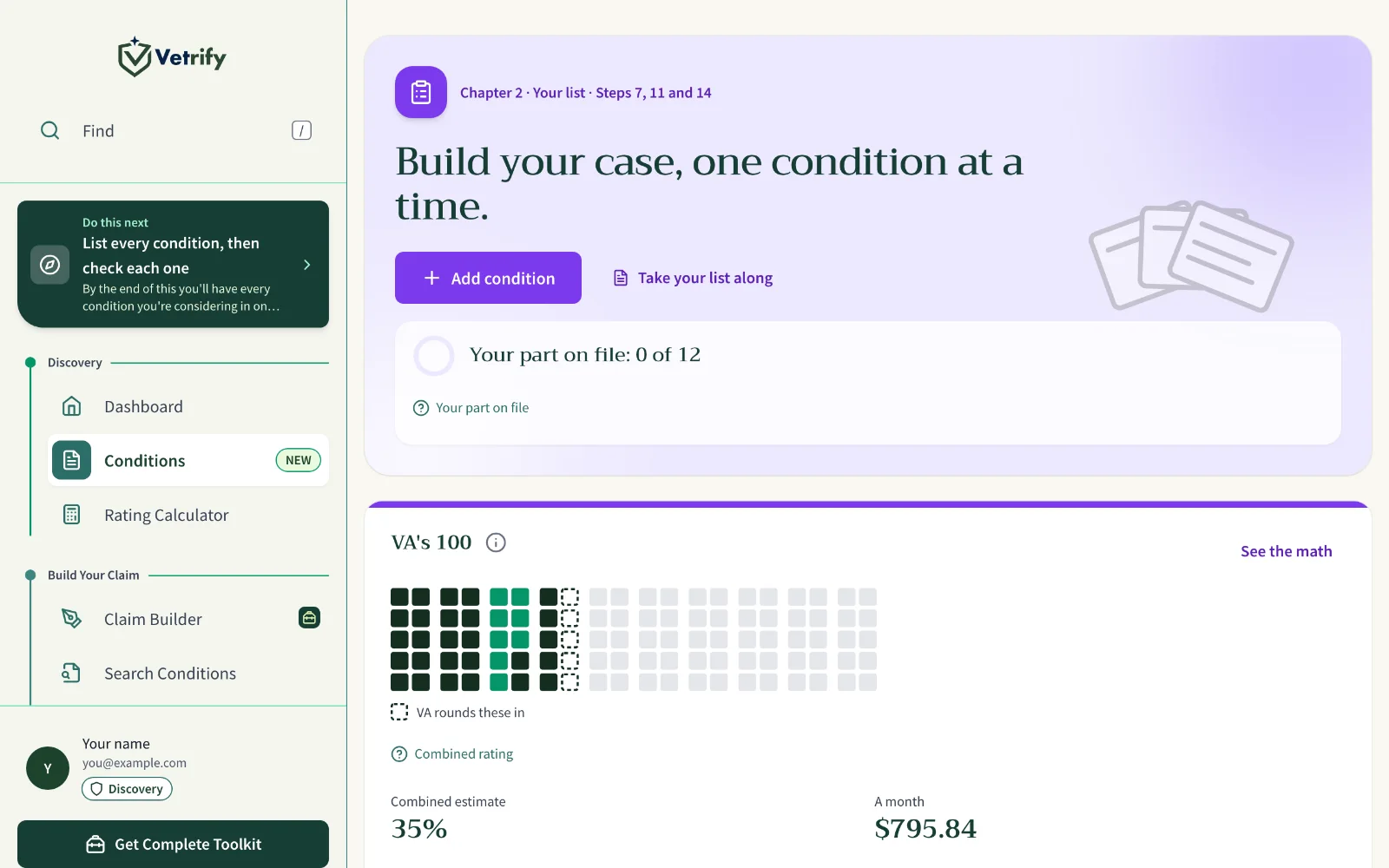
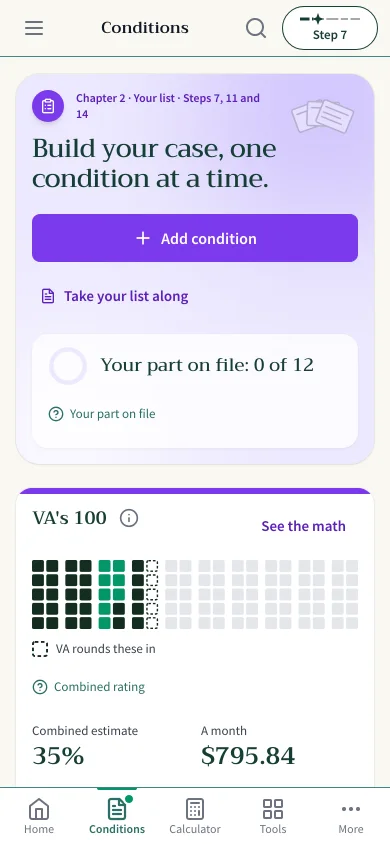
A free account keeps your conditions in one list and shows your combined rating as you add them. Have it ready when you ask the state about a benefit.
HOW TO READ THIS PAGE
Every row, in the source's own words.
Each benefit says what it is, who qualifies in the source's words, and where it comes from. Open a row to read the passage it quotes.
Find your kind of benefit
The benefits are grouped by kind. Start with the one you came for.
Read who qualifies
Each row quotes the source's own words on who qualifies.
Check with the state
Rules change. Ask the office named in the source before you count on a benefit.
Vetrify is not a state agency and not a law firm. This page points to each state's own words; the state decides who qualifies.
5 BENEFITS
Property tax
For tax year 2021 and later, a veteran with a service-connected disability of 100%, or an individual unemployability rating paid at the 100% disability rate, as certified by VA, gets a special reduction in the property taxes or occupancy taxes on the homestead: $1,500 or the veteran's actual taxes, whichever is less. It comes on top of any reduction under the income-limited Property Tax Reduction program, but the two together may not exceed the actual taxes on the homestead. Applicants follow the property tax relief chapter's procedures, except that no income documentation is needed. If a qualified veteran applies and then dies, the surviving spouse receives the reduction that year and later years until remarrying, dying or no longer having property tax levied on the homestead. A veteran with a 100% service-connected permanent and total disability who has applied and received it once keeps receiving it without applying each year, unless the veteran changes homesteads. A veteran granted the reduction before April 15 who moves to another qualifying homestead after April 15 and before October 1 can have it transferred by telling the State Tax Commission before October 1. The homestead is the owner-occupied home and up to one acre (its own row).
Who qualifies, in the source's wordsTied to a VA rating
“a veteran with a service-connected disability of one hundred percent (100%) or a disability rating based on individual unemployability rating that is compensated at the one hundred percent (100%) disability rate, as certified by the United States department of veterans affairs, shall receive a special reduction in property taxes or occupancy taxes levied on his homestead, as defined in section 63-701, Idaho Code.”
What the source says
“(1) For tax year 2021 and thereafter, regardless of any reduction received under section 63-705, Idaho Code, a veteran with a service-connected disability of one hundred percent (100%) or a disability rating based on individual unemployability rating that is compensated at the one hundred percent (100%) disability rate, as certified by the United States department of veterans affairs, shall receive a special reduction in property taxes or occupancy taxes levied on his homestead, as defined in section 63-701, Idaho Code. The special tax reduction shall be in the amount of one thousand five hundred dollars ($1,500) or for the amount of the veteran’s actual property taxes or occupancy taxes, as applicable, whichever is less. If a veteran qualifies for tax reduction under both this section and section 63-705, Idaho Code, the combined tax reduction amount may not exceed the actual amount of the veteran’s property taxes or occupancy taxes on his homestead. (2) An applicant for a special property tax or occupancy tax reduction under this section shall comply with all procedural requirements set forth in sections 63-701 through 63-710, Idaho Code, with the exception of any income documentation and the exception of the date limitations as set forth in subsection (5) of this section. (3) In the event that a qualified veteran applies for the special tax reduction in this section but then dies, the veteran’s surviving spouse is entitled to receive the special tax reduction in that year and subsequent years, until such time as the surviving spouse remarries, dies, or no longer has property tax levied on the homestead. (4) An applicant who is a veteran with a one hundred percent (100%) service-connected permanent and total disability, having once applied for and received the reduction under this section, shall be entitled to continue receiving the benefit in subsequent years without applying annually, unless the veteran changes homesteads pursuant to subsection (5) of this section. (5) If a qualified veteran has applied for the special tax reduction under this section but after April 15 changes his homestead to a different property that would otherwise qualify for the special tax reduction under this section, the special tax reduction benefit is available for transfer. The state tax commission must notify the appropriate county officials to transfer the special tax reduction benefit to the qualifying property when all of the following conditions are met: (a) The qualified veteran has applied for and been granted the tax reduction benefit before April 15; (b) After April 15 but before October 1, the qualified veteran has changed his homestead to a separate property that would otherwise qualify for the special tax reduction authorized under this section; and (c) The qualified veteran notifies the state tax commission before October 1 of the desire to transfer the tax reduction benefits to the qualifying property.”
Source: Idaho Code 63-705A, Special property tax or occupancy tax reduction for disabled veterans. Read .
How the State Tax Commission runs the disabled veterans property tax benefit for 2027. It has no income limit. You might qualify if you are an Idaho resident and homeowner; VA recognizes you, as of January 1, 2027, as a veteran with a 100% service-connected disability or pays you 100% compensation due to individual unemployability; you owned and lived in a home in Idaho as your primary residence before April 15, 2027; and the property has a current homeowner's exemption. The home can be a mobile home, and you could still qualify if you live in a care facility or nursing home in 2027 or lived in one in 2026 (ask your county assessor). Apply between January 1 and April 15, 2027, online or on the paper form to your county assessor, with a current VA letter confirming the rating or the individual unemployability compensation as of January 1, 2027; the reduction shows on the December 2027 tax bill. You apply every year unless your disability is permanent and total, in which case it renews automatically. It reduces the taxes on the home and up to one acre by as much as $1,500, not solid waste, irrigation or other fees. A surviving spouse can use the benefit once it was granted to the veteran, but it does not move to a new property after the veteran's death. The law (its own row) ends the surviving spouse's benefit when the surviving spouse remarries, dies or no longer has property tax levied on the homestead.
Who qualifies, in the source's wordsTied to a VA rating
“You might qualify for this program in 2027 if both of these apply: You’re recognized as a veteran with a 100% service-connected disability or receive 100% compensation due to individual unemployability by the U.S. Department of Veterans Affairs as of January 1, 2027. You owned and lived in a home in Idaho that was your primary residence before April 15, 2027. The property must have a current homeowner’s exemption.”
What the source says
“Property Tax Benefit for Disabled Veterans You might qualify for this program if you’re an Idaho resident, homeowner, and qualified veteran with a 100% service-connected disability. The program could reduce the property taxes on your home and up to one acre of land by as much as $1,500. Once granted to a qualifying veteran, a surviving spouse can use this benefit. However, the benefit isn’t transferable to a new property after the death of the veteran. Note: This program won’t reduce solid waste, irrigation, or other fees that government entities charge. Read more about the program: Property Tax Benefit for Veterans with a 100% Service-Connected Disability County assessors and the Tax Commission manage this program. If the guide above and this page don’t answer your questions, contact your county assessor’s office or call us at (208) 334-7736. Who qualifies The Disabled Veterans benefit doesn’t have an income limit. You might qualify for this program in 2027 if both of these apply: You’re recognized as a veteran with a 100% service-connected disability or receive 100% compensation due to individual unemployability by the U.S. Department of Veterans Affairs as of January 1, 2027. You owned and lived in a home in Idaho that was your primary residence before April 15, 2027. The property must have a current homeowner’s exemption. The home can be a mobile home. You could qualify if you live in a care facility or nursing home in 2027 or lived in one in 2026. Contact your county assessor’s office for information. 100% Service-Connected Disabled Veterans Property Tax Benefit, Application Applying You must apply and qualify for this program every year. You must apply between January 1 and April 15, 2027, for a reduction to 2027 property taxes. If your disability is permanent and total, you don’t need to reapply each year. The benefit will renew automatically. If your application’s approved, your benefit will appear on your December 2027 property tax bill. Before you begin: Get a current letter from the U.S. Department of Veterans Affairs confirming your 100% service-connected disability rating or your 100% compensation due to individual unemployability as of January 1, 2027. Apply online Contact your county assessor’s office or call us at (208) 334-7736 if you need help. Alternately, you can fill out and mail a paper form to your county assessor. Download it here: Disabled Veteran Property Tax Benefit Application”
Source: Idaho State Tax Commission, Property Tax Benefit for Disabled Veterans. Read .
For Idaho's property tax relief programs, including the disabled veteran reduction, the homestead is the dwelling the claimant owns and occupies as the primary dwelling place (household members may live there too) and as much of the land around it, not more than one acre, as is reasonably necessary to use it as a home. It can be part of a multi-dwelling or multipurpose building and the land under it, and a manufactured home can be a homestead; furniture, furnishings and appliances are not part of it.
Who qualifies, in the source's wordsOther rule
“"Homestead" means the dwelling, owner-occupied by the claimant as described in this chapter and used as the primary dwelling place of the claimant and may be occupied by any members of the household as their home, and so much of the land surrounding it, not exceeding one (1) acre, as is reasonably necessary for the use of the dwelling as a home.”
What the source says
“(2) "Homestead" means the dwelling, owner-occupied by the claimant as described in this chapter and used as the primary dwelling place of the claimant and may be occupied by any members of the household as their home, and so much of the land surrounding it, not exceeding one (1) acre, as is reasonably necessary for the use of the dwelling as a home. It may consist of a part of a multidwelling or multipurpose building and part of the land upon which it is built. "Homestead" does not include personal property such as furniture, furnishings or appliances, but a manufactured home may be a homestead.”
Source: Idaho Code 63-701, Definitions (subsection 2, "Homestead"). Read .
Idaho's income-limited Property Tax Reduction program (often called the circuit breaker) is open to a disabled veteran of any war engaged in by the United States whose service-connected disability is 10% or more, or who has a VA pension for nonservice-connected disabilities, among others; the claimant must have that status on January 1 of the year the claim is first filed on the homestead. On January 1 or before April 15 of the first year the claim is filed, the claimant must own the homestead, have applied for the homeowner's exemption, and have lawful presence in the United States, except as section 63-702(2) provides (who else may file a claim, and what happens after a claimant's death: its own row). When figuring the program's income, VA disability pensions are not counted for a claimant (or a claimant's spouse) whose service-connected disability is 40% or more, and VA dependency and indemnity compensation or death benefits from a service-connected death or disability are not counted. The income limit and the reduction amounts change every year; the State Tax Commission's Property Tax Reduction page gives them.
Who qualifies, in the source's wordsTied to a VA rating
“"Claimant" means a person who has filed an application under section 63-602G, Idaho Code, and has filed a claim under the provisions of sections 63-701 through 63-710, Idaho Code. Except as provided in section 63-702(2), Idaho Code, on January 1 or before April 15 of the year in which the claimant first filed a claim on the homestead in question, a claimant must be an owner of the homestead, a claimant must have lawful presence in the United States pursuant to section 67-7903, Idaho Code, and on January 1 of said year a claimant must be: (a) Not less than sixty-five (65) years old; or (b) A child under the age of eighteen (18) years who is fatherless or motherless or who has been abandoned by any surviving parent or parents; or (c) A widow or widower; or (d) A disabled person who is recognized as disabled by the social security administration pursuant to title 42 of the United States Code, or by the railroad retirement board pursuant to title 45 of the United States Code, or by the office of management and budget pursuant to title 5 of the United States Code, or, if a person is not within the purview of, and is therefore not recognized as disabled by, any other entity listed in this paragraph, then by the public employee retirement system or public employee disability plan in which the person participates that may be of any state, local unit of government or other jurisdiction in the United States of America; or (e) A disabled veteran of any war engaged in by the United States, whose disability is recognized as a service-connected disability of a degree of ten percent (10%) or more, or who has a pension for nonservice-connected disabilities, in accordance with laws and regulations administered by the United States department of veterans affairs”
What the source says
“(1) "Claimant" means a person who has filed an application under section 63-602G, Idaho Code, and has filed a claim under the provisions of sections 63-701 through 63-710, Idaho Code. Except as provided in section 63-702(2), Idaho Code, on January 1 or before April 15 of the year in which the claimant first filed a claim on the homestead in question, a claimant must be an owner of the homestead, a claimant must have lawful presence in the United States pursuant to section 67-7903, Idaho Code, and on January 1 of said year a claimant must be: (a) Not less than sixty-five (65) years old; or (b) A child under the age of eighteen (18) years who is fatherless or motherless or who has been abandoned by any surviving parent or parents; or (c) A widow or widower; or (d) A disabled person who is recognized as disabled by the social security administration pursuant to title 42 of the United States Code, or by the railroad retirement board pursuant to title 45 of the United States Code, or by the office of management and budget pursuant to title 5 of the United States Code, or, if a person is not within the purview of, and is therefore not recognized as disabled by, any other entity listed in this paragraph, then by the public employee retirement system or public employee disability plan in which the person participates that may be of any state, local unit of government or other jurisdiction in the United States of America; or (e) A disabled veteran of any war engaged in by the United States, whose disability is recognized as a service-connected disability of a degree of ten percent (10%) or more, or who has a pension for nonservice-connected disabilities, in accordance with laws and regulations administered by the United States department of veterans affairs; or (f) A person, as specified in 42 U.S.C. 1701, who was or is entitled to receive benefits because he is known to have been taken by a hostile force as a prisoner, hostage or otherwise; or (g) Blind. (2) "Homestead" means the dwelling, owner-occupied by the claimant as described in this chapter and used as the primary dwelling place of the claimant and may be occupied by any members of the household as their home, and so much of the land surrounding it, not exceeding one (1) acre, as is reasonably necessary for the use of the dwelling as a home. It may consist of a part of a multidwelling or multipurpose building and part of the land upon which it is built. "Homestead" does not include personal property such as furniture, furnishings or appliances, but a manufactured home may be a homestead. (3) "Household" means the claimant and the claimant’s spouse. The term does not include bona fide lessees, tenants, or roomers and boarders on contract. "Household" includes persons described in subsection (8)(b) of this section. (4) "Household income" means all income received by the claimant and, if married, all income received by the claimant’s spouse, in a calendar year. (5) "Income" means the sum of federal adjusted gross income as defined in the Internal Revenue Code, as defined in section 63-3004, Idaho Code, and to the extent not already included in federal adjusted gross income: (a) Alimony; (b) Support money; (c) Nontaxable strike benefits; (d) The nontaxable amount of any individual retirement account, pension or annuity, including railroad retirement benefits, all payments received under the federal social security act except the social security death benefit as specified in this subsection, state unemployment insurance laws, and veterans disability pensions and compensation, excluding any return of principal paid by the recipient of an annuity and excluding rollovers as provided in 26 U.S.C. 402 or 403, and excluding the nontaxable portion of a Roth individual retirement account distribution, as provided in 26 U.S.C. 408A; (e) Nontaxable interest received from the federal government or any of its instrumentalities or a state government or any of its instrumentalities; (f) Worker’s compensation; and (g) The gross amount of loss of earnings insurance. It does not include gifts from nongovernmental sources or inheritances. To the extent not reimbursed, the cost of medical care as defined in section 213(d) of the Internal Revenue Code, incurred and paid by the claimant and, if married, the claimant’s spouse, may be deducted from income. To the extent not reimbursed, personal funeral expenses, including prepaid funeral expenses and premiums on funeral insurance, of the claimant and claimant’s spouse only, may be deducted from income up to an annual maximum of five thousand dollars ($5,000) per claim. "Income" does not include veterans disability pensions received by a person described in subsection (1)(e) of this section who is a claimant or a claimant’s spouse if the disability pension is received pursuant to a service-connected disability of a degree of forty percent (40%) or more. "Income" does not include dependency and indemnity compensation or death benefits paid to a person described in subsection (1) of this section by the United States department of veterans affairs and arising from a service-connected death or disability.”
Source: Idaho Code 63-701, Definitions (subsections 1 to 5, "Claimant" to "Income"). Read .
The right to file a Property Tax Reduction claim is personal to the claimant and does not survive the claimant's death, except in these cases. For a living claimant, the claim may be filed by an agent authorized in writing, by a guardian or other representative acting under a court's authority, or by any person or entity described in section 63-711(3). If a claimant dies after filing a timely claim, the amount goes to the personal representative (if one is appointed), the surviving heirs, or the trust or other entity owning the property, as appropriate. Where an estate, revocable trust, irrevocable trust, limited partnership, limited liability company or corporation owns the property, and the deceased person's widow or widower succeeds to the deceased person's interest in it and lives in the home as the chapter requires, the widow or widower (or a person or entity described in section 63-711(3) acting for them) may file a claim for the deceased spouse if the deceased spouse qualified or would have qualified as a claimant in the year of the claim; or the widow or widower is treated as the owner in any year after the year of the death. These are the exceptions the program's claimant rule (its own row) points to.
Who qualifies, in the source's wordsOther rule
“(2) The right to file a claim under the provisions of sections 63-701 through 63-710, Idaho Code, shall be personal to the claimant and shall not survive his death except: (a) Such right may be exercised on behalf of a living claimant by an agent authorized in writing to so act, by a guardian or other representative acting pursuant to judicial authority or by any person or entity described in section 63-711(3), Idaho Code. If a claimant dies after having filed a timely claim, the amount thereof shall be allowed to his personal representative, if one is appointed, or to surviving heirs or to the trust or other entity owning the property, as appropriate; and (b) In the case of property owned by an estate, revocable trust, irrevocable trust, limited partnership, limited liability company or corporation, where the deceased person’s widow or widower succeeds to the interest of the deceased person in that entity and occupies the dwelling as required in this chapter, the deceased owner’s widow or widower, or any person or entity described in section 63-711(3), Idaho Code, on behalf of that widow or widower: (i) May file a claim on behalf of the deceased spouse if the deceased spouse qualified or would have qualified as a claimant under subsection (1) of this section in the year in which the claim is filed; or (ii) The widow or widower shall be deemed the owner of the property in any year after the year of the death of the spouse.”
What the source says
“(2) The right to file a claim under the provisions of sections 63-701 through 63-710, Idaho Code, shall be personal to the claimant and shall not survive his death except: (a) Such right may be exercised on behalf of a living claimant by an agent authorized in writing to so act, by a guardian or other representative acting pursuant to judicial authority or by any person or entity described in section 63-711(3), Idaho Code. If a claimant dies after having filed a timely claim, the amount thereof shall be allowed to his personal representative, if one is appointed, or to surviving heirs or to the trust or other entity owning the property, as appropriate; and (b) In the case of property owned by an estate, revocable trust, irrevocable trust, limited partnership, limited liability company or corporation, where the deceased person’s widow or widower succeeds to the interest of the deceased person in that entity and occupies the dwelling as required in this chapter, the deceased owner’s widow or widower, or any person or entity described in section 63-711(3), Idaho Code, on behalf of that widow or widower: (i) May file a claim on behalf of the deceased spouse if the deceased spouse qualified or would have qualified as a claimant under subsection (1) of this section in the year in which the claim is filed; or (ii) The widow or widower shall be deemed the owner of the property in any year after the year of the death of the spouse.”
Source: Idaho Code 63-702, Reduction in property taxes or occupancy taxes; claim is personal; exceptions (subsection 2). Read .
4 BENEFITS
Vehicles and license plates
No registration fee is charged for one motor vehicle at a time owned by a veteran who, at the time of registration or reregistration, receives compensation from VA (or, in lieu of it, from any of the armed forces) for a 100% service-connected disability or for any of these: loss or permanent loss of use of one or both feet or one or both hands, or loss of sight in both eyes or permanent impairment of vision in both eyes amounting to virtual blindness. The same goes for a vehicle owned by a veteran who has established rights to benefits under Public Law 662 of the 79th Congress and Public Law 187 of the 82nd Congress (each as amended). It does not apply to a vehicle registered at over 26,000 pounds maximum gross weight or registered under the law's fleet registration option (section 49-434(5)). The Transportation Department issues special plates marked "D.V." (not the counties), with a special placard; the vehicle gets the same privileges as section 49-410(7) gives a vehicle with disability plates. The Transportation Department's Disabled Veteran plate application is narrower than the law: it asks for a 100% rating letter and says applicants must be veterans with a 100% service-connected permanent disability, while the law also covers the specific losses of feet, hands or sight above and the veterans with rights under the two public laws, and does not require the 100% disability to be permanent. Confirm with its Special Plates office.
Who qualifies, in the source's wordsTied to a VA rating
“a veteran, who is at the time of the registration or reregistration receiving compensation from the veterans administration or in lieu thereof, from any of the armed forces of the United States, for one hundred percent (100%) service-connected disability or for any of the following specific disabilities: Loss or permanent loss of use of one (1) or both feet; loss or permanent loss of use of one (1) or both hands; loss of sight in both eyes or permanent impairment of vision in both eyes to the degree as to constitute virtual blindness.”
What the source says
“No fee shall be charged for the registration or reregistration of a motor vehicle owned by a veteran who has established his rights to benefits under the provisions of Public Law 662, 79th Congress, as amended, and Public Law 187, 82nd Congress, as amended. The provisions of this section shall not apply to any vehicle with a registered maximum gross weight over twenty-six thousand (26,000) pounds, nor to any vehicle registered under section 49-434(5), Idaho Code. No fee shall be charged for the registration or reregistration of a motor vehicle owned by a veteran, who is at the time of the registration or reregistration receiving compensation from the veterans administration or in lieu thereof, from any of the armed forces of the United States, for one hundred percent (100%) service-connected disability or for any of the following specific disabilities: Loss or permanent loss of use of one (1) or both feet; loss or permanent loss of use of one (1) or both hands; loss of sight in both eyes or permanent impairment of vision in both eyes to the degree as to constitute virtual blindness. These provisions shall be considered applicable not only as to the vehicle originally purchased under this authorization, but also as to any vehicle subsequently purchased and owned by the same veteran, so long as the privilege shall not extend to more than one (1) vehicle at a time. Special license plates shall be issued for such a vehicle, identified by the inscription "D.V.", and a separate number series shall be used to further identify the license plates so issued. These license plates shall not be issued by the counties but shall be issued by the department. The plates shall be displayed in accordance with the procedure applicable to license plates set forth in section 49-428, Idaho Code. A vehicle displaying plates issued in accordance with the provisions of this section shall be afforded the same privileges specified in section 49-410(7), Idaho Code. Together with a license plate issued pursuant to this section the department shall issue a special placard pursuant to section 49-410(4), Idaho Code.”
Source: Idaho Code 49-403, Disabled veteran: license plates. Read .
Purple Heart recipient license plates for a veteran or an active or retired member of the armed forces, reserve forces or Idaho National Guard who shows proof of the Purple Heart: a DD214 or equivalent showing the award, the certificate presented with the medal, or the military order awarding it. You pay the regular registration fee but not the plate fee, and you may register more than one vehicle this way (not a vehicle registered at over 26,000 pounds maximum gross weight, or under the fleet registration option). A Purple Heart recipient who also qualifies for the disabled veteran fee exemption may choose a Purple Heart plate or a disabled veteran plate and pays no plate fee and no registration fee, for one vehicle at a time. A surviving spouse may keep and display the plates, and may reapply for them if the recipient died on or after January 1 of the five years before the reapplication. Plates with the accessible symbol (for a recipient who also qualifies as disabled) do not pass to a surviving spouse unless the spouse meets the disability rules.
Who qualifies, in the source's wordsOther rule
“Purple heart recipient license plates are available to any applicant who is a veteran or an active or retired member of any of the armed forces of the United States, reserve forces, or Idaho national guard and who furnishes proof of entitlement by providing one (1) of the following documents: (a) A copy of form DD214 or equivalent document showing an award of the purple heart medal; (b) A copy of the certificate presented with the medal; or (c) A copy of the military order describing the award of the medal to the applicant.”
What the source says
“(1) Purple heart recipient license plates are available to any applicant who is a veteran or an active or retired member of any of the armed forces of the United States, reserve forces, or Idaho national guard and who furnishes proof of entitlement by providing one (1) of the following documents: (a) A copy of form DD214 or equivalent document showing an award of the purple heart medal; (b) A copy of the certificate presented with the medal; or (c) A copy of the military order describing the award of the medal to the applicant. (2) The applicant shall be charged the regular registration fee but shall not be charged the plate fee required in section 49-450, Idaho Code. Whenever title or interest in a vehicle registered under the provisions of this section is transferred or assigned, the registration shall expire, but the purple heart recipient may transfer his plates to another vehicle upon payment of the required transfer fees. He may display the plates only after receipt of new registration from the department. A purple heart recipient may register multiple vehicles under the provisions of this section. The provisions of this section shall not apply to any vehicle with a registered maximum gross weight over twenty-six thousand (26,000) pounds, nor to any vehicle registered under section 49-434(5), Idaho Code. (3) Purple heart recipient license plates may be retained and displayed on vehicles owned by the surviving spouse of a deceased purple heart recipient. In addition, the surviving spouse of a deceased purple heart recipient is eligible to reapply for and shall be issued purple heart recipient license plates if the deceased purple heart recipient died on or after January 1 of the five (5) years preceding the date of reapplication for the plates. Such plates shall be used on a vehicle owned by the surviving spouse. (4) The purple heart recipient license plates shall be of a color and design acceptable to the military order of the purple heart association and approved by the department, utilizing a numbering system as determined by the department. (5) Effective January 1, 2015, for those purple heart recipients who are listed as an owner of the vehicle who also qualify as disabled pursuant to section 49-410, Idaho Code, the international accessible symbol will also appear on the purple heart license plates. Such requirements must be met upon application for the license plates. Those plates with the disability symbol shall be nontransferable to a surviving spouse, unless the requirements of section 49-410, Idaho Code, can be met by the spouse. (6) A purple heart recipient who qualifies for a disabled veteran fee exemption under section 49-403, Idaho Code, shall have a choice between a purple heart recipient license plate or a disabled veteran license plate and shall not be charged a plate fee or a fee for registration or reregistration of the motor vehicle. The provisions of this subsection shall apply to the vehicle originally purchased under this authorization and also to any vehicle subsequently purchased and owned by the same veteran. The privilege shall not extend to more than one (1) vehicle owned by the veteran at a time.”
Source: Idaho Code 49-403A, Purple heart recipient: license plates. Read .
Veterans license plates, in place of regular plates and upon the Transportation Department's approval, for the owner of a vehicle registered under section 49-402 or 49-434(1) of the Idaho Code (not a vehicle registered at over 26,000 pounds maximum gross weight), with proof of being a current or former member of the U.S. armed forces: a copy of a DD214 or an equivalent document or statement from VA. You pay the regular registration fees plus a $25.00 initial program fee, a $15.00 annual program fee and the plate fee; part of the program fees goes to the state veterans cemetery fund. The plate shows the branch of service and the word "VETERAN", a recognized conflict or war period, or the post 9/11 theater for service in Afghanistan or Iraq. A surviving spouse may keep and display the plates on vehicles the surviving spouse owns, and the surviving spouse of a qualified veteran may apply for, renew and display them, whether or not the veteran lived in Idaho or had the plates, for so long as the surviving spouse is within the federal definition of a surviving spouse in 38 U.S.C. 101(3) (that definition generally leaves out a spouse who has remarried); such plates must be used on a vehicle the surviving spouse owns.
Who qualifies, in the source's wordsOther rule
“Proof of being a current or former member of the United States armed forces must be furnished to the department before special veterans plates will be issued. Acceptable proof shall be a copy of form DD214 or an equivalent document or statement from the department of veterans affairs.”
What the source says
“(1) Any person who is the owner of a vehicle registered under the provisions of section 49-402 or 49-434(1), Idaho Code, may apply for and upon department approval receive special veterans license plates in lieu of regular license plates. The provisions of this section shall not apply to any vehicle with a registered maximum gross weight over twenty-six thousand (26,000) pounds. Availability of veterans plates for other vehicles shall be subject to the rules, policies and procedures of the department. (2) Proof of being a current or former member of the United States armed forces must be furnished to the department before special veterans plates will be issued. Acceptable proof shall be a copy of form DD214 or an equivalent document or statement from the department of veterans affairs. (3) In addition to the regular registration fees required in section 49-402(1) or 49-434(1), Idaho Code, the applicant shall pay the initial program fee of twenty-five dollars ($25.00) and the annual program fee of fifteen dollars ($15.00) as specified in section 49-402, Idaho Code, and the plate fee specified in section 49-450, Idaho Code. Ten dollars ($10.00) of the initial program fee and ten dollars ($10.00) of the annual program fee shall be deposited in the state highway account and shall be used to fund the cost of administration of this special license plate program. Fifteen dollars ($15.00) of the initial program fee and five dollars ($5.00) of the annual program fee shall be deposited to the veterans cemetery maintenance fund created in section 65-107, Idaho Code, and shall be used to operate and maintain a state veterans cemetery. (4) Whenever title or interest in a vehicle registered under the provisions of this section is transferred or assigned, the owner may transfer the special plates to another vehicle upon payment of the required transfer fees. The owner may only display the plates on another vehicle upon receipt of the new registration from the department. (5) The veterans license plate design shall include the colors red, white and blue, shall designate one (1) of the five (5) branches of military service, and display either: (a) The word "VETERAN"; (b) The name of a conflict or war period recognized by the United States department of veterans affairs for the purpose of awarding federal veterans benefits as defined in 38 U.S.C. 101(11); or (c) For a current or former member of the United States armed forces who has served in Afghanistan or Iraq during the post 9/11 global operations period, as defined in 38 U.S.C. 4110A(c), the name of the post 9/11 global operations theater. The license plate design shall comply with all applicable rules of the department and shall include a separate and distinct numbering system. The design, color, and numbering system shall be subject to approval of the department. (6) Veterans license plates may be retained and displayed on vehicles owned by the surviving spouse of a qualified veteran. In addition, provided that the deceased veteran met the criteria set forth above in this section, surviving spouses of qualified veterans shall be authorized to apply for and receive veterans plates and may retain, renew and display veterans plates for so long as the surviving spouse is within the definition set forth in 38 U.S.C. 101(3). There shall be no requirement that the veteran, while living, resided in Idaho or had applied for or received veterans plates. Such plates shall be used on a vehicle owned by the surviving spouse.”
Source: Idaho Code 49-418, Veterans plates. Read .
Congressional Medal of Honor license plates, for a recipient who proves entitlement with certification from VA of their status as a Congressional Medal of Honor recipient. The plates are provided free of charge, but the regular annual registration fees still apply. Not for a vehicle registered at over 26,000 pounds maximum gross weight. The privilege covers no more than two vehicles at a time; the plates can move to another vehicle the recipient owns (the transfer fee applies, with credit for any unexpired registration). A surviving spouse may keep and display the plates on vehicles the surviving spouse owns, and may reapply for them if the recipient died on or after January 1 of the five years before the reapplication; such plates must be used on a vehicle the surviving spouse owns.
Who qualifies, in the source's wordsOther rule
“(1) Congressional medal of honor license plates are available to applicants who furnish proof of entitlement by certification from the United States Veterans Administration attesting to their status as a congressional medal of honor recipient.”
What the source says
“(1) Congressional medal of honor license plates are available to applicants who furnish proof of entitlement by certification from the United States Veterans Administration attesting to their status as a congressional medal of honor recipient. (2) The license plates shall be provided free of charge. The applicant shall pay the regular annual registration fees required by section 49-402 or 49-434(1), Idaho Code. The provisions of this section shall not apply to any vehicle with a registered maximum gross weight over twenty-six thousand (26,000) pounds. If the plate holder transfers his title or interest to a vehicle registered under this section, the plates may be transferred to another vehicle owned by the plate holder. If the plates are unexpired, the plate holder shall be given credit for the unexpired portion of the registration fee against the new registration fee. The transfer fee specified by section 49-431(1), Idaho Code, shall apply. (3) These provisions shall apply to the vehicle to which the plates were originally issued and to any vehicle subsequently purchased and owned by the medal of honor recipient, except that the privilege shall not extend to more than two (2) vehicles at a time. (4) Congressional medal of honor license plates may be retained and displayed on vehicles owned by the surviving spouse of a deceased congressional medal of honor recipient. In addition, the surviving spouse of a deceased congressional medal of honor recipient is eligible to reapply for and shall be issued congressional medal of honor license plates if the deceased congressional medal of honor recipient died on or after January 1 of the five (5) years preceding the date of reapplication for the plates. Such plates shall be used on a vehicle owned by the surviving spouse.”
Source: Idaho Code 49-415A, Congressional medal of honor license plates. Read .
2 BENEFITS
Education and tuition
The Armed Forces and Public Safety Officer Scholarship: undergraduate study at any Idaho public college, university or public career technical college without paying tuition and fees, plus books, equipment and supplies up to $750 per term, and on-campus housing and subsistence for each month enrolled full time and living on campus, for up to 36 months (four nine-month periods). It is for the spouse or child of an Idaho resident who entered active service as an Idaho resident (as the DD 214 shows) and who, while an Idaho resident, was found by the federal government to be a prisoner of war or missing in action, or died of, or is found unemployable due to, injuries or wounds sustained during active duty or inactive duty training; and for the spouse or child of a member of the U.S. armed forces stationed in Idaho on military orders who either was deployed from Idaho to an area of armed conflict in which the United States is a party and has been found by the federal government to be a prisoner of war or missing in action, or has died of or is unemployable due to injuries or wounds sustained in action as a result of that deployment; or dies of, or is unemployable due to, injuries or wounds sustained during active duty or inactive duty training. For a member stationed in Idaho, prisoner of war or missing in action status counts only with such a deployment. Unemployable means that, at the time of application, VA has made a determination of individual unemployability, or Social Security has made or recognized a determination of total and permanent disability based on injuries or wounds sustained during active duty or inactive duty training. A child must be an Idaho resident and have finished high school or its equivalent in Idaho. A spouse must be an Idaho resident and have been married to the service member at the time of the death, capture or disability (and, for a disability, still be married). The benefit must start within 19 years after high school or 10 years after the event, whichever is longer. Apply to the State Board of Education (or the State Board for Career Technical Education), which verifies eligibility; the school's usual admission standards apply.
Who qualifies, in the source's wordsOther rule
“(i) Any spouse or child of any Idaho resident who entered active service as an Idaho resident as indicated on a DD form 214 certificate of release or discharge from active duty and, while such service member is, or was if deceased, a resident of the state of Idaho: 1. Has been determined by the federal government to be a prisoner of war or missing in action; or 2. Died of, or is determined to be unemployable due to, injuries or wounds sustained during active duty or inactive duty training; (ii) Any spouse or child of any member of the United States armed forces who is stationed in the state of Idaho on military orders and who: 1. Is deployed from the state of Idaho to any area of armed conflict in which the United States is a party and who has been determined by the federal government to be a prisoner of war or missing in action or has died of or is determined to be unemployable due to injuries or wounds sustained in action as a result of such deployment; or 2. Dies of, or is determined to be unemployable due to, injuries or wounds sustained during active duty or inactive duty training; and (iii) Any spouse or child of a full-time or part-time public safety officer, as defined in paragraph (b) of this subsection, employed by or volunteering for the state of Idaho or for a political subdivision of the state of Idaho, which public safety officer is or was a resident of the state of Idaho at the time such officer was killed or totally and permanently disabled in the line of duty. The scholarship provided for in this section shall not be available unless it is determined that: 1. The death or disablement of the public safety officer occurred in the performance of the officer’s duties; 2. The death or disablement was not caused by the intentional misconduct of the public safety officer or by such officer’s intentional infliction of injury; and 3. The public safety officer was not voluntarily intoxicated at the time of death. (b) As used in this section: (i) "Active duty" means state active duty as defined in section 46-409, Idaho Code, or full-time duty with any of the United States armed forces. (ii) "Inactive duty training" means training or maintenance activities prescribed, required, or authorized for military members that do not constitute active duty. (iii) "Military member" means a member of the United States armed forces. (iv) "Public safety officer" means a peace officer, a firefighter, or a paramedic, emergency medical responder, emergency medical technician, or advanced emergency medical technician as defined in section 46-903, Idaho Code. (v) "United States armed forces" means the air force, army, coast guard, marine corps, navy, or space force, or the reserve component of any such service. (vi) "Volunteering" means contributing services as a bona fide member of a legally organized law enforcement agency, fire department, or licensed emergency medical service provider organization. (2)(a) To be eligible for the scholarship provided for in this section, a child of a military member or a public safety officer must be a resident of the state of Idaho and must have completed secondary school or its equivalent in the state of Idaho. A child already born, or born after a military member or public safety officer is determined to be imprisoned or missing in action, or dies or becomes totally and permanently disabled, shall be eligible for this scholarship. (b) To be eligible for the scholarship provided for in this section, the spouse of a military member or public safety officer must be a resident of the state of Idaho and must have been married to such person at the time the military member or public safety officer was determined to be imprisoned or missing in action or died or became totally and permanently disabled. However, in the situation of disability, the spouse must be currently married to such person.”
What the source says
“(1)(a) The following individuals shall be eligible for the scholarship program provided for in this section: (i) Any spouse or child of any Idaho resident who entered active service as an Idaho resident as indicated on a DD form 214 certificate of release or discharge from active duty and, while such service member is, or was if deceased, a resident of the state of Idaho: 1. Has been determined by the federal government to be a prisoner of war or missing in action; or 2. Died of, or is determined to be unemployable due to, injuries or wounds sustained during active duty or inactive duty training; (ii) Any spouse or child of any member of the United States armed forces who is stationed in the state of Idaho on military orders and who: 1. Is deployed from the state of Idaho to any area of armed conflict in which the United States is a party and who has been determined by the federal government to be a prisoner of war or missing in action or has died of or is determined to be unemployable due to injuries or wounds sustained in action as a result of such deployment; or 2. Dies of, or is determined to be unemployable due to, injuries or wounds sustained during active duty or inactive duty training; and (iii) Any spouse or child of a full-time or part-time public safety officer, as defined in paragraph (b) of this subsection, employed by or volunteering for the state of Idaho or for a political subdivision of the state of Idaho, which public safety officer is or was a resident of the state of Idaho at the time such officer was killed or totally and permanently disabled in the line of duty. The scholarship provided for in this section shall not be available unless it is determined that: 1. The death or disablement of the public safety officer occurred in the performance of the officer’s duties; 2. The death or disablement was not caused by the intentional misconduct of the public safety officer or by such officer’s intentional infliction of injury; and 3. The public safety officer was not voluntarily intoxicated at the time of death. (b) As used in this section: (i) "Active duty" means state active duty as defined in section 46-409, Idaho Code, or full-time duty with any of the United States armed forces. (ii) "Inactive duty training" means training or maintenance activities prescribed, required, or authorized for military members that do not constitute active duty. (iii) "Military member" means a member of the United States armed forces. (iv) "Public safety officer" means a peace officer, a firefighter, or a paramedic, emergency medical responder, emergency medical technician, or advanced emergency medical technician as defined in section 46-903, Idaho Code. (v) "United States armed forces" means the air force, army, coast guard, marine corps, navy, or space force, or the reserve component of any such service. (vi) "Volunteering" means contributing services as a bona fide member of a legally organized law enforcement agency, fire department, or licensed emergency medical service provider organization. (2)(a) To be eligible for the scholarship provided for in this section, a child of a military member or a public safety officer must be a resident of the state of Idaho and must have completed secondary school or its equivalent in the state of Idaho. A child already born, or born after a military member or public safety officer is determined to be imprisoned or missing in action, or dies or becomes totally and permanently disabled, shall be eligible for this scholarship. (b) To be eligible for the scholarship provided for in this section, the spouse of a military member or public safety officer must be a resident of the state of Idaho and must have been married to such person at the time the military member or public safety officer was determined to be imprisoned or missing in action or died or became totally and permanently disabled. However, in the situation of disability, the spouse must be currently married to such person. (3) An eligible individual who applies for the scholarship provided for in this section shall, after verification of eligibility, receive the scholarship and be admitted to attend undergraduate studies at any public institution of higher education or public career technical college within the state of Idaho without the necessity of paying tuition and fees therefor; such student shall be provided with books, equipment, and supplies necessary for pursuit of such program of enrollment not to exceed seven hundred fifty dollars ($750) per quarter, semester, intensified semester, or like educational period; and such student shall be furnished on-campus institution housing and subsistence for each month he or she is enrolled full-time under this program and actually resides in such on-campus facility. However, such undergraduate educational benefits shall not exceed a total of thirty-six (36) months or four (4) nine (9) month periods. Effective July 1, 2022, the initiation of such educational benefits shall extend for a period of nineteen (19) years after achieving a high school diploma or its equivalency or for a period of ten (10) years after the event giving rise to the eligibility for the scholarship, whichever is longer. (4) The eligible individual shall meet such other educational qualifications as such institution of higher education or career technical college has established for other prospective students of this state, as well as any additional educational qualifications established by the state board of education and board of regents of the university of Idaho. (5) Application for eligibility under this section shall be made to the state board of education and the board of regents of the university of Idaho or the state board for career technical education. The board shall verify the eligibility of the applicant and communicate such eligibility to such person and the affected institution or college. (6) Affected institutions shall in their preparation of future budgets include costs resultant from such tuition, fee, book, equipment, supply, housing and subsistence loss for reimbursement from appropriations of state funds. (7) For purposes of this section, a member of the United States armed forces is considered unemployable if at the time of application: (a) The United States department of veterans affairs has made a determination of individual unemployability; or (b) The United States social security administration has made or recognized a determination of total and permanent disability, and the determination is based on injuries or wounds sustained during active duty or inactive duty training.”
Source: Idaho Code 33-4302, Armed forces and public safety officer scholarships (subsections 1 to 7). Read .
At Idaho's public colleges and universities, a resident student (paying resident tuition) includes a person separated under honorable conditions from the U.S. armed forces after at least two years of service who, at separation, designates Idaho as the intended domicile or has Idaho as the home of record in service, and enters a college or university in Idaho within one year of separation, or who moves to Idaho to establish domicile. To keep resident status, the person must actively establish domicile in Idaho within one year of enrolling at an Idaho public institution of higher education.
Who qualifies, in the source's wordsOther rule
“(h) A person separated, under honorable conditions, from the United States armed forces after at least two (2) years of service, who at the time of separation designates the state of Idaho as his intended domicile or who has Idaho as the home of record in service and enters a college or university in the state of Idaho within one (1) year of the date of separation, or who moves to Idaho for the purpose of establishing domicile; provided however, to maintain status as a resident student, such person must actively establish domicile in Idaho within one (1) year of matriculation in a public institution of higher education in Idaho.”
What the source says
“(1) For any Idaho public institution of higher education, a "resident student" is: (a) Any student who has one (1) or more parent or parents or court-appointed guardians who are domiciled in the state of Idaho, and the parent, parents or guardians provide at least fifty percent (50%) of the student’s support. Domicile, as used in this section, means that individual’s true, fixed and permanent home and place of habitation. It is the place where that individual intends to remain, and to which that individual expects to return when that individual leaves without intending to establish a new domicile elsewhere. To qualify under this section, the parent, parents or guardians must have maintained a domicile in the state of Idaho for at least twelve (12) months prior to the opening day of the term for which the student matriculates. (b) Any student who receives less than fifty percent (50%) of the student’s support from a parent, parents or legal guardians and who has continuously resided and maintained a bona fide domicile in the state of Idaho primarily for purposes other than educational for twelve (12) months preceding the opening day of the term for which the student matriculates. (c) Any student who is a graduate of an accredited secondary school in the state of Idaho pursuant to section 33-119, Idaho Code, is domiciled in Idaho, and matriculates at an Idaho public institution of higher education within eight (8) years immediately following secondary school graduation regardless of the domicile of the student’s parent or guardian, or any student who completes six (6) years of elementary and secondary education in Idaho, is domiciled in Idaho, and matriculates at an Idaho public institution of higher education within eight (8) years immediately following completion of secondary education. (d) The spouse of a person who is classified, or is eligible for classification, as a resident of the state of Idaho for the purposes of attending an Idaho public institution of higher education, except that a student who was enrolled as a full-time student in any term during the twelve (12) month period before the term in which the student proposes to enroll as a resident student must independently establish domicile under subsection (2) of this section. (e) A member of the armed forces of the United States who entered service as an Idaho resident and who has maintained Idaho resident status, but is not stationed within the state of Idaho on military orders. (f) A member of the armed forces of the United States, stationed in the state of Idaho on military orders. (g) An officer or an enlisted member of the Idaho national guard. (h) A person separated, under honorable conditions, from the United States armed forces after at least two (2) years of service, who at the time of separation designates the state of Idaho as his intended domicile or who has Idaho as the home of record in service and enters a college or university in the state of Idaho within one (1) year of the date of separation, or who moves to Idaho for the purpose of establishing domicile; provided however, to maintain status as a resident student, such person must actively establish domicile in Idaho within one (1) year of matriculation in a public institution of higher education in Idaho.”
Source: Idaho Code 33-3717B, Residency requirements (subsection 1, paragraphs a to h). Read .
4 BENEFITS
Other state benefits
Reduced fees on Idaho hunting and fishing licenses and tags for disabled veterans with a service-connected disability rating of 40% or greater, shown by a copy of the VA disability percentage rating letter (the one-page Benefits Summary letter; any date before you apply). For residents (see the residency row), the resident DAV license is $5 and lets you buy reduced-fee DAV tags for deer $10.75, elk $16.50, bear $6.75 or turkey $10.75, with archery or muzzleloader permits $3.75 each. Nonresident disabled veterans can buy the nonresident DAV hunting with 3-day fishing license at $31.75 and reduced-fee nonresident tags for deer $23.75, elk $39.75, bear $23.75 or turkey $19.75 (archery or muzzleloader permits $5.75 each); the nonresident DAV-priced tags are limited to 500 deer and 300 elk tags. In the same nonresident section the page says DAV deer tags are valid statewide and DAV elk tags are only valid in the selected zone. The resident license needs the letter only the first time. Idaho Fish and Game may change these fees; check its page before you buy.
Who qualifies, in the source's wordsTied to a VA rating
“To receive DAV reduced fees, veterans must provide a copy of their official VA Disability Percentage Rating letter, and the letter must verify a service-connected disability rating of 40% or greater.”
What the source says
“Resident Disabled Veterans - Reduced Fees Resident disabled American veterans (DAV) may be eligible for DAV reduced fees for licenses and tags. The resident DAV license, $5, allows the disabled veteran to purchase reduced fee DAV tags for deer $10.75, elk $16.50, bear $6.75, or turkey $10.75. Permits for archery or muzzleloader are $3.75 each. See below for what documentation is required for eligibility. Nonresident Disabled Veterans - Reduced Fees Nonresident disabled American veterans (DAV) may be eligible for reduced fees for licenses and tags. The nonresident DAV hunting with 3-day fishing license, $31.75, allows the nonresident disabled veteran to purchase reduced fee nonresident DAV tags for deer $23.75, elk $39.75, bear $23.75, or turkey $19.75. Permits for archery or muzzleloader are $5.75 each. See below for what documentation is required for eligibility. Nonresident DAV priced tags are limited to 500 deer tags, and 300 elk tags. DAV deer tags are valid statewide, and DAV elk tags are only valid in the selected zone. Once those 800 tags have been sold, DAV license holders can purchase available general nonresident tags at the nonresident fee. Required Documentation for DAV Reduced Fees To receive DAV reduced fees, veterans must provide a copy of their official VA Disability Percentage Rating letter, and the letter must verify a service-connected disability rating of 40% or greater. The letter is also called a "Benefits Summary Percentage Letter," and typically is one page. The letter may bear any date prior to license application. Documentation for the resident DAV license will be required only for the initial application and will not be required for subsequent applications.”
Source: Idaho Fish and Game, Disabled Veterans Programs. Read .
For Idaho hunting and fishing licenses, a resident has been domiciled in Idaho, intending to make it the permanent home, for at least six months immediately before applying for the license, tag or permit, keeps that residency with intent to return when temporarily away, and claims no resident privileges in any other state or country for any purpose (such as a driver's license, voter registration, resident income tax return or homeowner's exemption there). Owning property or paying property taxes in Idaho does not make you a resident. Idaho residents in the U.S. military who keep Idaho as their official state of residence on their leave and earnings statement, with their spouse and children under 18 living in the household, may buy resident licenses, and so may service members (and their families) transferred, stationed, domiciled and on active duty in Idaho for the 30 days before applying, while the assignment lasts.
Who qualifies, in the source's wordsOther rule
“"Resident" means any person who has been domiciled in this state, with a bona fide intent to make this his place of permanent abode, for a period of not less than six (6) months immediately preceding the date of application for any license, tag, or permit required under the provisions of this title or orders of the commission and who, when temporarily absent from this state, continues residency with intent to return, and who does not claim any resident privileges in any other state or country for any purpose.”
What the source says
“(s) "Resident" means any person who has been domiciled in this state, with a bona fide intent to make this his place of permanent abode, for a period of not less than six (6) months immediately preceding the date of application for any license, tag, or permit required under the provisions of this title or orders of the commission and who, when temporarily absent from this state, continues residency with intent to return, and who does not claim any resident privileges in any other state or country for any purpose. Such privileges include, but are not limited to: state where valid driver’s license is issued; state of voter registration; state where resident state income taxes are filed; state where homeowner’s tax exemption is granted. Provided that, until any such person has been continuously domiciled outside the state of Idaho for a sufficient period of time to qualify for resident hunting and fishing privileges in his new state of residence, said person shall be deemed not to have lost his residency in Idaho for the purposes of this title. However, mere ownership of real property or payment of property taxes in Idaho does not establish residency. Provided further that: 1. Idaho residents shall not lose their residency in Idaho if they are absent from the state for religious (not to exceed two (2) years) or full-time educational (not to exceed five (5) years) purposes, full-time to be defined by the educational institution attended, and do not claim residency or use resident privileges in any other state or country for any purpose. 2. Idaho residents who are in the military service of the United States and maintain Idaho as their official state of residence as shown on their current leave and earnings statement, together with their spouse and children under eighteen (18) years of age living in the household, shall be eligible for the purchase of resident licenses. 3. A member of the military service of the United States or of a foreign country, together with his spouse and children under eighteen (18) years of age residing in his household, who have been officially transferred, stationed, domiciled and on active duty in this state for a period of thirty (30) days last preceding application shall be eligible, as long as such assignment continues, to purchase a resident license. A member of the state national guard or air national guard, domiciled in this state for a period of thirty (30) days last preceding application shall be eligible, as long as such residency continues, to purchase a resident license.”
Source: Idaho Code 36-202, Definitions (paragraph s, "Resident"). Read .
A lifetime Idaho state parks pass for eligible Idaho veterans: it waives the motor vehicle entrance fee for one personal vehicle with the veteran in it, and the usage fees for one individual campsite per eligible veteran (not cabins, yurts, lodges or group camps; reservation fees still apply; a 14-night limit in a 30-day period applies). The pass is not transferable. To qualify you need a 100% VA disability evaluation that is permanent and total and service connected, and you must be an Idaho resident; being paid at the 100% rate by itself does not qualify.
Who qualifies, in the source's wordsPermanent and total
“100% VA Disability Evaluation -Being compensated at 100% by itself does not meet the program’s eligibility requirements. Permanent & Total Service Connected Idaho Resident”
What the source says
“The Idaho Department of Parks and Recreation offers eligible Idaho Veterans a lifetime pass with the following benefits: Day Use: Waives the Motor Vehicle Entrance Fee for one personal vehicle with the Veteran present. Camping: Waives the Usage Fees for one individual campsite per eligible veteran. This does not include cabins, yurts, lodges, or group camps. Advanced Reservation Fees still apply. A 14‐night limit in a 30-day period applies. Passes are Non‐Transferrable. Eligibility To be eligible to receive the pass, you must meet the following conditions: 100% VA Disability Evaluation -Being compensated at 100% by itself does not meet the program’s eligibility requirements. Permanent & Total Service Connected Idaho Resident”
Source: Idaho Department of Parks and Recreation, Disabled Veterans Application. Read .
Idaho's retirement benefits deduction can cover part of a retired service member's pension. The State Tax Commission's page says a military retiree might qualify if classified as disabled, age 62 or older, or under 62 and employed during the year with enough income from that work to have to file a federal return. You generally can't deduct the full amount: the state recalculates the maximum each year, and the Form 39R or 39NR instructions give it and define "disabled". Right after this, the page says a surviving spouse might qualify if receiving the deceased spouse's federal pension, meeting the criteria above and not remarried; ask the Tax Commission whether that covers a military pension.
Who qualifies, in the source's wordsOther rule
“Retired Service Member pensions might qualify for the deduction from Idaho income tax. You as the pensioner might qualify if any of these are true: You’re classified as disabled. You’re age 62 or older. You’re under age 62 and were employed during the year and received sufficient income from such employment to be required to file a federal return.”
What the source says
“Idaho allows limited deductions for certain pensions. Even if you qualify, you generally can’t deduct the full amount or your benefits. Each year the state recalculates the maximum allowed. For more information beyond this page, see the Form 39R or Form 39NR instructions, Part B – Subtractions. Look for the subsection for Retirement Benefits Deduction. This subsection also includes definitions, such as what “disabled” means. Federal pensions and the deduction Some federal pensions might qualify for the deduction from Idaho income tax. You as the pensioner might qualify if all of these are true: You’re at least 65, or at least 62 and disabled. You’re filing jointly if you’re married. Your pension is one of these: Under the Foreign Service Retirement and Disability System (FSRDS). Under the Civil Service Retirement System (CSRS). See the instructions to determine if your pension is from CSRS (not the Federal Employees Retirement System, or FERS). Retired Service Member pensions might qualify for the deduction from Idaho income tax. You as the pensioner might qualify if any of these are true: You’re classified as disabled. You’re age 62 or older. You’re under age 62 and were employed during the year and received sufficient income from such employment to be required to file a federal return. Surviving spouse benefits: You might qualify for the deduction if you receive your deceased spouse’s federal pension and meet the criteria above. You can’t have remarried.”
Source: Idaho State Tax Commission, Idaho Retirement Benefits Deduction. Read .
Not covered on this page yet
These have no row here yet, so the page is not a full list. Ask the Idaho Division of Veterans Services about them.
- The free Idaho State Parks Passport the Transportation Department's plate application mentions for disabled veteran plates: not yet read against the parks department's own page.
- Former prisoner of war and Pearl Harbor survivor plates: the law charges the regular registration fees and the plate fee for them, so they are not listed as savings.
- The emergency relief grant from the Division of Veterans Services: not yet read against its policy.
- The Disabled Veterans Special Big Game Tag Program: tags go through sponsoring organizations, so it is not listed as a benefit a veteran claims.

On the App Store
Your combined rating and what it pays, on your phone.
VA Calc combines your ratings with VA's whole-person formula and shows what that rating pays at VA's official rates.
Official sources
- Idaho Code 63-705A, Special property tax or occupancy tax reduction for disabled veterans, legislature.idaho.gov
- Idaho State Tax Commission, Property Tax Benefit for Disabled Veterans, tax.idaho.gov
- Idaho Code 63-701, Definitions (subsection 2, "Homestead"), legislature.idaho.gov
- Idaho Code 63-702, Reduction in property taxes or occupancy taxes; claim is personal; exceptions (subsection 2), legislature.idaho.gov
- Idaho Code 49-403, Disabled veteran: license plates, legislature.idaho.gov
- Idaho Code 49-403A, Purple heart recipient: license plates, legislature.idaho.gov
- Idaho Code 49-418, Veterans plates, legislature.idaho.gov
- Idaho Code 49-415A, Congressional medal of honor license plates, legislature.idaho.gov
- Idaho Code 33-4302, Armed forces and public safety officer scholarships (subsections 1 to 7), legislature.idaho.gov
- Idaho Code 33-3717B, Residency requirements (subsection 1, paragraphs a to h), legislature.idaho.gov
- Idaho Fish and Game, Disabled Veterans Programs, idfg.idaho.gov
- Idaho Code 36-202, Definitions (paragraph s, "Resident"), legislature.idaho.gov
- Idaho Department of Parks and Recreation, Disabled Veterans Application, parksandrecreation.idaho.gov
- Idaho State Tax Commission, Idaho Retirement Benefits Deduction, tax.idaho.gov