
STATE BENEFITS FOR VETERANS · ND
North Dakota benefits for veterans
Quoted from the state's own law and agencies
What North Dakota law and North Dakota agencies say about property tax, vehicles and license plates, education and tuition, and other state benefits. Every row quotes its source and shows the day we read it.
See the benefitsFree · No account needed
Your North Dakota benefits list, in your inbox
Email yourself every North Dakota benefit on this page, with who qualifies in the source's words, each source and the day we read it.
North Dakota
YOUR NEXT STEP
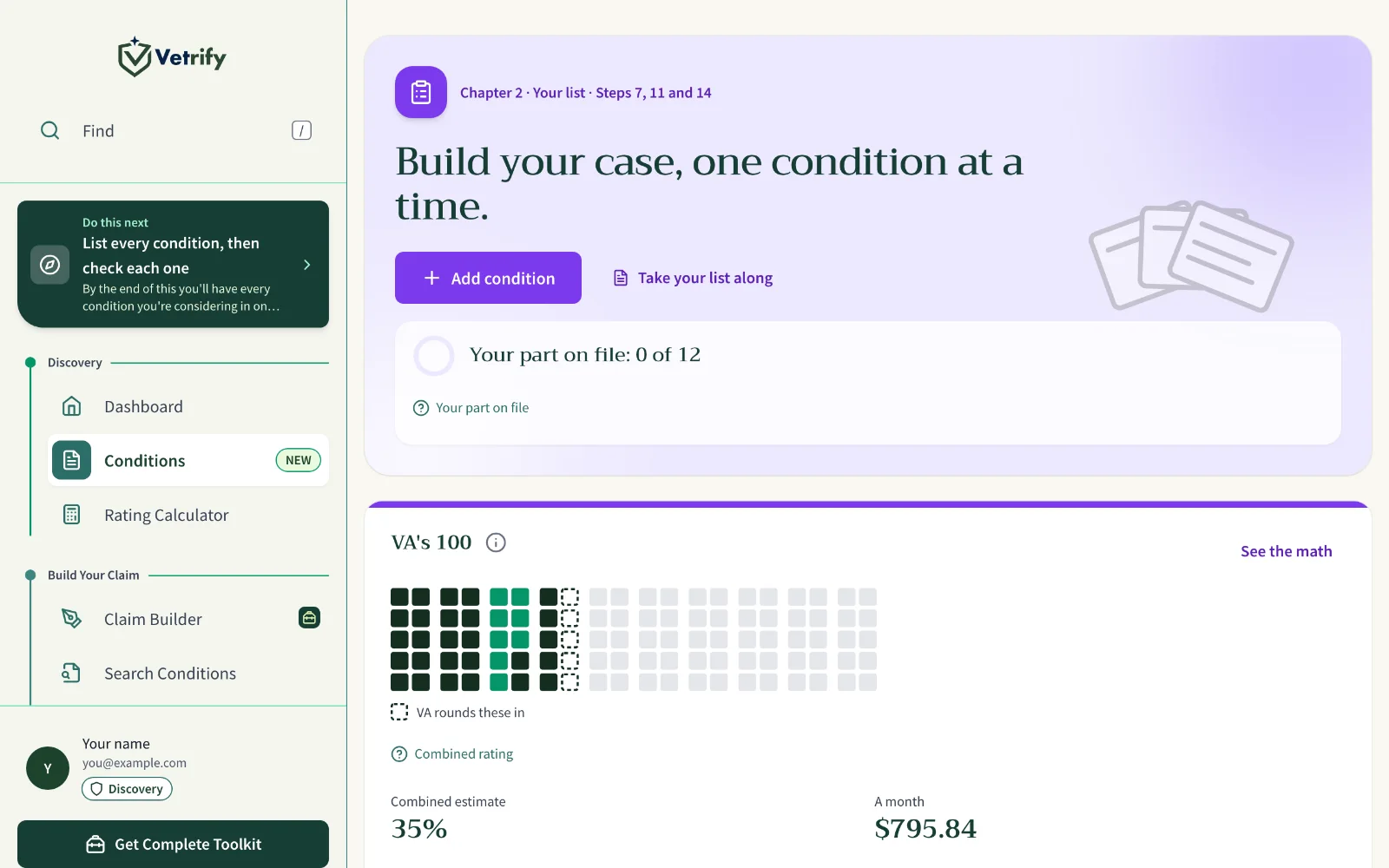
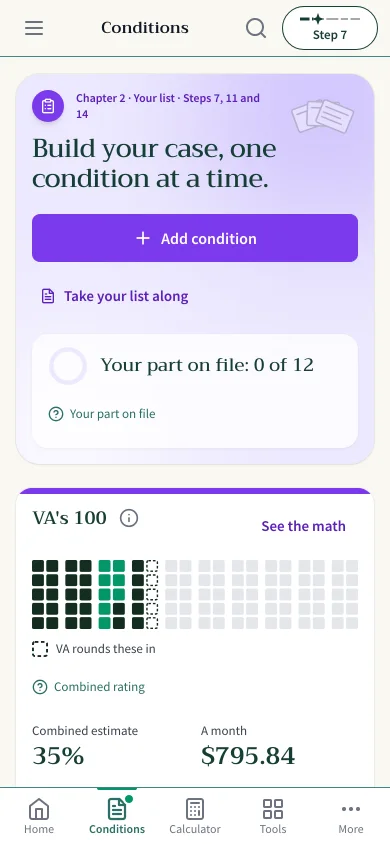
Keep your VA rating at hand.
A free account keeps your conditions in one list and shows your combined rating as you add them. Have it ready when you ask the state about a benefit.
HOW TO READ THIS PAGE
Every row, in the source's own words.
Each benefit says what it is, who qualifies in the source's words, and where it comes from. Open a row to read the passage it quotes.
Find your kind of benefit
The benefits are grouped by kind. Start with the one you came for.
Read who qualifies
Each row quotes the source's own words on who qualifies.
Check with the state
Rules change. Ask the office named in the source before you count on a benefit.
Vetrify is not a state agency and not a law firm. This page points to each state's own words; the state decides who qualifies.
6 BENEFITS
Property tax
A property tax credit on the homestead that the disabled veteran or surviving spouse owns and occupies. It is applied against the first nine thousand dollars of the homestead's taxable valuation and equals the percentage of the veteran's disability compensation rating for service-connected disabilities, as VA certifies it for this credit. It is for a veteran with a service-connected disability of fifty percent or greater, or with an extra-schedular rating to include individual unemployability that pays at the one hundred percent rate, who was discharged under honorable conditions or has retired from the U.S. armed forces, and for the surviving spouse if the veteran has died. A surviving spouse receiving VA dependency and indemnity compensation gets a one hundred percent credit; VA correspondence to the spouse saying the spouse is the veteran's survivor and receives it counts as proof. If VA's finding of disability or service-connected death comes after the veteran's death, through a law that makes the spouse eligible for that compensation, the law treats the finding as made before the death. Two disabled veterans married to each other and living together may not get more than one hundred percent of nine thousand dollars of taxable valuation between them. A veteran who co-owns the homestead with someone other than a spouse, parent or child gets the credit only on the veteran's own share. A first-time claim is an affidavit filed with the county auditor, with a description of the property and VA's certificate of the amount of the disability; the law says the affidavit and certificate must be open for public inspection. The Tax Commissioner's page (its own row) words the discharge rule as an honorable discharge; this row quotes the law.
Who qualifies, in the source's wordsTied to a VA rating
“A disabled veteran of the United States armed forces with an armed forces service-connected disability of fifty percent or greater or a disabled veteran who has an extra-schedular rating to include individual unemployability which results in the veteran being paid at the one hundred percent rate as determined by the department of veterans' affairs, who was discharged under honorable conditions or who has been retired from the armed forces of the United States, or the surviving spouse if the disabled veteran is deceased”
What the source says
“57-02-08.8. Property tax credit for disabled veterans - Certification - Distribution. 1. A disabled veteran of the United States armed forces with an armed forces service-connected disability of fifty percent or greater or a disabled veteran who has an extra-schedular rating to include individual unemployability which results in the veteran being paid at the one hundred percent rate as determined by the department of veterans' affairs, who was discharged under honorable conditions or who has been retired from the armed forces of the United States, or the surviving spouse if the disabled veteran is deceased, is eligible for a credit applied against the first nine thousand dollars of taxable valuation of the homestead owned and occupied by the disabled veteran or surviving spouse equal to the percentage of the disabled veteran's disability compensation rating for service-connected disabilities as certified by the department of veterans' affairs for the purpose of applying for a property tax credit. A surviving spouse who is receiving United States department of veterans affairs dependency and indemnity compensation receives a one hundred percent credit as described in this subsection. If the determination of disability or service-connected death occurs subsequent to the qualifying veteran's death through application of a law that renders a surviving spouse of a qualifying veteran eligible for United States department of veterans affairs disability and indemnity compensation, the determination for purposes of the credit under this subsection is presumed to precede the veteran's death. Sufficient proof of receipt of United States department of veterans affairs dependency and indemnity compensation includes correspondence directed to a surviving spouse of a qualifying veteran by the United States department of veterans affairs which indicates the surviving spouse is a survivor of the qualifying veteran and is in receipt of United States department of veterans affairs dependency and indemnity compensation. 2. If two disabled veterans are married to each other and living together, their combined credits may not exceed one hundred percent of nine thousand dollars of taxable valuation of the homestead. If a disabled veteran co-owns the homestead property with someone other than the disabled veteran's spouse, parent, or child, the credit is limited to that disabled veteran's interest in the homestead, calculated by multiplying the taxable valuation of the disabled veteran's interest in the homestead property by the applicant's certified disability percentage, not to exceed the maximum credit amount in subsection 1. 3. A disabled veteran or surviving spouse claiming a credit under this section for the first time shall file with the county auditor an affidavit showing the facts required under this section, a description of the property, and a certificate from the United States department of veterans' affairs, or its successor, certifying to the amount of the disability. The affidavit and certificate must be open for public inspection.”
Source: North Dakota Century Code 57-02-08.8, Property tax credit for disabled veterans (subsections 1 to 3, first two sentences). Read .
For the disabled veterans' credit, 'homestead' has the meaning in section 47-18-01, and it also applies to a person who otherwise qualifies whether or not that person is the head of the family. 'Child' means a child by birth, adoption or marriage, and 'parent' means a birth parent, adoptive parent or stepparent (these words set the co-owner rule in the credit row). The credit does not reduce special assessments. It ends at the end of the tax year in which the applicant dies. The board of county commissioners may cancel the part of unpaid taxes that the credit represents for any year in which the qualifying owner held title to the homestead.
Who qualifies, in the source's wordsOther rule
“"Homestead" has the meaning provided in section 47-18-01 except that it also applies to a person who otherwise qualifies under the provisions of this section whether the person is the head of the family.”
What the source says
“For purposes of this section, and except as otherwise provided in this section: a. "Child" means a child by birth, adoption, or marriage. b. "Homestead" has the meaning provided in section 47-18-01 except that it also applies to a person who otherwise qualifies under the provisions of this section whether the person is the head of the family. c. "Parent" means a birth parent, adoptive parent, or stepparent. This section does not reduce the liability of a person for special assessments levied upon property. A credit under this section terminates at the end of the taxable year of the death of the applicant. The board of county commissioners may cancel the portion of unpaid taxes that represents the credit calculated in accordance with this section for any year in which the qualifying owner has held title to the homestead property.”
How the Office of State Tax Commissioner states who qualifies: a disabled veteran of the U.S. Armed Forces with a service-connected disability of 50% or greater in the year for which you apply, or with an extra-schedular rating, including individual unemployability, paid at the 100% rate as VA determines it; who received an honorable discharge or is retired from the Armed Forces; and who lives on and has an ownership interest in the property. Two disabled veterans married and living together may not get combined credits of more than 100% or $9,000 of the homestead's taxable value. If the applicant dies, the spouse is eligible for the credit, and a spouse receiving VA dependency and indemnity compensation gets 100% of the credit. The law (its own row) says 'discharged under honorable conditions' where this page says 'honorable discharge'; the law is the rule, so confirm with your county director of tax equalization.
Who qualifies, in the source's wordsTied to a VA rating
“Be a disabled veteran of the United States Armed Forces with an armed forces service-connected disability of 50% or greater in the year for which the application is made, OR be a disabled veteran who has an extra-scheduler rating, to include individual unemployability, which results in being paid at the 100% rate as determined by the United States Department of Veterans Affairs. Have received an honorable discharge or be retired from the United States Armed Forces. Reside on and have an ownership interest in the property.”
What the source says
“The Disabled Veteran's Property Tax Credit is available to qualifying veterans of the United States Armed Forces. Qualifications To be eligible for this program, you must: Be a disabled veteran of the United States Armed Forces with an armed forces service-connected disability of 50% or greater in the year for which the application is made, OR be a disabled veteran who has an extra-scheduler rating, to include individual unemployability, which results in being paid at the 100% rate as determined by the United States Department of Veterans Affairs. Have received an honorable discharge or be retired from the United States Armed Forces. Reside on and have an ownership interest in the property. If two disabled veterans are married and living together, the combined credits may not exceed 100% or $9,000 of taxable value of the homestead. In the event of the applicant's death, the spouse is eligible for the credit. The spouse who is receiving United States Department of Veterans Affairs dependency and indemnity compensation receives 100% of the credit.”
Source: Office of State Tax Commissioner, Disabled Veteran's Property Tax Credit (qualifications). Read .
Send the Application for Disabled Veterans Property Tax Credit to your local assessor or county director of tax equalization by April 1 of the year in which the property is assessed and for which you want the credit, with documents showing your service-connected disability and your honorable discharge. The law (the credit row) asks for a veteran discharged under honorable conditions or retired from the armed forces, not only an honorable discharge, and says a first-time claim is an affidavit filed with the county auditor; the law is the rule, so ask your county which office takes the claim and what proof of discharge it needs.
Who qualifies, in the source's wordsOther rule
“To apply for the Disabled Veteran's Property Tax Credit submit: Application for Disabled Veterans Property Tax Credit to the local assessor or county director of tax equalization.”
What the source says
“To apply for the Disabled Veteran's Property Tax Credit submit: Application for Disabled Veterans Property Tax Credit to the local assessor or county director of tax equalization. The application is due by April 1st of the year in which the property is assessed and for which the credit is requested. Include documentation regarding the applicant's service-connected disability and military honorable discharge with your application.”
Source: Office of State Tax Commissioner, Disabled Veteran's Property Tax Credit (application process). Read .
The Tax Commissioner's guideline adds these rules. The property must be owned and occupied as a homestead by the qualifying disabled veteran or surviving spouse, who must live on it and, as of the assessment date, have an interest in it (generally best shown by a written record such as a deed, contract for deed, life estate or declaration of homestead). The veteran must have a 50% or greater service-connected disability on the assessment date, and the rating on that date applies for the whole year. For a surviving spouse, the veteran must have been disabled before the assessment date. A first-time claim is an affidavit filed with the county auditor with a description of the property, a copy of the DD Form 214 showing the veteran's honorable discharge, and VA's certificate of the amount of the disability. The law (the credit row) asks for a veteran discharged under honorable conditions or retired from the armed forces, not only an honorable discharge, and says the affidavit and certificate must be open for public inspection, where this guideline calls the documents confidential under section 37-18-11; the law is the rule, so ask the county auditor. If you move to a different homestead, the credit is portable and may be applied to the new one. The credit ends at the end of the tax year in which the applicant dies. Property owned by a revocable trust can get the credit; property owned by an irrevocable trust cannot.
Who qualifies, in the source's wordsTied to a VA rating
“The veteran must have 50% or greater service-connected disability on the assessment date.”
What the source says
“13. Property must be owned and occupied as a homestead (defined in N.D.C.C. § 47-18-01) by a qualifying disabled veteran or surviving spouse. The applicant must reside on the property for which the credit is claimed and, as of the assessment date, have an interest in the property. Generally, such an interest can best be established by a written record or document, such as a deed, contract for deed, life estate, or declaration of homestead. 14. The veteran must have 50% or greater service-connected disability on the assessment date. The percentage rating on the assessment date applies for the whole year. 15. If the applicant is a surviving spouse of a deceased disabled veteran, the deceased veteran must have been disabled prior to the assessment date. 16. A disabled veteran or surviving spouse claiming a credit for the first time shall file with the county auditor an affidavit showing the required facts, a description of the property, a copy of the DD Form 214 showing the veteran's honorable discharge from active military service and a certificate from the United States Department of Veterans Affairs certifying to the amount of the disability. Those documents are confidential under N.D.C.C. § 37-18-11. 17. A person shall thereafter furnish to the assessor or other assessment officials, when requested to do so, any information which is believed will support the claim for credit for any subsequent year. 18. If a qualifying disabled veteran or surviving spouse moves to a different homestead, the credit is portable and may be applied to the person's new homestead. 19. A credit under this section terminates at the end of the taxable year of the death of the applicant. * 20. Applicants who have property in the ownership of a revocable trust are eligible for this credit. Applicants who have property in the ownership of an irrevocable trust are not eligible for this credit.”
Source: Office of State Tax Commissioner, Property Tax Credit for Disabled Veterans guideline (content revised 6-2025), items 13 to 20. Read .
An exemption from property tax for the fixtures, buildings and improvements of a homestead, for the first one hundred twenty thousand dollars of their true and full valuation, when the homestead is owned and occupied by a paraplegic disabled veteran of the U.S. armed forces, by any veteran VA has awarded specially adapted housing, or by the unremarried surviving spouse if the veteran has died. The same subsection gives a separate exemption to people who are permanently and totally disabled and permanently confined to a wheelchair, as a physician the local governing board selects certifies. A first-time claim is an affidavit filed with the county auditor showing the facts and describing the property; after that, give the assessor information when asked. 'Homestead' has the meaning in section 47-18-01, whether or not the person is the head of a family. The board of county commissioners may cancel the unpaid taxes for any year in which the qualifying owner held title to the property.
Who qualifies, in the source's wordsOther rule
“A paraplegic disabled veteran of the United States armed forces or any veteran who has been awarded specially adapted housing by the department of veterans' affairs, or the unremarried surviving spouse if such veteran is deceased”
What the source says
“Fixtures, buildings, and improvements up to the amount of valuation specified, when owned and occupied as a homestead, as hereinafter defined, by any of the following persons: a. A paraplegic disabled veteran of the United States armed forces or any veteran who has been awarded specially adapted housing by the department of veterans' affairs, or the unremarried surviving spouse if such veteran is deceased, for the first one hundred twenty thousand dollars of true and full valuation of the fixtures, buildings, and improvements. b. Any permanently and totally disabled person who is permanently confined to use of a wheelchair, or, if deceased, the unremarried surviving spouse of a permanently and totally disabled person. If the spouse of a permanently and totally disabled person owns the homestead or if it is jointly owned by them, the same reduction in assessed valuation applies as long as both reside thereon. The provisions of this subdivision do not reduce the liability for special assessments levied upon the homestead. The phrase "permanently confined to use of a wheelchair" means that the person cannot walk with the assistance of crutches or any other device and will never be able to do so and that a physician selected by the local governing board has so certified. Any person claiming an exemption under this subsection for the first time shall file with the county auditor an affidavit showing the facts herein required and a description of the property. The affidavit must be open for public inspection. A person thereafter shall furnish to the assessor or other assessment officials when requested to do so any information that is believed will support the claim for exemption for a subsequent year. For purposes of this subsection, and except as otherwise provided in this subsection, "homestead" has the meaning provided in section 47-18-01 except that it also applies to any person who otherwise qualifies under the provisions of this subsection whether or not the person is the head of a family. The board of county commissioners is hereby authorized to cancel the unpaid taxes for any year in which the qualifying owner has held title to the exempt property.”
Source: North Dakota Century Code 57-02-08, Property exempt from taxation (subsection 20). Read .
9 BENEFITS
Vehicles and license plates
A disabled veteran under Public Law 79-663 [38 U.S.C. 3901], a disabled veteran with a one hundred percent service-connected disability as VA determines it, or a disabled veteran with an extra-schedular rating to include individual unemployability paid at the one hundred percent rate, is entitled to display either a distinctive license plate or a standard plate that does not identify the veteran as a veteran or disabled veteran, issued by the department at no cost, or any other distinctive or vanity plate bought from the department, on motor vehicles of up to twenty-six thousand pounds registered gross weight that the veteran owns and operates. The exemption covers no more than two such vehicles at a time. A surviving spouse receiving VA dependency and indemnity compensation is eligible for one vehicle; VA correspondence to the spouse saying so counts as proof. The Department of Transportation's manual (its own row) says no license fee is required. The Department of Veterans Affairs' DAV Plates page words the surviving spouse rule differently (it says an un-remarried surviving spouse may retain one DAV plate); this row quotes the law.
Who qualifies, in the source's wordsTied to a VA rating
“a disabled veteran under the provisions of Public Law 79-663 [38 U.S.C. 3901], a disabled veteran who has a one hundred percent service-connected disability as determined by the department of veterans' affairs, or a disabled veteran who has an extra-schedular rating to include individual unemployability which results in the veteran being paid at the one hundred percent rate as determined by the department of veterans' affairs”
What the source says
“Motor vehicles not exceeding twenty-six thousand pounds [11793.40 kilograms] registered gross weight owned and operated by a disabled veteran under the provisions of Public Law 79-663 [38 U.S.C. 3901], a disabled veteran who has a one hundred percent service-connected disability as determined by the department of veterans' affairs, or a disabled veteran who has an extra-schedular rating to include individual unemployability which results in the veteran being paid at the one hundred percent rate as determined by the department of veterans' affairs is entitled to display either a distinctive license plate or a standard plate that does not identify the veteran as a veteran or disabled veteran which is issued by the department at no cost to the qualifying veteran or surviving spouse or any other distinctive or vanity plate purchased from the department by the qualifying veteran or surviving spouse. This exemption applies to no more than two such motor vehicles owned by a disabled veteran at any one time. A surviving spouse of a disabled veteran who is receiving United States department of veterans affairs dependency and indemnity compensation is eligible for the exemption under this subdivision for one vehicle. If the determination of disability or service-connected death occurs subsequent to the qualifying veteran's death through application of a law that renders a surviving spouse of a qualifying veteran eligible for United States department of veterans affairs disability and indemnity compensation, the determination for purposes of the exemption under this subdivision is presumed to precede the veteran's death. Sufficient proof of receipt of United States department of veterans affairs dependency and indemnity compensation includes correspondence directed to a surviving spouse of a qualifying veteran by the United States department of veterans affairs which indicates the surviving spouse is a survivor of the qualifying veteran and is in receipt of United States department of veterans affairs dependency and indemnity compensation.”
Source: North Dakota Century Code 39-04-18, Motor vehicles exempt from registration fees (subsection 2, subdivision j). Read .
How the Department of Transportation handles DAV plates. A letter from VA attesting eligibility under Public Law 663 of the 79th Congress, a 100 percent service-connected disability, or an extra-schedular rating including unemployability to a 100 percent rating is required when you first apply. A qualified veteran may have no more than two vehicles at a time; a passenger vehicle, truck, motorcycle or motor home up to 26,000 pounds registered gross weight may carry DAV plates. No license fee is required, and the license renews January 1 each year. The $5 certificate of title fee applies, and so does the $1.50 abandoned motor vehicle disposal fee on a first North Dakota title. Motor vehicle excise tax is not due, also on a leased vehicle. A vehicle with DAV plates may park in a mobility-impaired zone, and mobility-impaired DAV plates are also available. Plates must be transferred to a replacement vehicle, with no transfer fee; when a DAV vehicle is resold, registration fees are due from the date of sale. A surviving spouse may apply for or keep the excise tax and registration exemptions for one vehicle, with a VA letter attesting eligibility; the law (the plates row and the excise tax row) gives them to a surviving spouse who is receiving VA dependency and indemnity compensation. A veteran may choose standard, vanity or other distinctive plates instead and still get the tax and registration exemptions.
Who qualifies, in the source's wordsTied to a VA rating
“Letter from the Veterans Affairs office attesting eligibility under Public Law 663 of the 79th Congress, as amended, or a 100 percent service-connected disability, or having an extra-schedular rating to include unemployability to a rating of 100 percent service-connected disability, as verified by the Department of Veterans Affairs, is required when first applying for DAV license.”
What the source says
“Disabled American Veteran (DAV): 39-01-15 (NDCC), 39-04-18 Subsection 2(j) (NDCC) and 57-40-3-04(1) (NDCC) A. Letter from the Veterans Affairs office attesting eligibility under Public Law 663 of the 79th Congress, as amended, or a 100 percent service-connected disability, or having an extra-schedular rating to include unemployability to a rating of 100 percent service-connected disability, as verified by the Department of Veterans Affairs, is required when first applying for DAV license. B. A qualified veteran is eligible for no more than two vehicles at any one time. A passenger, truck, motorcycle, or any motor home not exceeding 26,000 pounds [11793.40 kilograms] registered gross weight may be registered with DAV plates. C. No license fee is required. License is renewed January 1 each year. D. Certificate of title fee is $5. E. Abandoned motor vehicle disposal fee of $1.50 applies upon initial application for North Dakota certificate of title. F. Motor vehicle excise tax is NOT due. A qualified veteran may lease a vehicle and remain exempt from motor vehicle excise tax. G. DAV plates are issued. A vehicle with DAV plates may park in a mobility-impaired zone; in addition, mobility-impaired DAV license plates are also available. Plates must be transferred to the replacement vehicle. No plate transfer fee is assessed. H. When a DAV vehicle is resold, applicable registration fees are due from date of sale. I. A surviving spouse may apply or retain retain the DAV excise tax exemption and registration exemption for one vehicle. The surviving spouse can apply or retain the DAV, standard, vanity, or any other distinctive plate purchased from the department. A letter from the Veterans Affairs office attesting eligibility is required. J. A Disabled American Veteran may choose to receive standard, vanity, or any other distinctive plates instead of DAV plates. They receive the DAV tax and registration exemptions.”
Source: North Dakota Department of Transportation, Motor Vehicle Registration Manual (Rev. 07/25), Disabled American Veteran (DAV). Read .
The motor vehicle excise tax does not apply to a motor vehicle acquired by, or leased and in the possession of, a North Dakota resident disabled veteran under Pub. L. 79-663 [38 U.S.C. 3901], with a one hundred percent service-connected disability as VA determines it, or with an extra-schedular rating to include individual unemployability paid at the one hundred percent rate, who registers, or is eligible to register, the vehicle with the distinctive plate under the registration exemption (its own row, which covers no more than two vehicles at a time). A surviving spouse receiving VA dependency and indemnity compensation is eligible for this exemption too.
Who qualifies, in the source's wordsTied to a VA rating
“a resident disabled veteran under the provisions of Pub. L. 79-663 [38 U.S.C. 3901], a resident disabled veteran who has a one hundred percent service-connected disability as determined by the department of veterans' affairs, or a resident disabled veteran who has an extra-schedular rating to include individual unemployability which results in the veteran being paid at the one hundred percent rate as determined by the department of veterans' affairs who registers, or is eligible to register, the vehicle with a distinctive license plate issued by the department of transportation under subdivision j of subsection 2 of section 39-04-18”
What the source says
“57-40.3-04. Exemptions. There are specifically exempted from the provisions of this chapter and from computation of the amount of tax imposed by it the following: 1. Any motor vehicle acquired by, or leased and in the possession of, a resident disabled veteran under the provisions of Pub. L. 79-663 [38 U.S.C. 3901], a resident disabled veteran who has a one hundred percent service-connected disability as determined by the department of veterans' affairs, or a resident disabled veteran who has an extra-schedular rating to include individual unemployability which results in the veteran being paid at the one hundred percent rate as determined by the department of veterans' affairs who registers, or is eligible to register, the vehicle with a distinctive license plate issued by the department of transportation under subdivision j of subsection 2 of section 39-04-18. A surviving spouse who is receiving United States department of veterans affairs dependency and indemnity compensation is eligible for the exemption in this subsection. If the determination of disability or service-connected death occurs subsequent to the qualifying veteran's death through application of a law that renders a surviving spouse of a qualifying veteran eligible for United States department of veterans affairs disability and indemnity compensation, the determination for purposes of the exemption under this subsection is presumed to precede the veteran's death. Sufficient proof of receipt of United States department of veterans affairs dependency and indemnity compensation includes correspondence directed to a surviving spouse of a qualifying veteran by the United States department of veterans affairs which indicates the surviving spouse is a survivor of the qualifying veteran and is in receipt of United States department of veterans affairs dependency and indemnity compensation.”
Source: North Dakota Century Code 57-40.3-04, Exemptions (motor vehicle excise tax, subsection 1). Read .
A North Dakota resident who was a prisoner of war while serving in the U.S. armed forces and has received an honorable discharge is entitled to display a distinctive license plate on passenger motor vehicles, house cars or pickup trucks of up to twenty thousand pounds registered gross weight that the person owns and operates, including such vehicles bought or acquired later. The exemption covers no more than two vehicles at a time. A surviving spouse who has not remarried keeps the exemption for one vehicle. The Department of Transportation's manual (its own row) says what is and is not charged.
Who qualifies, in the source's wordsOther rule
“a resident who, while serving in the United States armed forces, was a prisoner of war and has received an honorable discharge from the United States armed forces”
What the source says
“Passenger motor vehicles, house cars, or pickup trucks not exceeding twenty thousand pounds [9071.84 kilograms] registered gross weight owned and operated by a resident who, while serving in the United States armed forces, was a prisoner of war and has received an honorable discharge from the United States armed forces is entitled to display a distinctive license plate issued by the department. This exemption also applies to any passenger motor vehicle, house car, or pickup truck not exceeding twenty thousand pounds [9071.84 kilograms] registered gross weight subsequently purchased or acquired by such a former prisoner of war. This exemption applies to no more than two motor vehicles owned by a former prisoner of war at any one time. A surviving spouse of a former prisoner of war who has not remarried retains the exemption of the deceased veteran who qualified under this subdivision for one vehicle.”
Source: North Dakota Century Code 39-04-18, Motor vehicles exempt from registration fees (subsection 2, subdivision o). Read .
How the Department of Transportation handles POW plates. A letter from VA stating you were a prisoner of war must go with the Application for Certificate of Title and Registration of a Vehicle (SFN 2872) when you first apply. A passenger vehicle, truck or motor home up to 20,000 pounds gross weight may carry POW plates; the license must be renewed by January 1 each year, and the plates may move to a replacement vehicle. The $5 certificate of title fee applies, and so does the $1.50 abandoned motor vehicle disposal fee on a first North Dakota title. Motor vehicle excise tax is not due, for up to two vehicles at a time. After the former prisoner of war dies, the surviving spouse may keep the POW plates and the exemption for one vehicle for the spouse's own use until the spouse remarries, and must surrender the plates to the Motor Vehicle Division within 30 days of remarriage. The law (the plates row) gives the plates to a North Dakota resident who was a prisoner of war while serving and has received an honorable discharge.
Who qualifies, in the source's wordsOther rule
“A letter from the Department of Veteran's Affairs stating the applicant was a prisoner of war must accompany the Application for Certificate of Title and Registration of a Vehicle (SFN 2872) when first applying for a POW license.”
What the source says
“Prisoner of War (POW): 39-04-10.5, 39-04-18 Subsection 2(o) (NDCC) A. A letter from the Department of Veteran's Affairs stating the applicant was a prisoner of war must accompany the Application for Certificate of Title and Registration of a Vehicle (SFN 2872) when first applying for a POW license. B. Passenger, truck, or motor home not exceeding 20,000 pounds gross weight may be registered with POW plates. License must be renewed by January 1 of each year. Plates may be transferred to a replacement vehicle. C. Certificate of title fee is $5. D. Abandoned motor vehicle disposal fee of $1.50 applies upon initial application for North Dakota certificate of title. E. Motor vehicle excise tax is NOT due. Eligibility for this exemption is two vehicles at a time. F. Upon the death of a former prisoner of war, the surviving spouse may elect to retain the POW plates and retain exemption of deceased veteran for one vehicle for their own use until such time as the surviving spouse remarries. Within 30 days of remarriage, the surviving spouse must surrender the plates to the Motor Vehicle Division. If requested, a free commemorative plaque will be issued by the division as a keepsake for the family.”
Source: North Dakota Department of Transportation, Motor Vehicle Registration Manual (Rev. 07/25), Prisoner of War (POW). Read .
A veteran awarded the Purple Heart is entitled to a distinctive license plate on a motor vehicle of up to twenty-six thousand pounds registered gross weight that the veteran owns and operates. The exemption covers one motor vehicle. The Department of Transportation's manual (its own row) says what is and is not charged, and it issues the Purple Heart plate only to a person eligible for burial in the North Dakota Veterans' Cemetery who was awarded the Purple Heart, as the veterans' number plate law (its own row) is written; this subdivision of the law says only 'a veteran who was awarded the purple heart'. Confirm with the Motor Vehicle Division.
Who qualifies, in the source's wordsOther rule
“a veteran who was awarded the purple heart is entitled to a distinctive license plate issued by the department.”
What the source says
“Motor vehicles not exceeding twenty-six thousand pounds [11793.40 kilograms] registered gross weight owned and operated by a veteran who was awarded the purple heart is entitled to a distinctive license plate issued by the department. This exemption applies to one motor vehicle owned by a veteran who was awarded the purple heart.”
Source: North Dakota Century Code 39-04-18, Motor vehicles exempt from registration fees (subsection 2, subdivision p). Read .
How the Department of Transportation handles Purple Heart plates. They are issued to a person eligible for burial in the North Dakota Veterans' Cemetery who was awarded the Purple Heart, on the Application for North Dakota Veteran's Number Plate (SFN 51628). A passenger vehicle, truck or motor home up to 26,000 pounds registered gross weight may carry them. A qualified veteran who displays a Purple Heart plate is exempt from paying registration fees for one motor vehicle the veteran owns; full registration fees are due on any other vehicle. The initial $15 plate fee and the later $10 plate fee are not due for a vehicle the veteran owns. Motor vehicle excise tax (5%) must still be paid when you apply for a certificate of title, and the $1.50 abandoned motor vehicle disposal fee applies on a first North Dakota title. The cemetery rule follows the veterans' number plate law (its own row); the law's registration exemption for Purple Heart vehicles (its own row) says only 'a veteran who was awarded the purple heart'. Confirm with the Motor Vehicle Division.
Who qualifies, in the source's wordsOther rule
“A purple heart plate is issued to an individual eligible for interment in the North Dakota Veterans's Cemetery and who have been awarded the Purple Heart.”
What the source says
“Purple Heart Plate: 39-04-18 Subsection 2 (NDCC) A. A purple heart plate is issued to an individual eligible for interment in the North Dakota Veterans's Cemetery and who have been awarded the Purple Heart. Application for North Dakota Veterans's Number Plate (SFN 51628) must be completed. B. A passenger, truck, or any motor home not exceeding 26,000 pounds [11793.40 kilograms] registered gross weight may be registered with a set of purple heart plates. C. Qualified veterans who have received a Purple Heart and display a Purple Heart plate are exempt from paying registration fees for one motor vehicle owned by that veteran. Any additional vehicles, full registration fees are due. D. Motor vehicle excise tax (5%) must be remitted when applying for a certificate of title. E. Abandoned motor vehicle disposal fee of $1.50 applies upon initial application for North Dakota certificate of title. F. The initial $15 plate fee and subsequent $10 plate fee is not due for a motor vehicle owned by that veteran.”
Source: North Dakota Department of Transportation, Motor Vehicle Registration Manual (Rev. 07/25), Purple Heart Plate. Read .
The Department of Transportation may issue distinctive veterans' number plates to people eligible for burial in the North Dakota veterans' cemetery. Besides all the other registration fees, the plate costs an initial fee of fifteen dollars and an annual surcharge of ten dollars, except that a plate issued to a veteran who has been awarded the Purple Heart has no initial fee and no annual surcharge.
Who qualifies, in the source's wordsOther rule
“The director may issue distinctive number plates to individuals eligible for interment in the North Dakota veterans' cemetery.”
What the source says
“39-04-10.10. North Dakota veterans' number plates. 1. The director may issue distinctive number plates to individuals eligible for interment in the North Dakota veterans' cemetery. The director shall issue a number plate under this section upon receiving: a. Payment of all other fees required under this chapter for registration of a motor vehicle; b. Payment of an initial fee of fifteen dollars of which ten dollars is to be deposited in the highway tax distribution fund and five dollars is to be deposited in the veterans' cemetery maintenance fund unless for a plate issued to a veteran who has been awarded the purple heart, then there is not an initial fee; and c. Verification of subsequent payments of an annual surcharge of ten dollars paid to the adjutant general unless for a plate issued to a veteran who has been awarded the purple heart, then there is not an annual surcharge.”
Source: North Dakota Century Code 39-04-10.10, North Dakota veterans' number plates (subsection 1). Read .
A North Dakota resident serving in the U.S. armed forces for more than one year may relicense a motor vehicle the veteran owns without paying a fee or penalty for the years it was not licensed, by showing in an affidavit that the vehicle was not used in any year it was not licensed. The vehicle is then licensed at the fee for the month of the year in which the application is made.
Who qualifies, in the source's wordsOther rule
“A resident of the state of North Dakota, serving in the armed forces of the United States for a period of time greater than one year”
What the source says
“A resident of the state of North Dakota, serving in the armed forces of the United States for a period of time greater than one year, may relicense a motor vehicle owned by the veteran without paying a fee or penalty for the intervening years when the vehicle was not licensed, providing the veteran shows by suitable affidavit that the vehicle was not in use during a year in which it was not licensed. The vehicle must be licensed for the license fee applicable to the month of the year in which application for license is made.”
Source: North Dakota Century Code 39-04-18, Motor vehicles exempt from registration fees (subsection 1, subdivision e). Read .
4 BENEFITS
Education and tuition
A dependent (as the law defines one, its own row) who is accepted for enrollment into an undergraduate degree or certificate program of a North Dakota state institution of higher education must be allowed to obtain a bachelor's degree or certificate of completion free of any tuition and fee charges, for so long as the dependent is eligible; the law says this holds if the tuition and fee charges do not include costs for aviation flight charges or expenses. Once someone qualifies, the benefit is not lost because a prisoner of war or a person missing in action returns, or because the veteran had a one hundred percent service-connected disability at the time of death.
Who qualifies, in the source's wordsOther rule
“A dependent, as defined in section 15-10-18.2, upon being duly accepted for enrollment into an undergraduate degree or certificate program of a North Dakota state institution of higher education”
What the source says
“15-10-18.3. Free tuition in North Dakota institutions of higher education. A dependent, as defined in section 15-10-18.2, upon being duly accepted for enrollment into an undergraduate degree or certificate program of a North Dakota state institution of higher education, must be allowed to obtain a bachelor's degree or certificate of completion, for so long as the dependent is eligible, free of any tuition and fee charges if tuition and fee charges do not include costs for aviation flight charges or expenses. Once an individual qualifies as a dependent under section 15-10-18.2 and this section, the dependent may not be disqualified from the benefits of this section: 1. Due to the return of the prisoner of war; 2. Due to the return of the individual missing in action; or 3. Because the veteran through whom the benefit was obtained had a one hundred percent service-connected disability at the time of death.”
Source: North Dakota Century Code 15-10-18.3, Free tuition in North Dakota institutions of higher education. Read .
Who counts as a dependent for the tuition waiver: a child, stepchild, spouse, widow or widower of a veteran (as section 37-01-40 defines one, its own row) who was killed in action or died from wounds or other service-connected causes, has a one hundred percent service-connected disability as VA determines it, has an extra-schedular rating to include individual unemployability paid at the one hundred percent rate, died from service-connected disabilities, was a prisoner of war, or was declared missing in action. One of three residency rules must also be met: the veteran was a resident veteran (its own row); or the spouse, widow or widower, or the child's or stepchild's other parent, has been a North Dakota resident and was one at the time of the veteran's death or determination of total disability; or that person established residency in North Dakota and kept it for five years immediately before the dependent's enrollment at an institution under the state board of higher education. A widow or widower receiving VA dependency and indemnity compensation who meets one of those residency rules also counts; VA correspondence saying so counts as proof.
Who qualifies, in the source's wordsOther rule
“A child, stepchild, spouse, widow, or widower of a resident veteran, as "veteran" is defined in section 37-01-40, who was killed in action or died from wounds or other service-connected causes, has a one hundred percent service-connected disability as determined by the department of veterans' affairs, has an extra-schedular rating to include individual unemployability which results in the veteran being paid at the one hundred percent rate as determined by the department of veterans' affairs, died from service-connected disabilities, was a prisoner of war, or was declared missing in action”
What the source says
“15-10-18.2. Definitions. 1. "Dependent" for purposes of section 15-10-18.3 means: a. A child, stepchild, spouse, widow, or widower of a resident veteran, as "veteran" is defined in section 37-01-40, who was killed in action or died from wounds or other service-connected causes, has a one hundred percent service-connected disability as determined by the department of veterans' affairs, has an extra-schedular rating to include individual unemployability which results in the veteran being paid at the one hundred percent rate as determined by the department of veterans' affairs, died from service-connected disabilities, was a prisoner of war, or was declared missing in action; b. A child, stepchild, spouse, widow, or widower of a veteran, as defined in section 37-01-40, who was killed in action or died from wounds or other service-connected causes, has a one hundred percent service-connected disability as determined by the department of veterans' affairs, has an extra-schedular rating to include individual unemployability which results in the veteran being paid at the one hundred percent rate as determined by the department of veterans' affairs, died from service-connected disabilities, was a prisoner of war, or was declared missing in action, provided the spouse, widow, or widower, or the child's or stepchild's other parent, has been a resident of this state and was a resident of this state at the time of death or determination of total disability of the veteran; c. A child, stepchild, spouse, widow, or widower of a veteran, as defined in section 37-01-40, who was killed in action or died from wounds or other service-connected causes, has a one hundred percent service-connected disability as determined by the department of veterans' affairs, has an extra-schedular rating to include individual unemployability which results in the veteran being paid at the one hundred percent rate as determined by the department of veterans' affairs, died from service-connected disabilities, was a prisoner of war, or was declared missing in action, provided the spouse, widow, or widower, or the child's or stepchild's other parent, establishes residency in this state and maintains that residency for a period of five years immediately preceding the spouse's, widow's, widower's, child's, or stepchild's enrollment at an institution under the control of the state board of higher education; or d. A widow or widower of a veteran, as defined in section 37-01-40, who is receiving United States department of veterans affairs dependency and indemnity compensation and satisfies the residency requirement in subdivision a, b, or c. For purposes of this subdivision, sufficient proof of receipt of United States department of veterans affairs dependency and indemnity compensation includes correspondence directed to a qualifying veteran's widow or widower by the United States department of veterans affairs which indicates the widow or widower is a survivor of the qualifying veteran and is in receipt of United States department of veterans affairs dependency and indemnity compensation.”
Source: North Dakota Century Code 15-10-18.2, Definitions (subsection 1, 'Dependent'). Read .
For the tuition waiver, a resident veteran is one who was born in North Dakota and lived there until entering the U.S. armed forces; or was born there and was living outside the state only temporarily, without abandoning residence, before entering; or was born elsewhere but lived in North Dakota for at least six months before entering military service and, before or during those six months, registered to vote or voted in North Dakota, or as an unemancipated minor lived with a parent or person standing in place of a parent who had acquired a residence as the section sets out, or, if not registered to vote in North Dakota, was not registered to vote in another state; or has been a North Dakota resident for the five years before the request for the tuition waiver. A stepchild's other parent means the spouse, widow or widower of a veteran.
Who qualifies, in the source's wordsOther rule
“"Resident veteran" means a veteran who: a. Was born in and lived in this state until entrance into the armed forces of the United States; b. Was born in, but was temporarily living outside this state, not having abandoned residence therein prior to entrance into the armed forces of the United States; c. Was born elsewhere but had resided within this state for at least six months prior to entrance into military service and had prior to or during such six-month period: (1) Registered for voting, or voted in this state; (2) Being an unemancipated minor during such period of residence, had lived with a parent or person standing in loco parentis who had acquired a residence as set forth in this section; or (3) If not registered for voting in this state, not registered for voting in another state; or d. Has been a resident of this state for the five years prior to the request for tuition waiver.”
What the source says
“"Resident veteran" means a veteran who: a. Was born in and lived in this state until entrance into the armed forces of the United States; b. Was born in, but was temporarily living outside this state, not having abandoned residence therein prior to entrance into the armed forces of the United States; c. Was born elsewhere but had resided within this state for at least six months prior to entrance into military service and had prior to or during such six-month period: (1) Registered for voting, or voted in this state; (2) Being an unemancipated minor during such period of residence, had lived with a parent or person standing in loco parentis who had acquired a residence as set forth in this section; or (3) If not registered for voting in this state, not registered for voting in another state; or d. Has been a resident of this state for the five years prior to the request for tuition waiver. "Stepchild's other parent" means the spouse, widow, or widower of a veteran.”
Source: North Dakota Century Code 15-10-18.2, Definitions (subsections 2 and 3, 'Resident veteran' and 'Stepchild's other parent'). Read .
In the chapter of North Dakota law on the State Board of Higher Education, a 'resident student' for tuition purposes includes, each as its own route: a veteran (as section 37-01-40 defines one, its own row); the spouse of a veteran or a dependent of a veteran, including a veteran eligible to transfer Post-9/11 GI Bill entitlement; a child, spouse, widow or widower of a veteran who was killed in action or died from wounds or other service-connected causes, was totally disabled as a result of service-connected causes, died from service-connected disabilities, was a prisoner of war, or was declared missing in action; and a covered individual as section 702 of Public Law No. 113-146 defines one. Other routes, such as twelve months' residence, are in the same list.
Who qualifies, in the source's wordsOther rule
“A veteran, as defined in section 37-01-40”
What the source says
“15-10-19.1. Nonresident and resident student for tuition purposes defined. 1. A "nonresident student" for tuition purposes means any student other than a resident student. 2. A "resident student" for tuition purposes means: a. An individual whose guardian, custodial parent, or parents are legal residents of this state and have resided in this state for twelve months, or a dependent child whose custodial parent moved into the state with the intent to establish legal residency for a period of years within the last twelve months immediately prior to the beginning of the academic term; b. An individual of age eighteen or over who is a legal resident of this state and has resided in this state after reaching age eighteen for twelve months immediately prior to the beginning of the academic term; c. An individual who graduated from a North Dakota high school; d. (1) A full-time active duty member of the armed forces; (2) A member of the national guard; (3) A member of the armed forces reserve component; or (4) A veteran, as defined in section 37-01-40; e. A benefited employee of the North Dakota university system; f. The spouse of: (1) A full-time active duty member of the armed forces; (2) A member of the national guard; (3) A member of the armed forces reserve component; (4) A veteran, as defined in section 37-01-40, including a veteran eligible to transfer entitlement under the Post 9-11 Veterans Educational Assistance Act of 2008 [38 U.S.C. 3301]; (5) A benefited employee of the North Dakota university system; or (6) Any other individual who is a resident for tuition purposes; g. A dependent of: (1) A full-time active duty member of the armed forces; (2) A member of the national guard; (3) A member of the armed forces reserve component; (4) A veteran, as defined in section 37-01-40, including a veteran eligible to transfer entitlement under the Post 9-11 Veterans Educational Assistance Act of 2008 [38 U.S.C. 3301]; or (5) A benefited employee of the North Dakota university system; h. An individual who was a legal resident of this state for at least three consecutive years within six years of the beginning of the academic term; i. A child, spouse, widow, or widower of a veteran as defined in section 37-01-40 who was killed in action or died from wounds or other service-connected causes, was totally disabled as a result of service-connected causes, died from service-connected disabilities, was a prisoner of war, or was declared missing in action; j. A covered individual as defined by section 702 of Public Law No. 113-146 [128 Stat. 1797; 38 U.S.C. 3679]; or k. An individual certified by a director of the peace corps as having completed service as a peace corps volunteer.”
Source: North Dakota Century Code 15-10-19.1, Nonresident and resident student for tuition purposes defined (subsections 1 and 2). Read .
6 BENEFITS
Other state benefits
For the North Dakota laws that use this definition (the tuition rows point here), a veteran is someone who served on continuous federalized active uniformed services duty for one hundred eighty days, or for the full period for which the person was called or ordered to active duty for reasons other than training, and was discharged or released under other than dishonorable conditions. A discharge reflecting 'expiration of term of service' or 'completion of required service', or words to that effect, makes the shorter service count.
Who qualifies, in the source's wordsOther rule
“A "veteran" is an individual who served on continuous federalized active uniformed services duty for one hundred eighty days or the full period for which the individual was called or ordered to active duty for reasons other than training, and who was discharged or released under other than dishonorable conditions.”
What the source says
“37-01-40. Veteran and wartime veteran defined - Uniform service dates for wartime veterans. 1. A "veteran" is an individual who served on continuous federalized active uniformed services duty for one hundred eighty days or the full period for which the individual was called or ordered to active duty for reasons other than training, and who was discharged or released under other than dishonorable conditions. A discharge reflecting "expiration of term of service" or "completion of required service" or words to that effect qualifies the shorter term of service as making the individual a veteran.”
Source: North Dakota Century Code 37-01-40, Veteran and wartime veteran defined (subsection 1). Read .
One of the law's adjustments from federal taxable income to North Dakota taxable income: a reduction by the amount received as retired military personnel benefits, including retired military personnel benefits paid to the surviving spouse of a deceased retired member of the U.S. armed forces, a reserve component of the armed forces or the national guard, but only to the extent the amount was included in federal taxable income.
Who qualifies, in the source's wordsOther rule
“retired military personnel benefits, including retired military personnel benefits paid to the surviving spouse of a deceased retired member of the armed forces of the United States, a reserve component of the armed forces of the United States, or the national guard, but only to the extent the amount was included in federal taxable income.”
What the source says
“r. Reduced by the amount received by a taxpayer as retired military personnel benefits, including retired military personnel benefits paid to the surviving spouse of a deceased retired member of the armed forces of the United States, a reserve component of the armed forces of the United States, or the national guard, but only to the extent the amount was included in federal taxable income.”
A North Dakota resident disabled veteran with at least a fifty percent service-connected disability as VA determines it, or with an extra-schedular rating to include individual unemployability that brings the total disability ratio to at least fifty percent, pays ten dollars for a resident fishing license instead of the regular twenty-five dollars. 'Resident' has its own meaning for game and fish licenses (its own row).
Who qualifies, in the source's wordsTied to a VA rating
“a resident disabled veteran who has at least a fifty percent service-connected disability as determined by the department of veterans' affairs or has an extra-schedular rating to include individual unemployability that brings the veteran's total disability ratio to at least fifty percent”
What the source says
“For a resident fishing license, twenty-five dollars, except that for a resident sixty-five years or over, a resident totally or permanently disabled, or a resident disabled veteran who has at least a fifty percent service-connected disability as determined by the department of veterans' affairs or has an extra-schedular rating to include individual unemployability that brings the veteran's total disability ratio to at least fifty percent, the license fee is ten dollars.”
Source: North Dakota Century Code 20.1-03-12, Schedule of fees for licenses and permits (subsection 6). Read .
A North Dakota resident disabled veteran with at least a fifty percent service-connected disability as VA determines it can buy a combined general game, habitat stamp, small game and fur-bearer license for ten dollars. 'Resident' has its own meaning for game and fish licenses (its own row).
Who qualifies, in the source's wordsTied to a VA rating
“a resident disabled veteran who has at least a fifty percent service-connected disability as determined by the department of veterans' affairs”
What the source says
“For a combined general game, habitat stamp, small game, and fur-bearer license for a resident disabled veteran who has at least a fifty percent service-connected disability as determined by the department of veterans' affairs, ten dollars.”
Source: North Dakota Century Code 20.1-03-12, Schedule of fees for licenses and permits (subsection 46). Read .
For North Dakota game and fish licenses, a resident is a person who has actually lived in North Dakota, or kept a residence there, for at least six months immediately before the date residence is determined. A person's residence is where the person stays when not called elsewhere for special or temporary purposes; a person can have only one residence and keeps it until gaining another. A residence is a permanent building or part of one, such as a house, condominium, apartment, room in a house or mobile home; a rental property, a vacant lot, or a house, cabin or premises used mainly for business or recreation cannot be a residence.
Who qualifies, in the source's wordsOther rule
“"Resident" means any person who has actually lived within this state or maintained that person's residence therein for at least six months immediately preceding the date that residence is to be determined.”
What the source says
“"Resident" means any person who has actually lived within this state or maintained that person's residence therein for at least six months immediately preceding the date that residence is to be determined. A person's residence is the place where the person remains when not called elsewhere for special or temporary purposes. A resident can only have one residence and a residence cannot be lost until another is gained. A residence or home is a permanent building or part of a building and may include a house, condominium, apartment, room in a house, or mobile home. A rental property, vacant lot, or house, cabin, or premises used primarily for business or recreational pursuits may not be considered a residence.”
Source: North Dakota Century Code 20.1-01-02, Definitions ('Resident'). Read .
On the Parks and Recreation Department's daily and annual permits page, North Dakota veterans with a 50 percent or greater service-related disability, and former prisoners of war, are eligible for a free annual lifetime pass (the page's words). All other North Dakota veterans with service-related disabilities may buy an annual permit for $28. Proof of disability is a current Summary of Benefits Letter from VA; proof of prisoner of war status is a DD214 or, for a civilian, official written proof from the National Archives Database.
Who qualifies, in the source's wordsTied to a VA rating
“ND veterans with a 50 percent or greater service-related disability and former POWs are eligible for a free annual lifetime pass.”
What the source says
“Disabled Veterans and Prisoners of War (POW): ND veterans with a 50 percent or greater service-related disability and former POWs are eligible for a free annual lifetime pass. All other ND veterans with service-related disabilities may purchase an annual permit for $28. Requires a current Summary of Benefits Letter issued by the U.S. Department of Veterans Affairs for proof of disability. Acceptable proof of POW includes DD214 or, if civilian, official written proof from the National Archives Database attesting to former POW status. Contact parkrec@nd.gov for more information.”
Source: North Dakota Parks and Recreation Department, Daily & Annual Permits (Disabled Veterans and Prisoners of War). Read .
Not covered on this page yet
These have no row here yet, so the page is not a full list. Ask the North Dakota Department of Veterans Affairs about them.
- Gold Star and military sacrifice plates: not yet read.
- The Department of Veterans Affairs' Veterans Aid loans and its other grant programs: not yet read.
- Veterans' preference in state and local government jobs: not yet read.
- The veteran mark on a North Dakota driver's license: not yet read.

On the App Store
Your combined rating and what it pays, on your phone.
VA Calc combines your ratings with VA's whole-person formula and shows what that rating pays at VA's official rates.
Official sources
- North Dakota Century Code 57-02-08.8, Property tax credit for disabled veterans (subsections 1 to 3, first two sentences), ndlegis.gov
- Office of State Tax Commissioner, Disabled Veteran's Property Tax Credit (qualifications), www.tax.nd.gov
- Office of State Tax Commissioner, Property Tax Credit for Disabled Veterans guideline (content revised 6-2025), items 13 to 20, www.tax.nd.gov
- North Dakota Century Code 39-04-18, Motor vehicles exempt from registration fees (subsection 2, subdivision j), ndlegis.gov
- North Dakota Department of Transportation, Motor Vehicle Registration Manual (Rev. 07/25), Disabled American Veteran (DAV), www.dot.nd.gov
- North Dakota Century Code 57-40.3-04, Exemptions (motor vehicle excise tax, subsection 1), ndlegis.gov
- North Dakota Century Code 15-10-18.3, Free tuition in North Dakota institutions of higher education, ndlegis.gov
- North Dakota Century Code 37-01-40, Veteran and wartime veteran defined (subsection 1), ndlegis.gov
- North Dakota Century Code 57-38-30.3, Individual, estate, and trust income tax (subsection 2, the adjustments from federal taxable income to North Dakota taxable income, subdivision r), ndlegis.gov
- North Dakota Century Code 20.1-03-12, Schedule of fees for licenses and permits (subsection 6), ndlegis.gov
- North Dakota Century Code 20.1-01-02, Definitions ('Resident'), ndlegis.gov
- North Dakota Parks and Recreation Department, Daily & Annual Permits (Disabled Veterans and Prisoners of War), www.parkrec.nd.gov