
STATE BENEFITS FOR VETERANS · UT
Utah benefits for veterans
Quoted from the state's own law and agencies
What Utah law and Utah agencies say about property tax, vehicles and license plates, education and tuition, and other state benefits. Every row quotes its source and shows the day we read it.
See the benefitsFree · No account needed
Your Utah benefits list, in your inbox
Email yourself every Utah benefit on this page, with who qualifies in the source's words, each source and the day we read it.
Utah
YOUR NEXT STEP
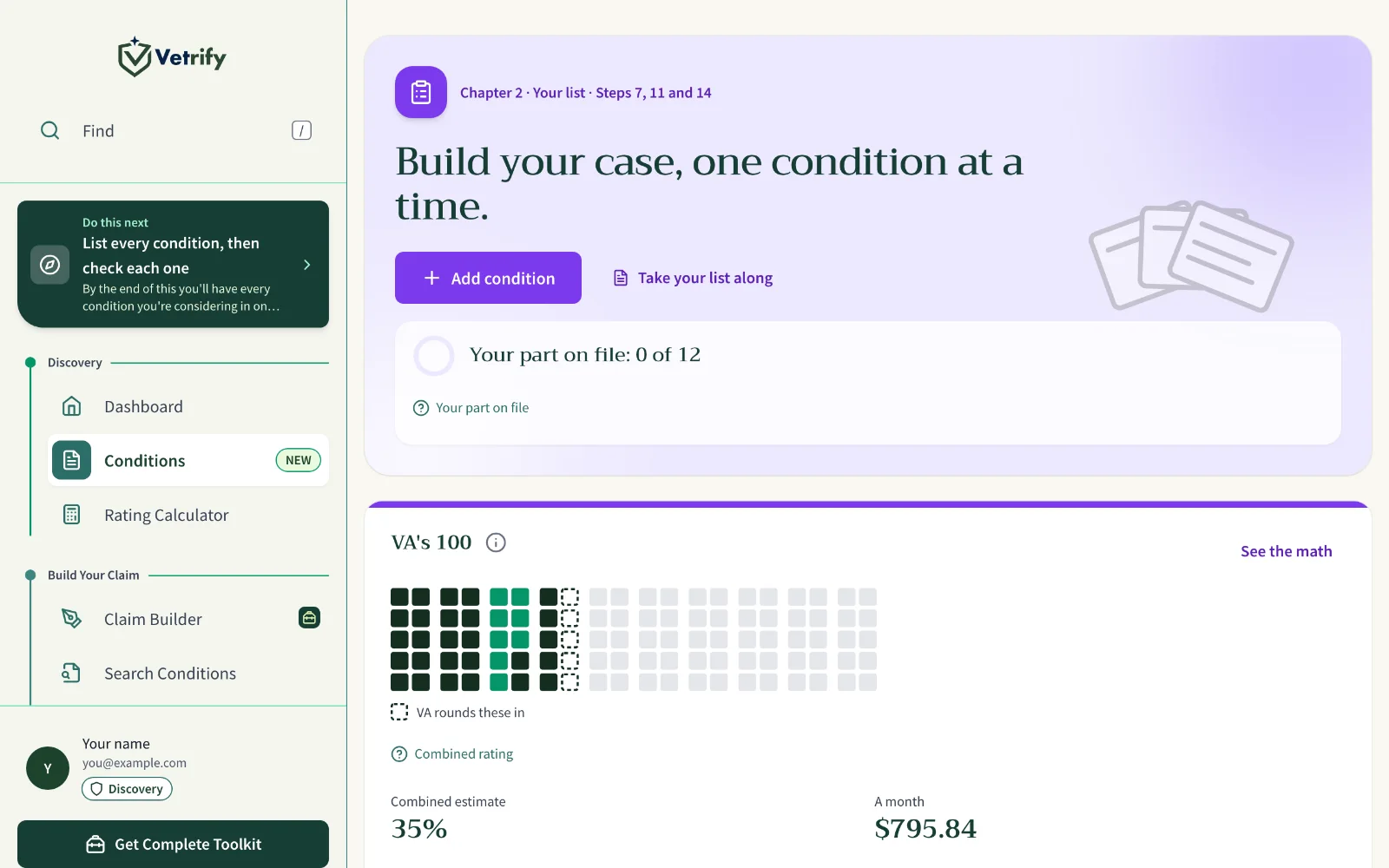
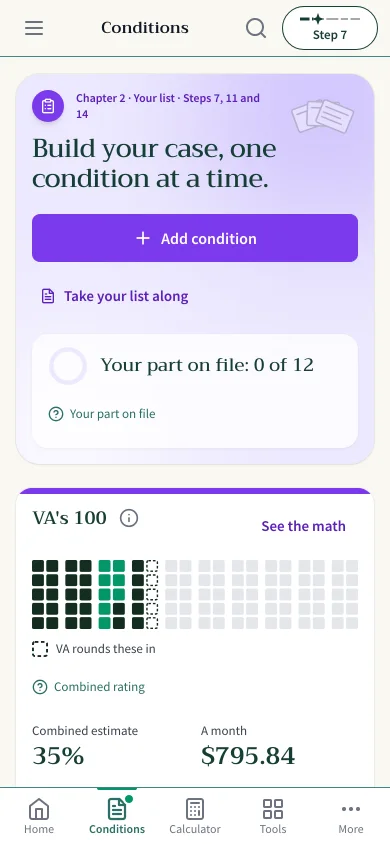
Keep your VA rating at hand.
A free account keeps your conditions in one list and shows your combined rating as you add them. Have it ready when you ask the state about a benefit.
HOW TO READ THIS PAGE
Every row, in the source's own words.
Each benefit says what it is, who qualifies in the source's words, and where it comes from. Open a row to read the passage it quotes.
Find your kind of benefit
The benefits are grouped by kind. Start with the one you came for.
Read who qualifies
Each row quotes the source's own words on who qualifies.
Check with the state
Rules change. Ask the office named in the source before you count on a benefit.
Vetrify is not a state agency and not a law firm. This page points to each state's own words; the state decides who qualifies.
7 BENEFITS
Property tax
Part of the taxable value of a veteran claimant's eligible property is exempt from property tax: the percentage of disability on the veteran's statement of disability (a document from a military entity that lists the percentage) multiplied by the law's adjusted taxable value limit, a dollar limit that changes every year (its own row). The exemption may not exceed the property's taxable value. The county counts a veteran whom VA certifies as individually unemployable as having a 100% disability, whatever percentage the statement shows, and allows no exemption when the statement shows less than 10%. Eligible property (the claimant's primary residence, or personal property held only for personal use) and veteran claimant (a veteran with a disability, or certain unmarried surviving spouses and minor orphans) each have their own row. For this exemption, a person with an honorable or general discharge from an active or reserve component of the Armed Forces is presumed to be a U.S. citizen and may not be asked for more proof of citizenship. The Utah Department of Veterans and Military Affairs settles disputes over whether someone is a veteran with a disability.
Who qualifies, in the source's wordsTied to a VA rating
“(1) In accordance with this part, the amount of taxable value of eligible property described in Subsection (2) or (3) is exempt from taxation if the eligible property is owned by a veteran claimant. (2) (a) Except as provided in Subsection (3), the amount of taxable value of eligible property that is exempt under Subsection (1) is equal to the percentage of disability described in the statement of disability multiplied by the adjusted taxable value limit. (b) The amount of an exemption calculated under Subsection (2)(a) may not exceed the taxable value of the eligible property. (c) A county shall consider a veteran with a disability to have a 100% disability, regardless of the percentage of disability described on the statement of disability, if the United States Department of Veterans Affairs certifies the veteran in the classification of individual unemployability. (d) A county may not allow an exemption claimed under this section if the percentage of disability listed on the statement of disability is less than 10%.”
What the source says
“(1) In accordance with this part, the amount of taxable value of eligible property described in Subsection (2) or (3) is exempt from taxation if the eligible property is owned by a veteran claimant. (2) (a) Except as provided in Subsection (3), the amount of taxable value of eligible property that is exempt under Subsection (1) is equal to the percentage of disability described in the statement of disability multiplied by the adjusted taxable value limit. (b) The amount of an exemption calculated under Subsection (2)(a) may not exceed the taxable value of the eligible property. (c) A county shall consider a veteran with a disability to have a 100% disability, regardless of the percentage of disability described on the statement of disability, if the United States Department of Veterans Affairs certifies the veteran in the classification of individual unemployability. (d) A county may not allow an exemption claimed under this section if the percentage of disability listed on the statement of disability is less than 10%. (3) The amount of taxable value of eligible property that is exempt under Subsection (1) is equal to the total taxable value of the veteran claimant's eligible property if the property is owned by: (a) the unmarried surviving spouse of a veteran who was killed in action or died in the line of duty; (b) a minor orphan of a veteran who was killed in action or died in the line of duty; or (c) the unmarried surviving spouse or minor orphan of a deceased veteran with a disability: (i) who served in the military service of the United States or the state prior to January 1, 1921; and (ii) whose percentage of disability described in the statement of disability is 10% or more. (4) For purposes of this section and Section 59-2a-502, an individual who received an honorable or general discharge from military service of an active component of the United States Armed Forces or a reserve component of the United States Armed Forces: (a) is presumed to be a citizen of the United States; and (b) may not be required to provide additional proof of citizenship to establish that the individual is a citizen of the United States. (5) The Department of Veterans and Military Affairs created in Section 71A-1-201 shall, through an informal hearing held in accordance with Title 63G, Chapter 4, Administrative Procedures Act, resolve each dispute arising under this section concerning an individual's status as a veteran with a disability.”
Source: Utah Code 59-2a-501, Veteran armed forces exemption amount. Read .
The whole taxable value of the eligible property is exempt when it is owned by the unmarried surviving spouse or a minor orphan of a veteran who was killed in action or died in the line of duty, or by the unmarried surviving spouse or minor orphan of a deceased veteran with a disability who served in the military service of the United States or the state before January 1, 1921, with a percentage of disability of 10% or more on the statement of disability. The unmarried surviving spouse or a minor orphan of any other deceased veteran with a disability is also a veteran claimant (see that row), and gets the partial exemption figured from the veteran's percentage of disability.
Who qualifies, in the source's wordsOther rule
“(3) The amount of taxable value of eligible property that is exempt under Subsection (1) is equal to the total taxable value of the veteran claimant's eligible property if the property is owned by: (a) the unmarried surviving spouse of a veteran who was killed in action or died in the line of duty; (b) a minor orphan of a veteran who was killed in action or died in the line of duty; or (c) the unmarried surviving spouse or minor orphan of a deceased veteran with a disability: (i) who served in the military service of the United States or the state prior to January 1, 1921; and (ii) whose percentage of disability described in the statement of disability is 10% or more.”
What the source says
“(1) In accordance with this part, the amount of taxable value of eligible property described in Subsection (2) or (3) is exempt from taxation if the eligible property is owned by a veteran claimant. (2) (a) Except as provided in Subsection (3), the amount of taxable value of eligible property that is exempt under Subsection (1) is equal to the percentage of disability described in the statement of disability multiplied by the adjusted taxable value limit. (b) The amount of an exemption calculated under Subsection (2)(a) may not exceed the taxable value of the eligible property. (c) A county shall consider a veteran with a disability to have a 100% disability, regardless of the percentage of disability described on the statement of disability, if the United States Department of Veterans Affairs certifies the veteran in the classification of individual unemployability. (d) A county may not allow an exemption claimed under this section if the percentage of disability listed on the statement of disability is less than 10%. (3) The amount of taxable value of eligible property that is exempt under Subsection (1) is equal to the total taxable value of the veteran claimant's eligible property if the property is owned by: (a) the unmarried surviving spouse of a veteran who was killed in action or died in the line of duty; (b) a minor orphan of a veteran who was killed in action or died in the line of duty; or (c) the unmarried surviving spouse or minor orphan of a deceased veteran with a disability: (i) who served in the military service of the United States or the state prior to January 1, 1921; and (ii) whose percentage of disability described in the statement of disability is 10% or more. (4) For purposes of this section and Section 59-2a-502, an individual who received an honorable or general discharge from military service of an active component of the United States Armed Forces or a reserve component of the United States Armed Forces: (a) is presumed to be a citizen of the United States; and (b) may not be required to provide additional proof of citizenship to establish that the individual is a citizen of the United States. (5) The Department of Veterans and Military Affairs created in Section 71A-1-201 shall, through an informal hearing held in accordance with Title 63G, Chapter 4, Administrative Procedures Act, resolve each dispute arising under this section concerning an individual's status as a veteran with a disability.”
Source: Utah Code 59-2a-501, Veteran armed forces exemption amount (subsection 3). Read .
The adjusted taxable value limit, which the veteran exemption multiplies by the percentage of disability, was set in the law for the calendar year that began January 1, 2023. Each later year it is the previous year's limit plus that limit multiplied by the actual percent change in the consumer price index during the previous calendar year. So this year's limit is not the figure in the law's text; your county gives this year's figure.
Who qualifies, in the source's wordsOther rule
“(b) for each calendar year after the calendar year that begins on January 1, 2023, the amount of the adjusted taxable value limit for the previous year plus an amount calculated by multiplying the amount of the adjusted taxable value limit for the previous year by the actual percent change in the consumer price index during the previous calendar year.”
What the source says
“(3) "Adjusted taxable value limit" means: (a) for the calendar year that begins on January 1, 2023, $479,504; or (b) for each calendar year after the calendar year that begins on January 1, 2023, the amount of the adjusted taxable value limit for the previous year plus an amount calculated by multiplying the amount of the adjusted taxable value limit for the previous year by the actual percent change in the consumer price index during the previous calendar year.”
Source: Utah Code 59-2a-101, Definitions (subsection 3, "Adjusted taxable value limit"). Read .
The veteran exemption covers property owned by a veteran claimant that is either the claimant's primary residence (including a residence the claimant does not live in because the claimant is admitted as an inpatient at a health care facility), or tangible personal property held exclusively for personal use and not used in a trade or business. The definitions row says what counts as a residence.
Who qualifies, in the source's wordsOther rule
“"Eligible property" means property owned by a veteran claimant that is: (a) the veteran claimant's primary residence, including a residence that the veteran claimant does not reside in because the veteran claimant is admitted as an inpatient at a health care facility as defined in Section 26B-4-501; or (b) tangible personal property that: (i) is held exclusively for personal use; and (ii) is not used in a trade or business.”
What the source says
“(10) "Eligible property" means property owned by a veteran claimant that is: (a) the veteran claimant's primary residence, including a residence that the veteran claimant does not reside in because the veteran claimant is admitted as an inpatient at a health care facility as defined in Section 26B-4-501; or (b) tangible personal property that: (i) is held exclusively for personal use; and (ii) is not used in a trade or business.”
Source: Utah Code 59-2a-101, Definitions (subsection 10, "Eligible property"). Read .
The words the veteran exemption uses, as the property tax relief chapter defines them. A veteran with a disability acquired a disability in the line of duty, during military training or a military conflict, in an active or reserve component of the U.S. Armed Forces, as determined by a military entity. A veteran claimant who applies for the exemption is a veteran with a disability; the unmarried surviving spouse of a deceased veteran with a disability, or of a veteran who was killed in action or died in the line of duty (whether or not that veteran had a disability); or a minor orphan of either. A statement of disability is a document issued by a military entity that lists the percentage of disability. A qualifying disabled veteran claimant is a veteran claimant with a 100% service-connected disability rating by the Veterans Benefits Administration that is permanent and total. A residence is a dwelling in Utah, owned or rented, and as much of the land around it, not more than one acre, as is reasonably necessary to use it as a home; it includes a mobile home, manufactured home or houseboat, but not furniture, furnishings or appliances.
Who qualifies, in the source's wordsOther rule
“(35) "Veteran claimant" means one of the following individuals who applies for an exemption described in Section 59-2a-501: (a) a veteran with a disability; (b) the unmarried surviving spouse of: (i) a deceased veteran with a disability; or (ii) a veteran who was killed in action or died in the line of duty; or (c) a minor orphan of: (i) a deceased veteran with a disability; or (ii) a veteran who was killed in action or died in the line of duty.”
What the source says
“(26) "Qualifying disabled veteran claimant" means a veteran claimant who has a 100% service-connected disability rating by the Veterans Benefits Administration that is permanent and total. (27) "Qualifying increase" means a valuation that is equal to or more than 150% higher than the previous year's valuation for property that: (a) is county assessed; and (b) on or after January 1 of the previous year and before January 1 of the current year has not had: (i) a physical improvement if the fair market value of the physical improvement increases enough to result in the valuation increase solely as a result of the physical improvement; (ii) a zoning change if the fair market value of the real property increases enough to result in the valuation increase solely as a result of the zoning change; or (iii) a change in the legal description of the real property, if the fair market value of the real property increases enough to result in the valuation increase solely as a result of the change in the legal description of the real property. (28) "Qualifying trust" means a trust holding title to real or tangible personal property for which an individual: (a) makes a claim under this part; (b) proves to the satisfaction of the county that title to the portion of the trust will revest in the individual upon the exercise of a power: (i) by: (A) the individual as grantor, trustor, settlor, or in another similar role of the trust; (B) a nonadverse party; or (C) both the individual and a nonadverse party; and (ii) regardless of whether the power is a power: (A) to revoke; (B) to terminate; (C) to alter; (D) to amend; or (E) to appoint; and (c) is obligated to pay the taxes on that portion of the trust property beginning January 1 of the year the individual makes the claim. (29) "Relative" means a spouse, child, parent, grandparent, grandchild, brother, sister, parent-in-law, brother-in-law, sister-in-law, nephew, niece, aunt, uncle, first cousin, or a spouse of any of these individuals. (30) "Rental assistance payment" means any payment that: (a) is made by a: (i) governmental entity; (ii) charitable organization; or (iii) religious organization; and (b) is specifically designated for the payment of rent of a claimant: (i) for the calendar year for which the claimant seeks a renter's credit under this part; and (ii) regardless of whether the payment is made to the claimant or the landlord. (31) "Reserve component of the United States Armed Forces" means the same as that term is defined in Section 59-10-1027. (32) (a) (i) "Residence" means a dwelling in this state, whether owned or rented, and so much of the land surrounding the dwelling, not exceeding one acre, as is reasonably necessary for use of the dwelling as a home. (ii) "Residence" includes a dwelling that is: (A) a part of a multidwelling or multipurpose building and a part of the land upon which the multidwelling or multipurpose building is built; and (B) a mobile home, manufactured home, or houseboat. (b) "Residence" does not include personal property such as furniture, furnishings, or appliances. (c) For purposes of this Subsection (32), "owned" includes a vendee in possession under a land contract or one or more joint tenants or tenants in common. (33) "Statement of disability" means a document: (a) issued by a military entity; and (b) that lists the percentage of disability for the veteran with a disability or deceased veteran with a disability. (34) "Tax notice charge" means the same as that term is defined in Section 59-2-1301.5. (35) "Veteran claimant" means one of the following individuals who applies for an exemption described in Section 59-2a-501: (a) a veteran with a disability; (b) the unmarried surviving spouse of: (i) a deceased veteran with a disability; or (ii) a veteran who was killed in action or died in the line of duty; or (c) a minor orphan of: (i) a deceased veteran with a disability; or (ii) a veteran who was killed in action or died in the line of duty. (36) "Veteran who was killed in action or died in the line of duty" means an individual who was killed in action or died in the line of duty in an active component of the United States Armed Forces or a reserve component of the United States Armed Forces, regardless of whether that individual had a disability at the time that individual was killed in action or died in the line of duty. (37) "Veteran with a disability" means an individual with a disability who, during military training or a military conflict, acquired a disability in the line of duty in an active component of the United States Armed Forces or a reserve component of the United States Armed Forces, as determined by a military entity.”
Source: Utah Code 59-2a-101, Definitions (subsections 26 to 37). Read .
You may claim the exemption if you own the eligible property at any time during the calendar year you claim it for. File the application on or before September 1 of that year with the county where you reside on September 1, with a copy of the veteran's certificate of discharge (or other satisfactory evidence of eligible military service), and, when the claim is for a veteran with a disability or a deceased veteran with a disability, make sure the county has the veteran's statement of disability on file. The county may not ask for another statement unless the percentage of disability changes or a different person claims than the year before, and it gives you a receipt within 30 days. Once the county has issued the receipt, you do not reapply unless something the law lists changes: you apply the exemption to personal property, the percentage of disability changes, the veteran dies, your ownership or occupancy of the primary residence changes, or a different survivor claims. The county extends the September 1 deadline by one more year if, on or after January 4, 2004, a military entity issues a decision finding the veteran (or the deceased veteran) a veteran with a disability that takes effect in an earlier year, or the county legislative body finds that an illness or injury (yours or an immediate family member's) kept you from filing on time, that an immediate family member died that year, that you were out of the state for at least six consecutive months that year, or that the failure to file on time would be against equity or good conscience and was beyond your reasonable control; and it lets you amend a filed application if, on or after January 4, 2004, a military entity issues a decision changing the percentage of disability that takes effect in an earlier year; the amended application must include a statement, issued by a military entity, giving the date that decision takes effect. A qualifying disabled veteran claimant (rated permanent and total; see the definitions row) may apply before owning a home, with a purchase contract or similar documents, in the county where the home is, if the veteran intends it as the primary residence; the county then sends a preliminary approval or denial, and the exemption amount, within 15 business days. The county may check that the property is your primary residence. The law's other deadline extension, for good cause, has its own row.
Who qualifies, in the source's wordsOther rule
“(1) A veteran claimant may claim an exemption in accordance with Section 59-2a-501 and this section if the veteran claimant owns the property eligible for the exemption at any time during the calendar year for which the veteran claimant claims the exemption.”
What the source says
“(1) A veteran claimant may claim an exemption in accordance with Section 59-2a-501 and this section if the veteran claimant owns the property eligible for the exemption at any time during the calendar year for which the veteran claimant claims the exemption. (2) (a) Except as provided in Section 59-2a-108 or Subsection (3) or (5), a veteran claimant shall file, on or before September 1 of the calendar year for which the veteran claimant is applying for the exemption, an application for an exemption described in Section 59-2a-501 with the county in which the veteran claimant resides on September 1 of that calendar year. (b) An application described in Subsection (2)(a) shall include: (i) a copy of the veteran's certificate of discharge from military service or other satisfactory evidence of eligible military service; and (ii) for an application submitted under the circumstances described in Subsection (4)(a), a statement, issued by a military entity, that gives the date on which the written decision described in Subsection (4)(a) takes effect. (c) A veteran claimant who is claiming an exemption for a veteran with a disability or a deceased veteran with a disability shall ensure that, as part of the application described in this Subsection (2), the county has on file, for the veteran related to the exemption, a statement of disability. (d) If a veteran claimant is in compliance with Subsection (2)(c), a county may not require the veteran claimant to file another statement of disability, except under the following circumstances: (i) the percentage of disability has changed for the veteran with a disability or the deceased veteran with a disability; or (ii) the veteran claimant is not the same individual who filed an application for the exemption for the calendar year immediately preceding the current calendar year. (e) A county that receives an application described in Subsection (2)(a) shall, within 30 days after the day on which the county received the application, provide the veteran claimant with a receipt that states that the county received the veteran claimant's application. (3) A county shall extend the September 1 application deadline by one additional year if, on or after January 4, 2004: (a) a military entity issues a written decision that: (i) (A) for a potential claimant who is a living veteran, determines the veteran is a veteran with a disability; or (B) for a potential claimant who is the unmarried surviving spouse or minor orphan of a deceased veteran, determines the deceased veteran was a deceased veteran with a disability at the time the deceased veteran with a disability died; and (ii) takes effect in a year before the current calendar year; or (b) the county legislative body determines that: (i) the veteran claimant or a member of the veteran claimant's immediate family had an illness or injury that prevented the veteran claimant from filing the application on or before the September 1 application deadline; (ii) a member of the veteran claimant's immediate family died during the calendar year of the September 1 application deadline; (iii) the veteran claimant was not physically present in the state for a time period of at least six consecutive months during the calendar year of the September 1 application deadline; or (iv) the failure of the veteran claimant to file the application on or before the September 1 application deadline: (A) would be against equity or good conscience; and (B) was beyond the reasonable control of the veteran claimant. (4) (a) A county shall allow a veteran claimant to amend an application described in Subsection (2)(b) after the application deadline if, on or after January 4, 2004, a military entity issues a written decision: (i) that the percentage of disability has changed: (A) for a veteran with a disability, if the veteran with a disability is the veteran claimant; or (B) for a deceased veteran with a disability, if the claimant is the unmarried surviving spouse or minor orphan of a deceased veteran with a disability; and (ii) that takes effect in a year before the current calendar year. (b) A veteran claimant who files an amended application under Subsection (4)(a) shall include a statement, issued by a military entity, that gives the date on which the written decision described in Subsection (4)(a) takes effect. (5) (a) A qualifying disabled veteran claimant may submit an application described in Subsection (2)(b) before the qualifying disabled veteran claimant owns a residence if the qualifying disabled veteran claimant: (i) intends to purchase the residence as evidenced by a real estate purchase contract or similar documentation; (ii) files the application in the county where the residence that the qualifying disabled veteran claimant intends to purchase is located; and (iii) intends to use the residence as the qualifying disabled veteran claimant's primary residence. (b) (i) The county shall process the application and send the qualifying disabled veteran claimant a receipt, which shall also include documentation that: (A) the application is preliminarily approved or denied; and (B) if the application is preliminarily approved, the amount of the qualifying disabled veteran claimant's tax exemption calculated in accordance with Section 59-2a-501. (ii) The county shall provide the receipt within 15 business days after the day on which the county received the application. (6) After issuing the receipt described in Subsection (2)(e) or (5)(b), a county may not require a veteran claimant to file another application under Subsection (2) or (5), except under the following circumstances relating to the veteran claimant: (a) the veteran claimant applies all or a portion of an exemption to tangible personal property; (b) the percentage of disability changes for a veteran with a disability or a deceased veteran with a disability; (c) the veteran with a disability dies; (d) a change in the veteran claimant's ownership of the veteran claimant's primary residence; (e) a change in the veteran claimant's occupancy of the primary residence for which the veteran claimant claims an exemption under this section; or (f) for an exemption relating to a deceased veteran with a disability or a veteran who was killed in action or died in the line of duty, the veteran claimant is not the same individual who filed an application for the exemption for the calendar year immediately preceding the current calendar year. (7) A county may verify that real property for which a veteran claimant applies for an exemption is the veteran claimant's primary residence.”
Source: Utah Code 59-2a-502, Application (subsections 1 to 7). Read .
The Tax Commission or a county may extend the deadline to file for the veteran exemption until December 31 of the same year, if it finds good cause, subject to any rules the commission makes. A county granting the veteran exemption must refund the amount by which the property taxes paid exceed the property taxes due, if that amount is $1 or more.
Who qualifies, in the source's wordsOther rule
“The commission or a county may extend the time for filing an application until December 31 of the year the application is required to be filed if, subject to any rules made by the commission under Subsection (1)(b), the commission or county finds that good cause exists to extend the deadline.”
What the source says
“(1) (a) The commission or a county may extend the time for filing an application until December 31 of the year the application is required to be filed if, subject to any rules made by the commission under Subsection (1)(b), the commission or county finds that good cause exists to extend the deadline. (b) In accordance with Title 63G, Chapter 3, Utah Administrative Rulemaking Act, the commission may make rules to establish the circumstances under which the commission or a county may, for good cause, extend the deadline for filing an application under Subsection (1)(a). (2) A county granting an abatement described in Subsection 59-2a-101(21) or to an indigent individual, a homeowner's credit, or an exemption described in Part 5, Veteran Armed Forces Exemption, or Part 6, Active Duty Armed Forces Exemption, shall refund to the recipient of the abatement, homeowner's credit, or exemption an amount equal to the amount by which the property taxes paid exceed the property taxes due, if that amount is $1 or more.”
Source: Utah Code 59-2a-108, Extension of time for filing application; county authority to make refunds. Read .
3 BENEFITS
Vehicles and license plates
A Disabled Veteran license plate (an honor special group plate) for Utah resident disabled veterans. Bring a letter from the Utah Department of Veterans and Military Affairs or another United States military entity certifying the veteran's disabled status. The plate does not give disabled parking privileges: that needs a disabled windshield placard, obtained separately. The plate may be transferred to the veteran's surviving spouse as long as the surviving spouse remains unmarried, and it may be personalized.
Who qualifies, in the source's wordsOther rule
“This license plate recognizes Utah resident disabled veterans for their military service.”
What the source says
“This license plate recognizes Utah resident disabled veterans for their military service. It does not provide handicapped parking space privileges, a disabled windshield placard must be obtained separately. Please refer to our Disabled Plates and Placards page to see what qualifies for disable placard parking privileges. This plate may be transferred to the surviving spouse of a disabled veteran so long as the surviving spouse remains unmarried. This plate may be personalized with up to six alphanumeric characters, or up to four for motorcycles. Requirements Letter from Utah Department of Veterans’ and Military Affairs or other United States military entity certifying the disabled status of the veteran”
Source: Utah Division of Motor Vehicles, Disabled Veteran plate. Read .
A vehicle with a Purple Heart special group license plate (one issued on or before December 31, 2023, or issued under the law's part on sponsored special group license plates) is exempt from the registration fees set in subsection (1) of the registration fee law (the fees by kind and weight of vehicle). The exemption names only subsection (1)'s fees; confirm with the Division of Motor Vehicles what else you owe at registration. The law quoted is the version in force when this row was read; the Legislature has posted the version that replaces it on January 1 next year, and its subsection (5) reads the same.
Who qualifies, in the source's wordsOther rule
“A vehicle with a Purple Heart special group license plate issued on or before December 31, 2023, or issued in accordance with Part 16, Sponsored Special Group License Plates”
What the source says
“(5) A vehicle with a Purple Heart special group license plate issued on or before December 31, 2023, or issued in accordance with Part 16, Sponsored Special Group License Plates, is exempt from the registration fees under Subsection (1).”
Source: Utah Code 41-1a-1206, Registration fees (subsection 5), version effective October 1, 2026. Read .
An applicant for a Purple Heart special group license plate (one issued on or before December 31, 2023, or issued under the law's part on sponsored special group license plates) is exempt from the license plate fee and the special group plate fee in subsections (1) and (3) of the plate fee law. Separately, an individual is exempt from the license plate fee in subsection (1) by presenting official documentation of receiving the Purple Heart Award: a membership card in the Military Order of the Purple Heart; an original or certificate in lieu of the military discharge form DD-214, issued by the National Personnel Records Center; or documentation from a recognized association representing peace officers who are paid by a government and work in Utah. Other plate fees in the law (such as personalized plate fees and postage) are not named in these exemptions. The Division of Motor Vehicles' Purple Heart/Combat Wounded plate page lists plate fees for this plate in its fee table (a standard plate fee and a special group plate fee), though subsection (10)(b) of the law exempts these applicants from the fees in subsections (1) and (3); confirm with the Division of Motor Vehicles what you will be charged.
Who qualifies, in the source's wordsOther rule
“An applicant for a Purple Heart special group license plate issued on or before December 31, 2023, or issued in accordance with Part 16, Sponsored Special Group License Plates, is exempt from the fees under Subsections (1) and (3).”
What the source says
“(10) (a) An applicant for a license plate issued under Section 41-1a-407 is not subject to the license plate fee under Subsection (1). (b) An applicant for a Purple Heart special group license plate issued on or before December 31, 2023, or issued in accordance with Part 16, Sponsored Special Group License Plates, is exempt from the fees under Subsections (1) and (3). (11) A person is exempt from the fee under Subsection (1) or (6) if the person: (a) was issued a clean fuel special group license plate in accordance with Section 41-1a-418 before the effective date of rules made by the Department of Transportation under Subsection 41-6a-702(5)(b); (b) beginning on the effective date of rules made by the Department of Transportation authorized under Subsection 41-6a-702(5)(b), is no longer eligible for a clean fuel special group license plate under the rules made by the Department of Transportation; and (c) upon renewal or reissuance, is required to replace the clean fuel special group license plate with a new license plate. (12) An individual is exempt from the license plate fee under Subsection (1) if the individual presents official documentation that the individual is a recipient of the Purple Heart Award in one of the following forms: (a) official documentation issued by a recognized association representing peace officers who: (i) receive a salary from a federal, state, county, or municipal government or any other subdivision of the state; and (ii) work in the state; (b) a membership card in the Military Order of the Purple Heart; or (c) an original or certificate in lieu of the applicant's military discharge form, DD-214, issued by the National Personnel Records Center.”
Source: Utah Code 41-1a-1211, License plate fees (subsections 10 to 12). Read .
5 BENEFITS
Education and tuition
Utah's public colleges, universities and technical colleges (the Utah system of higher education) must grant resident student status for tuition purposes, without the usual year of Utah residency, to a veteran (as the Utah Code defines one, its own row), whether or not the veteran served in Utah, who provides evidence of an honorable or general discharge; to the veteran's immediate family member (the section's term for a spouse or dependent child) who provides evidence of the veteran's honorable or general discharge; and to anyone entitled to federal veterans' education benefits under 38 U.S.C. who provides evidence of eligibility and a signed written declaration that they will use those benefits. It also covers serving members, their families and certain others.
Who qualifies, in the source's wordsOther rule
“(c) a military veteran, regardless of whether the military veteran served in Utah, if the military veteran provides evidence of an honorable or general discharge”
What the source says
“(1) As used in this section: (a) "DOD civilian" means an employee of the United States Department of Defense who is assigned to perform the employee's duties at a military organization based in Utah. (b) "Eligible person" means an individual who is entitled to post-secondary educational benefits under Veterans' Benefits, 38 U.S.C. Sec. 101 et seq. (c) "Immediate family member" means an individual's spouse or dependent child. (d) "Inmate" means the same as that term is defined in Section 64-13-1. (e) "Military service member" means an individual who: (i) is serving on active duty in the United States Armed Forces; (ii) is a member of a reserve component of the United States Armed Forces; or (iii) is a member of the National Guard. (f) "Military veteran" means a veteran as that term is defined in Section 68-3-12.5. (g) "National Guard" means the same as that term is defined in Section 39A-1-102. (h) "Parent" means, with respect to a student, an individual who has a parent-child relationship, as defined in Section 81-5-102, with the student. (i) "ROTC participant" means a student who is: (i) enrolled at an institution; (ii) participates in the Reserve Officers' Training Corps at an institution; and (iii) eligible to enlist in a branch of the United States military. (2) The meaning of "resident student" is determined by reference to the general law on the subject of domicile, except as provided in this section. (3) (a) Institutions may grant resident student status to any student who has come to Utah and established residency for the purpose of attending an institution of higher education, and who, prior to registration as a resident student: (i) has maintained continuous Utah residency status for one full year; (ii) has signed a written declaration that the student has relinquished residency in any other state; and (iii) has submitted objective evidence that the student has taken overt steps to establish permanent residency in Utah and that the student does not maintain a residence elsewhere. (b) Evidence to satisfy the requirements under Subsection (3)(a)(iii) includes: (i) a Utah high school transcript issued in the past year confirming attendance at a Utah high school in the past 12 months; (ii) a Utah voter registration dated a reasonable period prior to application; (iii) a Utah driver license or identification card with an original date of issue or a renewal date several months prior to application; (iv) a Utah vehicle registration dated a reasonable period prior to application; (v) evidence of employment in Utah for a reasonable period prior to application; (vi) proof of payment of Utah resident income taxes for the previous year; (vii) a rental agreement showing the student's name and Utah address for at least 12 months prior to application; and (viii) utility bills showing the student's name and Utah address for at least 12 months prior to application. (c) A student who is claimed as a dependent on the tax returns of a person who is not a resident of Utah is not eligible to apply for resident student status. (4) Except as provided in Subsection (8), an institution within the state system of higher education may establish stricter criteria for determining resident student status. (5) If an institution does not have a minimum credit-hour requirement, that institution shall honor the decision of another institution within the state system of higher education to grant a student resident student status, unless: (a) the student obtained resident student status under false pretenses; or (b) the facts existing at the time of the granting of resident student status have changed. (6) Within the limits established in this chapter, each institution within the state system of higher education may, regardless of its policy on obtaining resident student status, waive nonresident tuition either in whole or in part, but not other fees. (7) In addition to the waivers of nonresident tuition under Subsection (6), each institution may, as athletic scholarships, grant full waiver of fees and nonresident tuition, up to the maximum number allowed by the appropriate athletic conference as recommended by the president of each institution. (8) Notwithstanding Subsection (3), an institution shall grant resident student status for tuition purposes to: (a) a military service member, if the military service member provides: (i) the military service member's current United States military identification card; (ii) a leave and earning statement of the military service member; (iii) the military service member's military orders; (iv) documentation of enlistment by the military service member; or (v) a statement from the military service member's current commander stating that the military service member is currently serving in the military; (b) a military service member's immediate family member, if the military service member's immediate family member provides: (i) any of the documentation described in Subsection (8)(a); or (ii) the immediate family member's current United States military identification card; (c) a military veteran, regardless of whether the military veteran served in Utah, if the military veteran provides evidence of an honorable or general discharge; (d) a military veteran's immediate family member, regardless of whether the military veteran served in Utah, if the military veteran's immediate family member provides evidence of the military veteran's honorable or general discharge; (e) a foreign service member as defined in the Foreign Service Family Act of 2021 who is either: (i) domiciled in Utah, recognizing the individual may not be physically present in the state due to an assignment; or (ii) assigned to a duty station in Utah if the foreign service member provides: (A) evidence of the foreign service member's status; (B) a statement from the foreign service member's current commander, or equivalent, stating that the foreign service member is assigned in Utah; or (C) evidence that the foreign service member is domiciled in Utah; (f) a foreign service member's immediate family member if the foreign service member is either: (i) domiciled in Utah, recognizing the individual may not be physically present in the state due to an assignment; or (ii) assigned to a duty station in Utah if the foreign service member provides: (A) evidence of the foreign service member's status; (B) a statement from the foreign service member's current commander, or equivalent, stating that the foreign service member is assigned in Utah; or (C) evidence that the foreign service member is domiciled in Utah; (g) an eligible person who provides: (i) evidence of eligibility under Veterans' Benefits, 38 U.S.C. Sec. 101 et seq; and (ii) a signed written declaration that the eligible person will use the veteran benefits under Veterans' Benefits, 38 U.S.C. Sec. 101 et seq;”
Source: Utah Code 53H-11-202, Resident student status (subsections 1 to 8(g)), version effective July 1, 2026. Read .
Utah's public colleges, universities and technical colleges must waive undergraduate tuition (at the resident rate; fees are not waived) for a Purple Heart recipient who is admitted as a full-time, part-time or summer school student in an undergraduate program leading to a degree or certificate, is a resident student under the state's residency law, and submits verification that they are a Purple Heart recipient. Graduate tuition is waived too, for a graduate program leading to a degree, up to $15,000 in all, for no longer than it takes to complete a graduate degree or five years after acceptance to the graduate program, whichever is less. Ask the Utah Department of Veterans and Military Affairs for the verification.
Who qualifies, in the source's wordsOther rule
“"Purple Heart recipient" means any Utah resident who is a military veteran and who has earned a Purple Heart award as a result of military service.”
What the source says
“(1) As used in this section: (a) "Purple Heart recipient" means any Utah resident who is a military veteran and who has earned a Purple Heart award as a result of military service. (b) (i) "Tuition" means tuition at the rate for residents of the state. (ii) "Tuition" excludes fees. (2) An institution of higher education shall waive undergraduate tuition for each Purple Heart recipient who: (a) is admitted as a full-time, part-time, or summer school student in an undergraduate program of study leading to a degree or certificate; (b) is a resident student of the state as determined under Section 53H-11-202; and (c) submits verification as provided in Subsection (4) that the student is a Purple Heart recipient. (3) (a) An institution of higher education shall waive graduate tuition as provided in this Subsection (3) for each Purple Heart recipient who: (i) is admitted as a full-time, part-time, or summer school student in a graduate program of study leading to a degree; (ii) is a resident student of the state as determined under Section 53H-11-202; and (iii) submits verification as provided in Subsection (4) that the student is a Purple Heart recipient. (b) The total amount of all graduate tuition waived for a Purple Heart recipient may not exceed $15,000. (c) A Purple Heart recipient may receive a graduate tuition waiver for a period of time that does not exceed the lesser of: (i) the time it takes for the Purple Heart recipient to complete a graduate degree; or (ii) five years after the day on which the Purple Heart recipient is accepted to a graduate program. (4) (a) A Purple Heart recipient seeking a tuition waiver shall request the Department of Veterans and Military Affairs to provide the verification required by Subsection (2)(c). (b) The Department of Veterans and Military Affairs shall provide the verification upon obtaining evidence satisfactory to the division that the student is a Purple Heart recipient. (5) The waiver in this section does not apply to fees. (6) The board may request reimbursement from the Legislature for costs incurred in providing the tuition waiver under this section.”
Source: Utah Code 53H-11-303, Tuition waivers for Purple Heart recipients. Read .
The Scott B. Lundell Military Survivors' tuition waiver: Utah's public colleges, universities and technical colleges must waive undergraduate tuition (not fees, books or housing) for a dependent of a qualifying deceased military member. In plain words, the member must have died on duty and have had a Utah tie. Died on duty: killed while serving on state or federal active duty, or died of wounds or injuries received while serving on it, in either case under orders of competent authority and not as a result of the member's own misconduct. Utah tie: a member of the U.S. Armed Forces who was a Utah resident, a member of a reserve component on or after September 11, 2001 who was a Utah resident, or a member of the Utah National Guard on or after September 11, 2001. Federal active duty means serving under orders on or after September 11, 2001. The dependent must be accepted by the institution, be a resident student (not required if the member was in the Utah National Guard), not have already completed an undergraduate degree, and use the waiver only for courses that count toward the program's degree or certificate. Undergraduate study only. The Department of Veterans and Military Affairs certifies that the dependent is eligible.
Who qualifies, in the source's wordsOther rule
“(b) "Qualifying deceased military member" means a person who: (i) was killed while serving on state or federal active duty, under orders of competent authority and not as a result of the member's own misconduct; or (ii) dies of wounds or injuries received while serving on state or federal active duty, under orders of competent authority and not as a result of the member's own misconduct; and (iii) was a member of the armed forces of the United States and a Utah resident; (iv) was a member of the reserve component of the armed forces on or after September 11, 2001, and a Utah resident; or (v) was a member of the Utah National Guard on or after September 11, 2001.”
What the source says
“(1) As used in this section: (a) "Federal active duty" means serving under orders in accordance with 10 U.S.C. or 32 U.S.C. on or after September 11, 2001. (b) "Qualifying deceased military member" means a person who: (i) was killed while serving on state or federal active duty, under orders of competent authority and not as a result of the member's own misconduct; or (ii) dies of wounds or injuries received while serving on state or federal active duty, under orders of competent authority and not as a result of the member's own misconduct; and (iii) was a member of the armed forces of the United States and a Utah resident; (iv) was a member of the reserve component of the armed forces on or after September 11, 2001, and a Utah resident; or (v) was a member of the Utah National Guard on or after September 11, 2001. (c) "State active duty" means serving in the Utah National Guard in any duty status authorized by the governor under Title 39A, National Guard and Militia Act. (2) An institution of higher education shall waive undergraduate tuition for a dependent of a qualifying deceased military member under the following conditions: (a) the dependent has been accepted by the institution in accordance with the institution's admissions guidelines; (b) except as provided in Subsection (3), the dependent is a resident student as determined under Section 53H-11-202; (c) the dependent may not have already completed a course of studies leading to an undergraduate degree; (d) the dependent may only utilize the waiver for courses that are applicable toward the degree or certificate requirements of the program in which the dependent is enrolled; and (e) the dependent may not be excluded from the waiver if the dependent has previously taken courses at or has been awarded credit by an institution of higher education. (3) Notwithstanding Subsection (2)(b), a dependent of a qualifying deceased military member that was a member of the Utah National Guard is not required to be a resident student as determined under Section53H-11-202. (4) The tuition waiver in this section is applicable for undergraduate study only. (5) The Department of Veterans and Military Affairs, after consultation with the adjutant general if necessary, shall certify to the institution that the dependent is a surviving dependent eligible for the tuition waiver in accordance with this section. (6) The waiver in this section does not apply to fees, books, or housing expenses. (7) The board may request reimbursement from the Legislature for costs incurred in providing the tuition waiver under this section.”
Source: Utah Code 53H-11-308, Scott B. Lundell Military Survivors' tuition waiver. Read .
Utah's public colleges, universities and technical colleges must let Utah residents who are veterans (as the Utah Code defines one, its own row) enroll in classes they are qualified for, on the basis of surplus space in regularly scheduled classes, under the section and the board's rules. They are exempt from tuition and other charges, except a quarterly registration fee the Utah Board of Higher Education sets. Each institution decides these enrollments under the board's rules, on a finding that space is available without increased teaching cost.
Who qualifies, in the source's wordsOther rule
“An institution of higher education shall allow Utah residents who have reached 62 years old or are veterans as defined in Section 68-3-12.5 to enroll at the institution, in classes for which the Utah residents may be qualified, on the basis of surplus space in regularly scheduled classes and in accordance with this section and implementing rules.”
What the source says
“(2) (a) An institution of higher education shall allow Utah residents who have reached 62 years old or are veterans as defined in Section 68-3-12.5 to enroll at the institution, in classes for which the Utah residents may be qualified, on the basis of surplus space in regularly scheduled classes and in accordance with this section and implementing rules. (b) These persons are exempt from tuition and other charges, except for a quarterly registration fee established by the board. (3) Enrollment of senior citizens under this section is permissible after regularly enrolled students have been assigned and admitted to available classroom space in accordance with regular procedures and normal teaching loads in that space within the approved budget. (4) Enrollments are determined by each institution under rules and guidelines made by the board in accordance with findings of fact that space is available for the enrollments without increased instructional cost.”
Source: Utah Code 53H-11-304, Higher education for senior citizens and veterans (subsections 2 to 4). Read .
The Veterans Tuition Gap Program: grants, from money appropriated for the program, through Utah's public institutions of higher education and private colleges and universities, for a qualifying military veteran in the final year of a bachelor's degree program whose federal benefits are used up or not available. A qualifying military veteran is a veteran (as the Utah Code defines one) who is a resident student under the state's residency law and the board's rules, is accepted and enrolled in a program leading to a bachelor's degree, has used up the federal benefit under one of the listed federal veterans' education programs (or shows they no longer qualify for any), has not completed a bachelor's degree, and is not a family member. Grants are awarded yearly and paid a quarter or semester at a time; they continue only with satisfactory academic progress, need a completed Free Application for Federal Student Aid (the board's rules provide for opting out), and may be used for tuition, fees, books, education-related supplies and a housing allowance, until you finish the degree or reach the board's maximum award.
Who qualifies, in the source's wordsOther rule
“(c) "Qualifying military veteran" means a veteran, as defined in Section 68-3-12.5, who: (i) is a resident student under: (A) Section 53H-11-202; and (B) rules of the board; (ii) is accepted into an institution and enrolled in a program leading to a bachelor's degree; (iii) (A) has exhausted the federal benefit under a federal program; or (B) demonstrates that the veteran no longer qualifies to receive federal benefits under any federal program; (iv) has not completed a bachelor's degree; and (v) is not a family member.”
What the source says
“(1) As used in this section: (a) "Federal program" means a veterans educational assistance program established in: (i) 10 U.S.C., Chapter 1606, Educational Assistance for Members of the Selected Reserve; (ii) 38 U.S.C., Chapter 30, All-Volunteer Force Educational Assistance Program; (iii) 38 U.S.C., Chapter 31, Training and Rehabilitation for Veterans with Service-Connected Disabilities; (iv) 38 U.S.C., Chapter 31, Post-Vietnam Era Veterans' Educational Assistance; or (v) 38 U.S.C., Chapter 33, Post-9/11 Educational Assistance. (b) "Program" means the Veterans Tuition Gap Program created in this section. (c) "Qualifying military veteran" means a veteran, as defined in Section 68-3-12.5, who: (i) is a resident student under: (A) Section 53H-11-202; and (B) rules of the board; (ii) is accepted into an institution and enrolled in a program leading to a bachelor's degree; (iii) (A) has exhausted the federal benefit under a federal program; or (B) demonstrates that the veteran no longer qualifies to receive federal benefits under any federal program; (iv) has not completed a bachelor's degree; and (v) is not a family member. (d) There is established a Veterans Tuition Gap Program to serve qualifying military veterans with tuition assistance at an institution or private postsecondary educational institution when: (i) federal benefits under the federal program have been exhausted or are not available; and (ii) a qualifying military veteran has not finished a bachelor's degree and is in the final year of a bachelor's degree program. (2) The board shall use the guidelines in this section to develop policies to implement and administer the program. (3) (a) The board shall allocate money appropriated for the program to institutions or private postsecondary educational institutions to provide grants for qualifying military veterans. (b) The board may not use program money for administrative costs or overhead. (c) An institution or private postsecondary educational institution may not use more than 3% of the institution's program money for administrative costs or overhead. (d) Money returned to the board under Subsection (8)(b) shall be used for future allocations to institutions or private postsecondary educational institutions. (4) (a) An institution or private postsecondary educational institution shall award a program grant to a qualifying military veteran on an annual basis but distribute the money one quarter or semester at a time, with continuing awards contingent upon the qualifying military veteran maintaining satisfactory academic progress as defined by the institution or private postsecondary educational institution in published policies or rules. (b) At the conclusion of the academic year, money distributed to an institution or private postsecondary educational institution that was not awarded to a qualifying military veteran or used for allowed administrative purposes shall be returned to the board. (c) (i) To qualify for a program grant under this section, a military veteran shall demonstrate, in accordance with rules described in Subsection (4)(c)(ii), the completion of a Free Application for Federal Student Aid. (ii) In accordance with Title 63G, Chapter 3, Utah Administrative Rulemaking Act, the board shall make rules regarding the completion of the Free Application for Federal Student Aid described in Subsection (4)(c)(i), including: (A) provisions for students or parents to opt out of the requirement due to financial ineligibility for any potential grant or other financial aid, personal privacy concerns, or other reasons the board specifies; and (B) direction for applicants to financial aid advisors. (5) A qualifying military veteran may receive a program grant until: (a) the qualifying military veteran completes the requirements for a bachelor's degree; or (b) the qualifying military veteran receives the maximum award that the board sets. (6) A qualifying military veteran who receives a program grant may use the grant toward tuition, fees, books, education-related supplies, and a housing allowance at an institution or private postsecondary educational institution. (7) The board may accept grants, gifts, bequests, and devises of real and personal property from any source for the purpose of awarding grants to qualifying military veterans in addition to those funded by the state.”
Source: Utah Code 53H-11-413, Establishment of the Veterans Tuition Gap Program. Read .
8 BENEFITS
Other state benefits
The Utah Code's general meaning of veteran, which the resident tuition, surplus space and tuition gap laws use: a person who served in the U.S. Armed Forces for at least 180 days, on active duty or in a reserve component (including the National Guard), or who incurred an actual service-related injury or disability while in the Armed Forces whether or not they completed 180 days, and who was separated or retired under conditions characterized as honorable or general. The definition does not by itself give anyone a benefit.
Who qualifies, in the source's wordsOther rule
“(a) "Veteran" means an individual who: (i) has served in the United States Armed Forces for at least 180 days: (A) on active duty; or (B) in a reserve component, to include the National Guard; or (ii) has incurred an actual service-related injury or disability while in the United States Armed Forces regardless of whether the individual completed 180 days; and (iii) was separated or retired under conditions characterized as honorable or general.”
What the source says
“(43) (a) "Veteran" means an individual who: (i) has served in the United States Armed Forces for at least 180 days: (A) on active duty; or (B) in a reserve component, to include the National Guard; or (ii) has incurred an actual service-related injury or disability while in the United States Armed Forces regardless of whether the individual completed 180 days; and (iii) was separated or retired under conditions characterized as honorable or general. (b) This definition is not intended to confer eligibility for benefits.”
Source: Utah Code 68-3-12.5, Definitions for Utah Code (subsection 43, "Veteran"). Read .
A Utah resident (for wildlife licenses, see the residency row) with a service-connected disability of 20% or greater may buy a discounted hunting, fishing or combination license by furnishing verification: an official written letter, statement or card from VA or a branch of the Armed Forces certifying a service-connected disability rating of 20% or higher. The disability is an injury or illness incurred or aggravated while in the armed forces and recognized by VA or a branch of the Armed Forces. Once approved for a veteran hunting or combination license discount, you need not reapply each year; after your first discounted veteran license, you can renew or repurchase at the discounted rate.
Who qualifies, in the source's wordsTied to a VA rating
“A Utah resident who has a service-connected disability of 20% or greater may purchase a discounted hunting, fishing or combination license upon furnishing verification of a service-connected disability.”
What the source says
“A Utah resident who has a service-connected disability of 20% or greater may purchase a discounted hunting, fishing or combination license upon furnishing verification of a service-connected disability. Service-connected disability means injury or illness incurred or aggravated while in the armed forces and is recognized by the United States Department of Veteran Affairs or by a branch of the US Armed Forces. Armed Forces means the United States Army, Navy, Marine Corps, Air Force and Coast Guard, including the reserve components thereof and the Army and Air National Guard of the United States. Verification of service-connected disability means an official written letter, statement or card issued by the Department of Veterans Affairs, or by a branch of the Armed Forces certifying that the person has a service-connected disability rating of 20% or higher. Attention: If you have already applied and have been approved for a veteran hunting or combination license discount, you do not need to reapply each year. Once you purchase your first discounted veteran license, you will automatically be eligible to renew or repurchase your license at the discounted rate going forward.”
Source: Utah Division of Wildlife Resources, Application for a disabled veteran hunting, fishing or combination license. Read .
The law behind the discounted licenses: the Wildlife Board makes rules under which a veteran with a disability may get a hunting, fishing or combination license free or at a reduced price, using VA's guidelines for disability, and the reduction must be at least 25% of the full fee. The Division of Wildlife Resources' own row gives who qualifies under the current rules.
Who qualifies, in the source's wordsOther rule
“a veteran with a disability may receive a hunting, fishing, or combination license free or at a reduced price”
What the source says
“(1) The Wildlife Board shall make rules in accordance with Title 63G, Chapter 3, Utah Administrative Rulemaking Act, under which a veteran with a disability may receive a hunting, fishing, or combination license free or at a reduced price. (2) In making rules under this section, the Wildlife Board shall: (a) use the same guidelines for disability as the United States Department of Veterans Affairs; and (b) provide at a minimum a reduction under this section of 25% of the full fee.”
Source: Utah Code 23A-4-302, Licenses for disabled veterans. Read .
For Utah hunting, fishing and trapping licenses, a resident has been domiciled in Utah for six consecutive months immediately before buying the license or applying for a license, permit or tag, and does not claim residency for hunting, fishing or trapping in another state or country. A Utah resident who leaves the state to serve in the U.S. Armed Forces keeps Utah residency, if not claiming residency elsewhere. A member of the Armed Forces assigned to duty in Utah under orders (not on temporary duty), and the member's dependents, are residents from the day the member reports for duty, if the member does not claim residency for hunting, fishing or trapping in another state or country (the condition in Subsection 23A-1-101(50)(b), which this section cites); the member shows a copy of the orders at a division office to prove it. A Utah resident license is invalid if a resident license is bought in another state or country, and owning land and paying property tax in Utah does not make an absentee landowner a resident.
Who qualifies, in the source's wordsOther rule
“an individual is considered a resident who: (i) has been domiciled in the state for six consecutive months immediately preceding the purchase of a license or application of a license, permit, or tag; and (ii) does not claim residency for hunting, fishing, or trapping in another state or country.”
What the source says
“(1) (a) Subject to Subsections 23A-1-101(15) and 23A-1-101(50), an individual is considered a resident who: (i) has been domiciled in the state for six consecutive months immediately preceding the purchase of a license or application of a license, permit, or tag; and (ii) does not claim residency for hunting, fishing, or trapping in another state or country. (b) To create a new domicile an individual shall: (i) abandon the old domicile; and (ii) be able to prove that a new domicile has been established. (2) A Utah resident retains Utah residency if that individual leaves this state: (a) to serve in the armed forces of the United States or for religious or educational purposes; and (b) the individual complies with Subsection 23A-1-101(50)(b). (3) (a) A member of the armed forces of the United States and dependents are residents for the purposes of this title as of the date the member reports for duty under assigned orders in the state if the member: (i) is not on temporary duty in this state; and (ii) complies with Subsection 23A-1-101(50)(b). (b) A member shall present a copy of the assignment orders to a division office to verify the member's qualification as a resident. (4) A nonresident attending an institution of higher learning in this state as a full-time student may qualify as a resident for purposes of this title if the student: (a) has been present in this state for 60 consecutive days immediately preceding the purchase of the license; and (b) complies with Subsection 23A-1-101(50)(b). (5) A Utah resident license is invalid if a resident license for hunting, fishing, or trapping is purchased in another state or country. (6) An absentee landowner paying property tax on land in Utah does not qualify as a resident.”
Source: Utah Code 23A-1-103, Domicile or residency. Read .
Free day-use admission to Utah state parks, through the Veterans with Disabilities Honor Pass, for the veteran and up to seven guests traveling in the same vehicle. You must be a Utah resident, honorably discharged from military service, with a documented service-connected disability. The pass system is being upgraded: 2025 pass holders keep using that pass until the updates are finalized, and new applicants show their VA documentation at the park gate or a participating office. To get the pass itself, at select locations across Utah, bring a current Summary of Benefits letter from VA. The page adds that the pass (named the Veterans Adventure pass in that sentence) is not valid for special charges or fees within the park, so it covers day-use entry only; ask the park what else it charges for.
Who qualifies, in the source's wordsTied to a VA rating
“Must be a Utah resident, honorably discharged from military service, and have a documented service-connected disability.”
What the source says
“Veterans with Disabilities Honor Pass To express our gratitude for your service, eligible Utah veterans receive free day-use admission to state parks across the state. Passes cover the veteran and up to seven guests traveling in the same vehicle. FREE for qualified veterans Must be a Utah resident, honorably discharged from military service, and have a documented service-connected disability. Program Status & Current Guidelines: *The Honor Pass system is currently undergoing digital upgrades. Access remains fully active: 2025 Pass Holders: Your 2025 pass remains fully accepted at all state parks until system updates are finalized. New Applicants: Simply present your VA documentation at the park gate or a participating office for immediate free entry. Veterans meeting this requirement will need to provide a current Summary of Benefits letter issued by the Department of Veteran Affairs in order to obtain the Honor Pass at select locations across Utah. The Veterans Adventure pass is not valid for special charges or fees within the park”
Source: Utah State Parks, Park Passes (Veterans with Disabilities Honor Pass). Read .
The law behind the Honor Pass: the Division of State Parks must make rules granting free admission to state parks to an honorably discharged veteran who is a Utah resident and has a current service-connected disability rating issued by the Veterans Benefits Administration.
Who qualifies, in the source's wordsTied to a VA rating
“an honorably discharged veteran who: (1) is a resident of the state; and (2) has a current service-connected disability rating issued by the United States Veterans Benefits Administration.”
What the source says
“The division shall make rules, in accordance with Title 63G, Chapter 3, Utah Administrative Rulemaking Act, to grant free admission to state parks to an honorably discharged veteran who: (1) is a resident of the state; and (2) has a current service-connected disability rating issued by the United States Veterans Benefits Administration.”
Source: Utah Code 79-4-1002, Veteran access to state parks. Read .
A Utah income tax credit for taxable military retirement pay that you (or your spouse, if filing jointly) received, counting only military retirement income included in the adjusted gross income on the return. Military retirement pay means retirement pay related to service in the armed forces, including retirement pay a survivor of a deceased service member receives; it does not include Social Security, 401(k) or IRA distributions, or non-military federal retirement. You may not claim it if you (or your spouse, filing jointly) claim the Retirement Credit, and someone receiving survivor benefits for a service member who died on active duty or in training takes the Military Survivor Benefits Credit instead. The credit is figured on the Tax Commission's worksheet and is nonrefundable (the page files it with its nonrefundable credits, in Part 3 of form TC-40A): you may not carry forward or back any credit that is more than your tax liability. The page's Part 3 heading says these credits must be apportioned for nonresidents and part-year residents, so a nonresident or part-year resident gets only an apportioned part of the credit. These are the Tax Commission's instructions for the tax year named in the source title; the next year's may differ.
Who qualifies, in the source's wordsOther rule
“You may qualify for this credit if you (or your spouse, if filing jointly) received taxable military retirement pay.”
What the source says
“(AJ) Military Retirement Credit (UCA §59-10-1043) You may qualify for this credit if you (or your spouse, if filing jointly) received taxable military retirement pay. Military retirement pay means retirement pay related to service in the armed forces, including retirement pay received by a survivor of a deceased service member. It does not include Social Security income, 401(k) or IRA distributions, or other sources of income, such as non-military federal retirement. You may only claim this credit for military retirement income included in adjusted gross income reported on this return. Complete the Military Retirement Credit Worksheet, below, to calculate this credit. You may not claim this credit if you (or your spouse, if filing jointly) claim the Retirement Credit (code 18). TIP: Do not take this credit if you receive survivor benefits for a service member who died while on active duty or while in training. Instead, take the Military Survivor Benefits Credit (code AA). Military Retirement Credit Worksheet Calculation Steps Amount Enter the amount of taxable military retirement pay 1 _________ Military Retirement Credit: Multiply line 1 by 0.045 2 _________ Complete one worksheet for each person taking this credit. If claiming this credit, add the amount on line 2 of all worksheets and enter the total amount on TC-40A, Part 3, using code AJ. Note: You may not carry forward or back any credit that is more than your tax liability.”
Source: Utah State Tax Commission, 2025 TC-40 Instructions, TC-40A Supplemental Schedule Instructions (code AJ, Military Retirement Credit). Read .
A Utah income tax credit for a surviving spouse or dependent child (as 10 U.S.C. 1447 defines them) of a deceased military member, figured as a percentage of the survivor benefits received during the year. Survivor benefits here are benefits paid because a member of the armed forces or reserve died while on active duty, or because a member of the reserve died from a service-connected cause while performing inactive duty training. If the deceased service member was retired from the armed forces, take the Military Retirement Credit instead. Survivor benefits for any other death do not count. The credit is nonrefundable (the page lists it with its nonrefundable credits): you may not carry forward or back any credit that is more than your tax liability. The rate is in the Tax Commission's instructions for each year; these are its instructions for the tax year named in the source title.
Who qualifies, in the source's wordsOther rule
“Survivor benefits are benefits paid due to: the death of a member of the armed forces or reserve while on active duty, or the death of a member of the reserve that results from a service-connected cause while performing inactive duty training. TIP: Do not take this credit if the deceased service member was retired from the armed forces; instead, take the Military Retirement Credit (code AJ).”
What the source says
“(AA) Military Survivor Benefits Credit (UCA §59-10-1036) If you are a surviving spouse or dependent child (10 U.S.C. Sec 1447) of a deceased military member, you may claim a credit for 4.5 percent of the survivor benefits you received during the year. Survivor benefits are benefits paid due to: the death of a member of the armed forces or reserve while on active duty, or the death of a member of the reserve that results from a service-connected cause while performing inactive duty training. TIP: Do not take this credit if the deceased service member was retired from the armed forces; instead, take the Military Retirement Credit (code AJ). Credit calculation Survivor benefits _______ x .045 = Credit _________ Note: You may not carry forward or back any credit that is more than your tax liability.”
Source: Utah State Tax Commission, 2025 TC-40 Instructions, TC-40A Supplemental Schedule Instructions (code AA, Military Survivor Benefits Credit). Read .
Not covered on this page yet
These have no row here yet, so the page is not a full list. Ask the Utah Department of Veterans and Military Affairs about them.
- The Utah Veteran First-Time Homebuyer Grant: not yet read against its law.
- The property tax exemption for members of the Armed Forces on long active duty outside Utah: it is for serving members, not veterans.
- Honor license plates for former prisoners of war, Pearl Harbor survivors and Gold Star families: not yet read.
- This year's dollar limit for the veteran property tax exemption: it changes every year, so ask your county.
- The State Tax Commission's credit for a combat-related death and its credit for hiring a recently deployed veteran: not yet read.

On the App Store
Your combined rating and what it pays, on your phone.
VA Calc combines your ratings with VA's whole-person formula and shows what that rating pays at VA's official rates.
Official sources
- Utah Code 59-2a-501, Veteran armed forces exemption amount, le.utah.gov
- Utah Code 59-2a-101, Definitions (subsection 3, "Adjusted taxable value limit"), le.utah.gov
- Utah Code 59-2a-502, Application (subsections 1 to 7), le.utah.gov
- Utah Code 59-2a-108, Extension of time for filing application; county authority to make refunds, le.utah.gov
- Utah Division of Motor Vehicles, Disabled Veteran plate, dmv.utah.gov
- Utah Code 41-1a-1206, Registration fees (subsection 5), version effective October 1, 2026, le.utah.gov
- Utah Code 41-1a-1211, License plate fees (subsections 10 to 12), le.utah.gov
- Utah Code 53H-11-202, Resident student status (subsections 1 to 8(g)), version effective July 1, 2026, le.utah.gov
- Utah Code 53H-11-303, Tuition waivers for Purple Heart recipients, le.utah.gov
- Utah Code 53H-11-308, Scott B. Lundell Military Survivors' tuition waiver, le.utah.gov
- Utah Code 53H-11-304, Higher education for senior citizens and veterans (subsections 2 to 4), le.utah.gov
- Utah Code 53H-11-413, Establishment of the Veterans Tuition Gap Program, le.utah.gov
- Utah Code 68-3-12.5, Definitions for Utah Code (subsection 43, "Veteran"), le.utah.gov
- Utah Division of Wildlife Resources, Application for a disabled veteran hunting, fishing or combination license, wildlife.utah.gov
- Utah Code 23A-4-302, Licenses for disabled veterans, le.utah.gov
- Utah Code 23A-1-103, Domicile or residency, le.utah.gov
- Utah State Parks, Park Passes (Veterans with Disabilities Honor Pass), stateparks.utah.gov
- Utah Code 79-4-1002, Veteran access to state parks, le.utah.gov
- Utah State Tax Commission, 2025 TC-40 Instructions, TC-40A Supplemental Schedule Instructions (code AJ, Military Retirement Credit), incometax.utah.gov