
STATE BENEFITS FOR VETERANS · TN
Tennessee benefits for veterans
Quoted from the state's own law and agencies
What Tennessee law and Tennessee agencies say about property tax. Every row quotes its source and shows the day we read it.
See the benefitsFree · No account needed
Your Tennessee benefits list, in your inbox
Email yourself every Tennessee benefit on this page, with who qualifies in the source's words, each source and the day we read it.
Tennessee
YOUR NEXT STEP
Keep your VA rating at hand.
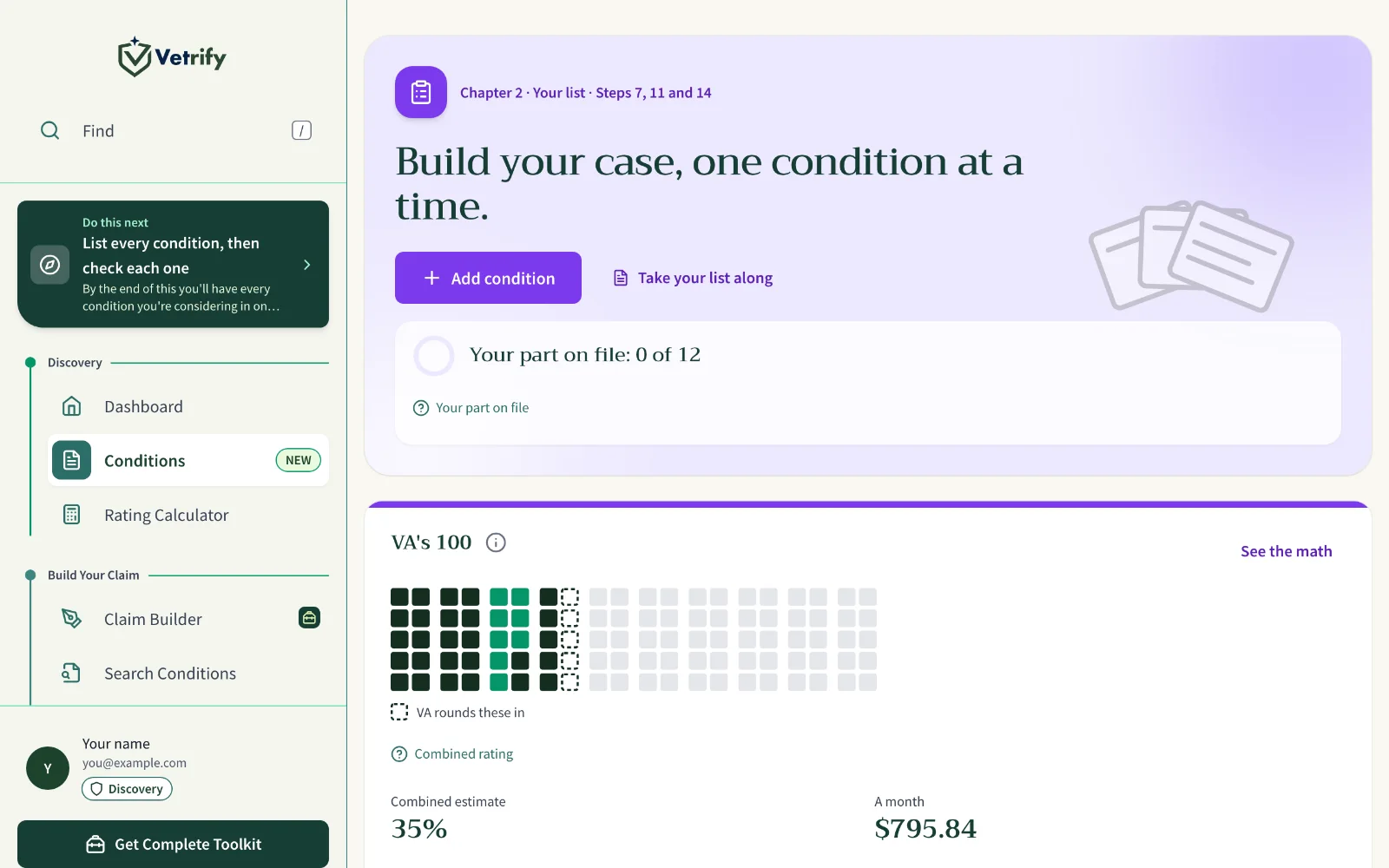
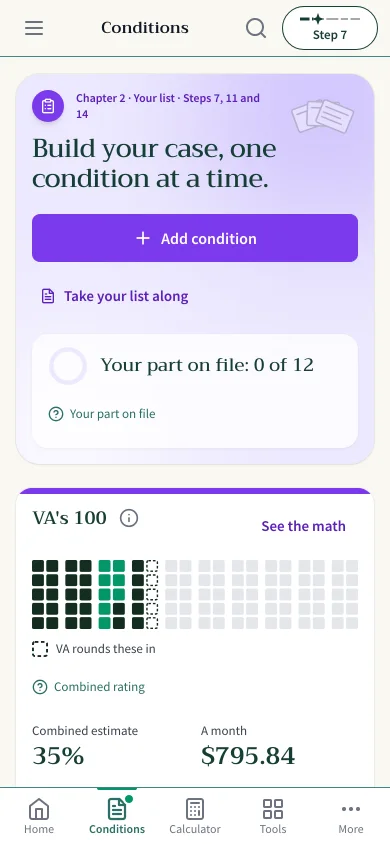
A free account keeps your conditions in one list and shows your combined rating as you add them. Have it ready when you ask the state about a benefit.
HOW TO READ THIS PAGE
Every row, in the source's own words.
Each benefit says what it is, who qualifies in the source's words, and where it comes from. Open a row to read the passage it quotes.
Find your kind of benefit
The benefits are grouped by kind. Start with the one you came for.
Read who qualifies
Each row quotes the source's own words on who qualifies.
Check with the state
Rules change. Ask the office named in the source before you count on a benefit.
Vetrify is not a state agency and not a law firm. This page points to each state's own words; the state decides who qualifies.
8 BENEFITS
Property tax
The state pays or reimburses all or part of the local property taxes you paid for the year on the home you own and use as your residence. The payment is figured on the first $175,000 of the home's full market value. VA's determination of your disability status is conclusive, and no one who was dishonorably discharged from any of the armed services can get this relief.
Who qualifies, in the source's wordsOther rule
“a "disabled veteran" means a person who has served in the armed forces of the United States, and who has: (1) Acquired in connection with such service a disability from paraplegia or permanent paralysis of both legs and lower part of the body resulting from traumatic injury or disease to the spinal cord or brain, or from legal blindness, or from loss or loss of use of two (2) or more limbs from any service-connected cause; (2) Acquired one hundred percent (100%) permanent total disability, as determined by the United States veterans' administration, and such disability resulting from having served as a prisoner of war; or (3) Acquired service-connected permanent and total disability or disabilities, as determined by the United States department of veterans' affairs. (c) Under no conditions shall property tax relief extend to any person who was dishonorably discharged from any of the armed services.”
What the source says
“(a) (1) There shall be paid from the general funds of the state to certain disabled veterans the amount necessary to pay or reimburse such taxpayers for all or part of the local property taxes paid for a given tax year on that property that the disabled veteran owned and used as the disabled veteran's residence as provided in this section. (2) Such reimbursement shall be paid on the first one hundred seventy-five thousand dollars ($175,000) of the full market value of such property. (3) In determining the amount of relief to a taxpayer, the effective assessed value on the first one hundred seventy-five thousand dollars ($175,000) of full market value shall be multiplied by a tax rate that has been adjusted to reflect the relationship between appraised value and market value in that jurisdiction, as determined by the state board of equalization. (4) The effective assessed value shall be determined by multiplying the full market value of the property up to one hundred seventy-five thousand dollars ($175,000) by twenty-five percent (25%). (5) The full market value of the property shall be determined by adjusting the appraised value of the property as shown on the records of the assessor of property by a factor that reflects the relationship between appraised value and market value in that jurisdiction, as determined by the state board of equalization. (b) For the purposes of this section, a "disabled veteran" means a person who has served in the armed forces of the United States, and who has: (1) Acquired in connection with such service a disability from paraplegia or permanent paralysis of both legs and lower part of the body resulting from traumatic injury or disease to the spinal cord or brain, or from legal blindness, or from loss or loss of use of two (2) or more limbs from any service-connected cause; (2) Acquired one hundred percent (100%) permanent total disability, as determined by the United States veterans' administration, and such disability resulting from having served as a prisoner of war; or (3) Acquired service-connected permanent and total disability or disabilities, as determined by the United States department of veterans' affairs. (c) Under no conditions shall property tax relief extend to any person who was dishonorably discharged from any of the armed services. (d) The determination of the United States veterans' administration concerning the disability status of a veteran shall be conclusive for purposes of this section.”
Source: Tenn. Code Ann. 67-5-704, Disabled veteran's residence (the Tennessee Comptroller's copy of 67-5-701 through 67-5-704). Read .
Disabled veterans' property tax relief continues for the surviving spouse of a veteran who was eligible for it at death, or who would have been eligible under a later change in the law, as long as the spouse does not remarry, solely or jointly owns the property, and uses it only as a home.
Who qualifies, in the source's wordsOther rule
“the surviving spouse of a disabled veteran who, at the time of the disabled veteran's death, was eligible for disabled veterans' property tax relief. If a subsequent amendment to the law concerning eligibility as a disabled veteran would have made the deceased veteran eligible for disabled veterans' property tax relief, then property tax relief shall also be extended to the surviving spouse. A surviving spouse shall continue to qualify for disabled veterans' property tax relief as long as the surviving spouse: (1) Does not remarry; (2) Solely or jointly owns the property for which tax relief is claimed; and (3) Uses the property for which tax relief is claimed exclusively as a home.”
What the source says
“(e) Property tax relief shall also be extended to the surviving spouse of a disabled veteran who, at the time of the disabled veteran's death, was eligible for disabled veterans' property tax relief. If a subsequent amendment to the law concerning eligibility as a disabled veteran would have made the deceased veteran eligible for disabled veterans' property tax relief, then property tax relief shall also be extended to the surviving spouse. A surviving spouse shall continue to qualify for disabled veterans' property tax relief as long as the surviving spouse: (1) Does not remarry; (2) Solely or jointly owns the property for which tax relief is claimed; and (3) Uses the property for which tax relief is claimed exclusively as a home.”
Source: Tenn. Code Ann. 67-5-704, Disabled veteran's residence (the Tennessee Comptroller's copy of 67-5-701 through 67-5-704). Read .
Property tax relief also goes to the surviving spouse of a veteran whose death VA determined resulted from a service-connected, combat-related cause, as long as the spouse does not remarry and the property is owned by and used only by the spouse as a home.
Who qualifies, in the source's wordsOther rule
“the surviving spouse of a veteran whose death results from a service-connected, combat-related cause, as determined by the United States veterans' administration; provided, that: (1) The surviving spouse does not remarry; and (2) The property for which tax relief is claimed is owned by and used exclusively by the surviving spouse as a home.”
What the source says
“(f) Property tax relief shall also be extended to the surviving spouse of a veteran whose death results from a service-connected, combat-related cause, as determined by the United States veterans' administration; provided, that: (1) The surviving spouse does not remarry; and (2) The property for which tax relief is claimed is owned by and used exclusively by the surviving spouse as a home.”
Source: Tenn. Code Ann. 67-5-704, Disabled veteran's residence (the Tennessee Comptroller's copy of 67-5-701 through 67-5-704). Read .
Property tax relief also goes to the surviving spouse of a soldier whose death resulted from being deployed, away from any home base of training and in support of combat or peace operations, as long as the spouse does not remarry, solely or jointly owns the property, and uses it only as a home.
Who qualifies, in the source's wordsOther rule
“the surviving spouse of a soldier whose death results from being deployed, away from any home base of training and in support of combat or peace operations; provided, that the surviving spouse: (1) Does not remarry; (2) Solely or jointly owns the property for which tax relief is claimed; and (3) Uses the property for which tax relief is claimed exclusively as a home.”
What the source says
“(g) Property tax relief shall also be extended to the surviving spouse of a soldier whose death results from being deployed, away from any home base of training and in support of combat or peace operations; provided, that the surviving spouse: (1) Does not remarry; (2) Solely or jointly owns the property for which tax relief is claimed; and (3) Uses the property for which tax relief is claimed exclusively as a home.”
Source: Tenn. Code Ann. 67-5-704, Disabled veteran's residence (the Tennessee Comptroller's copy of 67-5-701 through 67-5-704). Read .
This relief takes the place of, and does not add to, the relief for elderly low-income or disabled homeowners under sections 67-5-702 and 67-5-703. A disabled veteran keeps qualifying while temporarily staying with a friend or relative, or in a hospital or skilled or intermediate care facility, for health care, if the disabled veteran indicates an intent to return to the residence when recovered sufficiently.
Who qualifies, in the source's wordsOther rule
“A disabled veteran shall continue to qualify for property tax relief while the disabled veteran is temporarily relocated for health care to the home of a friend or relative, or to a hospital or skilled or intermediate care facility if the disabled veteran indicates an intent to return to the residence when recovered sufficiently.”
What the source says
“(h) The refund provided by this section shall be in lieu of any payment under § 67-5-702 or § 67-5-703. (i) Any information concerning the disability status of a disabled veteran or the death of a soldier shall be confidential and shall not be subject to inspection under Tennessee public records law, compiled in title 10, chapter 7, but shall be available to local or state officials who administer, enforce, or audit the tax relief program or requirements under this section. (j) A disabled veteran shall continue to qualify for property tax relief while the disabled veteran is temporarily relocated for health care to the home of a friend or relative, or to a hospital or skilled or intermediate care facility if the disabled veteran indicates an intent to return to the residence when recovered sufficiently.”
Source: Tenn. Code Ann. 67-5-704, Disabled veteran's residence (the Tennessee Comptroller's copy of 67-5-701 through 67-5-704). Read .
Tax relief is not an exemption: the state reimburses part or all of the property taxes you paid, so you still get your tax bills and must pay your property taxes each year. The amount depends on your property assessment, your county or city tax rate and the county appraisal ratio, and can change from year to year. Relief is only for your primary residence. Once you are approved, a tax relief voucher comes with your tax bills, and you present it to the collecting official before the deadline with payment of any balance due.
Who qualifies, in the source's wordsOther rule
“Tax relief is payment by the State of Tennessee to reimburse homeowners meeting certain eligibility requirements, for a part or all of paid property taxes.”
What the source says
“1. Are tax relief recipients exempt from paying property taxes? NO. Tax relief is payment by the State of Tennessee to reimburse homeowners meeting certain eligibility requirements, for a part or all of paid property taxes. Tax Relief is not an exemption. You still receive your tax bill(s) and are responsible for paying your property taxes each year. 2. How much tax relief will I get? The amount varies depending on your property assessment, county/city tax rate, and county appraisal ratio. 3. Will my tax relief check be the same each year? The amount may vary year to year depending on your property assessment and your county or city tax rate. 4. How long does it take to process an application? Processing time depends on the amount of workload received at any given time within the tax year. So it is not possible to provide a specific length of time in which to expect your application to process. 5. Are tax relief checks forwarded? NO. State checks may not be forwarded. 6. What should I do if I will be away from my home for an extended period of time? Notify the collecting official of any address changes or expected absences. 7. Can I receive relief on more than one property? NO. You can only receive tax relief on your primary residence in any given tax year. 8. What happens next year if I am approved for tax relief? You will receive a property tax relief voucher when you receive your property tax bill(s). You will need to present the voucher(s) to the collecting official(s) before the deadline date along with payment of any balance due.”
Source: Tennessee Comptroller of the Treasury, Property Tax Relief (frequently asked questions). Read .
Eligibility is decided from information VA provides through consent forms: a disabled veteran completes form F-16, and the widow or widower of a disabled veteran completes form F-16S. The forms are at the county trustee's office or the city collecting official's office.
Who qualifies, in the source's wordsOther rule
“a homeowner who is a disabled veteran or widow(er) of a disabled veteran”
What the source says
“Determination of eligibility for a homeowner who is a disabled veteran or widow(er) of a disabled veteran will be made based on information provided by the VA through use of consent forms. If you are applying as a disabled veteran, you will need to complete an F-16 or, for a widow(er) of a disabled veteran you must complete an F-16S. These forms are available at the county trustee’s office or the city collecting official’s office.”
Source: Tennessee Comptroller of the Treasury, 2026 Property Tax Relief Brochure. Read .
For 2026, you may apply when you receive your 2026 property tax bills. The deadline is 35 days after the delinquency date, and your taxes must also be paid by then.
Who qualifies, in the source's wordsOther rule
“You may apply when you receive your 2026 property tax bill(s).”
What the source says
“When do I apply? You may apply when you receive your 2026 property tax bill(s). The deadline to apply is 35 days after the delinquency date. Taxes must also be paid by this date.”
Source: Tennessee Comptroller of the Treasury, 2026 Property Tax Relief Brochure. Read .
Not covered on this page yet
These have no row here yet, so the page is not a full list. Ask the Tennessee Department of Veterans Services about them.
- Vehicle benefits (license plates and the county privilege tax): tn.gov refused automated reading on 2026-11-25, so there is no row yet.
- Education benefits (the Higher Education Commission): tn.gov refused automated reading on 2026-11-25, so there is no row yet.
- Hunting and fishing licenses (the Wildlife Resources Agency): tn.gov refused automated reading on 2026-11-25, so there is no row yet.
- The Tennessee Department of Veterans Services' own list of benefits: tn.gov refused automated reading on 2026-11-25, so no row quotes it.

On the App Store
Your combined rating and what it pays, on your phone.
VA Calc combines your ratings with VA's whole-person formula and shows what that rating pays at VA's official rates.
Official sources
- Tenn. Code Ann. 67-5-704, Disabled veteran's residence (the Tennessee Comptroller's copy of 67-5-701 through 67-5-704), comptroller.tn.gov
- Tennessee Comptroller of the Treasury, Property Tax Relief (frequently asked questions), comptroller.tn.gov
- Tennessee Comptroller of the Treasury, 2026 Property Tax Relief Brochure, comptroller.tn.gov