
STATE BENEFITS FOR VETERANS · NC
North Carolina benefits for veterans
Quoted from the state's own law and agencies
What North Carolina law and North Carolina agencies say about property tax, vehicles and license plates, education and tuition, and other state benefits. Every row quotes its source and shows the day we read it.
See the benefitsFree · No account needed
Your North Carolina benefits list, in your inbox
Email yourself every North Carolina benefit on this page, with who qualifies in the source's words, each source and the day we read it.
North Carolina
YOUR NEXT STEP
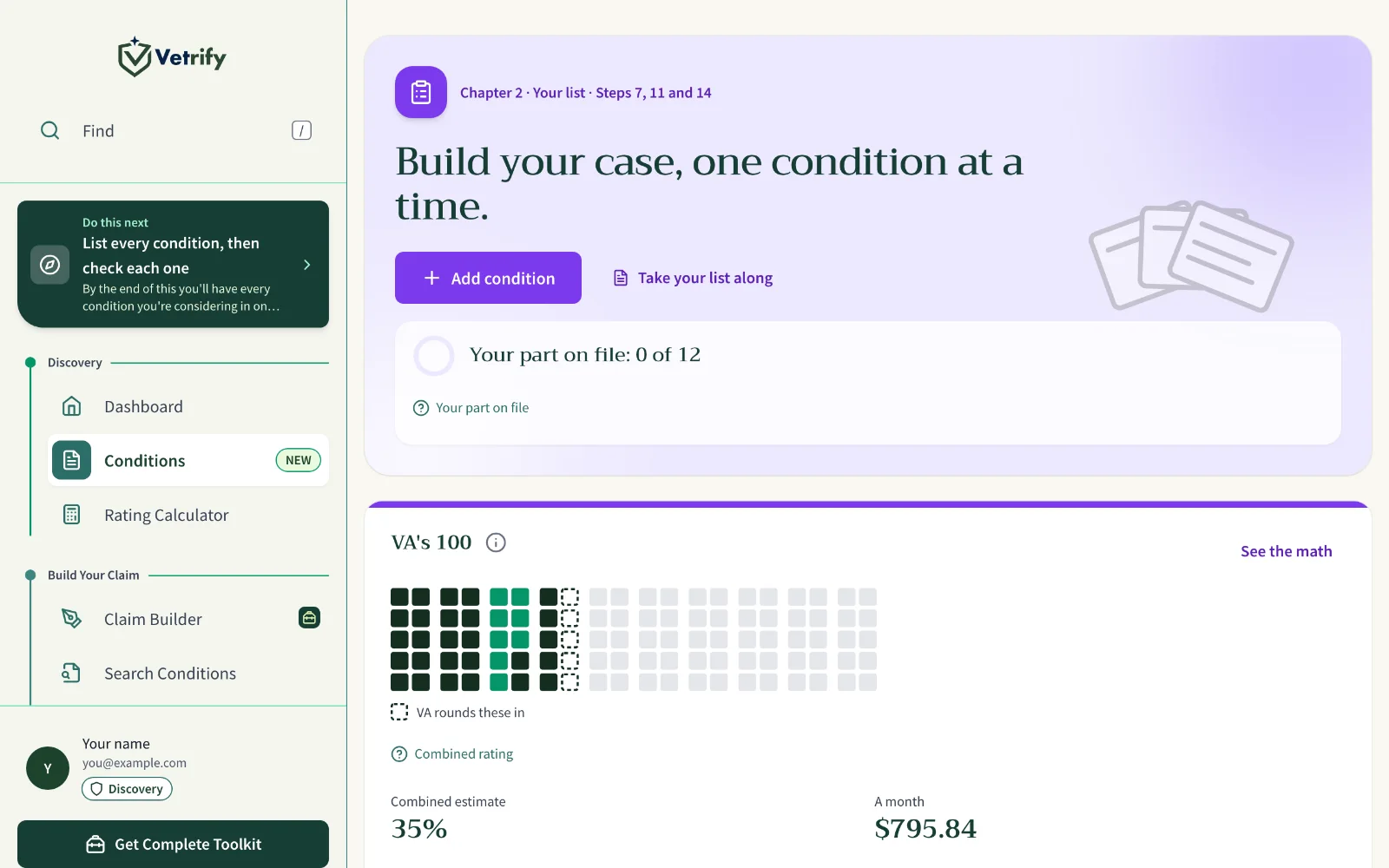
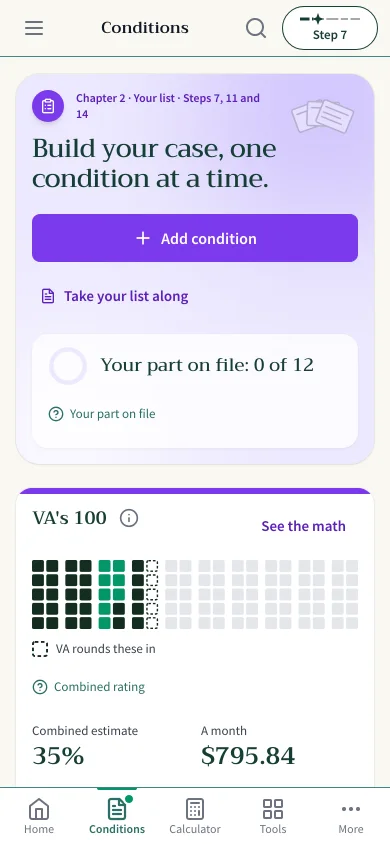
Keep your VA rating at hand.
A free account keeps your conditions in one list and shows your combined rating as you add them. Have it ready when you ask the state about a benefit.
HOW TO READ THIS PAGE
Every row, in the source's own words.
Each benefit says what it is, who qualifies in the source's words, and where it comes from. Open a row to read the passage it quotes.
Find your kind of benefit
The benefits are grouped by kind. Start with the one you came for.
Read who qualifies
Each row quotes the source's own words on who qualifies.
Check with the state
Rules change. Ask the office named in the source before you count on a benefit.
Vetrify is not a state agency and not a law firm. This page points to each state's own words; the state decides who qualifies.
4 BENEFITS
Property tax
The first $45,000 of the appraised value of a permanent residence you own and occupy is excluded from property tax. You must be a North Carolina resident, your service at separation must have been honorable or under honorable conditions, and as of January 1 before the tax year you must either have received benefits under 38 U.S.C. § 2101 or have a certification from VA or another federal agency of a service-connected, permanent, and total disability. If you receive this exclusion, you may not receive other property tax relief.
Who qualifies, in the source's wordsPermanent and total
“A veteran of any branch of the Armed Forces of the United States whose character of service at separation was honorable or under honorable conditions and who satisfies one of the following requirements: a. As of January 1 preceding the taxable year for which the exclusion allowed by this section is claimed, the veteran had received benefits under 38 U.S.C. § 2101. b. The veteran has received a certification by the United States Department of Veterans Affairs or another federal agency indicating that, as of January 1 preceding the taxable year for which the exclusion allowed by this section is claimed, he or she has a service-connected, permanent, and total disability.”
What the source says
“(a) Classification. - A permanent residence owned and occupied by a qualifying owner is designated a special class of property under Article V, Section 2(2) of the North Carolina Constitution and is taxable in accordance with this section. The first forty-five thousand dollars ($45,000) of appraised value of the residence is excluded from taxation. A qualifying owner who receives an exclusion under this section may not receive other property tax relief. (b) Definitions. - The following definitions apply in this section: (1) Disabled veteran. - A veteran of any branch of the Armed Forces of the United States whose character of service at separation was honorable or under honorable conditions and who satisfies one of the following requirements: a. As of January 1 preceding the taxable year for which the exclusion allowed by this section is claimed, the veteran had received benefits under 38 U.S.C. § 2101. b. The veteran has received a certification by the United States Department of Veterans Affairs or another federal agency indicating that, as of January 1 preceding the taxable year for which the exclusion allowed by this section is claimed, he or she has a service-connected, permanent, and total disability. c. The veteran is deceased and the United States Department of Veterans Affairs or another federal agency has certified that, as of January 1 preceding the taxable year for which the exclusion allowed by this section is claimed, the veteran's death was the result of a service-connected condition. (2) Repealed by Session Laws 2009-445, s. 22(c), effective for taxes imposed for taxable years beginning on or after July 1, 2009. (3) Permanent residence. - Defined in G.S. 105-277.1. (4) Property tax relief. - Defined in G.S. 105-277.1. (4a) Qualifying owner. - An owner, as defined in G.S. 105-277.1, who is a North Carolina resident and one of the following: a. A disabled veteran. b. The surviving spouse of a disabled veteran who has not remarried.”
Source: North Carolina General Statutes 105-277.1C, Disabled veteran property tax homestead exclusion. Read .
The same exclusion goes to a surviving spouse who has not remarried, is a North Carolina resident, and owns and occupies the home as a permanent residence. The veteran must have met the rules above, or VA or another federal agency must have certified that, as of January 1 before the tax year, the veteran's death was the result of a service-connected condition; either way the veteran's service at separation must have been honorable or under honorable conditions.
Who qualifies, in the source's wordsOther rule
“The surviving spouse of a disabled veteran who has not remarried.”
What the source says
“(a) Classification. - A permanent residence owned and occupied by a qualifying owner is designated a special class of property under Article V, Section 2(2) of the North Carolina Constitution and is taxable in accordance with this section. The first forty-five thousand dollars ($45,000) of appraised value of the residence is excluded from taxation. A qualifying owner who receives an exclusion under this section may not receive other property tax relief. (b) Definitions. - The following definitions apply in this section: (1) Disabled veteran. - A veteran of any branch of the Armed Forces of the United States whose character of service at separation was honorable or under honorable conditions and who satisfies one of the following requirements: a. As of January 1 preceding the taxable year for which the exclusion allowed by this section is claimed, the veteran had received benefits under 38 U.S.C. § 2101. b. The veteran has received a certification by the United States Department of Veterans Affairs or another federal agency indicating that, as of January 1 preceding the taxable year for which the exclusion allowed by this section is claimed, he or she has a service-connected, permanent, and total disability. c. The veteran is deceased and the United States Department of Veterans Affairs or another federal agency has certified that, as of January 1 preceding the taxable year for which the exclusion allowed by this section is claimed, the veteran's death was the result of a service-connected condition. (2) Repealed by Session Laws 2009-445, s. 22(c), effective for taxes imposed for taxable years beginning on or after July 1, 2009. (3) Permanent residence. - Defined in G.S. 105-277.1. (4) Property tax relief. - Defined in G.S. 105-277.1. (4a) Qualifying owner. - An owner, as defined in G.S. 105-277.1, who is a North Carolina resident and one of the following: a. A disabled veteran. b. The surviving spouse of a disabled veteran who has not remarried.”
Source: North Carolina General Statutes 105-277.1C, Disabled veteran property tax homestead exclusion. Read .
A home owned and occupied by a husband and wife gets the full exclusion even if only one of them meets the rules.
Who qualifies, in the source's wordsOther rule
“A permanent residence owned and occupied by husband and wife”
What the source says
“(d) Ownership by Spouses - A permanent residence owned and occupied by husband and wife is entitled to the full benefit of this exclusion notwithstanding that only one of them meets the requirements of this section.”
Source: North Carolina General Statutes 105-277.1C, Disabled veteran property tax homestead exclusion. Read .
To apply, fill in Sections 1 and 2 of Form NCDVA-9, take it to your local veterans service office for certification, then send Form NCDVA-9 and Form AV-9 to your county tax office. The Department gives June 1 as the date for timely submission to the county and suggests getting the certification done well before then.
Who qualifies, in the source's wordsOther rule
“The property owner must be a veteran or a never-remarried surviving spouse of a veteran of any branch of the US Armed Forces with an honorable or under honorable conditions discharge AND a. If owned by veteran: The veteran must either (1) have a permanent and total service-connected disability of 100% or (2) receive benefits for specially adapted housing under 38 U.S.C. 2101. OR b. If owned by surviving spouse: The property owner must be the surviving spouse of either (1) a veteran who had a permanent and total service-connected disability or (2) a veteran that received benefits for specially adapted housing under 38 U.S.C. 2101 or (3) a veteran who died as a result of a service-connected condition.”
What the source says
“To qualify for the disabled veteran homestead property tax relief under North Carolina law a person must meet the following criteria: The property owner must be a veteran or a never-remarried surviving spouse of a veteran of any branch of the US Armed Forces with an honorable or under honorable conditions discharge AND a. If owned by veteran: The veteran must either (1) have a permanent and total service-connected disability of 100% or (2) receive benefits for specially adapted housing under 38 U.S.C. 2101. OR b. If owned by surviving spouse: The property owner must be the surviving spouse of either (1) a veteran who had a permanent and total service-connected disability or (2) a veteran that received benefits for specially adapted housing under 38 U.S.C. 2101 or (3) a veteran who died as a result of a service-connected condition. The disabled veteran homestead exemption is the first $45,000 of your assessed real property value. Co-owners who are not spouses and who are individually eligible for the benefit will receive no more than the first $45,000 of the assessed real property. $45,000 is the maximum allowed exclusion for property tax relief N.C.G.A 105.277.1C. 1. Complete Sections 1 and 2 of the NCDVA-9 Form. 2. Take the form to your local veteran’s service office for certification. 3. Once certified, submit Form NCDVA-9 and Form AV-9 Application for Property Tax Relief to your local county tax office. The date for timely submission of documents to your county tax office is June 1 of the current tax year. We recommend that you submit Form NCDVA-9 to the State Veterans Service Center or County Veterans Service Office well in advance of June 1 to allow sufficient time for the certification process.”
Source: Veterans Property Tax Relief | DMVA. Read .
6 BENEFITS
Vehicles and license plates
A Disabled Veteran special plate, for a motor vehicle or a motorcycle, for a veteran with a 100% service-connected disability.
Who qualifies, in the source's wordsTied to a VA rating
“a veteran of the Armed Forces of the United States who suffered a 100% service-connected disability”
What the source says
“(64) Disabled Veteran. - Issuable to a veteran of the Armed Forces of the United States who suffered a 100% service-connected disability. A person may obtain from the Division a special registration plate under this subdivision for the registered owner of a motor vehicle or a motorcycle.”
Source: North Carolina General Statutes 20-79.4, Special registration plates (subdivision (b)(64)). Read .
On request, one 100% Disabled Veteran plate for a motor vehicle and one for a motorcycle are issued free of charge each year. This does not apply to a vehicle with a registered weight greater than 6,000 pounds; the regular registration fees apply to those.
Who qualifies, in the source's wordsTied to a VA rating
“A 100% Disabled Veteran registration plate to a 100% disabled veteran.”
What the source says
“(a) Free of Charge. - Upon request, and except for the special registration plate listed in subdivision (2) of this subsection, the Division shall annually provide and issue free of charge a single special registration plate listed in this subsection to a person qualified to receive the plate in accordance with G.S. 20-79.4(a2). For the special registration plate listed in subdivision (2) of this subsection, and upon request, the Division shall annually provide and issue free of charge a single registration plate for both a motor vehicle and a motorcycle to a person qualified to receive each plate in accordance with G.S. 20-79.4(a2). This subsection does not apply to a special registration plate issued for a vehicle that has a registered weight greater than 6,000 pounds. The regular motor vehicle registration fees in G.S. 20-88 apply if the registered weight of the vehicle is greater than 6,000 pounds: (1) A Legion of Valor registration plate to a recipient of the Legion of Valor award. (2) A 100% Disabled Veteran registration plate to a 100% disabled veteran.”
Source: North Carolina General Statutes 20-79.7, Fees for special registration plates and distribution of the fees. Read .
The Department certifies the Disabled Veterans plate for a combined rating of 100%, or for Individual Unemployability paid at the 100% rate; any other rating is certified for the Partially Disabled Veteran plate. Bring a VA rating letter or summary of benefits letter showing the combined rating, dated and no more than one year old, with your name on the same page as the rating.
Who qualifies, in the source's wordsTied to a VA rating
“The Disabled Veterans License Plate is reserved for those who have a combined rating of 100% or receive Individual Unemployability (I.U.) and are paid at the 100% rate.”
What the source says
“For Disabled Veteran & Partially Disabled Veteran Plates Provide a copy of your VA Rating Letter or Summary of Benefits letter showing combined rating. This letter cannot be more than one year old, and must include a date. The veteran/owner’s name must be on the same page as the combined rating. The Disabled Veterans License Plate is reserved for those who have a combined rating of 100% or receive Individual Unemployability (I.U.) and are paid at the 100% rate. All other ratings will receive a partially disabled veteran certification.”
Source: Military and Veteran License Plates | DMVA. Read .
A Partially Disabled Veteran special plate, for a motor vehicle or a motorcycle, for a veteran with a service-connected disability of less than 100%.
Who qualifies, in the source's wordsTied to a VA rating
“a veteran of the Armed Forces of the United States who suffered a service connected disability of less than 100%”
What the source says
“(190) Partially Disabled Veteran. - Issuable to a veteran of the Armed Forces of the United States who suffered a service connected disability of less than 100%. A person may obtain from the Division a special registration plate under this subdivision for the registered owner of a motor vehicle or a motorcycle.”
Source: North Carolina General Statutes 20-79.4, Special registration plates (subdivision (b)(190)). Read .
The Partially Disabled Veteran plate costs nothing more than the regular license plate.
Who qualifies, in the source's wordsOther rule
“the following Military and Veteran License Plates are available at no additional cost than the regular license plate.”
What the source says
“As a benefit to Military and Veteran Community of the State of North Carolina, the following Military and Veteran License Plates are available at no additional cost than the regular license plate. Afghanistan Veteran Air Medal Recipient Bronze Star Recipient Desert Storm Veteran Gold Star Lapel Button Iraq Veteran Korean Conflict Legion of Merit Partially Disabled Veteran”
Source: Military and Veteran License Plates | DMVA. Read .
A surviving spouse may keep renewing a special plate based on military service that the veteran had, as long as the spouse does not remarry; that renewal is a qualifying condition that needs verification. Every plate based on military service is issued only with a motor vehicle registration (MVR) verification form signed by the Secretary of Military and Veterans Affairs or the Secretary's designee.
Who qualifies, in the source's wordsOther rule
“The surviving spouse of a person who had a special plate issued under the terms of this subsection may continue to renew the plate so long as the surviving spouse does not remarry.”
What the source says
“(a2) Special Plates Based Upon Military Service. - The Department of Military and Veterans Affairs shall be responsible for verifying and maintaining all verification documentation for all special plates that are based upon military service. The Department shall not issue a special plate that is based on military service unless the application is accompanied by a motor vehicle registration (MVR) verification form signed by the Secretary of Military and Veterans Affairs, or the Secretary's designee, showing that the Department of Military and Veterans Affairs has verified the applicant's credentials and qualifications to hold the special plate applied for. The following shall apply to special plates issued under this subsection: (1) Unless a qualifying condition exists requiring annual verification, no additional verification shall be required to renew a special registration plate either in person or through an online service. (2) If the Department of Military and Veterans Affairs determines a special registration plate has been issued due to an error on the part of the Division of Motor Vehicles, the plate shall be recalled and canceled. (3) If the Department of Military and Veterans Affairs determines a special registration plate has been issued to an applicant who falsified documents or has fraudulently applied for the special registration plate, the Division of Motor Vehicles shall revoke the special plate and take appropriate enforcement action. (4) The surviving spouse of a person who had a special plate issued under the terms of this subsection may continue to renew the plate so long as the surviving spouse does not remarry. This is a qualifying condition requiring verification under subdivision (1) of this subsection.”
Source: North Carolina General Statutes 20-79.4, Special registration plates (subsection (a2)). Read .
10 BENEFITS
Education and tuition
North Carolina's scholarship for children of war veterans. At a State educational institution it pays tuition, a standard board allowance, a standard room allowance, and the institutional fees required to stay enrolled, and for Classes I-A, I-B and IV the cost of short-term workforce training courses leading to industry credentials; at a private educational institution it is a money allowance. A child gets only one scholarship, for no more than four academic years, used within eight years of the first award. At a State educational institution it may not exceed the cost of attendance there, and other grants covering that cost reduce it. The student must keep a cumulative grade point average of 2.0.
Who qualifies, in the source's wordsOther rule
“Only one scholarship may be granted pursuant to this Part with respect to each child”
What the source says
“(a) A scholarship granted pursuant to this Part shall consist of the following benefits in either a State or private educational institution: (1) With respect to State educational institutions, unless expressly limited elsewhere in this Part, a scholarship shall consist of: a. Tuition at the State educational institution. b. A standard board allowance. c. A standard room allowance. d. Matriculation and other institutional fees required to be paid as a condition to remaining in the institution and pursuing the course of study selected. e. For Class I-A, I-B, and IV scholarships, as defined by G.S. 143B-1226(b), the cost of short-term workforce training courses leading to industry credentials. (2) With respect to private educational institutions, a scholarship shall consist of a monetary allowance as prescribed in G.S. 143B-1227(d). (3) Only one scholarship may be granted pursuant to this Part with respect to each child and it shall not extend for a longer period than four academic years, which years, however, need not be consecutive. (4) No educational assistance shall be afforded a child under this Part after the end of an eight-year period beginning on the date the scholarship is first awarded. Whenever a child is enrolled in an educational institution and the period of entitlement ends while enrolled in a term, quarter or semester, such period shall be extended to the end of such term, quarter or semester, but not beyond the entitlement limitation of four academic years. (5) A scholarship awarded to a student under this section shall not exceed the cost of attendance at the State educational institution at which the student is enrolled. If a student, who is eligible for a scholarship under this section, also receives a scholarship or other grant covering the cost of attendance at the State educational institution for which the scholarship is awarded, then the amount of the scholarship shall be reduced by an appropriate amount determined by the State educational institution at which the student is enrolled. The scholarship shall be reduced so that the sum of all grants and scholarship aid covering the cost of attendance received by the student, including the scholarship under this section, shall not exceed the cost of attendance for the State educational institution at which the student is enrolled. (6) A student who has been awarded a scholarship under this section shall maintain a cumulative grade point average of 2.0 throughout the four academic years for which the student is eligible for a scholarship under this section.”
Source: North Carolina General Statutes 143B-1225, Scholarship (scholarships for children of war veterans). Read .
For the scholarship, the child must be under 25 when applying, be a domiciliary and a resident of North Carolina when applying, have finished high school or its equivalent before receiving it, and have complied with Selective Service if it applies. Also, either the veteran parent was a legal resident of North Carolina on entering the period of service the scholarship is based on, or the child was born in North Carolina and has lived there continuously since birth. The Department may waive the birth rule only in the case the law describes.
Who qualifies, in the source's wordsOther rule
“(i) under 25 years of age at the time of application for a scholarship, (ii) who is a domiciliary of North Carolina and is a resident of North Carolina when applying for a scholarship, (iii) who has completed high school or its equivalent prior to receipt of a scholarship awarded under this Part, (iv) who has complied with the requirements of the Selective Service System, if applicable”
What the source says
“(3) "Child" means a person: (i) under 25 years of age at the time of application for a scholarship, (ii) who is a domiciliary of North Carolina and is a resident of North Carolina when applying for a scholarship, (iii) who has completed high school or its equivalent prior to receipt of a scholarship awarded under this Part, (iv) who has complied with the requirements of the Selective Service System, if applicable, and (v) who further meets one of the following requirements: a. A person whose veteran parent was a legal resident of North Carolina at the time of said veteran's entrance into that period of service in the Armed Forces during which eligibility is established under G.S. 143B-1226. b. A veteran's child who was born in North Carolina and has been a resident of North Carolina continuously since birth. Provided, that the requirement in the preceding sentence as to birth in North Carolina may be waived by the Department of Military and Veterans Affairs if it is shown to the satisfaction of the Department that the child's mother was a native-born resident of North Carolina and was such resident at the time of her marriage to the veteran and was outside the State temporarily at the time of the child's birth, following which the child was returned to North Carolina within a reasonable period of time where said child has since lived continuously. c. A person meeting either of the requirements set forth in subdivision (3) a or b above, and who is a child, as that term is defined in 37 U.S.C. § 401.”
Source: North Carolina General Statutes 143B-1224, Definitions (scholarships for children of war veterans). Read .
The veteran parent must have served in the Armed Forces in active federal service during a period of war, and either been separated under honorable conditions or be serving a second or later enlistment. The law's periods of war are World War I, World War II, the Korean Conflict, the Vietnam era, and the Persian Gulf War (from August 2, 1990, to a date set by Presidential proclamation or concurrent resolution of Congress), plus any service in which the parent died or was disabled as a direct result of armed conflict or in extra-hazardous service. State educational institutions are the constituent institutions of The University of North Carolina and the community colleges under Chapter 115D; a private educational institution must be a nonprofit college or university in North Carolina that meets the law's terms and is approved by the State Board of Veterans Affairs.
Who qualifies, in the source's wordsOther rule
“a person who served as a member of the Armed Forces in active federal service during a period of war and who was either separated from the Armed Forces under honorable conditions or who is currently serving in a second or subsequent enlistment”
What the source says
“(4) "Period of war" and "wartime" shall mean any of the periods or circumstances as defined below: a. World War I, meaning (i) the period beginning on April 6, 1917 and ending on November 11, 1918, and (ii) in the case of a veteran who served with the Armed Forces in Russia, the period beginning on April 6, 1917 and ending on April 1, 1920. b. World War II, meaning the period beginning on December 7, 1941 and ending on December 31, 1946. c. Korean Conflict, meaning the period beginning on June 27, 1950 and ending on January 31, 1955. d. Vietnam era, meaning the period beginning on August 5, 1964, and ending on May 7, 1975. e. Persian Gulf War, meaning the period beginning on August 2, 1990, and ending on the date prescribed by Presidential proclamation or concurrent resolution of the United States Congress. f. Any period of service in the Armed Forces during which the veteran parent of an applicant for a scholarship under this Part suffered death or disability (i) as a direct result of armed conflict or (ii) while engaged in extra-hazardous service, including such service under conditions simulating war. (5) "Private educational institution" means any junior college, senior college or university which is operated and governed by private interests not under the control of the federal, State or any local government, which is located within the State of North Carolina, which does not operate for profit, whose curriculum is primarily directed toward the awarding of associate, baccalaureate or graduate degrees, which agrees to the applicable administration and funding provisions of G.S. 143B-1227, of this Part, and which is otherwise approved by the State Board of Veterans Affairs. (6) "State educational institution" means any constituent institution of The University of North Carolina, or any community college operated under the provisions of Chapter 115D of the General Statutes of North Carolina. (7) "Veteran" means a person who served as a member of the Armed Forces in active federal service during a period of war and who was either separated from the Armed Forces under honorable conditions or who is currently serving in a second or subsequent enlistment. A person who was separated from the Armed Forces under honorable conditions and whose death or disability was incurred (i) as a direct result of armed conflict or (ii) while engaged in extra-hazardous service, including such service under conditions simulating war, is also a "veteran" and the death or disability is wartime service-connected.”
Source: North Carolina General Statutes 143B-1224, Definitions (scholarships for children of war veterans). Read .
A scholarship (Class I-A) shall be awarded to a child, as the law defines one, whose veteran parent was killed in action, or died from wounds or other causes not due to the parent's own willful misconduct while a member of the Armed Forces during a period of war, or has died of service-connected injuries, wounds, illness or other causes incurred or aggravated during wartime service, as rated by VA.
Who qualifies, in the source's wordsOther rule
“a. Was killed in action or died from wounds or other causes not due to the parent's own willful misconduct while a member of the Armed Forces during a period of war, or b. Has died of service-connected injuries, wounds, illness or other causes incurred or aggravated during wartime service in the Armed Forces, as rated by the United States Department of Veterans Affairs.”
What the source says
“(b) Scholarship Eligibility Classes. - (1) Class I-A: Under this class a scholarship shall be awarded to any child whose veteran parent: a. Was killed in action or died from wounds or other causes not due to the parent's own willful misconduct while a member of the Armed Forces during a period of war, or b. Has died of service-connected injuries, wounds, illness or other causes incurred or aggravated during wartime service in the Armed Forces, as rated by the United States Department of Veterans Affairs.”
Source: North Carolina General Statutes 143B-1226, Classes or categories of eligibility under which scholarships may be awarded. Read .
A limited scholarship (Class I-B), giving only the parts listed in G.S. 143B-1225(a)(1)a., d., and e., and G.S. 143B-1225(a)(2) (the row on what the scholarship pays sets them out), shall be awarded to a child, as the law defines one, whose veteran parent receives, or was receiving at death, compensation for a wartime service-connected disability of 100%, as rated by VA. If that parent dies of the wartime service-connected condition before the child has used all the scholarship time, the award changes to Class I-A for the rest of it.
Who qualifies, in the source's wordsTied to a VA rating
“is or was at the time of his death receiving compensation for a wartime service-connected disability of one hundred percent (100%) as rated by the United States Department of Veterans Affairs”
What the source says
“(2) Class I-B: Under this class a limited scholarship providing only those benefits set forth in G.S. 143B-1225(a)(1)a., d., and e., and G.S. 143B-1225(a)(2) shall be awarded to any child whose veteran parent, at the time the benefits pursuant to this Part are sought to be availed of, is or was at the time of his death receiving compensation for a wartime service-connected disability of one hundred percent (100%) as rated by the United States Department of Veterans Affairs. Provided, that if the veteran parent of a recipient under this class should die of his wartime service-connected condition before the recipient shall have utilized all of his scholarship eligibility time, then the North Carolina Department of Military and Veterans Affairs shall amend the recipient's award from Class I-B to Class I-A for the remainder of the recipient's eligibility time. The effective date of such an amended award shall be determined by the Department of Military and Veterans Affairs but, in no event shall it predate the date of the veteran parent's death.”
Source: North Carolina General Statutes 143B-1226, Classes or categories of eligibility under which scholarships may be awarded. Read .
A scholarship (Class II) may be awarded to a limited number of children each year whose veteran parent receives, or was receiving at death, compensation for a wartime service-connected disability of 20% or more but less than 100%, as rated by VA, or was awarded a Purple Heart for wounds received as a result of an act of any opposing armed force, an international terrorist attack, or military operations while serving as part of a peacekeeping force.
Who qualifies, in the source's wordsTied to a VA rating
“Is or was at the time of the parent's death receiving compensation for a wartime service-connected disability of twenty percent (20%) or more, but less than one hundred percent (100%), as rated by the United States Department of Veterans Affairs”
What the source says
“(3) Class II: Under this class a scholarship may be awarded to not more than 100 children yearly, each of whose veteran parent, at the time the benefits pursuant to this Part are sought to be availed of: a. Is or was at the time of the parent's death receiving compensation for a wartime service-connected disability of twenty percent (20%) or more, but less than one hundred percent (100%), as rated by the United States Department of Veterans Affairs, or b. Was awarded a Purple Heart for wounds received as a result of an act of any opposing armed force, as a result of an international terrorist attack, or as a result of military operations while serving as part of a peacekeeping force.”
Source: North Carolina General Statutes 143B-1226, Classes or categories of eligibility under which scholarships may be awarded. Read .
A scholarship (Class III) may be awarded to a limited number of children each year whose veteran parent draws, or drew at death, a pension for nonservice-connected permanent and total disability, as rated by VA; or is deceased; or served in a combat zone or waters next to one, or in any other campaign, expedition, or engagement for which the Department of Defense authorizes a campaign badge or medal.
Who qualifies, in the source's wordsOther rule
“a. Is or was at the time of his death drawing pension for permanent and total disability, nonservice-connected, as rated by the United States Department of Veterans Affairs. b. Is deceased. c. Served in a combat zone, or waters adjacent to a combat zone, or any other campaign, expedition, or engagement for which the United States Department of Defense authorizes a campaign badge or medal.”
What the source says
“(4) Class III: Under this class a scholarship may be awarded to not more than 100 children yearly, each of whose veteran parent, at the time the benefits pursuant to this Part are sought to be availed of: a. Is or was at the time of his death drawing pension for permanent and total disability, nonservice-connected, as rated by the United States Department of Veterans Affairs. b. Is deceased. c. Served in a combat zone, or waters adjacent to a combat zone, or any other campaign, expedition, or engagement for which the United States Department of Defense authorizes a campaign badge or medal.”
Source: North Carolina General Statutes 143B-1226, Classes or categories of eligibility under which scholarships may be awarded. Read .
A scholarship (Class IV) shall be awarded to a child whose parent, while serving honorably in the Armed Forces in active federal service during a period of war, was listed by the United States government as missing in action, captured in line of duty by a hostile force, or forcibly detained or interned in line of duty by a foreign government or power.
Who qualifies, in the source's wordsOther rule
“(i) missing in action, (ii) captured in line of duty by a hostile force, or (iii) forcibly detained or interned in line of duty by a foreign government or power”
What the source says
“(5) Class IV: Under this class a scholarship as defined in G.S. 143B-1225 shall be awarded to any child whose parent, while serving honorably as a member of the Armed Forces in active federal service during a period of war, as defined in G.S. 143B-1224(4), was listed by the United States government as (i) missing in action, (ii) captured in line of duty by a hostile force, or (iii) forcibly detained or interned in line of duty by a foreign government or power.”
Source: North Carolina General Statutes 143B-1226, Classes or categories of eligibility under which scholarships may be awarded. Read .
In-State tuition and applicable mandatory fees, without the usual 12-month residency requirement, at an institution of higher education as defined in G.S. 116-143.1(a)(3), to the extent required by 38 U.S.C. § 3679. Your abode must be North Carolina, you must give the school a letter of intent to establish residence in North Carolina, and you must meet the definition of a "covered individual" under 38 U.S.C. § 3679(c). A veteran here is a person who served active duty for not less than 90 days and was discharged or released.
Who qualifies, in the source's wordsOther rule
“Any veteran, dependent of a veteran, or other individual who qualifies for admission to an institution of higher education as defined in G.S. 116-143.1(a)(3)”
What the source says
“(a) Definitions. - The following definitions apply in this section: (1) Abode. - Has the same meaning as G.S. 116-143.3(a)(1). (2) Armed Forces. - Has the same meaning as G.S. 116-143.3(a)(2). (3) Veteran. - A person who served active duty for not less than 90 days in the Armed Forces, the Commissioned Corps of the U.S. Public Health Service, or the National Oceanic and Atmospheric Administration and who was discharged or released from such service. (b) Waiver of 12-Month Residency Requirement for Certain Individuals. - Any veteran, dependent of a veteran, or other individual who qualifies for admission to an institution of higher education as defined in G.S. 116-143.1(a)(3) is eligible to be charged the in-State tuition rate and applicable mandatory fees for enrollment, to the extent required by 38 U.S.C. § 3679, without satisfying the 12-month residency requirement under G.S. 116-143.1, provided the individual meets all of the following criteria: (1), (2) Repealed by Session Laws 2019-201, s. 5(a), effective August 23, 2019. (3) The individual's abode is North Carolina. (4) The individual provides the institution of higher education at which the individual intends to enroll a letter of intent to establish residence in North Carolina. (5) The individual meets the definition of a "covered individual" under 38 U.S.C. § 3679(c).”
Source: North Carolina General Statutes 116-143.3A, Waiver of 12-month residency requirement for certain veterans and other individuals. Read .
In North Carolina's in-State tuition law, an institution of higher education is a constituent institution of the University of North Carolina or a community college under the State Board of Community Colleges.
Who qualifies, in the source's wordsOther rule
“any of the constituent institutions of the University of North Carolina and the community colleges under the jurisdiction of the State Board of Community Colleges”
What the source says
“(3) "Institution of higher education" means any of the constituent institutions of the University of North Carolina and the community colleges under the jurisdiction of the State Board of Community Colleges.”
Source: North Carolina General Statutes 116-143.1, Provisions for determining resident status for tuition purposes. Read .
2 BENEFITS
Other state benefits
A lifetime hunting and fishing license for a North Carolina resident whom VA has found fifty percent or more disabled. It stays valid for life so long as you remain fifty percent or more disabled, and VA's certification must be sent with the application. The license types and prices are on the Wildlife Resources Commission's application.
Who qualifies, in the source's wordsTied to a VA rating
“an individual resident of North Carolina who is a fifty percent or more disabled veteran as determined by the U.S. Department of Veterans Affairs”
What the source says
“Lifetime Hunting & Fishing License for Resident Disabled Veterans Application This license shall be issued only to an individual resident of North Carolina who is a fifty percent or more disabled veteran as determined by the U.S. Department of Veterans Affairs, remaining valid for the lifetime of the individual so long as the individual remains fifty percent or more disabled. Certification from the Department of Veterans Affairs must be submitted with this application.”
Source: Hunting and Fishing License Application | DMVA. Read .
Retirement pay from the United States government for service in the uniformed services (as 10 U.S.C. § 101(a)(5) defines them) can be deducted in figuring North Carolina income tax, if the retiree served at least 20 years in the uniformed services or was medically retired under 10 U.S.C. Chapter 61. Severance pay for a separation under Chapter 61 does not count. Payments of a Plan defined in 10 U.S.C. § 1447 to the beneficiary of a retiree who qualifies can also be deducted.
Who qualifies, in the source's wordsOther rule
“1. Served at least 20 years in the uniformed services. 2. Medically retired under 10 U.S.C. Chapter 61.”
What the source says
“(5a) The amount received during the taxable year from the United States government for the payments listed in this subdivision. Amounts deducted under this subdivision may not also be deducted under subdivision (5) of this subsection. The payments are: a. Retirement pay for service in the uniformed services of the United States to a retired member that meets either of the criteria listed in this sub-subdivision. For purposes of this sub-subdivision, the term "uniformed services" has the same meaning as in 10 U.S.C. § 101(a)(5). The criteria are: 1. Served at least 20 years in the uniformed services. 2. Medically retired under 10 U.S.C. Chapter 61. This deduction does not apply to severance pay received by a person due to separation under 10 U.S.C. Chapter 61. b. Payments of a Plan defined in 10 U.S.C. § 1447 to a beneficiary of a retired member eligible to deduct retirement pay under sub-subdivision a. of this subdivision.”
Source: North Carolina General Statutes 105-153.5, Modifications to adjusted gross income (subdivision (b)(5a)). Read .
Not covered on this page yet
These have no row here yet, so the page is not a full list. Ask the North Carolina Department of Military and Veterans Affairs about them.
- The yearly cap on Class II and Class III scholarships: the law and the Department's scholarship page give different numbers, so no row states it.
- The price of the disabled veteran lifetime hunting and fishing license: the law and the Wildlife Resources Commission's application differ, so no row states it.
- Bills in the General Assembly's 2025-2026 session that would raise or widen the disabled veteran homestead exclusion: not law when read.
On the App Store
Your combined rating and what it pays, on your phone.
VA Calc combines your ratings with VA's whole-person formula and shows what that rating pays at VA's official rates.
Official sources
- North Carolina General Statutes 105-277.1C, Disabled veteran property tax homestead exclusion, www.ncleg.gov
- Veterans Property Tax Relief | DMVA, www.milvets.nc.gov
- North Carolina General Statutes 20-79.4, Special registration plates (subdivision (b)(64)), www.ncleg.gov
- North Carolina General Statutes 20-79.7, Fees for special registration plates and distribution of the fees, www.ncleg.gov
- Military and Veteran License Plates | DMVA, www.milvets.nc.gov
- North Carolina General Statutes 143B-1225, Scholarship (scholarships for children of war veterans), www.ncleg.gov
- North Carolina General Statutes 143B-1224, Definitions (scholarships for children of war veterans), www.ncleg.gov
- North Carolina General Statutes 143B-1226, Classes or categories of eligibility under which scholarships may be awarded, www.ncleg.gov
- North Carolina General Statutes 116-143.3A, Waiver of 12-month residency requirement for certain veterans and other individuals, www.ncleg.gov
- North Carolina General Statutes 116-143.1, Provisions for determining resident status for tuition purposes, www.ncleg.gov
- Hunting and Fishing License Application | DMVA, www.milvets.nc.gov
- North Carolina General Statutes 105-153.5, Modifications to adjusted gross income (subdivision (b)(5a)), www.ncleg.gov