
STATE BENEFITS FOR VETERANS · TX
Texas benefits for veterans
Quoted from the state's own law and agencies
What Texas law and Texas agencies say about property tax, vehicles and license plates, education and tuition, and other state benefits. Every row quotes its source and shows the day we read it.
See the benefitsFree · No account needed
Your Texas benefits list, in your inbox
Email yourself every Texas benefit on this page, with who qualifies in the source's words, each source and the day we read it.
Texas
YOUR NEXT STEP
Keep your VA rating at hand.
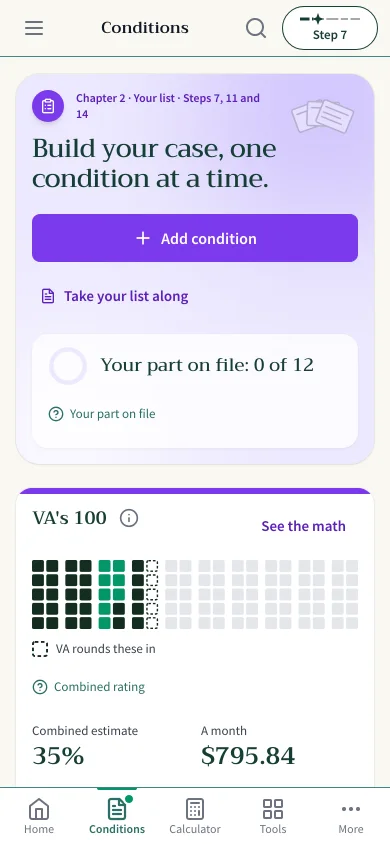
A free account keeps your conditions in one list and shows your combined rating as you add them. Have it ready when you ask the state about a benefit.

HOW TO READ THIS PAGE
Every row, in the source's own words.
Each benefit says what it is, who qualifies in the source's words, and where it comes from. Open a row to read the passage it quotes.
Find your kind of benefit
The benefits are grouped by kind. Start with the one you came for.
Read who qualifies
Each row quotes the source's own words on who qualifies.
Check with the state
Rules change. Ask the office named in the source before you count on a benefit.
Vetrify is not a state agency and not a law firm. This page points to each state's own words; the state decides who qualifies.
12 BENEFITS
Property tax
Your residence homestead is exempt from property tax on its total appraised value.
Who qualifies, in the source's wordsTied to a VA rating
“A disabled veteran who has been awarded by the United States Department of Veterans Affairs or its successor 100 percent disability compensation due to a service-connected disability and a rating of 100 percent disabled or of individual unemployability”
What the source says
“A disabled veteran who has been awarded by the United States Department of Veterans Affairs or its successor 100 percent disability compensation due to a service-connected disability and a rating of 100 percent disabled or of individual unemployability is entitled to an exemption from taxation of the total appraised value of the veteran's residence homestead.”
Source: Texas Tax Code Sec. 11.131. Residence Homestead of 100 Percent or Totally Disabled Veteran. Read .
The surviving spouse of a 100 percent disabled veteran can keep the homestead exemption on the same home.
Who qualifies, in the source's wordsOther rule
“A surviving spouse of a disabled veteran who qualified for this exemption or who would have qualified for this exemption if it had been in effect at the time of the veteran's death is eligible if: the surviving spouse has not remarried; the property was the surviving spouse's residence homestead at the time of the veteran's death; and the property remains the surviving spouse's residence homestead.”
What the source says
“Who qualifies for the exemption for the surviving spouse of 100 percent disabled veterans? A surviving spouse of a disabled veteran who qualified for this exemption or who would have qualified for this exemption if it had been in effect at the time of the veteran's death is eligible if: the surviving spouse has not remarried; the property was the surviving spouse's residence homestead at the time of the veteran's death; and the property remains the surviving spouse's residence homestead.”
Source: 100 Percent Disabled Veteran and Surviving Spouse Frequently Asked Questions. Read .
An exemption of up to $5,000, $7,500, $10,000 or $12,000 from a property's value, set by your disability rating.
Who qualifies, in the source's wordsTied to a VA rating
“10% to 29% $5,000 from the property's value 30% to 49% $7,500 from the property's value 50% to 69% $10,000 from the property's value 70% to 100% $12,000 from the property's value”
What the source says
“The exemption amount depends on the veteran's disability rating from the U.S. Veterans' Administration or the branch of the armed services in which the veteran served. Disabled Veteran Exemption Disability Rating Exemption Amount Up To 10% to 29% $5,000 from the property's value 30% to 49% $7,500 from the property's value 50% to 69% $10,000 from the property's value 70% to 100% $12,000 from the property's value”
Source: Disabled Veteran and Surviving Spouse Exemptions Frequently Asked Questions. Read .
A $12,000 exemption from the assessed value of a property you own and designate.
Who qualifies, in the source's wordsTied to a VA rating
“if the veteran: (1) is 65 years of age or older and has a disability rating of at least 10 percent; (2) is totally blind in one or both eyes; or (3) has lost the use of one or more limbs”
What the source says
“A disabled veteran is entitled to an exemption from taxation of $12,000 of the assessed value of a property the veteran owns and designates as provided by Subsection (f) of this section if the veteran: (1) is 65 years of age or older and has a disability rating of at least 10 percent; (2) is totally blind in one or both eyes; or (3) has lost the use of one or more limbs.”
Source: Texas Tax Code Sec. 11.22. Disabled Veterans. Read .
If you qualify for both the rating-based exemption and the age, blindness or limb exemption in this section, you get only one of them, and you may choose the greatest.
Who qualifies, in the source's wordsOther rule
“a disabled veteran who qualifies for more than one exemption authorized by Subsections (a) and (b) of this section”
What the source says
“(e) An individual who qualifies for more than one exemption authorized by this section is entitled to aggregate the amounts of the exemptions, except that: (1) a disabled veteran who qualifies for more than one exemption authorized by Subsections (a) and (b) of this section is entitled to only one exemption but may choose the greatest exemption for which he qualifies;”
Source: Texas Tax Code Sec. 11.22. Disabled Veterans. Read .
The rating-based, age, blindness or limb, and surviving family exemptions in this section of the Tax Code go only to a resident of Texas.
Who qualifies, in the source's wordsOther rule
“unless he is a resident of this state”
What the source says
“(g) An individual is not entitled to an exemption by this section unless he is a resident of this state.”
Source: Texas Tax Code Sec. 11.22. Disabled Veterans. Read .
The surviving spouse gets the same exemption amount the veteran had at death, on a property the spouse owns and designates, while unmarried.
Who qualifies, in the source's wordsOther rule
“If a disabled veteran who is entitled to an exemption by Subsection (a) or (b) of this section dies, the veteran's surviving spouse is entitled to an exemption from taxation of a portion of the assessed value of a property the spouse owns and designates as provided by Subsection (f) of this section. The amount of the exemption is the amount of the veteran's exemption at time of death. The spouse is entitled to an exemption by this subsection only for as long as the spouse remains unmarried.”
What the source says
“If a disabled veteran who is entitled to an exemption by Subsection (a) or (b) of this section dies, the veteran's surviving spouse is entitled to an exemption from taxation of a portion of the assessed value of a property the spouse owns and designates as provided by Subsection (f) of this section. The amount of the exemption is the amount of the veteran's exemption at time of death. The spouse is entitled to an exemption by this subsection only for as long as the spouse remains unmarried.”
Source: Texas Tax Code Sec. 11.22. Disabled Veterans. Read .
A $5,000 exemption from the assessed value of a property the surviving spouse owns and designates.
Who qualifies, in the source's wordsOther rule
“If an individual dies while on active duty as a member of the armed services of the United States: (1) the individual's surviving spouse”
What the source says
“If an individual dies while on active duty as a member of the armed services of the United States: (1) the individual's surviving spouse is entitled to an exemption from taxation of $5,000 of the assessed value of the property the spouse owns and designates as provided by Subsection (f) of this section”
Source: Texas Tax Code Sec. 11.22. Disabled Veterans. Read .
A disabled veteran with a disability rating of less than 100 percent may qualify for an exemption on a residence homestead donated by a charitable organization, equal in percentage to the veteran's disability rating.
Who qualifies, in the source's wordsTied to a VA rating
“A disabled veteran with a disability rating of less than 100 percent”
What the source says
“A disabled veteran with a disability rating of less than 100 percent may qualify for an exemption on their residence homestead donated by a charitable organization. The percentage amount of the exemption is equal to the disabled veteran's disability rating.”
Source: Disabled Veteran and Surviving Spouse Exemptions Frequently Asked Questions. Read .
The same percentage exemption extends to the surviving spouse if the spouse has not remarried, the home was the spouse's homestead when the disabled veteran died, and it remains the spouse's residence homestead.
Who qualifies, in the source's wordsOther rule
“the surviving spouse if: the surviving spouse has not remarried; the property was the surviving spouse's homestead when the disabled veteran died; and the property remains his or her residence homestead”
What the source says
“A disabled veteran with a disability rating of less than 100 percent may qualify for an exemption on their residence homestead donated by a charitable organization. The percentage amount of the exemption is equal to the disabled veteran's disability rating. The same percentage exemption extends to the surviving spouse if: the surviving spouse has not remarried; the property was the surviving spouse's homestead when the disabled veteran died; and the property remains his or her residence homestead.”
Source: Disabled Veteran and Surviving Spouse Exemptions Frequently Asked Questions. Read .
The surviving spouse's residence homestead is exempt from property tax on its total appraised value.
Who qualifies, in the source's wordsOther rule
“The surviving spouse of a member of the armed services of the United States who is killed or fatally injured in the line of duty is entitled to an exemption from taxation of the total appraised value of the surviving spouse's residence homestead if the surviving spouse has not remarried since the death of the member of the armed services.”
What the source says
“The surviving spouse of a member of the armed services of the United States who is killed or fatally injured in the line of duty is entitled to an exemption from taxation of the total appraised value of the surviving spouse's residence homestead if the surviving spouse has not remarried since the death of the member of the armed services.”
Source: Texas Tax Code Sec. 11.133. Residence Homestead of Surviving Spouse of Member of Armed Services Killed in Line of Duty. Read .
A total property tax exemption on the residence homestead of the surviving spouse of a veteran who died as a result of a condition or disease the PACT Act presumes service-connected, whatever the veteran's disability rating, if the spouse has not remarried.
Who qualifies, in the source's wordsOther rule
“The surviving spouse of a qualifying veteran is entitled to an exemption from taxation of the total appraised value of the surviving spouse's residence homestead if the surviving spouse has not remarried since the death of the veteran.”
What the source says
“(a) In this section: (1) "Qualifying condition or disease" means a condition or disease for which the Sergeant First Class Heath Robinson Honoring our Promise to Address Comprehensive Toxics Act of 2022 (Pub. L. No. 117-168) or a regulation adopted under that Act establishes a presumption of service connection. (2) "Qualifying veteran" means a veteran of the armed services of the United States who died as a result of a qualifying condition or disease, regardless of the veteran's disability rating at the time of the veteran's death. (3) "Residence homestead" has the meaning assigned by Section 11.13. (4) "Surviving spouse" means the individual who was married to a qualifying veteran at the time of the veteran's death. (b) The surviving spouse of a qualifying veteran is entitled to an exemption from taxation of the total appraised value of the surviving spouse's residence homestead if the surviving spouse has not remarried since the death of the veteran.”
Source: Texas Tax Code Sec. 11.136. Residence Homesteads of Surviving Spouses of Certain Qualifying Veterans. Read .
4 BENEFITS
Vehicles and license plates
You are entitled to register motor vehicles you own, for your own use, under the specialty license plate section for veterans with disabilities, if the vehicle has a gross vehicle weight of 18,000 pounds or less or is a motor home.
Who qualifies, in the source's wordsTied to a VA rating
“(1) the person has suffered, as a result of military service: (A) at least a 50 percent service-connected disability; or (B) a 40 percent service-connected disability because of the amputation of a lower extremity; (2) the person receives compensation from the United States because of the disability”
What the source says
“A veteran of the United States armed forces is entitled to register, for the person's own use, motor vehicles under this section if: (1) the person has suffered, as a result of military service: (A) at least a 50 percent service-connected disability; or (B) a 40 percent service-connected disability because of the amputation of a lower extremity; (2) the person receives compensation from the United States because of the disability; and (3) the motor vehicle: (A) is owned by the person; and (B) has a gross vehicle weight of 18,000 pounds or less or is a motor home.”
Source: Texas Transportation Code Sec. 504.202. Veterans with Disabilities. Read .
A person entitled to these plates may register one vehicle, for the person's own use, without paying any fee at registration except the fee for the plates. The registration is valid for one year.
Who qualifies, in the source's wordsOther rule
“A person entitled to specialty license plates under this section”
What the source says
“A person entitled to specialty license plates under this section may register, for the person's own use, one vehicle without payment of any fee paid for or at the time of registration except the fee for the license plates. Registration under this section is valid for one year.”
Source: Texas Transportation Code Sec. 504.202. Veterans with Disabilities. Read .
Specialty plates for the surviving spouse of a disabled veteran. The spouse may register one vehicle, for the spouse's own use, without paying any fee except the plate fee.
Who qualifies, in the source's wordsOther rule
“the surviving spouse of a person who had been entitled to specialty plates for veterans with disabilities under Section 504.202, regardless of whether the deceased spouse was issued plates under that section”
What the source says
“A person is eligible to receive specialty license plates under this section if the person is the surviving spouse of a person who had been entitled to specialty plates for veterans with disabilities under Section 504.202, regardless of whether the deceased spouse was issued plates under that section. (c) A person entitled to specialty license plates under this section may register, for the person's own use, one vehicle without payment of any fee other than the fee for the license plates under Subsection (d).”
Source: Texas Transportation Code Sec. 504.317. Surviving Spouses of Disabled Veterans Specialty License Plates. Read .
No fee at parking meters run by a government other than the federal government, for a vehicle with plates issued under Section 504.202 or the other plate sections the law lists, when it carries the person who registered it.
Who qualifies, in the source's wordsOther rule
“when being operated by or for the transportation of: (1) the person who registered the vehicle under Section 504.202(a), 504.2025(b), 504.308, 504.310, 504.315, 504.316, or 504.319”
What the source says
“A vehicle on which license plates described by Subsection (a)(2) or issued under Section 504.202, 504.2025, 504.308, 504.310, 504.315, 504.316, or 504.319 are displayed is exempt from the payment of a parking fee collected through a parking meter charged by a governmental authority other than a branch of the federal government, when being operated by or for the transportation of: (1) the person who registered the vehicle under Section 504.202(a), 504.2025(b), 504.308, 504.310, 504.315, 504.316, or 504.319;”
Source: Texas Transportation Code Sec. 681.008. Parking Privileges: Certain Peace Officers, Veterans, and Military Award Recipients. Read .
5 BENEFITS
Education and tuition
The Hazlewood Act covers up to 150 hours of tuition exemption, including most fees, at Texas public colleges and universities. It does not cover living expenses, books or supply fees.
Who qualifies, in the source's wordsOther rule
“qualified Veterans, spouses, and dependent children”
What the source says
“The Hazlewood Act is a State of Texas benefit that provides qualified Veterans, spouses, and dependent children with an education benefit of up to 150 hours of tuition exemption, including most fee charges, at public institutions of higher education in Texas. This does NOT include living expenses, books, or supply fees.”
Source: Hazlewood Act - Texas Military Department. Read .
Texas public colleges and universities exempt a veteran from tuition and most required fees (the Hazlewood Act) after an honorable discharge and more than 180 days of active duty, excluding training, part of it in a period the law lists.
Who qualifies, in the source's wordsOther rule
“provided the person seeking the exemption currently resides in this state and entered the service at a location in this state, declared this state as the person's home of record in the manner provided by the applicable military or other service, or would have been determined to be a resident of this state for purposes of Subchapter B at the time the person entered the service”
What the source says
“(a) The governing board of each institution of higher education shall exempt the following persons from the payment of tuition, dues, fees, and other required charges, including fees for correspondence courses but excluding general deposit fees, student services fees, and any fees or charges for lodging, board, or clothing, provided the person seeking the exemption currently resides in this state and entered the service at a location in this state, declared this state as the person's home of record in the manner provided by the applicable military or other service, or would have been determined to be a resident of this state for purposes of Subchapter B at the time the person entered the service: (1) all nurses and honorably discharged members of the armed forces of the United States who served during the Spanish-American War or during World War I; (2) all nurses, members of the Women's Army Auxiliary Corps, members of the Women's Auxiliary Volunteer Emergency Service, and all honorably discharged members of the armed forces of the United States who served during World War II except those who were discharged from service because they were over the age of 38 or because of a personal request on the part of the person that the person be discharged from service; (3) all honorably discharged men and women of the armed forces of the United States who served during the national emergency which began on June 27, 1950, and which is referred to as the Korean War; and (4) all persons who were honorably discharged from the armed forces of the United States after serving on active military duty, excluding training, for more than 180 days and who served a portion of their active duty during: (A) the Cold War which began on the date of the termination of the national emergency cited in Subdivision (3); (B) the Vietnam era which began on December 21, 1961, and ended on May 7, 1975; (C) the Grenada and Lebanon era which began on August 24, 1982, and ended on July 31, 1984; (D) the Panama era which began on December 20, 1989, and ended on January 21, 1990; (E) the Persian Gulf War which began on August 2, 1990, and ends on the date thereafter prescribed by Presidential proclamation or September 1, 1997, whichever occurs first; (F) the national emergency by reason of certain terrorist attacks that began on September 11, 2001; or (G) any future national emergency declared in accordance with federal law.”
Source: Texas Education Code Sec. 54.341. Veterans and Other Military Personnel; Dependents. Read .
The Hazlewood exemptions also apply to the spouse of a service member who was killed in action, died while in service, is missing in action, whose death is documented to be directly caused by illness or injury connected with service, or who became totally and permanently disabled or meets the requirements for individual unemployability under VA's disability ratings as a result of a service-related injury.
Who qualifies, in the source's wordsPermanent and total
“the spouse of: (1) a member of the armed forces of the United States: (A) who was killed in action; (B) who died while in service; (C) who is missing in action; (D) whose death is documented to be directly caused by illness or injury connected with service in the armed forces of the United States; or (E) who became totally and permanently disabled or meets the eligibility requirements for individual unemployability according to the disability ratings of the Department of Veterans Affairs as a result of a service-related injury”
What the source says
“The exemptions provided for in Subsection (a) also apply to the spouse of: (1) a member of the armed forces of the United States: (A) who was killed in action; (B) who died while in service; (C) who is missing in action; (D) whose death is documented to be directly caused by illness or injury connected with service in the armed forces of the United States; or (E) who became totally and permanently disabled or meets the eligibility requirements for individual unemployability according to the disability ratings of the Department of Veterans Affairs as a result of a service-related injury”
Source: Texas Education Code Sec. 54.341. Veterans and Other Military Personnel; Dependents. Read .
A veteran who qualifies for the Hazlewood exemption may assign unused credit hours to a child. The child must be classified as a Texas resident when enrolling, keep the grade point average for satisfactory academic progress, and be 25 or younger on the first day of the term.
Who qualifies, in the source's wordsOther rule
“a person who becomes eligible for an exemption provided by Subsection (a)”
What the source says
“(k) The Texas Veterans Commission by rule shall prescribe procedures to allow: (1) a person who becomes eligible for an exemption provided by Subsection (a) to waive the person's right to any unused portion of the number of cumulative credit hours for which the person could receive the exemption and assign the exemption for the unused portion of those credit hours to a child of the person; and (2) following the death of a person who becomes eligible for an exemption provided by Subsection (a), the assignment of the exemption for the unused portion of the credit hours to a child of the person, to be made by the person's spouse or by the conservator, guardian, custodian, or other legally designated caretaker of the child, if the child does not otherwise qualify for an exemption under Subsection (b). (k-1) The procedures under Subsection (k) must provide: (1) the manner in which a person may waive the exemption; (2) the manner in which a child may be designated to receive the exemption; (3) a procedure permitting the designation of a different child to receive the exemption if the child previously designated to receive the exemption did not use the exemption under this section for all of the assigned portion of credit hours; (4) a method of documentation to enable institutions of higher education to determine the eligibility of the designated child to receive the exemption; and (5) a procedure permitting a person who waived the exemption and designated a child to receive the exemption to revoke that designation as to any unused portion of the assigned credit hours. (l) To be eligible to receive an exemption under Subsection (k), the child must: (1) be a student who is classified as a resident under Subchapter B when the child enrolls in an institution of higher education; (2) as a graduate or undergraduate student, maintain a grade point average that satisfies the grade point average requirement for making satisfactory academic progress in a degree, certificate, or continuing education program as determined by the institution at which the child is enrolled in accordance with the institution's policy regarding eligibility for financial aid; and (3) be 25 years of age or younger on the first day of the semester or other academic term for which the exemption is claimed.”
Source: Texas Education Code Sec. 54.341. Veterans and Other Military Personnel; Dependents. Read .
No tuition or required fees for up to 120 semester credit hours.
Who qualifies, in the source's wordsOther rule
“(1) is a resident of Texas and was a resident of Texas at the time of the person's original entry into the United States armed forces; (2) was first classified as a prisoner of war by the United States Department of Defense on or after January 1, 1999; and (3) is enrolled for at least 12 semester credit hours”
What the source says
“For each semester or summer session and for a total number of semester credit hours not to exceed 120, the governing body of each institution of higher education shall exempt from the payment of tuition and required fees any person who: (1) is a resident of Texas and was a resident of Texas at the time of the person's original entry into the United States armed forces; (2) was first classified as a prisoner of war by the United States Department of Defense on or after January 1, 1999; and (3) is enrolled for at least 12 semester credit hours.”
Source: Texas Education Code Sec. 54.342. Prisoners of War. Read .
5 BENEFITS
Other state benefits
No fee to issue a Texas driver's license or personal identification certificate. This does not apply to a person subject to the registration requirements of Chapter 62, Code of Criminal Procedure.
Who qualifies, in the source's wordsTied to a VA rating
“(1) was honorably discharged; (2) has a service-related disability of at least 60 percent; and (3) receives compensation from the United States because of the disability”
What the source says
“(a) Except as provided by Subsection (c), a veteran of service in the armed forces of the United States is exempt from the payment of fees under this chapter for the issuance of a driver's license or personal identification certificate if the veteran: (1) was honorably discharged; (2) has a service-related disability of at least 60 percent; and (3) receives compensation from the United States because of the disability. (b) The department shall adopt rules relating to the proof of entitlement to this exemption. (c) Subsection (a) does not apply to a person subject to the registration requirements of Chapter 62, Code of Criminal Procedure.”
Source: Texas Transportation Code Sec. 521.426. Disabled Veteran Exemption. Read .
Free entry to Texas state parks for you and a companion with the Disabled Veterans passport.
Who qualifies, in the source's wordsTied to a VA rating
“a U.S. veteran with a 60 percent or more service-connected disability or loss of lower extremity”
What the source says
“The Disabled Veterans passport allows free entry to Texas state parks for a U.S. veteran with a 60 percent or more service-connected disability or loss of lower extremity. A companion gets free entry, as well.”
Source: Texas Parklands Passports | Texas Parks & Wildlife Department. Read .
Free entry to Texas state parks for the pass holder with the Veterans passport.
Who qualifies, in the source's wordsOther rule
“a U.S. veteran who was honorably discharged from the United States Armed Forces”
What the source says
“The Veterans passport allows free entry to Texas state parks for a U.S. veteran who was honorably discharged from the United States Armed Forces. This Parkland Passport only grants benefits to the pass holder, it does not grant entry to a companion.”
Source: Texas Parklands Passports | Texas Parks & Wildlife Department. Read .
The state waives the resident hunting license fee for a qualified veteran with a disability.
Who qualifies, in the source's wordsTied to a VA rating
“a veteran with a service connected disability, as defined by the United States Department of Veterans Affairs, consisting of the loss of the use of a lower extremity or of a disability rating of 50 percent or more and who is receiving compensation from the United States for the disability”
What the source says
“(a) The fee for a resident hunting license is $8 or an amount set by the commission, whichever amount is more. (b) The commission may set a lower fee or waive the fee or license requirement for a resident who is under 17 years old, 65 years old or older, or participating in an event that is sponsored or co-sponsored by the department with the approval of the director. The commission shall waive the fee for a qualified veteran with a disability and for a resident on active duty as a member of the United States military forces, the Texas Army National Guard, the Texas Air National Guard, or the Texas State Guard. (c) "Qualified veteran with a disability" means a veteran with a service connected disability, as defined by the United States Department of Veterans Affairs, consisting of the loss of the use of a lower extremity or of a disability rating of 50 percent or more and who is receiving compensation from the United States for the disability.”
Source: Texas Parks and Wildlife Code Sec. 42.012. Resident License Fee. Read .
The state waives the fishing license fee for a qualified veteran with a disability, as Section 42.012 defines it: the same definition the hunting fee waiver uses.
Who qualifies, in the source's wordsOther rule
“a qualified veteran with a disability as defined by Section 42.012”
What the source says
“The commission shall waive the fee for a qualified veteran with a disability as defined by Section 42.012 and for a resident on active duty as a member of the United States military forces, the Texas Army National Guard, the Texas Air National Guard, or the Texas State Guard.”
Source: Texas Parks and Wildlife Code Sec. 46.004. License Fees. Read .
Not covered on this page yet
These have no row here yet, so the page is not a full list. Ask the Texas Veterans Commission about them.
- The Texas Veterans Commission's own pages: its site refused automated reading on 2026-11-25, so no row quotes it.

On the App Store
Your combined rating and what it pays, on your phone.
VA Calc combines your ratings with VA's whole-person formula and shows what that rating pays at VA's official rates.
Official sources
- Texas Tax Code Sec. 11.131. Residence Homestead of 100 Percent or Totally Disabled Veteran, tcss.legis.texas.gov
- 100 Percent Disabled Veteran and Surviving Spouse Frequently Asked Questions, comptroller.texas.gov
- Disabled Veteran and Surviving Spouse Exemptions Frequently Asked Questions, comptroller.texas.gov
- Texas Transportation Code Sec. 504.202. Veterans with Disabilities, tcss.legis.texas.gov
- Texas Transportation Code Sec. 681.008. Parking Privileges: Certain Peace Officers, Veterans, and Military Award Recipients, tcss.legis.texas.gov
- Hazlewood Act - Texas Military Department, tmd.texas.gov
- Texas Education Code Sec. 54.341. Veterans and Other Military Personnel; Dependents, tcss.legis.texas.gov
- Texas Transportation Code Sec. 521.426. Disabled Veteran Exemption, tcss.legis.texas.gov
- Texas Parklands Passports | Texas Parks & Wildlife Department, tpwd.texas.gov
- Texas Parks and Wildlife Code Sec. 42.012. Resident License Fee, tcss.legis.texas.gov
- Texas Parks and Wildlife Code Sec. 46.004. License Fees, tcss.legis.texas.gov