
STATE BENEFITS FOR VETERANS · LA
Louisiana benefits for veterans
Quoted from the state's own law and agencies
What Louisiana law and Louisiana agencies say about property tax, vehicles and license plates, education and tuition, and other state benefits. Every row quotes its source and shows the day we read it.
See the benefitsFree · No account needed
Your Louisiana benefits list, in your inbox
Email yourself every Louisiana benefit on this page, with who qualifies in the source's words, each source and the day we read it.
Louisiana
YOUR NEXT STEP
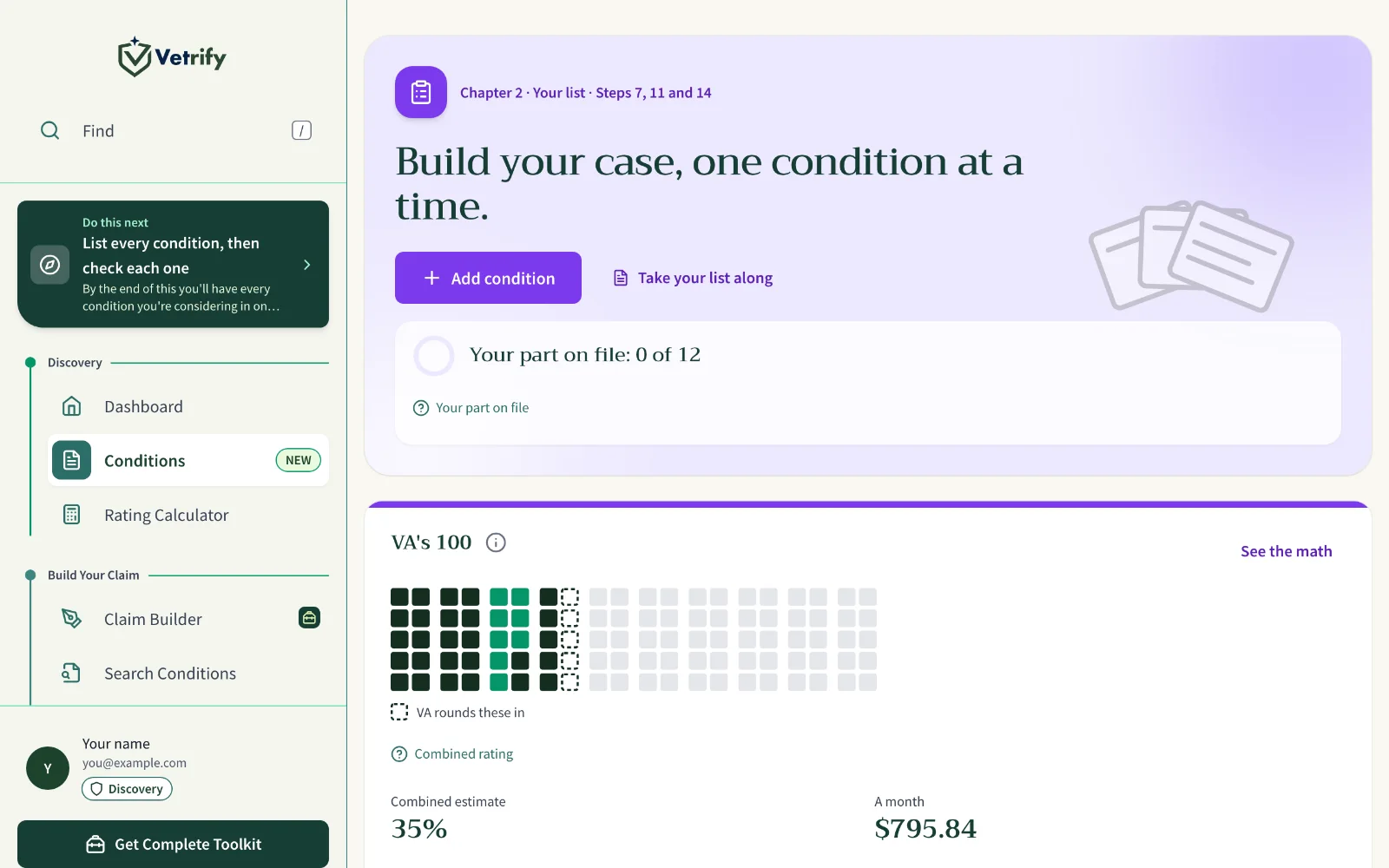
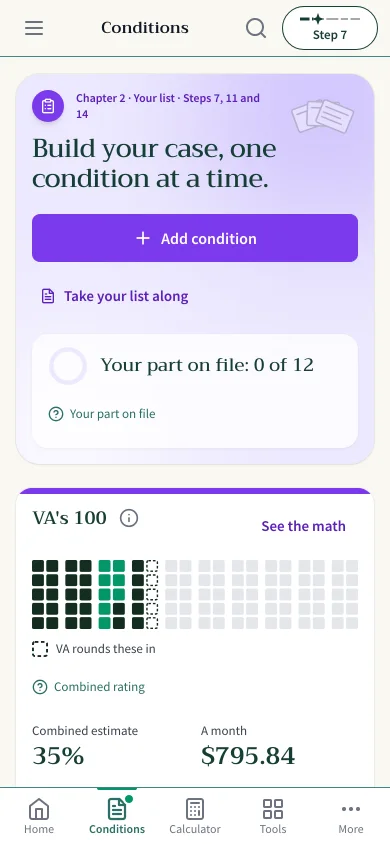
Keep your VA rating at hand.
A free account keeps your conditions in one list and shows your combined rating as you add them. Have it ready when you ask the state about a benefit.
HOW TO READ THIS PAGE
Every row, in the source's own words.
Each benefit says what it is, who qualifies in the source's words, and where it comes from. Open a row to read the passage it quotes.
Find your kind of benefit
The benefits are grouped by kind. Start with the one you came for.
Read who qualifies
Each row quotes the source's own words on who qualifies.
Check with the state
Rules change. Ask the office named in the source before you count on a benefit.
Vetrify is not a state agency and not a law firm. This page points to each state's own words; the state decides who qualifies.
6 BENEFITS
Property tax
On top of the general homestead exemption on the first seven thousand five hundred dollars of a home's assessed value, the next two thousand five hundred dollars of assessed value of property that receives the homestead exemption and is owned and occupied by a veteran with a service-connected disability rating of fifty percent or more but less than seventy percent by VA is exempt from property tax. Property taxes still apply to any assessed value over ten thousand dollars. This is the Constitution's text in force until January 1, 2027. The text that takes its place that day, which voters ratified on November 3, 2026 (Acts 2026, No. 39, Amendment No. 1), words the veteran's part the same way and changes only the surviving spouse's rules (see that row).
Who qualifies, in the source's wordsTied to a VA rating
“property receiving the homestead exemption that is owned and occupied by a veteran with a service-connected disability rating of fifty percent or more but less than seventy percent by the United States Department of Veterans Affairs”
What the source says
“NOTE: Subparagraph (K)(1) eff. until Jan. 1, 2027, upon ratification of the const. amend. proposed by Acts 2026, No. 39. (K)(1)(a) In addition to the homestead exemption authorized pursuant to the provisions of Section 20 of this Article, which applies to the first seven thousand five hundred dollars of the assessed valuation of property, the next two thousand five hundred dollars of the assessed valuation of property receiving the homestead exemption that is owned and occupied by a veteran with a service-connected disability rating of fifty percent or more but less than seventy percent by the United States Department of Veterans Affairs shall be exempt from ad valorem taxation. The surviving spouse of a deceased veteran with a service-connected disability rating of fifty percent or more but less than seventy percent by the United States Department of Veterans Affairs shall be eligible for this exemption if the surviving spouse occupies and remains the owner of the property, whether or not the exemption was in effect on the property prior to the death of the veteran. If property eligible for the exemption provided for in this Subsubparagraph has an assessed value in excess of ten thousand dollars, ad valorem property taxes shall apply to the assessment in excess of ten thousand dollars.”
Source: Louisiana Constitution, Article VII, Section 21(K)(1)(a), Other property exemptions (the text in force until January 1, 2027). Read .
On top of the general homestead exemption on the first seven thousand five hundred dollars of a home's assessed value, the next four thousand five hundred dollars of assessed value of property owned and occupied by a veteran with a service-connected disability rating of seventy percent or more but less than one hundred percent by VA is exempt from property tax. Property taxes still apply to any assessed value over twelve thousand dollars. This is the Constitution's text in force until January 1, 2027. The text that takes its place that day, which voters ratified on November 3, 2026 (Acts 2026, No. 39, Amendment No. 1), words the veteran's part the same way and changes only the surviving spouse's rules (see that row).
Who qualifies, in the source's wordsTied to a VA rating
“property owned and occupied by a veteran with a service-connected disability rating of seventy percent or more but less than one hundred percent by the United States Department of Veterans Affairs”
What the source says
“NOTE: Subparagraph (K)(1) eff. until Jan. 1, 2027, upon ratification of the const. amend. proposed by Acts 2026, No. 39. (K)(1)(a) In addition to the homestead exemption authorized pursuant to the provisions of Section 20 of this Article, which applies to the first seven thousand five hundred dollars of the assessed valuation of property, the next two thousand five hundred dollars of the assessed valuation of property receiving the homestead exemption that is owned and occupied by a veteran with a service-connected disability rating of fifty percent or more but less than seventy percent by the United States Department of Veterans Affairs shall be exempt from ad valorem taxation. The surviving spouse of a deceased veteran with a service-connected disability rating of fifty percent or more but less than seventy percent by the United States Department of Veterans Affairs shall be eligible for this exemption if the surviving spouse occupies and remains the owner of the property, whether or not the exemption was in effect on the property prior to the death of the veteran. If property eligible for the exemption provided for in this Subsubparagraph has an assessed value in excess of ten thousand dollars, ad valorem property taxes shall apply to the assessment in excess of ten thousand dollars. (b) In addition to the homestead exemption authorized pursuant to the provisions of Section 20 of this Article, which applies to the first seven thousand five hundred dollars of the assessed valuation of property, the next four thousand five hundred dollars of the assessed valuation of property owned and occupied by a veteran with a service-connected disability rating of seventy percent or more but less than one hundred percent by the United States Department of Veterans Affairs shall be exempt from ad valorem taxation. The surviving spouse of a deceased veteran with a service-connected disability rating of seventy percent or more but less than one hundred percent by the United States Department of Veterans Affairs shall be eligible for this exemption if the surviving spouse occupies and remains the owner of the property, whether or not the exemption was in effect on the property prior to the death of the veteran. If property eligible for the exemption provided for in this Subsubparagraph has an assessed value in excess of twelve thousand dollars, ad valorem property taxes shall apply to the assessment in excess of twelve thousand dollars.”
Source: Louisiana Constitution, Article VII, Section 21(K)(1)(a) and (b), Other property exemptions (the text in force until January 1, 2027). Read .
The whole assessed value of property that receives the homestead exemption and is owned and occupied by a veteran with a service-connected disability rating of one hundred percent unemployability or totally disabled by VA is exempt from property tax: the general homestead exemption covers the first seven thousand five hundred dollars of assessed value and this exemption covers the rest. This is the Constitution's text in force until January 1, 2027. The text that takes its place that day, which voters ratified on November 3, 2026 (Acts 2026, No. 39, Amendment No. 1), words the veteran's part the same way and changes only the surviving spouse's rules (see that row).
Who qualifies, in the source's wordsTied to a VA rating
“property receiving the homestead exemption that is owned and occupied by a veteran with a service-connected disability rating of one hundred percent unemployability or totally disabled by the United States Department of Veterans Affairs”
What the source says
“NOTE: Subparagraph (K)(1) eff. until Jan. 1, 2027, upon ratification of the const. amend. proposed by Acts 2026, No. 39. (K)(1)(a) In addition to the homestead exemption authorized pursuant to the provisions of Section 20 of this Article, which applies to the first seven thousand five hundred dollars of the assessed valuation of property, the next two thousand five hundred dollars of the assessed valuation of property receiving the homestead exemption that is owned and occupied by a veteran with a service-connected disability rating of fifty percent or more but less than seventy percent by the United States Department of Veterans Affairs shall be exempt from ad valorem taxation. The surviving spouse of a deceased veteran with a service-connected disability rating of fifty percent or more but less than seventy percent by the United States Department of Veterans Affairs shall be eligible for this exemption if the surviving spouse occupies and remains the owner of the property, whether or not the exemption was in effect on the property prior to the death of the veteran. If property eligible for the exemption provided for in this Subsubparagraph has an assessed value in excess of ten thousand dollars, ad valorem property taxes shall apply to the assessment in excess of ten thousand dollars. (b) In addition to the homestead exemption authorized pursuant to the provisions of Section 20 of this Article, which applies to the first seven thousand five hundred dollars of the assessed valuation of property, the next four thousand five hundred dollars of the assessed valuation of property owned and occupied by a veteran with a service-connected disability rating of seventy percent or more but less than one hundred percent by the United States Department of Veterans Affairs shall be exempt from ad valorem taxation. The surviving spouse of a deceased veteran with a service-connected disability rating of seventy percent or more but less than one hundred percent by the United States Department of Veterans Affairs shall be eligible for this exemption if the surviving spouse occupies and remains the owner of the property, whether or not the exemption was in effect on the property prior to the death of the veteran. If property eligible for the exemption provided for in this Subsubparagraph has an assessed value in excess of twelve thousand dollars, ad valorem property taxes shall apply to the assessment in excess of twelve thousand dollars. (c) In addition to the homestead exemption authorized pursuant to the provisions of Section 20 of this Article, which applies to the first seven thousand five hundred dollars of the assessed valuation of property, the remaining assessed valuation of property receiving the homestead exemption that is owned and occupied by a veteran with a service-connected disability rating of one hundred percent unemployability or totally disabled by the United States Department of Veterans Affairs shall be exempt from ad valorem taxation. The surviving spouse of a deceased veteran with a service-connected disability rating of one hundred percent unemployability or totally disabled by the United States Department of Veterans Affairs shall be eligible for this exemption if the surviving spouse occupies and remains the owner of the property, whether or not the exemption was in effect on the property prior to the death of the veteran. NOTE: Subparagraph (K)(1) eff. Jan. 1, 2027, upon ratification of the const. amend. proposed by Acts 2026, No. 39.”
Source: Louisiana Constitution, Article VII, Section 21(K)(1)(a) to (c), Other property exemptions (the text in force until January 1, 2027). Read .
All three levels of the disabled veteran homestead exemption (fifty percent or more but less than seventy percent, seventy percent or more but less than one hundred percent, and one hundred percent unemployability or totally disabled) carry a rule for the surviving spouse of a deceased veteran rated at that level by VA; the words below quote the one hundred percent level's, and the other two say the same. Until January 1, 2027, the surviving spouse is eligible for the same exemption if the surviving spouse occupies and remains the owner of the property, whether or not the exemption was in effect on the property before the veteran's death. Voters approved Acts 2026, No. 39 (Amendment No. 1) on November 3, 2026, so from January 1, 2027 the page's text effective that day applies: it drops the rule that the surviving spouse occupy and remain the owner, and once a surviving spouse is eligible for and has taken the exemption, a surviving spouse who then acquires a different property that qualifies for the homestead exemption is entitled to a one-time transfer of the exemption to that later homestead, limited in value to the amount claimed on the prior homestead in the last year it was claimed. Ask your parish assessor which text applies to your tax year.
Who qualifies, in the source's wordsOther rule
“The surviving spouse of a deceased veteran with a service-connected disability rating of one hundred percent unemployability or totally disabled by the United States Department of Veterans Affairs shall be eligible for this exemption if the surviving spouse occupies and remains the owner of the property, whether or not the exemption was in effect on the property prior to the death of the veteran.”
What the source says
“NOTE: Subparagraph (K)(1) eff. until Jan. 1, 2027, upon ratification of the const. amend. proposed by Acts 2026, No. 39. (K)(1)(a) In addition to the homestead exemption authorized pursuant to the provisions of Section 20 of this Article, which applies to the first seven thousand five hundred dollars of the assessed valuation of property, the next two thousand five hundred dollars of the assessed valuation of property receiving the homestead exemption that is owned and occupied by a veteran with a service-connected disability rating of fifty percent or more but less than seventy percent by the United States Department of Veterans Affairs shall be exempt from ad valorem taxation. The surviving spouse of a deceased veteran with a service-connected disability rating of fifty percent or more but less than seventy percent by the United States Department of Veterans Affairs shall be eligible for this exemption if the surviving spouse occupies and remains the owner of the property, whether or not the exemption was in effect on the property prior to the death of the veteran. If property eligible for the exemption provided for in this Subsubparagraph has an assessed value in excess of ten thousand dollars, ad valorem property taxes shall apply to the assessment in excess of ten thousand dollars. (b) In addition to the homestead exemption authorized pursuant to the provisions of Section 20 of this Article, which applies to the first seven thousand five hundred dollars of the assessed valuation of property, the next four thousand five hundred dollars of the assessed valuation of property owned and occupied by a veteran with a service-connected disability rating of seventy percent or more but less than one hundred percent by the United States Department of Veterans Affairs shall be exempt from ad valorem taxation. The surviving spouse of a deceased veteran with a service-connected disability rating of seventy percent or more but less than one hundred percent by the United States Department of Veterans Affairs shall be eligible for this exemption if the surviving spouse occupies and remains the owner of the property, whether or not the exemption was in effect on the property prior to the death of the veteran. If property eligible for the exemption provided for in this Subsubparagraph has an assessed value in excess of twelve thousand dollars, ad valorem property taxes shall apply to the assessment in excess of twelve thousand dollars. (c) In addition to the homestead exemption authorized pursuant to the provisions of Section 20 of this Article, which applies to the first seven thousand five hundred dollars of the assessed valuation of property, the remaining assessed valuation of property receiving the homestead exemption that is owned and occupied by a veteran with a service-connected disability rating of one hundred percent unemployability or totally disabled by the United States Department of Veterans Affairs shall be exempt from ad valorem taxation. The surviving spouse of a deceased veteran with a service-connected disability rating of one hundred percent unemployability or totally disabled by the United States Department of Veterans Affairs shall be eligible for this exemption if the surviving spouse occupies and remains the owner of the property, whether or not the exemption was in effect on the property prior to the death of the veteran. NOTE: Subparagraph (K)(1) eff. Jan. 1, 2027, upon ratification of the const. amend. proposed by Acts 2026, No. 39. (K)(1)(a) In addition to the homestead exemption authorized pursuant to the provisions of Section 20 of this Article, which applies to the first seven thousand five hundred dollars of the assessed valuation of property, the next two thousand five hundred dollars of the assessed valuation of property receiving the homestead exemption that is owned and occupied by a veteran with a service-connected disability rating of fifty percent or more but less than seventy percent by the United States Department of Veterans Affairs shall be exempt from ad valorem taxation. The surviving spouse of a deceased veteran with a service-connected disability rating of fifty percent or more but less than seventy percent by the United States Department of Veterans Affairs shall be eligible for this exemption, whether or not the exemption was in effect on the property prior to the death of the veteran. If property eligible for the exemption provided for in this Subsubparagraph has an assessed value in excess of ten thousand dollars, ad valorem property taxes shall apply to the assessment in excess of ten thousand dollars. (b) In addition to the homestead exemption authorized pursuant to the provisions of Section 20 of this Article, which applies to the first seven thousand five hundred dollars of the assessed valuation of property, the next four thousand five hundred dollars of the assessed valuation of property owned and occupied by a veteran with a service-connected disability rating of seventy percent or more but less than one hundred percent by the United States Department of Veterans Affairs shall be exempt from ad valorem taxation. The surviving spouse of a deceased veteran with a service-connected disability rating of seventy percent or more but less than one hundred percent by the United States Department of Veterans Affairs shall be eligible for this exemption, whether or not the exemption was in effect on the property prior to the death of the veteran. If property eligible for the exemption provided for in this Subsubparagraph has an assessed value in excess of twelve thousand dollars, ad valorem property taxes shall apply to the assessment in excess of twelve thousand dollars. (c) In addition to the homestead exemption authorized pursuant to the provisions of Section 20 of this Article, which applies to the first seven thousand five hundred dollars of the assessed valuation of property, the remaining assessed valuation of property receiving the homestead exemption that is owned and occupied by a veteran with a service-connected disability rating of one hundred percent unemployability or totally disabled by the United States Department of Veterans Affairs shall be exempt from ad valorem taxation. The surviving spouse of a deceased veteran with a service-connected disability rating of one hundred percent unemployability or totally disabled by the United States Department of Veterans Affairs shall be eligible for this exemption, whether or not the exemption was in effect on the property prior to the death of the veteran. (d) Once a surviving spouse of a deceased veteran with a service-connected disability is eligible for and has taken the exemption, if the surviving spouse then acquires a different property which qualifies for the homestead exemption, the surviving spouse shall be entitled to a one-time transfer of the exemption to that subsequent homestead, the exemption being limited in value to the amount of the exemption claimed on the prior homestead in the last year for which the exemption was claimed. The assessor may require the submission of certain information concerning the amount of the exemption on the prior homestead for purposes of determining the extent of the exemption available for the subsequent homestead.”
The special assessment level (an assessment freeze): the assessment of residential property that receives the homestead exemption and is owned and occupied by a person with a service-connected disability rating of fifty percent or more by VA, who meets all the section's other requirements, is not increased above its total assessment for the first year the owner qualifies for and receives the special assessment level, as long as the owner remains qualified for and receives it. Apply with a signed application to the parish assessor (in Orleans Parish, the assessor of the district where the property is). There is an income limit: no one may receive it whose adjusted gross income on the federal tax return for the year before applying exceeds a limit the Constitution sets and adjusts each year by the Consumer Price Index, beginning for the tax year 2026, so ask your assessor for this year's limit. If you file married filing separately, the adjusted gross income on both federal returns is combined. An owner below the age of sixty-five who has received it may keep it the next year by certifying to the assessor that the prior year's adjusted gross income met the income rule. Voters approved Acts 2025, No. 220 (Amendment Nine on the ballot) on November 3, 2026, so from January 1, 2027 the limit becomes one hundred fifty thousand dollars, its Consumer Price Index adjustment starts beginning for the tax year 2028, and the assessor may establish your income eligibility by checking the federal adjusted gross income reported on your Louisiana income tax return for the year before you apply. The special assessment level stays on the property as long as the owner with the service-connected disability of fifty percent or more, or that owner's surviving spouse who is forty-five years of age or older or has minor children, remains the owner, and the property's value does not increase more than twenty-five percent because of construction or reconstruction.
Who qualifies, in the source's wordsTied to a VA rating
“residential property receiving the homestead exemption which is owned and occupied by any of the following and who meet all of the other requirements of this Section shall not be increased above the total assessment of that property for the first year that the owner qualifies for and receives the special assessment level, provided that such person or persons remain qualified for and receive the special assessment level: (aa) People who are sixty-five years of age or older. (bb) People who have a service-connected disability rating of fifty percent or more by the United States Department of Veterans Affairs. (cc) Members of the armed forces of the United States or the Louisiana National Guard who owned and last occupied such property who are killed in action, or who are missing in action or are a prisoner of war for a period exceeding ninety days. (dd) Any person or persons permanently totally disabled as determined by a final non-appealable judgment of a court or as certified by a state or federal administrative agency charged with the responsibility for making determinations regarding disability. NOTE: Item (ii) eff. until Jan. 1, 2027, upon ratification of the const. amend. proposed by Acts 2025, No. 220. (ii) Any person or persons shall be prohibited from receiving the special assessment as provided in this Section if such person's or persons' adjusted gross income, as reported in the federal tax return for the year prior to the application for the special assessment, exceeds one hundred thousand dollars. For persons applying for the special assessment whose filing status is married filing separately, the adjusted gross income for purposes of this Section shall be determined by combining the adjusted gross income on both federal tax returns. Beginning for the tax year 2026, and for each tax year thereafter, the one hundred thousand dollar limit shall be adjusted annually by the Consumer Price Index as reported by the United States Government.”
What the source says
“(G) Special Assessment Level. (1)(a)(i) The assessment of residential property receiving the homestead exemption which is owned and occupied by any of the following and who meet all of the other requirements of this Section shall not be increased above the total assessment of that property for the first year that the owner qualifies for and receives the special assessment level, provided that such person or persons remain qualified for and receive the special assessment level: (aa) People who are sixty-five years of age or older. (bb) People who have a service-connected disability rating of fifty percent or more by the United States Department of Veterans Affairs. (cc) Members of the armed forces of the United States or the Louisiana National Guard who owned and last occupied such property who are killed in action, or who are missing in action or are a prisoner of war for a period exceeding ninety days. (dd) Any person or persons permanently totally disabled as determined by a final non-appealable judgment of a court or as certified by a state or federal administrative agency charged with the responsibility for making determinations regarding disability. NOTE: Item (ii) eff. until Jan. 1, 2027, upon ratification of the const. amend. proposed by Acts 2025, No. 220. (ii) Any person or persons shall be prohibited from receiving the special assessment as provided in this Section if such person's or persons' adjusted gross income, as reported in the federal tax return for the year prior to the application for the special assessment, exceeds one hundred thousand dollars. For persons applying for the special assessment whose filing status is married filing separately, the adjusted gross income for purposes of this Section shall be determined by combining the adjusted gross income on both federal tax returns. Beginning for the tax year 2026, and for each tax year thereafter, the one hundred thousand dollar limit shall be adjusted annually by the Consumer Price Index as reported by the United States Government. NOTE: Item (ii) eff. Jan. 1, 2027, upon ratification of the const. amend. proposed by Acts 2025, No. 220. (ii) Any person or persons shall be prohibited from receiving the special assessment as provided in this Section if such person's or persons' adjusted gross income, as reported in the federal tax return for the year prior to the application for the special assessment, exceeds one hundred fifty thousand dollars. For persons applying for the special assessment whose filing status is married filing separately, the adjusted gross income for purposes of this Section shall be determined by combining the adjusted gross income on both federal tax returns. The assessor may establish an applicant's income eligibility for the special assessment level by verifying the applicant's federal adjusted gross income as reported on the Louisiana income tax return for the year prior to the application. Beginning for the tax year 2028 and for each tax year thereafter, the one hundred fifty thousand dollar limit shall be adjusted annually by the Consumer Price Index as reported by the United States Government. Notwithstanding any provision of this constitution to the contrary, a decrease in the total amount of ad valorem tax collected by a taxing authority as a result of the special assessment level shall be absorbed by the taxing authority and shall not create any additional tax liability for other taxpayers in the taxing district as a result of any subsequent reappraisal and valuation or millage adjustment. Implementation of the special assessment level shall neither trigger nor be cause for a reappraisal of property or an adjustment of millages pursuant to the provisions of Article VII, Section 23(B) of this constitution. (iii) An eligible owner or the owner's spouse or other legally qualified representative shall apply for the special assessment level by filing a signed application establishing that the owner qualifies for the special assessment level with the assessor of the parish or, in the parish of Orleans, the assessor of the district where the property is located. (iv) An owner who is below the age of sixty-five and who has applied for and received the special assessment level may qualify for and receive the special assessment level in the subsequent year by certifying to the assessor of the parish that such person or persons' adjusted gross income in the prior tax year satisfied the income requirement of this Section. The provisions of this Item shall not apply to an owner who has qualified for and received the special assessment level for persons sixty-five years of age or older or to such owner's surviving spouse as described in Item (2)(a)(i) of this Paragraph or for an owner who is permanently totally disabled as provided for in Subitem (i)(dd) of this Subsubparagraph. (b) Any millage rate applied to the special assessment level shall not be subject to a limitation. (2) Provided such owner is qualified for and receives the special assessment level, the special assessment level shall remain on the property as long as: (a)(i) The owner who is sixty-five years of age or older, or that owner's surviving spouse who is fifty-five years of age or older or who has minor children, remains the owner of the property. (ii) The owner who has a service-connected disability of fifty percent or more, or that owner's surviving spouse who is forty-five years of age or older or who has minor children, remains the owner of the property. (iii) The spouse of the owner who is killed in action remains the owner of the property. (iv) The first day of the tax year following the tax year in which an owner who was missing in action or was a prisoner of war for a period exceeding ninety days is no longer missing in action or a prisoner of war. (v) Even if the ownership interest of any surviving spouse or spouse of an owner who is missing in action as provided for in this Subparagraph is an interest in usufruct. (b) The value of the property does not increase more than twenty-five percent because of construction or reconstruction.”
The whole assessed value of the homestead of the unmarried surviving spouse of a member of the U.S. armed forces or the Louisiana National Guard who died while on active duty is exempt from property tax (for taxes due in 2017 and later, starting in the tax year of the death or 2017, whichever is later). The property must be eligible for the homestead exemption and must have been the service member's residence at the time of death, the surviving spouse must not have remarried, and the surviving spouse must give the assessor evidence of eligibility every year: in the first application, documentation from the deceased spouse's employer showing the death, and after that a yearly sworn statement of not having remarried. If the surviving spouse later acquires a different property that qualifies for the homestead exemption, the exemption carries to it, limited to the amount claimed on the prior homestead in the last year it was claimed. (The same paragraph also covers the surviving spouses of state police, certain law enforcement and fire protection officers, emergency medical responders and volunteer firefighters who died on duty.)
Who qualifies, in the source's wordsOther rule
“the unmarried surviving spouse of a person who died under the conditions enumerated in Subsubparagraph (1)(a) or (b) of this Paragraph, and if the conditions established in Subsubparagraph (1)(c) of this Paragraph are met. (1)(a) For ad valorem taxes due in 2017 and thereafter, the exemption shall apply beginning in the tax year in which any of the following persons died or 2017, whichever is later: (i) A member of the armed forces of the United States or the Louisiana National Guard who died while on active duty.”
What the source says
“(M) There is hereby established an exemption from ad valorem tax for the total assessed value of the homestead of the unmarried surviving spouse of a person who died under the conditions enumerated in Subsubparagraph (1)(a) or (b) of this Paragraph, and if the conditions established in Subsubparagraph (1)(c) of this Paragraph are met. (1)(a) For ad valorem taxes due in 2017 and thereafter, the exemption shall apply beginning in the tax year in which any of the following persons died or 2017, whichever is later: (i) A member of the armed forces of the United States or the Louisiana National Guard who died while on active duty. (ii) A state police officer who died while on duty. (iii) A law enforcement or fire protection officer who qualified for the salary supplement authorized in Section 10(D)(3) of this Article who died while on duty. (b) For ad valorem taxes due in 2018 and thereafter, the exemption shall apply beginning in the tax year in which any of the following persons died or 2018, whichever is later: (i) An emergency medical responder, technician, or paramedic, as such terms may be defined by law, who died while performing the duties of their employment. (ii) A volunteer firefighter, verified by the Office of the State Fire Marshal to have died while performing firefighting duties. (iii) A law enforcement or fire protection officer who died while on duty and who would have qualified for the salary supplement authorized in Section 10(D)(3) of this Article if he had completed the first year of his employment before his death. (c)(i) The property is eligible for the homestead exemption and the property was the residence of a person listed within Subsubparagraph (a) or (b) of this Subparagraph at the time of that person's death. (ii) The surviving spouse has not remarried. (iii) The surviving spouse annually provides evidence of their eligibility for the exemption in accordance with the requirements of Subparagraph (2) of this Paragraph. (2) Each assessor shall establish a procedure whereby a person may annually apply for the exemption. Eligibility for the exemption shall be established by the production of documents and certification of information by the surviving spouse to the assessor as follows: (a) In an initial application for the exemption, the surviving spouse shall produce documentation issued by their deceased spouse's employer evidencing the death. (b) For purposes of the continuation of an existing exemption, the surviving spouse shall annually provide a sworn statement to the assessor attesting to the fact that the surviving spouse has not remarried. (3) Once an unmarried surviving spouse has qualified for and taken the exemption, if the surviving spouse then acquires a different property which qualifies for the homestead exemption, the surviving spouse shall be entitled to an exemption on that subsequent homestead, the exemption being limited in value to the amount of the exemption claimed on the prior homestead in the last year for which the exemption was claimed.”
Source: Louisiana Constitution, Article VII, Section 21(M), Other property exemptions. Read .
3 BENEFITS
Vehicles and license plates
A Louisiana resident veteran with a service-connected disability of fifty percent or more may apply for a military honor license plate marked "DV" with the international symbol of accessibility, used in place of the regular plate on a passenger car, pickup truck, recreational vehicle, motorcycle, or van. No fee is charged for the plate, and it is not subject to the renewal requirements of standard plates. You must still comply with all state laws on registering and licensing the vehicle, and show proof of your status acceptable to the secretary. The secretary may issue one for each vehicle registered in your name, and the plate carries the same privileges as a plate for persons with mobility impairments. On request, the secretary must also issue a hang tag with the accessibility symbol, at no fee and with no renewal; a lost, destroyed, or mutilated hang tag is replaced for the reissuance fee.
Who qualifies, in the source's wordsTied to a VA rating
“a qualified disabled veteran shall include any veteran who has a service-connected disability of fifty percent or more and who is a resident of this state.”
What the source says
“§490.4. Military honor license plates for certain disabled veterans A. For the purpose of this Section, a qualified disabled veteran shall include any veteran who has a service-connected disability of fifty percent or more and who is a resident of this state. B. Upon the application of a qualified disabled veteran, the secretary shall issue to such veteran a military honor license plate, restricted to passenger cars, pickup trucks, recreational vehicles, motorcycles, and vans, to be used in lieu of the regular motor vehicle registration license plate. The military honor license plate shall contain the designation "DV" and shall bear the international symbol of accessibility followed by such numbers as the secretary finds expedient. The applicant shall comply with all state laws relating to registration and licensing of motor vehicles and shall, at the time of application, present such proof of status as a qualified disabled veteran as shall be acceptable to the secretary. C. No fee shall be charged for the license plates authorized by this Section and such plates shall not be subject to the renewal requirements applicable to standard plates. D. The secretary shall establish such rules and regulations as are necessary to implement the provisions of this Section, including but not limited to rules and regulations governing the transfer and disposition of such license plates. E. The secretary may issue a military honor license plate, as provided for in this Section, for each vehicle registered in the applicant's name, and the holder of such license plate shall be accorded the same privileges as holders of license plates for persons with mobility impairments. The secretary shall also issue a hang tag as provided in R.S. 47:463.4(B)(1), which bears the international symbol of accessibility, to any disabled veteran who has or is issued such a plate and who requests the hang tag. No fee shall be charged for the hang tag, and it shall be exempt from renewal requirements applicable to hang tags issued pursuant to R.S. 47:463.4. However, lost, destroyed, or mutilated hang tags shall be replaced according to the provisions of R.S. 47:463.4(C), including payment of the reissuance fee. A person using the hang tag in a vehicle with a disabled veteran license plate is not required to obtain or possess a mobility impairment driver's license or identification card.”
Source: R.S. 47:490.4, Military honor license plates for certain disabled veterans. Read .
A Louisiana resident veteran with a service-connected disability of one hundred percent as determined by VA may apply for a military honor license plate marked "100% DAV" with the international symbol of accessibility, used in place of the regular plate on a passenger car, pickup truck, recreational vehicle, motorcycle, or van. No fee is charged for the plate, and it is not subject to the renewal requirements of standard plates. You must still comply with all state laws on registering and licensing the vehicle, and show proof of your status acceptable to the secretary. The secretary may issue one for each vehicle registered in your name, and the plate carries the same privileges as a plate for persons with mobility impairments. On request, the secretary must also issue a hang tag with the accessibility symbol, at no fee and with no renewal; a lost, destroyed, or mutilated hang tag is replaced for the reissuance fee.
Who qualifies, in the source's wordsTied to a VA rating
“a qualified disabled veteran shall be any veteran who has a service-connected disability of one hundred percent as determined by the United States Department of Veterans Affairs and who is a resident of this state.”
What the source says
“§490.31. Military honor license plates for certain disabled veterans; one hundred percent disabled A. For the purpose of this Section, a qualified disabled veteran shall be any veteran who has a service-connected disability of one hundred percent as determined by the United States Department of Veterans Affairs and who is a resident of this state. B. Upon the application of a qualified disabled veteran, the secretary shall issue to such veteran a military honor license plate, restricted to passenger cars, pickup trucks, recreational vehicles, motorcycles, and vans, to be used in lieu of the regular motor vehicle registration license plate. The military honor license plate shall contain the designation "100% DAV" and shall bear the international symbol of accessibility followed by such numbers as the secretary finds expedient. The applicant shall comply with all state laws relating to registration and licensing of motor vehicles and shall, at the time of application, present such proof of status as a qualified disabled veteran as shall be acceptable to the secretary. C. No fee shall be charged for the license plates authorized by this Section and such plates shall not be subject to the renewal requirements applicable to standard plates. D. The secretary shall establish such rules and regulations as are necessary to implement the provisions of this Section, including but not limited to rules and regulations governing the transfer and disposition of such license plates. E. The secretary may issue a military honor license plate, as provided for in this Section, for each vehicle registered in the applicant's name, and the holder of such license plate shall be accorded the same privileges as holders of license plates for persons with mobility impairments. The secretary shall also issue a hang tag as provided in R.S. 47:463.4(B)(1), which bears the international symbol of accessibility, to a one hundred percent disabled veteran who has or is issued such a plate and who requests the hang tag. No fee shall be charged for the hang tag, and it shall be exempt from renewal requirements applicable to hang tags issued pursuant to R.S. 47:463.4. However, lost, destroyed, or mutilated hang tags shall be replaced according to the provisions of R.S. 47:463.4(C), including payment of the reissuance fee. A person using the hang tag in a vehicle with a one hundred percent disabled veteran license plate is not required to obtain or possess a mobility impairment driver's license or identification card.”
Source: R.S. 47:490.31, Military honor license plates for certain disabled veterans; one hundred percent disabled. Read .
The section applies to Purple Heart recipients with a service-connected disability of fifty percent or more who live in Louisiana. A Purple Heart recipient who is also a qualified disabled veteran may apply for a military honor license plate numbered with a "DV" prefix and printed "Purple Heart Disabled Veteran", used in place of the regular plate on a passenger car, truck, recreational vehicle, motorcycle, or van, one for each vehicle registered in your name. No fee is charged for the plate, and it is not subject to the renewal requirements of standard plates. On request, the secretary must also issue a hang tag with the accessibility symbol, at no fee and with no renewal. The plate goes back to the secretary when the holder dies, except that a surviving spouse who has not remarried may keep it by applying for a transfer; it goes back on the surviving spouse's death or remarriage.
Who qualifies, in the source's wordsTied to a VA rating
“"Purple Heart" recipients that have a service-connected disability of fifty percent or more and who are residents of this state.”
What the source says
“§490.32. Military honor license plates for "Purple Heart" disabled veterans A. The provisions of this Section shall be applicable to "Purple Heart" recipients that have a service-connected disability of fifty percent or more and who are residents of this state. B. Upon application of a "Purple Heart" recipient who is also a qualified disabled veteran, the secretary shall issue a military honor license plate to be used in lieu of a regular motor vehicle registration plate on passenger cars, trucks, recreational vehicles, motorcycles, and vans. The license plate shall bear a number prefixed by "DV". "Purple Heart Disabled Veteran" shall be printed under the number. C. The secretary of the Department of Public Safety and Corrections shall change the design of the military honor license plate for "Purple Heart" recipients who are disabled veterans by enlarging the size of the "Purple Heart" medal on the license plate. D. No fee shall be charged for the license plates authorized by this Section, and such plates shall not be subject to the renewal requirements applicable to standard plates. E. The secretary shall adopt rules to implement the provisions of this Section, including but not limited to rules governing the transfer of the license plates from one vehicle to another and the disposition of such license plates. F.(1) Any applicant who qualifies for the military honor license plate authorized by this Section may be issued a plate for each vehicle registered in the applicant's name. (2) Except as otherwise provided in this Subsection, each military honor license plate issued pursuant to this Section shall be returned to the secretary upon the death of the person to whom the plate was issued. A surviving spouse of a person to whom a license plate was issued pursuant to this Section may retain a license plate issued pursuant to this Section, provided the surviving spouse has not remarried and provided the surviving spouse applies to the secretary for a transfer of the license plate to the surviving spouse. A military honor license plate transferred pursuant to this Paragraph to a surviving spouse shall be returned to the secretary upon the death or remarriage of the surviving spouse. In the event that a "Purple Heart" disabled veteran holds more than one military honor license plate at the time the "Purple Heart" disabled veteran dies, the surviving spouse may determine which of the license plates the surviving spouse wishes to retain. (3) The secretary shall also issue a hang tag as provided in R.S. 47:463.4(B)(1), which bears the international symbol of accessibility, to any disabled veteran who has or is issued a "Purple Heart" disabled veteran special prestige plate and who requests the hang tag. No fee shall be charged for the hang tag, and it shall be exempt from renewal requirements applicable to hang tags issued pursuant to R.S. 47:463.4. However, any lost, destroyed, or mutilated hang tags shall be replaced according to the provisions of R.S. 47:463.4(C), including payment of the reissuance fee. A person using the hang tag in a vehicle with a disabled veteran license plate is not required to obtain or possess a mobility impairment driver's license or identification card.”
Source: R.S. 47:490.32, Military honor license plates for "Purple Heart" disabled veterans. Read .
4 BENEFITS
Education and tuition
A child, not less than sixteen nor more than twenty-five years of age, of a qualified veteran may attend any public postsecondary education institution in Louisiana without paying tuition, matriculation, registration, laboratory, athletic, medical, and other school-imposed fees, including nonresidency and other special fees. For a child, a qualified veteran is a member of the armed forces who either (a) was killed in action, died in active service from other causes, is missing in action, is a prisoner of war, died as a result of a service-connected disability incurred during a wartime period as defined in R.S. 29:251.2, or before death was rated ninety to one hundred percent service-connected disabled by VA under the rating schedule or was found unemployable because of a service-connected disability, and who lived in Louisiana for at least twelve months immediately before entering service or for at least twelve months before death, or had been permanently assigned and reported for duty to an active, National Guard, or Reserve installation or assignment in Louisiana; or (b) is rated ninety to one hundred percent service-connected disabled by VA under the rating schedule, or is found unemployable because of a service-connected disability, and has lived in Louisiana for at least twelve months before the child's admission into a program of education at a public postsecondary institution. The school may not grant this benefit to a student who has received or is receiving the scholarship under R.S. 17:1686 (its own row).
Who qualifies, in the source's wordsOther rule
“Any child, not less than sixteen nor more than twenty-five years of age, of a qualified veteran”
What the source says
“§288. Educational benefits for children, spouses, and surviving spouses of veterans A.(1) For the purpose of this Subsection, "qualified veteran" shall mean a member of the armed forces of the United States of America who: (a) Was either killed in action, died in active service from other causes, is missing in action, is a prisoner of war, died as a result of a service-connected disability incurred during a wartime period as defined in R.S. 29:251.2, or who, prior to death, was rated ninety to one hundred percent service-connected disabled by the United States Department of Veterans Affairs by evaluation of the rating schedule or was determined by the department to be unemployable as a result of a service-connected disability, and who was a resident of Louisiana for a period of not less than twelve months immediately preceding entrance into service or for a period not less than twelve months prior to the veteran's death or who had been permanently assigned and reported for duty to an active, National Guard, or Reserve installation or assignment in the state of Louisiana. (b) Is rated ninety to one hundred percent service-connected disabled by the United States Department of Veterans Affairs by evaluation of the rating schedule or is determined by the department to be unemployable as a result of a service-connected disability and has been a resident of Louisiana for a period of not less than twelve months prior to the veteran's child's admission into a program of education at a public postsecondary institution. (2) Any child, not less than sixteen nor more than twenty-five years of age, of a qualified veteran may attend any public postsecondary education institution within the state without having to pay tuition, matriculation, registration, laboratory, athletic, medical, and other school-imposed fees, including but not limited to nonresidency and other special fees. B.(1) For the purpose of this Subsection, "qualified veteran" shall mean a member of the armed forces of the United States of America who was killed in action, died in active service from other causes, is missing in action, is a prisoner of war, died as a result of a service-connected disability incurred during a wartime period as defined in R.S. 29:251.2, or who, prior to death, was rated ninety to one hundred percent service-connected disabled by the United States Department of Veterans Affairs by evaluation of the rating schedule or was determined by the department to be unemployable as a result of a service-connected disability, and was a resident of Louisiana for a period of not less than twelve months immediately preceding entrance into service or for a period not less than twelve months prior to death or who had been permanently assigned and reported for duty to an active, National Guard, or Reserve installation or assignment in the state of Louisiana. (2) A spouse or surviving spouse of a qualified veteran, within ten years from the date of eligibility, may attend any public postsecondary education institution within the state without having to pay tuition, matriculation, registration, laboratory, athletic, medical, and other school-imposed fees, including but not limited to nonresidency and other special fees. C. The public postsecondary education institution shall not grant the benefits provided under the provisions of this Section if the student has received or is receiving the benefits provided under the provisions of R.S. 17:1686.”
Source: R.S. 29:288, Educational benefits for children, spouses, and surviving spouses of veterans. Read .
A spouse or surviving spouse of a qualified veteran may, within ten years from the date of eligibility, attend any public postsecondary education institution in Louisiana without paying tuition, matriculation, registration, laboratory, athletic, medical, and other school-imposed fees, including nonresidency and other special fees. For a spouse, a qualified veteran is a member of the armed forces who was killed in action, died in active service from other causes, is missing in action, is a prisoner of war, died as a result of a service-connected disability incurred during a wartime period as defined in R.S. 29:251.2, or before death was rated ninety to one hundred percent service-connected disabled by VA under the rating schedule or was found unemployable because of a service-connected disability, and who lived in Louisiana for at least twelve months immediately before entering service or for at least twelve months before death, or had been permanently assigned and reported for duty to an active, National Guard, or Reserve installation or assignment in Louisiana. The school may not grant this benefit to a student who has received or is receiving the scholarship under R.S. 17:1686.
Who qualifies, in the source's wordsOther rule
“A spouse or surviving spouse of a qualified veteran, within ten years from the date of eligibility”
What the source says
“§288. Educational benefits for children, spouses, and surviving spouses of veterans A.(1) For the purpose of this Subsection, "qualified veteran" shall mean a member of the armed forces of the United States of America who: (a) Was either killed in action, died in active service from other causes, is missing in action, is a prisoner of war, died as a result of a service-connected disability incurred during a wartime period as defined in R.S. 29:251.2, or who, prior to death, was rated ninety to one hundred percent service-connected disabled by the United States Department of Veterans Affairs by evaluation of the rating schedule or was determined by the department to be unemployable as a result of a service-connected disability, and who was a resident of Louisiana for a period of not less than twelve months immediately preceding entrance into service or for a period not less than twelve months prior to the veteran's death or who had been permanently assigned and reported for duty to an active, National Guard, or Reserve installation or assignment in the state of Louisiana. (b) Is rated ninety to one hundred percent service-connected disabled by the United States Department of Veterans Affairs by evaluation of the rating schedule or is determined by the department to be unemployable as a result of a service-connected disability and has been a resident of Louisiana for a period of not less than twelve months prior to the veteran's child's admission into a program of education at a public postsecondary institution. (2) Any child, not less than sixteen nor more than twenty-five years of age, of a qualified veteran may attend any public postsecondary education institution within the state without having to pay tuition, matriculation, registration, laboratory, athletic, medical, and other school-imposed fees, including but not limited to nonresidency and other special fees. B.(1) For the purpose of this Subsection, "qualified veteran" shall mean a member of the armed forces of the United States of America who was killed in action, died in active service from other causes, is missing in action, is a prisoner of war, died as a result of a service-connected disability incurred during a wartime period as defined in R.S. 29:251.2, or who, prior to death, was rated ninety to one hundred percent service-connected disabled by the United States Department of Veterans Affairs by evaluation of the rating schedule or was determined by the department to be unemployable as a result of a service-connected disability, and was a resident of Louisiana for a period of not less than twelve months immediately preceding entrance into service or for a period not less than twelve months prior to death or who had been permanently assigned and reported for duty to an active, National Guard, or Reserve installation or assignment in the state of Louisiana. (2) A spouse or surviving spouse of a qualified veteran, within ten years from the date of eligibility, may attend any public postsecondary education institution within the state without having to pay tuition, matriculation, registration, laboratory, athletic, medical, and other school-imposed fees, including but not limited to nonresidency and other special fees. C. The public postsecondary education institution shall not grant the benefits provided under the provisions of this Section if the student has received or is receiving the benefits provided under the provisions of R.S. 17:1686.”
Source: R.S. 29:288, Educational benefits for children, spouses, and surviving spouses of veterans. Read .
A Louisiana resident veteran with a service-connected disability as determined by VA, enrolled at a public postsecondary education institution in a program approved for educational assistance under 38 U.S.C. 3313, who does not qualify for the one hundred percent eligibility tier, receives an exemption equal to the tuition and fees still owed to the school after those federal benefits are applied. The student must stay enrolled full time and meet the school's academic standards and rules for enrollment and continued attendance, and may get the exemption for up to ten semesters or the equivalent in units.
Who qualifies, in the source's wordsTied to a VA rating
“A disabled veteran who has enrolled in a program of education approved for educational assistance under 38 U.S.C. 3313 at a public postsecondary education institution and who does not qualify for the one hundred percent eligibility tier shall receive an exemption in an amount equal to the remaining tuition and fees owed to the institution attended after the application of federal benefits under 38 U.S.C. 3313. (2) For purposes of this Section, "disabled veteran" means an individual who has a service-connected disability as determined by the United States Department of Veterans Affairs and who is a resident of Louisiana. B. In order to be eligible for the exemption, the student shall maintain full-time enrollment and meet the academic standards and comply with the rules and regulations of the institution for enrollment and continued attendance.”
What the source says
“§1688. Disabled veterans; tuition and fee exemption A.(1) A disabled veteran who has enrolled in a program of education approved for educational assistance under 38 U.S.C. 3313 at a public postsecondary education institution and who does not qualify for the one hundred percent eligibility tier shall receive an exemption in an amount equal to the remaining tuition and fees owed to the institution attended after the application of federal benefits under 38 U.S.C. 3313. (2) For purposes of this Section, "disabled veteran" means an individual who has a service-connected disability as determined by the United States Department of Veterans Affairs and who is a resident of Louisiana. B. In order to be eligible for the exemption, the student shall maintain full-time enrollment and meet the academic standards and comply with the rules and regulations of the institution for enrollment and continued attendance. A student shall be eligible for the exemption for up to ten semesters or an equivalent number of units in an eligible institution which operates on a schedule based on units other than semesters.”
Source: R.S. 17:1688, Disabled veterans; tuition and fee exemption. Read .
A child (the natural, adopted, or acknowledged offspring of the military person or his or her spouse, living in the same household with and dependent on the military person for support, or the military person's offspring dependent on him or her for support whether or not living in the same household) of a military person killed in the course of official duty who is eligible for admission to a Louisiana public postsecondary institution is admitted and enrolled without paying fees for tuition, books, or room and board, while meeting the school's academic standards and rules as a full-time student, plus a cash grant of one hundred twenty-five dollars per semester (or the equivalent) for books. It lasts as long as a full-time student needs for a baccalaureate or other undergraduate degree or certificate, but never more than eight semesters (or the equivalent) at a school offering baccalaureate or higher degrees, or four semesters at any other public postsecondary school. The military person must have served on active duty in certain theaters of military operation at any time beginning September 11, 2001, be eligible for the Afghanistan Campaign Medal or the Global War on Terrorism Expeditionary Medal, have served in Operation Enduring Freedom or Operation Iraqi Freedom, have been domiciled in Louisiana for civilian purposes and named Louisiana the home of residence for military purposes when inducted into active service, and have been killed or later died of injuries sustained in the course of official duty. No benefits are granted unless the student can demonstrate that he or she does not qualify for federal grant aid; the waiver is reduced if other aid plus the waiver exceeds the cost of attendance; and it cannot be granted to a student who has received or is receiving the benefit under R.S. 29:288.
Who qualifies, in the source's wordsOther rule
“Any child of a military person, as defined in Subsection A of this Section, who is eligible for admission and enrollment in a public postsecondary institution of education in Louisiana shall be admitted and enrolled in such institution without the payment of any fees for tuition, books, or room and board charges as long as such child meets the academic standards and complies with the rules and regulations of such institution required for enrollment and continued attendance as a full-time student.”
What the source says
“§1686. Scholarship for a child of a military person killed in performance of duty A. As used in this Section: (1) "Books" means textbooks, reference books, manuals, or other aids to instruction which are required to be purchased by a student in a given course of study. (2) "Child" means the natural, adopted, or acknowledged offspring of a military person or his or her spouse living in the same household with and dependent upon the military person for support and the offspring of a military person dependent upon him or her for support whether or not living in the same household. (3) "Military person" means any person who meets all of the following criteria: (a) Has served on active duty in the armed forces of the United States in certain theaters of military operation at any time beginning September 11, 2001, through the date as declared by the United States government to be the termination of service for members of the armed forces. (b) Is eligible for the award of the Afghanistan Campaign Medal or the Global War on Terrorism Expeditionary Medal. (c) Served in Operation Enduring Freedom or Operation Iraqi Freedom. (d) Was domiciled in Louisiana for civilian purposes and named Louisiana a home of residence for military purposes when inducted into active service. (e) During the course of his or her official duty was killed or later died as a result of injuries sustained in the course of such duty. (4) "Room and board charges" means any fee charged for lodging, quarters, or food furnished by the public postsecondary institution on its campus for which a regular and periodic charge is made to all students availing themselves of such services and all standard activity, academic, or other fees required for enrollment. B. Any child of a military person, as defined in Subsection A of this Section, who is eligible for admission and enrollment in a public postsecondary institution of education in Louisiana shall be admitted and enrolled in such institution without the payment of any fees for tuition, books, or room and board charges as long as such child meets the academic standards and complies with the rules and regulations of such institution required for enrollment and continued attendance as a full-time student. Such exemption shall exist for such child for the length of time required for a full-time student to obtain a baccalaureate or other undergraduate degree or completion certificate offered by such institution which, in no event, shall exceed eight semesters or the equivalent of eight semesters for any one child in any public postsecondary education institution that offers degrees at the baccalaureate level or higher or four semesters in any other public postsecondary education institution. In addition, such child shall be entitled to a cash grant of one hundred twenty-five dollars per semester or the equivalent from such institution as an allowance for books. C.(1) No benefits shall be granted under the provisions of this Section unless the student can demonstrate that he or she does not qualify for federal grant aid. (2) Additionally, if a student is receiving other financial assistance that when combined with the tuition waiver granted under this Section exceeds the "cost of attendance" as determined for that student in accordance with regulations governing the award of federal student aid under Title IV of the Higher Education Act of 1965, as amended, the amount of the waiver shall be reduced by the amount of such excess. D. The public postsecondary education institution shall not grant the benefits provided under the provisions of this Section if the student has received or is receiving the benefits provided under the provisions of R.S. 29:288.”
Source: R.S. 17:1686, Scholarship for a child of a military person killed in performance of duty. Read .
9 BENEFITS
Other state benefits
A veteran of the U.S. Armed Forces, including the Louisiana Army National Guard or Louisiana Air National Guard, with a permanent service-connected disability classification of fifty percent or more may be issued a Disabled/Special Needs Hunting and Fishing license, on identification and proof of disability satisfactory to the Department of Wildlife and Fisheries. So may a Louisiana resident who is the surviving spouse of a member of the U.S. Armed Forces (including the Louisiana Army or Air National Guard) who was killed in action while in a combat zone, on showing identification and documentation satisfactory to the department. The fee law lists this license among resident licenses (see the license fee row), and no resident license may be issued until the applicant gives valid proof of Louisiana residency, meeting the bona fide resident rules of R.S. 56:8 (see that row).
Who qualifies, in the source's wordsTied to a VA rating
“Upon identification and proof of disability satisfactory to the department, the following people may be issued a Disabled/Special Needs Hunting and Fishing license: (1) A person who is a veteran of the United States Armed Forces, including the Louisiana Army National Guard or the Louisiana Air National Guard, having a permanent service connected disability classification of fifty percent or more.”
What the source says
“E.(1) No resident license may be issued until valid proof of Louisiana residency has been provided by the applicant. Residents shall meet the residency requirements specified in R.S. 56:8 for bona fide residents. (2) The issuance of a license is conditional upon validation of all information on the application. If the department finds any material misstatement of fact regarding the residency of the applicant, the license shall be void and shall be immediately surrendered to an agent of the department. F. In addition to a person who qualifies as a resident of Louisiana, the following people qualify for resident licenses: (1) Any person who possesses a military identification card that signifies that he is currently on active military duty with any one of the armed forces of the United States, including the National Guard, or the spouse or dependent of such person, may be issued a license for hunting or recreational fishing in Louisiana after payment of the same fee as that required of Louisiana residents for that same license. Any license purchased under the provisions of this Subsection shall be valid only during that time when the person is on active duty in the armed forces of the United States. In addition, the provisions of this Subsection shall not apply to the purchase of lifetime licenses. The military identification card or dependent card and the appropriate license must be on the licensee's person at all times when he is engaged in hunting or fishing activities. (2) A nonresident full-time student who is enrolled in a Louisiana public or private high school or an accredited college or university that has a physical campus in the state of Louisiana may purchase a resident license. The applicant shall show a valid identification card issued by the high school, college, or university indicating current full-time status and, when engaged in the activity authorized by the license, must have both the license and the school identification card on his person. (3) Any person who was born in Louisiana and who possesses a valid Louisiana birth certificate may purchase a nonresident temporary hunting and fishing license that is valid for ten consecutive days for the cost of an annual resident license conveying an equivalent privilege. (4) Any person who has been awarded a Purple Heart may be issued an annual hunting and fishing license at the resident rate. The applicant must provide identification and proof of eligibility satisfactory to the department. (5) Any honorably discharged member of the United States Armed Forces or National Guard who either enlisted for service while residing in Louisiana or was discharged from service while residing in Louisiana may be issued an annual hunting and fishing license at the resident rate. The applicant must provide identification and proof of eligibility satisfactory to the department. In addition to any other documentation accepted by the department as satisfactory proof of military service, government-issued separation and discharge documentation, such as a DD-214 or NGB-22, showing enlistment or discharge in the state of Louisiana shall be considered satisfactory proof of eligibility under this Paragraph. G. The following seniors and retired or honorably discharged members of the United States Armed Forces qualify for a Senior/Retired Military/Honorably Discharged Veteran Hunting and Fishing license: (1) Seniors: (a) A resident who reaches age sixty prior to June 1, 2000, may obtain an annual license for no cost. (b) A resident who reaches age sixty between June 1, 2000, and May 31, 2022, may obtain an annual license for the cost of five dollars. (c) A resident who reaches age sixty-five on or after June 1, 2027, may obtain an annual license for the cost of twenty dollars. (2) Retired or honorably discharged members of the United States Armed Forces: (a) Any person who is a retired member of the United States Armed Forces, including the Louisiana Army National Guard or the Louisiana Air National Guard, and was either born in Louisiana or is a bona fide resident of Louisiana. (b) Any bona fide resident who is an honorably discharged member of the United States Armed Forces, including the Louisiana Army National Guard or the Louisiana Air National Guard. (c) The applicant must provide identification and proof of eligibility satisfactory to the department. In addition to any other documentation accepted by the department as satisfactory proof of military service, government-issued separation and discharge documentation, such as a DD-214 or NGB-22, shall be considered satisfactory proof of eligibility pursuant to this Paragraph. H. Upon identification and proof of disability satisfactory to the department, the following people may be issued a Disabled/Special Needs Hunting and Fishing license: (1) A person who is a veteran of the United States Armed Forces, including the Louisiana Army National Guard or the Louisiana Air National Guard, having a permanent service connected disability classification of fifty percent or more. (2) A resident who is blind, paraplegic, or is a single or multiple amputee, or is required to use one or more artificial limbs or permanent braces for mobility as a result of a permanent and total disability. (3) A resident who is totally and permanently disabled and receiving a disability benefit from the federal social security system or a disability retirement income from a retirement system whose members are exempt from federal social security, either pursuant to the Railroad Retirement Insurance Act, 45 U.S.C. 231, or because they are employees of a state or a political subdivision of the state that has not voluntarily agreed to participate in federal social security under 42 U.S.C. 418. (4) Any resident of Louisiana who is the surviving spouse of a member of the United States Armed Forces, including the Louisiana Army National Guard or the Louisiana Air National Guard, who was killed in action while in a combat zone, upon showing identification and documentation satisfactory to the department.”
Source: R.S. 56:3000(E) to (H), Recreational license requirements; definitions. Read .
A retired member of the U.S. Armed Forces (including the Louisiana Army or Air National Guard) who was born in Louisiana or is a bona fide resident of Louisiana, or a bona fide resident who is an honorably discharged member, qualifies for the Senior/Retired Military/Honorably Discharged Veteran Hunting and Fishing license. You must provide identification and proof of eligibility satisfactory to the department; separation and discharge papers such as a DD-214 or NGB-22 count as proof. Its fee is in the fee law (see the license fee row), and the definition of a bona fide resident for this license has its own row.
Who qualifies, in the source's wordsOther rule
“(a) Any person who is a retired member of the United States Armed Forces, including the Louisiana Army National Guard or the Louisiana Air National Guard, and was either born in Louisiana or is a bona fide resident of Louisiana. (b) Any bona fide resident who is an honorably discharged member of the United States Armed Forces, including the Louisiana Army National Guard or the Louisiana Air National Guard.”
What the source says
“G. The following seniors and retired or honorably discharged members of the United States Armed Forces qualify for a Senior/Retired Military/Honorably Discharged Veteran Hunting and Fishing license: (1) Seniors: (a) A resident who reaches age sixty prior to June 1, 2000, may obtain an annual license for no cost. (b) A resident who reaches age sixty between June 1, 2000, and May 31, 2022, may obtain an annual license for the cost of five dollars. (c) A resident who reaches age sixty-five on or after June 1, 2027, may obtain an annual license for the cost of twenty dollars. (2) Retired or honorably discharged members of the United States Armed Forces: (a) Any person who is a retired member of the United States Armed Forces, including the Louisiana Army National Guard or the Louisiana Air National Guard, and was either born in Louisiana or is a bona fide resident of Louisiana. (b) Any bona fide resident who is an honorably discharged member of the United States Armed Forces, including the Louisiana Army National Guard or the Louisiana Air National Guard. (c) The applicant must provide identification and proof of eligibility satisfactory to the department. In addition to any other documentation accepted by the department as satisfactory proof of military service, government-issued separation and discharge documentation, such as a DD-214 or NGB-22, shall be considered satisfactory proof of eligibility pursuant to this Paragraph.”
Source: R.S. 56:3000(G), Recreational license requirements; definitions. Read .
This is the fee law. It lists a yearly fee for each resident combination license (all hunting, fishing, and WMA access privileges) and does not itself say who may buy one. It lists the Senior/Retired Military/Honorably Discharged Veteran license at $20.00/year and the Disabled/Special Needs license at $4.00/year. The license requirements law lets some resident seniors get the Senior/Retired Military/Honorably Discharged Veteran license for less or for free, depending on when they turned sixty; confirm with the Department of Wildlife and Fisheries. Who qualifies for each license, and who counts as a Louisiana resident, is in the license requirements law: see the rows for each license and the bona fide resident row. The Louisiana Department of Veterans Affairs' state benefits page words it differently: it says veterans with a qualifying permanent service-connected disability rating may receive free hunting and fishing licenses. This law lists a yearly fee for the Disabled/Special Needs license, so confirm the fee with the Department of Wildlife and Fisheries.
Who qualifies, in the source's wordsOther rule
“Resident licenses”
What the source says
“§3004. Combination licenses (includes all hunting, fishing, and WMA access privileges); fees A. Resident licenses: (1) Sportsman's Paradise$100.00/year (2) Senior/Retired Military/Honorably Discharged Veteran $20.00/year (3) Disabled/Special Needs $4.00/year”
Source: R.S. 56:3004(A), Combination licenses (includes all hunting, fishing, and WMA access privileges); fees. Read .
For buying a hunting or recreational fishing license that allows no commercial activity, Louisiana counts as a bona fide resident any person who served in and was honorably discharged from the U.S. armed forces or a reserve component (including the National Guard) and who, if licensed to drive, holds a Louisiana driver's license, or, if not licensed to drive, holds a special identification card issued by the Department of Public Safety and Corrections. Anyone else must be a U.S. citizen or resident alien who has lived in Louisiana continuously for the six months before applying and shown, in the ways the definition lists, that Louisiana is their legal domicile. A person who holds a resident license from any other state or country does not qualify for a Louisiana resident license.
Who qualifies, in the source's wordsOther rule
“Any person who served in and was honorably discharged from the armed forces of the United States or a reserve component of the armed forces of the United States, including the National Guard, and who, if licensed to drive a motor vehicle, is in possession of a Louisiana driver's license, or, if not licensed to drive, is in possession of a special identification card issued by the Department of Public Safety and Corrections under the provisions of R.S. 40:1321.”
What the source says
“(b) "Bona fide resident", for purchase of a license for hunting or recreational fishing activities where such license does not authorize any commercial activity, means the following: (i) Any person who is a United States citizen or resident alien and has resided in this state continuously during the six months immediately prior to the date on which he applies for any such license and who has manifested his intent to remain in this state by establishing Louisiana as his legal domicile, as demonstrated by compliance with Items (a)(i) through (v) of this Paragraph. (ii) Any person who served in and was honorably discharged from the armed forces of the United States or a reserve component of the armed forces of the United States, including the National Guard, and who, if licensed to drive a motor vehicle, is in possession of a Louisiana driver's license, or, if not licensed to drive, is in possession of a special identification card issued by the Department of Public Safety and Corrections under the provisions of R.S. 40:1321. (c) As to a corporation or other legal entity, a resident shall be any which is incorporated or otherwise organized under and subject to the laws of Louisiana, and which is domiciled in Louisiana and has a permanent physical location of business in Louisiana where records are held in compliance with R.S. 56:306.5. (d) Any person, corporation, or other legal entity which possesses a resident license from any other state or country shall not qualify for a resident license in Louisiana.”
Source: R.S. 56:8(18)(b) to (d), Definitions: "Bona fide resident". Read .
Besides Louisiana residents, two groups qualify for resident licenses and may be issued an annual hunting and fishing license at the resident rate: anyone awarded a Purple Heart, and any honorably discharged member of the U.S. Armed Forces or National Guard who enlisted for service while living in Louisiana or was discharged from service while living in Louisiana. Each must provide identification and proof of eligibility satisfactory to the department; for the second group, separation and discharge papers such as a DD-214 or NGB-22 showing enlistment or discharge in Louisiana count as proof.
Who qualifies, in the source's wordsOther rule
“(4) Any person who has been awarded a Purple Heart may be issued an annual hunting and fishing license at the resident rate. The applicant must provide identification and proof of eligibility satisfactory to the department. (5) Any honorably discharged member of the United States Armed Forces or National Guard who either enlisted for service while residing in Louisiana or was discharged from service while residing in Louisiana may be issued an annual hunting and fishing license at the resident rate. The applicant must provide identification and proof of eligibility satisfactory to the department.”
What the source says
“F. In addition to a person who qualifies as a resident of Louisiana, the following people qualify for resident licenses: (1) Any person who possesses a military identification card that signifies that he is currently on active military duty with any one of the armed forces of the United States, including the National Guard, or the spouse or dependent of such person, may be issued a license for hunting or recreational fishing in Louisiana after payment of the same fee as that required of Louisiana residents for that same license. Any license purchased under the provisions of this Subsection shall be valid only during that time when the person is on active duty in the armed forces of the United States. In addition, the provisions of this Subsection shall not apply to the purchase of lifetime licenses. The military identification card or dependent card and the appropriate license must be on the licensee's person at all times when he is engaged in hunting or fishing activities. (2) A nonresident full-time student who is enrolled in a Louisiana public or private high school or an accredited college or university that has a physical campus in the state of Louisiana may purchase a resident license. The applicant shall show a valid identification card issued by the high school, college, or university indicating current full-time status and, when engaged in the activity authorized by the license, must have both the license and the school identification card on his person. (3) Any person who was born in Louisiana and who possesses a valid Louisiana birth certificate may purchase a nonresident temporary hunting and fishing license that is valid for ten consecutive days for the cost of an annual resident license conveying an equivalent privilege. (4) Any person who has been awarded a Purple Heart may be issued an annual hunting and fishing license at the resident rate. The applicant must provide identification and proof of eligibility satisfactory to the department. (5) Any honorably discharged member of the United States Armed Forces or National Guard who either enlisted for service while residing in Louisiana or was discharged from service while residing in Louisiana may be issued an annual hunting and fishing license at the resident rate. The applicant must provide identification and proof of eligibility satisfactory to the department. In addition to any other documentation accepted by the department as satisfactory proof of military service, government-issued separation and discharge documentation, such as a DD-214 or NGB-22, showing enlistment or discharge in the state of Louisiana shall be considered satisfactory proof of eligibility under this Paragraph.”
Source: R.S. 56:3000(F), Recreational license requirements; definitions. Read .
No day use entrance fee at any Louisiana state park for a Louisiana resident who is a veteran of the U.S. armed forces and who, in the law's words, "has suffered the amputation of a limb, who has at any time been awarded by the government of the United States an allowance toward the purchase of an automobile", or for a Louisiana resident veteran with a disability classification by the Social Security Administration or the Veterans' Administration as totally and permanently disabled or as having a fifty percent or greater disability. Apply to the assistant secretary of the Office of State Parks for an entrance permit, issued once the Louisiana Department of Veterans' Affairs verifies eligibility. Anyone riding with the permit holder in the same single, private, non-commercial vehicle is also free of the day use fee. Permit holders may also buy a Golden Pelican Permit (R.S. 56:1692(B)).
Who qualifies, in the source's wordsOther rule
“Any Louisiana resident who is a veteran of the armed forces of the United States, who has suffered the amputation of a limb, who has at any time been awarded by the government of the United States an allowance toward the purchase of an automobile, or any Louisiana resident who is a veteran of the Armed Forces of the United States having a disability classification by the Social Security Administration or the Veterans' Administration as totally and permanently disabled or classified as having a fifty percent or greater disability”
What the source says
“§1694. Exemption from entrance fees; certain veterans A. Any Louisiana resident who is a veteran of the armed forces of the United States, who has suffered the amputation of a limb, who has at any time been awarded by the government of the United States an allowance toward the purchase of an automobile, or any Louisiana resident who is a veteran of the Armed Forces of the United States having a disability classification by the Social Security Administration or the Veterans' Administration as totally and permanently disabled or classified as having a fifty percent or greater disability, shall be exempt from paying the day use entrance fee to any Louisiana state park. B. Application by eligible veterans shall be made to the assistant secretary, office of state parks, for an entrance permit, which will be issued by the agency upon verification of eligibility by the Department of Veterans' Affairs of Louisiana. Any person accompanying a veteran having a valid entrance permit in the same single, private, non-commercial vehicle shall be exempt from paying the day use entrance fee to any Louisiana state park. C. Persons exempt from the day use entrance fee as provided in Subsection A shall also be entitled to purchase a "Golden Pelican Permit" through the office of state parks as provided in R.S. 56:1692(B).”
Source: R.S. 56:1694, Exemption from entrance fees; certain veterans. Read .
Federal retirement benefits received by federal retirees, military and nonmilitary, may be excluded from Louisiana taxable income, and so may federal benefits received from a military survivor benefit plan. The law behind it is R.S. 47:44.2.
Who qualifies, in the source's wordsOther rule
“Federal retirement benefits received by federal retirees, both military and nonmilitary, may be excluded from Louisiana taxable income.”
What the source says
“Federal Retirement Benefits Exclusion (R.S. 47:44.2)—Federal retirement benefits received by federal retirees, both military and nonmilitary, may be excluded from Louisiana taxable income. Federal benefits received from a military survivor benefit plan may also be excluded.”
Source: Louisiana Department of Revenue, Is there a list of retirement system benefits that may be excluded from Louisiana income tax?. Read .
The Louisiana Department of Veterans Affairs runs five veterans homes. Louisiana veterans honorably discharged, in wartime or peacetime, who served 90 days of active duty, or eligible National Guard members and reservists, along with spouses of veterans and Gold Star parents, are eligible to live in one; apply to the home you choose. Veterans with a VA service-connected rating of 70% or higher, and veterans admitted with a diagnosis related to their service connection at any level, may be eligible to live there free of charge. Veterans rated below 70% may be eligible for a monthly fee, $2,424 on the department's page, which VA sets and changes each year and which may be offset by qualifying for VA's aid and attendance pension. Service-connected veterans rated over 50% receive their medications at no cost. Spouses, Gold Star parents and eligible Guard members and reservists may be eligible for a monthly fee, $5,500 on the page, subject to change.
Who qualifies, in the source's wordsOther rule
“Louisiana veterans who are honorably discharged, during wartime or peacetime, and served 90 days of active duty, or eligible National Guard/Reservist, along with spouses of veterans and Gold Star parents are eligible to live in a veterans home.”
What the source says
“Louisiana veterans who are honorably discharged, during wartime or peacetime, and served 90 days of active duty, or eligible National Guard/Reservist, along with spouses of veterans and Gold Star parents are eligible to live in a veterans home. Individuals interested in living in a veterans home will need to complete an admissions application or interest form for more information and submit to the selected veterans home. Why We’re Unique There are many reasons why our veterans homes are unique with the most prominent reason being cost. The cost to live in a veterans home is much less than a traditional nursing home, as they typically charge private rates of $6,000 – $7,000 per month or more. Our veterans homes also have: Veterans Assistance Counselors on Staff to Work with Veterans Regarding Their Benefits 24/7 RN Coverage Full-Time Pharmacist and Pharmacy Tech Full-Time Dietician Full-Time Master’s Level Social Worker Memory Care Wing for Alzheimer’s or Dementia-Related Diagnoses Ability for Veterans to Live Among Other Veterans Fees Our fees are as follows: Veterans with a VA service-connected rating of 70% or higher and Veterans admitted with a diagnosis related to their service connection at any level may be eligible to live in our veterans homes free of charge. Veterans who have a VA service-connected rating below 70% may be eligible to live in our veterans homes for a monthly fee of $2,424. The fee may be offset by applying and qualifying for federal aid and attendance pension. This fee is set by the U.S. Department of Veterans Affairs and changes annually. Service Connected Veterans with a rating of over 50% disability or higher receive their medications at no cost. Spouses of veterans, Gold Star parents, and eligible National Guard/Reservists may be eligible to live in our veterans homes for a monthly fee of $5,500. This fee is subject to change.”
Source: Louisiana Department of Veterans Affairs, Veterans Homes. Read .
The Louisiana Department of Veterans Affairs runs five veterans cemeteries for veterans, their spouses and dependent children. Veterans who served one day of active duty (not active duty for training) before Sept. 7, 1980 if enlisted or Oct. 16, 1981 if an officer, or two consecutive years after those dates, and were discharged under honorable conditions are eligible for burial, as are reservists called to active duty under Title 10 or retired and discharged under honorable conditions, and any veteran who was VA-service connected. A state burial benefit lets a Louisiana National Guard member or drilling reservist be buried with a spouse if the member was a Louisiana resident at death and received a discharge under honorable conditions. There is no burial fee for eligible veterans; for spouses and dependent children the fee equals the federal VA plot allowance at the time of death.
Who qualifies, in the source's wordsOther rule
“Veterans who served one day of active duty not active duty for training prior to Sept. 7, 1980 enlisted and Oct. 16, 1981 for an officer, or two consecutive years after those dates and were discharged under honorable conditions are eligible for interment (burial). Reservists who were called up to active duty under Title 10 or retired from the military and were discharged under honorable conditions, and any veteran who was VA-service connected, are eligible as well.”
What the source says
“The Louisiana Department of Veterans Affairs operates five cemeteries across the state. Each veterans cemetery offers a beautiful and tranquil environment that veterans, their spouses and dependent children can call their final resting pace. Central Louisiana Veterans Cemetery in Leesville Northeast Louisiana Veterans Cemetery in Rayville Northwest Louisiana Veterans Cemetery in Keithville Southeast Louisiana Veterans Cemetery in Slidell Southwest Louisiana Veterans Cemetery in Jennings Eligibility Veterans who served one day of active duty not active duty for training prior to Sept. 7, 1980 enlisted and Oct. 16, 1981 for an officer, or two consecutive years after those dates and were discharged under honorable conditions are eligible for interment (burial). Reservists who were called up to active duty under Title 10 or retired from the military and were discharged under honorable conditions, and any veteran who was VA-service connected, are eligible as well. In addition, there is a state burial benefit that provides for a service member of the Louisiana National Guard or a drilling reserve component to be interred (buried) with a spouse, if the service member was a Louisiana resident at the time of death and received a discharge under honorable conditions. Burial Services Louisiana’s veterans cemeteries offer dignified, lasting tributes to honor those who served our country. Each of our five cemeteries provide compassionate and professional services, including: Military Honors and/or Committal Service at the Time of Burial Options for In-Ground Casketed Remains, In-Ground Inurnment and Above-Ground Options for Cremated Remains U.S. Department of Veterans Affairs-Provided Headstones or Markers Perpetual Grounds Care at No Cost to the Family Personalized Assistance from Experienced Cemetery Staff Headstones and Markers There are several different options of headstones and markers, and availability varies for each of our cemeteries. Our experienced staff can advise you on which options are available. There are many emblems of belief available for headstones and markers, as well as inscriptions set forth by the federal VA. Veterans and their spouses will share the same marker. For an upright headstone, the spouse’s information will be on the back, and for all other markers, it will be listed below the veteran’s information. Interment Fees There is no interment, or burial, fee for eligible veterans. The interment fee for veteran spouses and dependent children is a nominal charge, equal to the federal VA plot allowance at the time of their death, which a member of our cemetery staff can provide.”
Source: Louisiana Department of Veterans Affairs, Veterans Cemeteries. Read .
Not covered on this page yet
These have no row here yet, so the page is not a full list. Ask the Louisiana Department of Veterans Affairs about them.
- The Department of Wildlife and Fisheries' license pages: its site refused automated reading on 2026-11-25, so the hunting and fishing rows quote the law only.
- Driver's license and identification card fees, and the veteran mark on a license: not yet read.

On the App Store
Your combined rating and what it pays, on your phone.
VA Calc combines your ratings with VA's whole-person formula and shows what that rating pays at VA's official rates.
Official sources
- Louisiana Constitution, Article VII, Section 21(K)(1)(a), Other property exemptions (the text in force until January 1, 2027), legis.la.gov
- Louisiana Constitution, Article VII, Section 18(G)(1) and (2), Special Assessment Level (the income rule in force until January 1, 2027, and the one effective that day upon ratification of Acts 2025, No. 220), legis.la.gov
- R.S. 47:490.4, Military honor license plates for certain disabled veterans, legis.la.gov
- R.S. 47:490.31, Military honor license plates for certain disabled veterans; one hundred percent disabled, legis.la.gov
- R.S. 47:490.32, Military honor license plates for "Purple Heart" disabled veterans, legis.la.gov
- R.S. 29:288, Educational benefits for children, spouses, and surviving spouses of veterans, legis.la.gov
- R.S. 17:1688, Disabled veterans; tuition and fee exemption, legis.la.gov
- R.S. 17:1686, Scholarship for a child of a military person killed in performance of duty, legis.la.gov
- R.S. 56:3000(E) to (H), Recreational license requirements; definitions, legis.la.gov
- R.S. 56:3004(A), Combination licenses (includes all hunting, fishing, and WMA access privileges); fees, legis.la.gov
- R.S. 56:8(18)(b) to (d), Definitions: "Bona fide resident", legis.la.gov
- R.S. 56:1694, Exemption from entrance fees; certain veterans, legis.la.gov
- Louisiana Department of Revenue, Is there a list of retirement system benefits that may be excluded from Louisiana income tax?, revenue.louisiana.gov
- Louisiana Department of Veterans Affairs, Veterans Homes, vetaffairs.la.gov
- Louisiana Department of Veterans Affairs, Veterans Cemeteries, vetaffairs.la.gov