
STATE BENEFITS FOR VETERANS · FL
Florida benefits for veterans
Quoted from the state's own law and agencies
What Florida law and Florida agencies say about property tax, vehicles and license plates, education and tuition, and other state benefits. Every row quotes its source and shows the day we read it.
See the benefitsFree · No account needed
Your Florida benefits list, in your inbox
Email yourself every Florida benefit on this page, with who qualifies in the source's words, each source and the day we read it.
Florida
YOUR NEXT STEP
Keep your VA rating at hand.
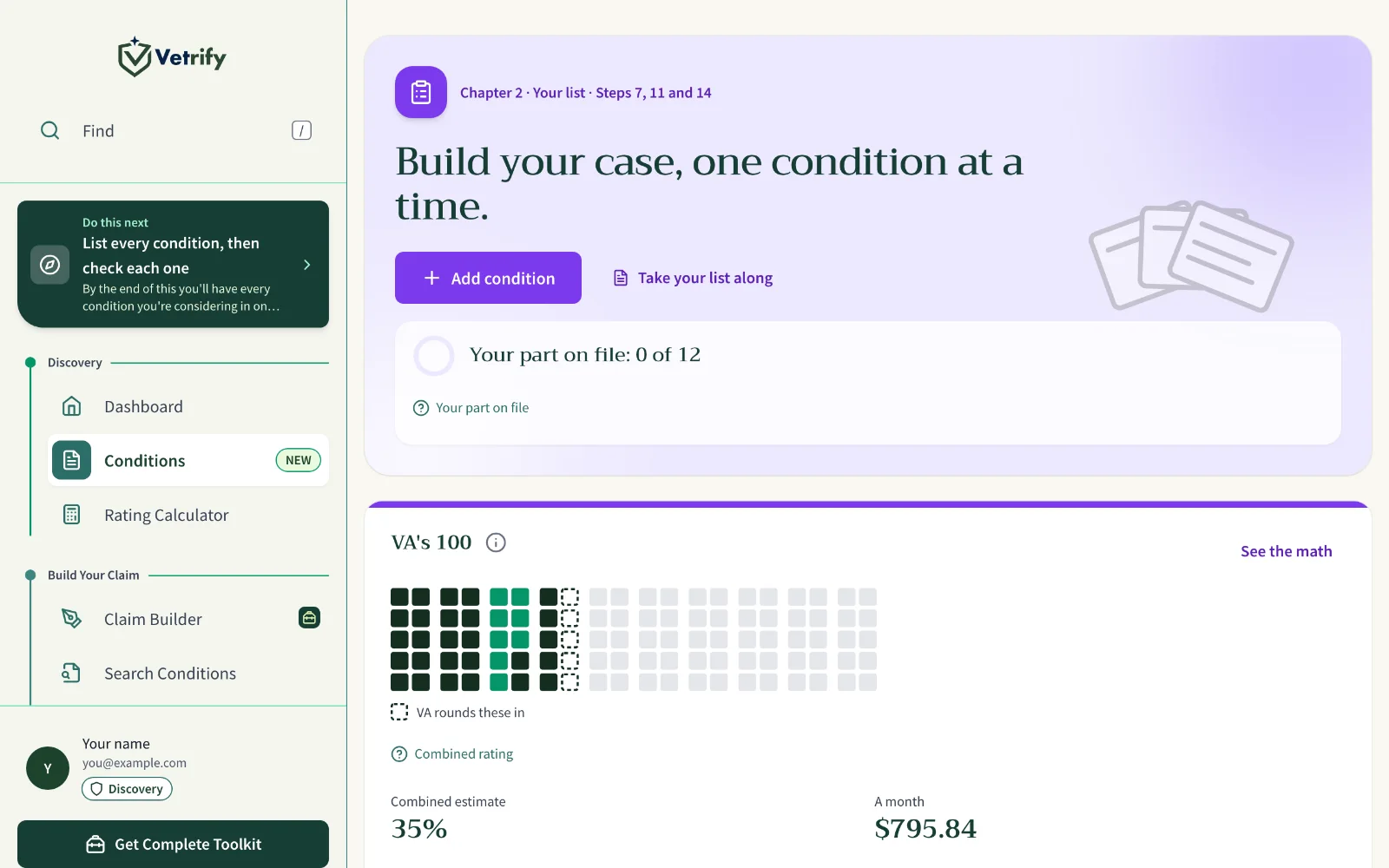
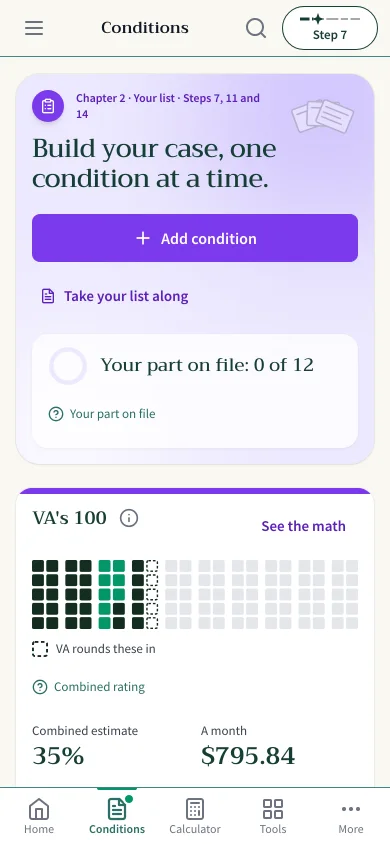
A free account keeps your conditions in one list and shows your combined rating as you add them. Have it ready when you ask the state about a benefit.
HOW TO READ THIS PAGE
Every row, in the source's own words.
Each benefit says what it is, who qualifies in the source's words, and where it comes from. Open a row to read the passage it quotes.
Find your kind of benefit
The benefits are grouped by kind. Start with the one you came for.
Read who qualifies
Each row quotes the source's own words on who qualifies.
Check with the state
Rules change. Ask the office named in the source before you count on a benefit.
Vetrify is not a state agency and not a law firm. This page points to each state's own words; the state decides who qualifies.
9 BENEFITS
Property tax
The homestead of a veteran with a service-connected total and permanent disability is exempt from property taxes, if the veteran is a permanent resident of Florida on January 1 of the tax year, or was on January 1 of the year the veteran died.
Who qualifies, in the source's wordsPermanent and total
“a veteran who was honorably discharged with a service-connected total and permanent disability and for whom a letter from the United States Government or United States Department of Veterans Affairs or its predecessor has been issued certifying that the veteran is totally and permanently disabled”
What the source says
“(1)(a) Any real estate that is owned and used as a homestead by a veteran who was honorably discharged with a service-connected total and permanent disability and for whom a letter from the United States Government or United States Department of Veterans Affairs or its predecessor has been issued certifying that the veteran is totally and permanently disabled is exempt from taxation, if the veteran is a permanent resident of this state on January 1 of the tax year for which exemption is being claimed or was a permanent resident of this state on January 1 of the year the veteran died.”
The disabled veteran's homestead exemption carries over to the surviving spouse until the spouse remarries or sells or otherwise disposes of the home.
Who qualifies, in the source's wordsOther rule
“If the totally and permanently disabled veteran predeceases his or her spouse and if, upon the death of the veteran, the spouse holds the legal or beneficial title to the homestead and permanently resides thereon as specified in s. 196.031”
What the source says
“(3) If the totally and permanently disabled veteran predeceases his or her spouse and if, upon the death of the veteran, the spouse holds the legal or beneficial title to the homestead and permanently resides thereon as specified in s. 196.031, the exemption from taxation carries over to the benefit of the veteran’s spouse until such time as he or she remarries or sells or otherwise disposes of the property.”
Homestead property tax exemption for the surviving spouse of a veteran who died from service-connected causes while on active duty, when a letter from the United States Government or the Department of Veterans Affairs has been issued certifying it.
Who qualifies, in the source's wordsOther rule
“the surviving spouse of a veteran who died from service-connected causes while on active duty as a member of the United States Armed Forces”
What the source says
“(4) Any real estate that is owned and used as a homestead by the surviving spouse of a veteran who died from service-connected causes while on active duty as a member of the United States Armed Forces and for whom a letter from the United States Government or United States Department of Veterans Affairs or its predecessor has been issued certifying that the veteran who died from service-connected causes while on active duty is exempt from taxation.”
A homestead property tax discount for a veteran 65 or older with a combat-related disability, equal to the veteran's VA disability percentage.
Who qualifies, in the source's wordsOther rule
“Each veteran who is age 65 or older and is partially or totally permanently disabled shall receive a discount from the amount of the ad valorem tax otherwise owed on homestead property that the veteran owns and resides in if: (a) The disability was combat-related; and (b) The veteran was honorably discharged upon separation from military service”
What the source says
“(1) Each veteran who is age 65 or older and is partially or totally permanently disabled shall receive a discount from the amount of the ad valorem tax otherwise owed on homestead property that the veteran owns and resides in if: (a) The disability was combat-related; and (b) The veteran was honorably discharged upon separation from military service. (2) The discount shall be in a percentage equal to the percentage of the veteran’s permanent, service-connected disability as determined by the United States Department of Veterans Affairs.”
Source: Florida Statutes 196.082, Discounts for disabled veterans; surviving spouse carryover. Read .
The combat-related disability discount carries over to the surviving spouse until the spouse remarries or sells or otherwise disposes of the home.
Who qualifies, in the source's wordsOther rule
“If the partially or totally and permanently disabled veteran predeceases his or her spouse and if, upon the death of the veteran, the spouse holds the legal or beneficial title to the homestead and permanently resides thereon as specified in s. 196.031”
What the source says
“(3) If the partially or totally and permanently disabled veteran predeceases his or her spouse and if, upon the death of the veteran, the spouse holds the legal or beneficial title to the homestead and permanently resides thereon as specified in s. 196.031, the discount from ad valorem tax that the veteran received carries over to the benefit of the veteran’s spouse until such time as he or she remarries or sells or otherwise disposes of the property.”
Source: Florida Statutes 196.082, Discounts for disabled veterans; surviving spouse carryover. Read .
The homestead of a totally disabled veteran who must use a wheelchair, and whom VA has helped with specially adapted housing, is exempt from property taxes.
Who qualifies, in the source's wordsOther rule
“an ex-servicemember who has been honorably discharged with a service-connected total disability and who has a certificate from the United States Government or United States Department of Veterans Affairs or its predecessor, or its successors, certifying that the ex-servicemember is receiving or has received special pecuniary assistance due to disability requiring specially adapted housing and required to use a wheelchair for his or her transportation”
What the source says
“(1) Any real estate used and owned as a homestead by an ex-servicemember who has been honorably discharged with a service-connected total disability and who has a certificate from the United States Government or United States Department of Veterans Affairs or its predecessor, or its successors, certifying that the ex-servicemember is receiving or has received special pecuniary assistance due to disability requiring specially adapted housing and required to use a wheelchair for his or her transportation is exempt from taxation.”
Source: Florida Statutes 196.091, Exemption for disabled veterans confined to wheelchairs. Read .
If the wheelchair veteran's homestead was held with the spouse as an estate by the entirety, the exemption carries over to the surviving spouse while the spouse lives there as his or her domicile, or until the spouse remarries or sells or otherwise disposes of the property.
Who qualifies, in the source's wordsOther rule
“In the event the homestead of the wheelchair veteran was or is held with the veteran’s spouse as an estate by the entirety, and in the event the veteran did or shall predecease his or her spouse”
What the source says
“(3) In the event the homestead of the wheelchair veteran was or is held with the veteran’s spouse as an estate by the entirety, and in the event the veteran did or shall predecease his or her spouse, the exemption from taxation shall carry over to the benefit of the veteran’s spouse, provided the spouse continues to reside on such real estate and uses it as his or her domicile or until such time as he or she remarries or sells or otherwise disposes of the property.”
Source: Florida Statutes 196.091, Exemption for disabled veterans confined to wheelchairs. Read .
$5,000 of the veteran's property value is exempt from property tax.
Who qualifies, in the source's wordsTied to a VA rating
“Any ex-servicemember, as defined in s. 196.012, who is a bona fide resident of the state, who was discharged under honorable conditions, and who has been disabled to a degree of 10 percent or more by misfortune or while serving during a period of wartime service as defined in s. 1.01(14)”
What the source says
“(1) Any ex-servicemember, as defined in s. 196.012, who is a bona fide resident of the state, who was discharged under honorable conditions, and who has been disabled to a degree of 10 percent or more by misfortune or while serving during a period of wartime service as defined in s. 1.01(14) is entitled to the exemption from taxation provided for in s. 3(b), Art. VII of the State Constitution as provided in this section. Property to the value of $5,000 of such a person is exempt from taxation.”
Source: Florida Statutes 196.24, Exemption for disabled ex-servicemember or surviving spouse; evidence of disability. Read .
The $5,000 property tax exemption also goes to the disabled veteran's unremarried surviving spouse.
Who qualifies, in the source's wordsOther rule
“The unremarried surviving spouse of such a disabled ex-servicemember”
What the source says
“Property to the value of $5,000 of such a person is exempt from taxation. The production by him or her of a certificate of disability from the United States Government or the United States Department of Veterans Affairs or its predecessor before the property appraiser of the county wherein the ex-servicemember’s property lies is prima facie evidence of the fact that he or she is entitled to the exemption. The unremarried surviving spouse of such a disabled ex-servicemember is also entitled to the exemption.”
Source: Florida Statutes 196.24, Exemption for disabled ex-servicemember or surviving spouse; evidence of disability. Read .
5 BENEFITS
Vehicles and license plates
One free disabled veteran license plate for a vehicle the veteran owns or leases.
Who qualifies, in the source's wordsTied to a VA rating
“any disabled veteran who has been a resident of this state continuously for the preceding 5 years or has established a domicile in this state as provided by s. 222.17(1), (2), or (3), and who has been honorably discharged from the United States Armed Forces, upon application, accompanied by proof that: (a) A vehicle was initially acquired through financial assistance by the United States Department of Veterans Affairs or its predecessor specifically for the purchase of an automobile; (b) The applicant has been determined by the United States Department of Veterans Affairs or its predecessor to have a service-connected 100-percent disability rating for compensation; or (c) The applicant has been determined to have a service-connected disability rating of 100 percent and is in receipt of disability retirement pay from any branch of the United States Armed Services.”
What the source says
“(1) One free disabled veteran motor vehicle license number plate shall be issued by the department for use on any motor vehicle owned or leased by any disabled veteran who has been a resident of this state continuously for the preceding 5 years or has established a domicile in this state as provided by s. 222.17(1), (2), or (3), and who has been honorably discharged from the United States Armed Forces, upon application, accompanied by proof that: (a) A vehicle was initially acquired through financial assistance by the United States Department of Veterans Affairs or its predecessor specifically for the purchase of an automobile; (b) The applicant has been determined by the United States Department of Veterans Affairs or its predecessor to have a service-connected 100-percent disability rating for compensation; or (c) The applicant has been determined to have a service-connected disability rating of 100 percent and is in receipt of disability retirement pay from any branch of the United States Armed Services.”
Source: Florida Statutes 320.084, Free motor vehicle license plate to certain disabled veterans. Read .
A disabled veteran license plate that carries all the privileges of a disabled parking permit.
Who qualifies, in the source's wordsOther rule
“in addition to the proof required by s. 320.084(1), proof that due to a service-connected disability he or she permanently uses a wheelchair or proof, in the form of an application that conforms to the requirements set forth in s. 320.0848, that he or she qualifies for a disabled parking permit under that section”
What the source says
“(b) The veteran must offer, in addition to the proof required by s. 320.084(1), proof that due to a service-connected disability he or she permanently uses a wheelchair or proof, in the form of an application that conforms to the requirements set forth in s. 320.0848, that he or she qualifies for a disabled parking permit under that section. The license plate entitles the person to all privileges afforded by a parking permit issued under s. 320.0848.”
Source: Florida Statutes 320.0842, Free motor vehicle license plates to veterans who use wheelchairs. Read .
A Purple Heart or Pearl Harbor Survivor license plate issued without the license tax.
Who qualifies, in the source's wordsOther rule
“an applicant for a Pearl Harbor Survivor license plate or a Purple Heart license plate who also qualifies for a disabled veteran’s license plate under s. 320.084”
What the source says
“Notwithstanding any provisions of law to the contrary, an applicant for a Pearl Harbor Survivor license plate or a Purple Heart license plate who also qualifies for a disabled veteran’s license plate under s. 320.084 shall be issued the appropriate special license plate without payment of the license tax imposed by s. 320.08.”
No fee for parking on public streets or at parking meters when the vehicle shows a disabled veteran plate and carries the veteran. Posted time limits and no-parking, bus loading, fire, access aisle and emergency zones still apply, a lot used for an event may charge, and the section lists other limits.
Who qualifies, in the source's wordsOther rule
“A license plate issued under s. 320.084, s. 320.0842, s. 320.0843, or s. 320.0845”
What the source says
“(1) A state agency, county, municipality, or any agency thereof, may not exact any fee for parking on the public streets or highways or in any metered parking space from the driver of a vehicle that displays: (a) A disabled parking permit or a license plate issued under s. 316.1958 or s. 320.0848; or (b) A license plate issued under s. 320.084, s. 320.0842, s. 320.0843, or s. 320.0845. Such exemptions apply only if the vehicle is transporting the person who has a disability and to whom the disabled parking permit or license plate was issued. (2) The driver of a vehicle that is parked as provided in subsection (1) may not be penalized for parking, except in clearly defined bus loading zones, fire zones, or access aisles adjacent to the parking spaces for persons who have disabilities, or in areas posted as “No Parking” zones or as emergency vehicle zones, or for parking in excess of the posted time limits. (3) Notwithstanding subsection (1), when a state, county, or municipal parking facility or lot is being used in connection with an event at a convention center, cruise-port terminal, sports stadium, sports arena, coliseum, or auditorium, the parking facility may charge a person whose vehicle displays such a parking permit a parking fee in the same manner and amount as it charges other persons.”
Source: Florida Statutes 316.1964, Exemption of vehicles transporting certain persons who have disabilities from payment of parking fees and penalties. Read .
Free parking at publicly owned or operated airports for a vehicle with a disabled veteran plate.
Who qualifies, in the source's wordsOther rule
“Displaying a license plate for disabled veterans issued under s. 320.084, s. 320.0842, or s. 320.0845”
What the source says
“(7) An airport that owns, operates, or leases parking facilities, or any other parking facilities that are used for the purpose of air travel, may charge for parking vehicles that display a disabled parking permit or license tag issued under s. 316.1958, s. 320.0843, or s. 320.0848. However, the governing body of each publicly owned or publicly operated airport must grant free parking to a vehicle: (a) Displaying a license plate for disabled veterans issued under s. 320.084, s. 320.0842, or s. 320.0845; (b) With specialized equipment, such as ramps, lifts, or foot or hand controls, for use by a person who has a disability; or (c) Displaying the Florida Toll Exemption permit.”
Source: Florida Statutes 316.1964, Exemption of vehicles transporting certain persons who have disabilities from payment of parking fees and penalties. Read .
5 BENEFITS
Education and tuition
A state university, a Florida College System institution, a career center operated by a school district under s. 1001.44, or a charter technical career center waives tuition for undergraduate college credit and career certificate programs, for up to 110 percent of the credit hours the program requires.
Who qualifies, in the source's wordsOther rule
“each recipient of a Purple Heart or another combat decoration superior in precedence who: (a) Is enrolled as a full-time, part-time, or summer-school student in a program that terminates in an associate or a baccalaureate degree, a college credit certificate, or a career certificate; (b) Is currently, or was at the time of the military action that resulted in the awarding of the Purple Heart or other combat decoration superior in precedence, a resident of this state; and (c) Submits to the university, institution, or center the DD-214 form issued at the time of separation from service as documentation that the student has received a Purple Heart or another combat decoration superior in precedence. If the DD-214 is not available, other documentation may be acceptable if recognized by the United States Department of Defense or the United States Department of Veterans Affairs as documenting the award.”
What the source says
“(8) A state university, a Florida College System institution, a career center operated by a school district under s. 1001.44, or a charter technical career center shall waive tuition for undergraduate college credit programs and career certificate programs for each recipient of a Purple Heart or another combat decoration superior in precedence who: (a) Is enrolled as a full-time, part-time, or summer-school student in a program that terminates in an associate or a baccalaureate degree, a college credit certificate, or a career certificate; (b) Is currently, or was at the time of the military action that resulted in the awarding of the Purple Heart or other combat decoration superior in precedence, a resident of this state; and (c) Submits to the university, institution, or center the DD-214 form issued at the time of separation from service as documentation that the student has received a Purple Heart or another combat decoration superior in precedence. If the DD-214 is not available, other documentation may be acceptable if recognized by the United States Department of Defense or the United States Department of Veterans Affairs as documenting the award. Such a waiver for a Purple Heart recipient or recipient of another combat decoration superior in precedence shall be applicable for 110 percent of the number of required credit hours of the degree or certificate program for which the student is enrolled.”
Source: Florida Statutes 1009.26, Fee waivers (subsection (8)). Read .
Out-of-state fees are waived at state universities, Florida College System institutions and career centers, so tuition and fees may not exceed what a resident pays.
Who qualifies, in the source's wordsOther rule
“1. An honorably discharged veteran of the United States Armed Forces, the United States Reserve Forces, or the National Guard who physically resides in this state while enrolled in the institution; or 2. Entitled to and uses educational assistance provided by the United States Department of Veterans Affairs for a quarter, semester, or term beginning after July 1, 2015, who physically resides in this state while enrolled in the institution.”
What the source says
“(13)(a) There is established the Congressman C.W. “Bill” Young Veteran Tuition Waiver Program. A state university, Florida College System institution, career center operated by a school district under s. 1001.44, or charter technical career center shall waive out-of-state fees for a person who is: 1. An honorably discharged veteran of the United States Armed Forces, the United States Reserve Forces, or the National Guard who physically resides in this state while enrolled in the institution; or 2. Entitled to and uses educational assistance provided by the United States Department of Veterans Affairs for a quarter, semester, or term beginning after July 1, 2015, who physically resides in this state while enrolled in the institution. (b) Tuition and fees charged to a student who qualifies for the out-of-state fee waiver under this subsection may not exceed the tuition and fees charged to a resident student.”
Source: Florida Statutes 1009.26, Fee waivers (subsection (13), Congressman C.W. “Bill” Young Veteran Tuition Waiver Program). Read .
It is the policy of the state to provide educational opportunity at state expense for the dependent child of a servicemember who died as a result of service-connected injuries, disease, or disability sustained while on active duty, or who has a service-connected 100-percent total and permanent disability rating, when the Florida residency rules in the law are met.
Who qualifies, in the source's wordsPermanent and total
“a dependent child, as defined in s. 1009.21(1), of a servicemember who: 1. Died as a result of service-connected injuries, disease, or disability sustained while on active duty; or 2. Has been: a. Determined by the United States Department of Veterans Affairs or its predecessor to have a service-connected 100-percent total and permanent disability rating for compensation; b. Determined to have a service-connected total and permanent disability rating of 100 percent and is in receipt of disability retirement pay from any branch of the United States Armed Forces; or c. Issued a valid identification card by the Department of Veterans’ Affairs in accordance with s. 295.17.”
What the source says
“(2)(a) It is the policy of the state to provide educational opportunity at state expense for a dependent child, as defined in s. 1009.21(1), of a servicemember who: 1. Died as a result of service-connected injuries, disease, or disability sustained while on active duty; or 2. Has been: a. Determined by the United States Department of Veterans Affairs or its predecessor to have a service-connected 100-percent total and permanent disability rating for compensation; b. Determined to have a service-connected total and permanent disability rating of 100 percent and is in receipt of disability retirement pay from any branch of the United States Armed Forces; or c. Issued a valid identification card by the Department of Veterans’ Affairs in accordance with s. 295.17. (b) The dependent child of a deceased servicemember is eligible for educational benefits under this section if: 1. Immediately preceding the death of the servicemember, Florida was listed as the servicemember’s official home of record in the Defense Enrollment Eligibility Reporting System (DEERS) database; or 2. The child qualifies as a resident for tuition purposes under s. 1009.21. (c) The dependent child of a disabled servicemember is eligible for educational benefits under this section if: 1. Immediately preceding the occurrence of the servicemember’s disability, Florida was listed as the servicemember’s official home of record in the Defense Enrollment Eligibility Reporting System (DEERS) database; or 2. The child qualifies as a resident for tuition purposes under s. 1009.21 and the servicemember is a resident of this state. All rules, restrictions, and limitations set forth in this section shall apply.”
Source: Florida Statutes 295.01, Spouses and dependent children of deceased or disabled servicemembers; education. Read .
For these children, the state's funds may pay tuition and registration fees, board, room rent, books and supplies, between the ages of 16 and 22.
Who qualifies, in the source's wordsOther rule
“who are between the ages of 16 and 22 years and who are in attendance at an eligible postsecondary education institution as defined in s. 295.04”
What the source says
“(1) Sums appropriated and expended to carry out the provisions of s. 295.01(2) may be used to pay tuition and registration fees, board, and room rent and to buy books and supplies for the children of deceased or disabled veterans or servicemembers, as defined and limited in s. 295.01, s. 295.016, s. 295.017, s. 295.018, s. 295.0185, s. 295.019, or s. 295.0195, or of parents classified as prisoners of war or missing in action, as defined and limited in s. 295.015, who are between the ages of 16 and 22 years and who are in attendance at an eligible postsecondary education institution as defined in s. 295.04.”
Source: Florida Statutes 295.02, Use of funds; age, etc.. Read .
It is also the policy of the state to provide educational opportunity at state expense for the unremarried spouse of a deceased servicemember or the spouse of a disabled servicemember, when the Florida rules in the law are met. Subsection (3) does not say which servicemembers; this row takes the ones subsection (2)(a) names for children: a servicemember who died as a result of service-connected injuries, disease, or disability sustained while on active duty, or who has a service-connected 100-percent total and permanent disability rating.
Who qualifies, in the source's wordsOther rule
“(a) The unremarried spouse of a deceased servicemember is eligible for educational benefits under this section if the unremarried spouse applies to use the benefit within 5 years after the servicemember’s death and: 1. Immediately preceding the servicemember’s death, Florida was listed as the servicemember’s official home of record in the Defense Enrollment Eligibility Reporting System (DEERS) database; or 2. The spouse qualifies as a resident for tuition purposes under s. 1009.21. (b) The dependent spouse of a disabled servicemember is eligible for educational benefits under this section if the servicemember and his or her spouse have been married to each other for 1 year and: 1. Immediately preceding the occurrence of the servicemember’s disability, Florida was listed as the servicemember’s official home of record in the Defense Enrollment Eligibility Reporting System (DEERS) database; or 2. The spouse qualifies as a resident for tuition purposes under s. 1009.21 and the servicemember is a resident of this state. (c) The eligibility for educational benefits under paragraph (b) applies only during the duration of the marriage and up to the point of termination of the marriage by dissolution or annulment.”
What the source says
“(2)(a) It is the policy of the state to provide educational opportunity at state expense for a dependent child, as defined in s. 1009.21(1), of a servicemember who: 1. Died as a result of service-connected injuries, disease, or disability sustained while on active duty; or 2. Has been: a. Determined by the United States Department of Veterans Affairs or its predecessor to have a service-connected 100-percent total and permanent disability rating for compensation; b. Determined to have a service-connected total and permanent disability rating of 100 percent and is in receipt of disability retirement pay from any branch of the United States Armed Forces; or c. Issued a valid identification card by the Department of Veterans’ Affairs in accordance with s. 295.17. (b) The dependent child of a deceased servicemember is eligible for educational benefits under this section if: 1. Immediately preceding the death of the servicemember, Florida was listed as the servicemember’s official home of record in the Defense Enrollment Eligibility Reporting System (DEERS) database; or 2. The child qualifies as a resident for tuition purposes under s. 1009.21. (c) The dependent child of a disabled servicemember is eligible for educational benefits under this section if: 1. Immediately preceding the occurrence of the servicemember’s disability, Florida was listed as the servicemember’s official home of record in the Defense Enrollment Eligibility Reporting System (DEERS) database; or 2. The child qualifies as a resident for tuition purposes under s. 1009.21 and the servicemember is a resident of this state. All rules, restrictions, and limitations set forth in this section shall apply. (3) It is also the policy of the state to provide educational opportunity at state expense for spouses of deceased or disabled servicemembers. (a) The unremarried spouse of a deceased servicemember is eligible for educational benefits under this section if the unremarried spouse applies to use the benefit within 5 years after the servicemember’s death and: 1. Immediately preceding the servicemember’s death, Florida was listed as the servicemember’s official home of record in the Defense Enrollment Eligibility Reporting System (DEERS) database; or 2. The spouse qualifies as a resident for tuition purposes under s. 1009.21. (b) The dependent spouse of a disabled servicemember is eligible for educational benefits under this section if the servicemember and his or her spouse have been married to each other for 1 year and: 1. Immediately preceding the occurrence of the servicemember’s disability, Florida was listed as the servicemember’s official home of record in the Defense Enrollment Eligibility Reporting System (DEERS) database; or 2. The spouse qualifies as a resident for tuition purposes under s. 1009.21 and the servicemember is a resident of this state. (c) The eligibility for educational benefits under paragraph (b) applies only during the duration of the marriage and up to the point of termination of the marriage by dissolution or annulment.”
Source: Florida Statutes 295.01, Spouses and dependent children of deceased or disabled servicemembers; education. Read .
4 BENEFITS
Other state benefits
A five-year Persons with Disabilities resident hunting and fishing license. The applicant must be a Florida resident, and the page's hunter safety rules apply to a license to hunt.
Who qualifies, in the source's wordsTied to a VA rating
“A disabled veteran of the United States Armed Forces who was honorably discharged upon separation from service and who is certified by the United States Department of Veterans Affairs or its predecessor or by any branch of the United States Armed Forces as having a service-connected disability percentage of 50 percent or greater”
What the source says
“Requirements/How to Qualify: Applicant must be a Florida resident and provide a valid Florida Driver License or ID to apply online. If the applicant does not have a Florida Driver License or ID card, he or she can provide proof of residency documentation at a local tax collector's office. Persons born on or after June 1, 1975 must comply with Florida Hunter Safety License Requirements and may not be issued a license to hunt with the use of a firearm, gun (including a muzzleloading gun), bow or crossbow without first having successfully completed a hunter safety course. A valid hunter safety certification is needed or use of the Hunter Safety Mentoring Exemption. Applicant must meet one of the following eligibility criteria as identified in 379.353, F. S. by being: Two-year license term for applicants who are certified or determined to be disabled by the United States Social Security Administration (SSA), with documentation dated within the last 12 months and indicating disability benefits are currently being received. The annual SSA benefits letter is acceptable, though the 1099 Form is not accepted. Applicants can obtain their benefit verification letters by printing them from the SSA portal at SSA.gov/myaccount. For examples of valid documentation, please click this link. 2. Five-year license term for applicants who are certified or determined to be: A disabled veteran of the United States Armed Forces who was honorably discharged upon separation from service and who is certified by the United States Department of Veterans Affairs or its predecessor or by any branch of the United States Armed Forces as having a service-connected disability percentage of 50 percent or greater.”
Source: Persons with Disabilities Resident Hunting/Fishing License | FWC. Read .
A free lifetime family annual entrance pass to Florida state parks.
Who qualifies, in the source's wordsOther rule
“Honorably discharged veterans who have service-connected disabilities”
What the source says
“(2) Honorably discharged veterans who have service-connected disabilities shall receive lifetime family annual entrance passes at no charge.”
Source: Florida Statutes 258.0145, Military, law enforcement, and firefighter state park fee discounts. Read .
A free lifetime family annual entrance pass to Florida state parks.
Who qualifies, in the source's wordsOther rule
“Surviving spouses and parents of deceased members of the United States Armed Forces, National Guard, or reserve components thereof who have fallen in combat”
What the source says
“(3) Surviving spouses and parents of deceased members of the United States Armed Forces, National Guard, or reserve components thereof who have fallen in combat shall receive lifetime family annual entrance passes at no charge.”
Source: Florida Statutes 258.0145, Military, law enforcement, and firefighter state park fee discounts. Read .
A 25-percent discount on Florida state park annual entrance passes.
Who qualifies, in the source's wordsOther rule
“Active duty members and honorably discharged veterans of the United States Armed Forces, National Guard, or reserve components thereof”
What the source says
“(1) Active duty members and honorably discharged veterans of the United States Armed Forces, National Guard, or reserve components thereof shall receive a 25-percent discount on annual entrance passes.”
Source: Florida Statutes 258.0145, Military, law enforcement, and firefighter state park fee discounts. Read .
Not covered on this page yet
These have no row here yet, so the page is not a full list. Ask the Florida Department of Veterans' Affairs about them.
- The Florida Department of Veterans' Affairs' own pages: its site refused automated reading on 2026-11-25, so no row quotes it.
- The homestead amendment voters passed in 2026 (Amendment No. 3), which starts January 1, 2027: not yet described here; the rows it touches are checked again after it starts.

On the App Store
Your combined rating and what it pays, on your phone.
VA Calc combines your ratings with VA's whole-person formula and shows what that rating pays at VA's official rates.
Official sources
- Florida Statutes 196.081, Exemption for certain permanently and totally disabled veterans and for surviving spouses of veterans; exemption for surviving spouses of first responders who die in the line of duty, www.leg.state.fl.us
- Florida Statutes 196.082, Discounts for disabled veterans; surviving spouse carryover, www.leg.state.fl.us
- Florida Statutes 196.091, Exemption for disabled veterans confined to wheelchairs, www.leg.state.fl.us
- Florida Statutes 196.24, Exemption for disabled ex-servicemember or surviving spouse; evidence of disability, www.leg.state.fl.us
- Florida Statutes 320.084, Free motor vehicle license plate to certain disabled veterans, www.leg.state.fl.us
- Florida Statutes 320.0842, Free motor vehicle license plates to veterans who use wheelchairs, www.leg.state.fl.us
- Florida Statutes 320.089, Veterans of the United States Armed Forces; members of National Guard; survivors of Pearl Harbor; Purple Heart medal recipients; Bronze Star recipients; active or retired United States Armed Forces reservists; Combat Infantry Badge, Combat Medical Badge, or Combat Action Badge recipients; Combat Action Ribbon recipients; Air Force Combat Action Medal recipients; Distinguished Flying Cross recipients; former prisoners of war; Korean War Veterans; Vietnam War Veterans; Operation Desert Shield Veterans; Operation Desert Storm Veterans; Operation Enduring Freedom Veterans; Operation Iraqi Freedom Veterans; Women Veterans; World War II Veterans; Navy Submariners; and Army of Occupation Veterans; special license plates; fee, www.leg.state.fl.us
- Florida Statutes 316.1964, Exemption of vehicles transporting certain persons who have disabilities from payment of parking fees and penalties, www.leg.state.fl.us
- Florida Statutes 1009.26, Fee waivers (subsection (8)), www.leg.state.fl.us
- Florida Statutes 295.01, Spouses and dependent children of deceased or disabled servicemembers; education, www.leg.state.fl.us
- Florida Statutes 295.02, Use of funds; age, etc., www.leg.state.fl.us
- Persons with Disabilities Resident Hunting/Fishing License | FWC, myfwc.com
- Florida Statutes 258.0145, Military, law enforcement, and firefighter state park fee discounts, www.leg.state.fl.us