
STATE BENEFITS FOR VETERANS · MI
Michigan benefits for veterans
Quoted from the state's own law and agencies
What Michigan law and Michigan agencies say about property tax, vehicles and license plates, education and tuition, and other state benefits. Every row quotes its source and shows the day we read it.
See the benefitsFree · No account needed
Your Michigan benefits list, in your inbox
Email yourself every Michigan benefit on this page, with who qualifies in the source's words, each source and the day we read it.
Michigan
YOUR NEXT STEP
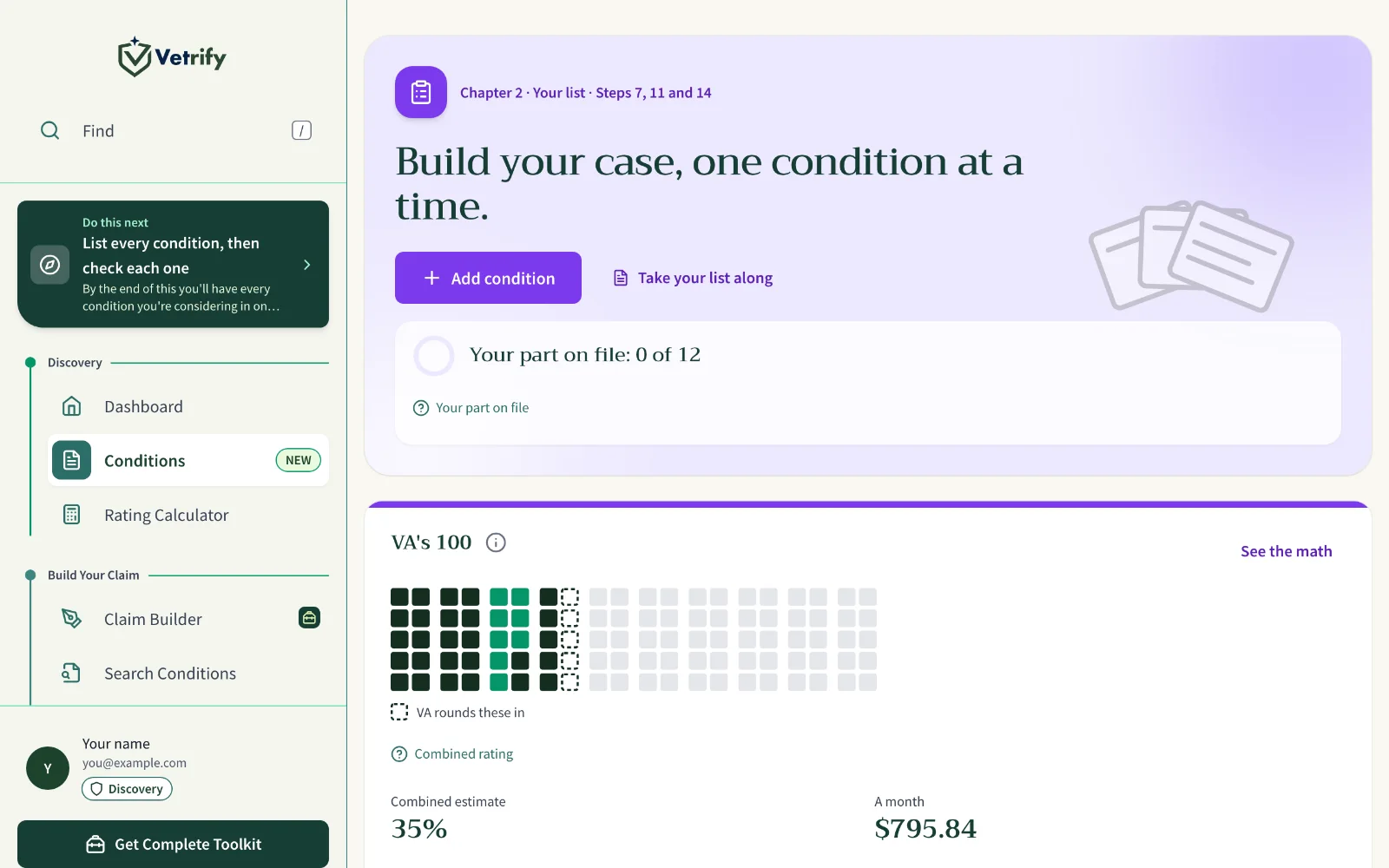
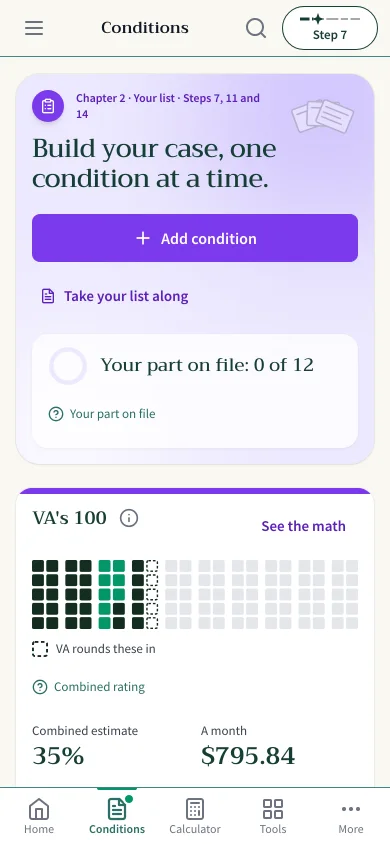
Keep your VA rating at hand.
A free account keeps your conditions in one list and shows your combined rating as you add them. Have it ready when you ask the state about a benefit.
HOW TO READ THIS PAGE
Every row, in the source's own words.
Each benefit says what it is, who qualifies in the source's words, and where it comes from. Open a row to read the passage it quotes.
Find your kind of benefit
The benefits are grouped by kind. Start with the one you came for.
Read who qualifies
Each row quotes the source's own words on who qualifies.
Check with the state
Rules change. Ask the office named in the source before you count on a benefit.
Vetrify is not a state agency and not a law firm. This page points to each state's own words; the state decides who qualifies.
2 BENEFITS
Property tax
Real property you use and own as a homestead is exempt from the collection of property taxes under Michigan's General Property Tax Act. You must be a Michigan resident with a discharge under honorable conditions. You, or your legal designee, file an application with the local assessing officer after January 1 and before December 31 of the year you claim it. An exemption granted for taxes levied on or after January 1, 2025 stays in effect without reapplying until you rescind it or the assessor denies it. If you do not use and own the property as a homestead for the whole tax year, the exemption must be prorated.
Who qualifies, in the source's wordsTied to a VA rating
“"Disabled veteran" means a veteran who is a resident of this state and who meets 1 of the following criteria: (i) Has been determined by the United States Department of Veterans Affairs to be permanently and totally disabled as a result of military service and entitled to veterans' benefits at the 100% rate. (ii) Has a certificate from the United States Department of Veterans Affairs certifying that the veteran is receiving or has received pecuniary assistance due to disability for specially adapted housing. (iii) Has been rated by the United States Department of Veterans Affairs as individually unemployable. (b) "Own" or "owned" means 1 of the following: (i) For an individual described in subsection (1)(a), legal title to the property is held solely by that individual or jointly by that individual and that individual's spouse. (ii) For an individual described in subsection (1)(b), legal title to the property is held solely by that individual. (c) "Veteran" means an individual who served in the United States Armed Forces, including the reserve components, and was discharged or released under honorable conditions.”
What the source says
“(1) Real property used and owned as a homestead by either of the following individuals is exempt from the collection of taxes under this act: (a) A disabled veteran. (b) A surviving spouse of a disabled veteran who, immediately before death, was eligible for the exemption under this section. An exemption under this subdivision continues as long as the surviving spouse does not remarry, and the exemption applies to any property used and owned as a homestead by the surviving spouse, including homestead property acquired after the decedent's death. (2) To obtain the exemption, an individual described in subsection (1)(a) or (b), or the individual's legal designee, must file an application, in a form and manner prescribed by the state tax commission, showing the facts required by this section and a description of the real property with the assessing officer for the local assessing unit after January 1 and before December 31 of the calendar year for which the exemption is claimed. The application when filed is open to inspection. The taxes subject to collection under this act shall be canceled for any year in which an individual described in subsection (1)(a) or (b) who is eligible for the exemption under this section has acquired title to real property exempt under this section. Upon granting the exemption under this section, each local taxing unit shall bear the loss of its portion of the taxes upon which the exemption has been granted. An exemption granted under this section as to taxes levied on or after January 1, 2025 remains in effect, without subsequent reapplication, until it is rescinded by the individual who was granted the exemption or is denied by the assessor, as provided in section 7c. (3) An exemption once granted applies to all property taxes for the current tax year that have been paid by the individual who qualified for the exemption under subsection (1)(a) or (b) and all property taxes for the current tax year that would have been owed by that individual if the property was not exempt. If the individual who qualified for the exemption under subsection (1)(a) or (b) does not use and own the property as a homestead for the entire tax year, the exemption must be prorated under 1 of the following methods: (a) Based on the closing or other purchase documents, if any, executed by or on behalf of the individual who qualified for the exemption under subsection (1)(a) or (b). That individual shall provide a copy of the closing or other purchase documents with the application claiming the exemption. The local treasurer shall use the closing or other purchase documents when calculating the amount of taxes to be exempted. There must be no refund of any property taxes not levied in the current tax year paid pursuant to the closing or other purchase documents to the seller by the individual who qualified for the exemption under subsection (1)(a) or (b). (b) If closing or other purchase documents are not provided for the proration under subdivision (a), based on a proration under which the local treasurer calculates the amount of property taxes levied in the current tax year to be exempted by dividing the total property taxes levied in the year by 365 and then multiplying that number by the number of days the individual will use and own the property as a homestead. (c) Based on a proration that takes into account the effective date of any removal of the exemption, which the assessor shall designate as the date of the relevant conveyance or disposition. Using that date, the local treasurer shall calculate the amount of property taxes levied in the current tax year to be exempted by dividing the total property taxes levied in the year by 365 and then multiplying that number by the number of days the individual, while qualified for the exemption, used and owned the property as a homestead. (4) As used in this section: (a) "Disabled veteran" means a veteran who is a resident of this state and who meets 1 of the following criteria: (i) Has been determined by the United States Department of Veterans Affairs to be permanently and totally disabled as a result of military service and entitled to veterans' benefits at the 100% rate. (ii) Has a certificate from the United States Department of Veterans Affairs certifying that the veteran is receiving or has received pecuniary assistance due to disability for specially adapted housing. (iii) Has been rated by the United States Department of Veterans Affairs as individually unemployable. (b) "Own" or "owned" means 1 of the following: (i) For an individual described in subsection (1)(a), legal title to the property is held solely by that individual or jointly by that individual and that individual's spouse. (ii) For an individual described in subsection (1)(b), legal title to the property is held solely by that individual. (c) "Veteran" means an individual who served in the United States Armed Forces, including the reserve components, and was discharged or released under honorable conditions.”
The surviving spouse of a disabled veteran who was eligible for the homestead exemption just before death keeps it for as long as the spouse does not remarry, on any property the spouse uses and owns as a homestead, including one acquired after the veteran's death. For the spouse, owning means legal title held solely by the spouse. The spouse files the same application with the local assessing officer after January 1 and before December 31 of the year claimed.
Who qualifies, in the source's wordsOther rule
“(b) A surviving spouse of a disabled veteran who, immediately before death, was eligible for the exemption under this section. An exemption under this subdivision continues as long as the surviving spouse does not remarry, and the exemption applies to any property used and owned as a homestead by the surviving spouse, including homestead property acquired after the decedent's death.”
What the source says
“(1) Real property used and owned as a homestead by either of the following individuals is exempt from the collection of taxes under this act: (a) A disabled veteran. (b) A surviving spouse of a disabled veteran who, immediately before death, was eligible for the exemption under this section. An exemption under this subdivision continues as long as the surviving spouse does not remarry, and the exemption applies to any property used and owned as a homestead by the surviving spouse, including homestead property acquired after the decedent's death. (2) To obtain the exemption, an individual described in subsection (1)(a) or (b), or the individual's legal designee, must file an application, in a form and manner prescribed by the state tax commission, showing the facts required by this section and a description of the real property with the assessing officer for the local assessing unit after January 1 and before December 31 of the calendar year for which the exemption is claimed. The application when filed is open to inspection. The taxes subject to collection under this act shall be canceled for any year in which an individual described in subsection (1)(a) or (b) who is eligible for the exemption under this section has acquired title to real property exempt under this section. Upon granting the exemption under this section, each local taxing unit shall bear the loss of its portion of the taxes upon which the exemption has been granted. An exemption granted under this section as to taxes levied on or after January 1, 2025 remains in effect, without subsequent reapplication, until it is rescinded by the individual who was granted the exemption or is denied by the assessor, as provided in section 7c. (3) An exemption once granted applies to all property taxes for the current tax year that have been paid by the individual who qualified for the exemption under subsection (1)(a) or (b) and all property taxes for the current tax year that would have been owed by that individual if the property was not exempt. If the individual who qualified for the exemption under subsection (1)(a) or (b) does not use and own the property as a homestead for the entire tax year, the exemption must be prorated under 1 of the following methods: (a) Based on the closing or other purchase documents, if any, executed by or on behalf of the individual who qualified for the exemption under subsection (1)(a) or (b). That individual shall provide a copy of the closing or other purchase documents with the application claiming the exemption. The local treasurer shall use the closing or other purchase documents when calculating the amount of taxes to be exempted. There must be no refund of any property taxes not levied in the current tax year paid pursuant to the closing or other purchase documents to the seller by the individual who qualified for the exemption under subsection (1)(a) or (b). (b) If closing or other purchase documents are not provided for the proration under subdivision (a), based on a proration under which the local treasurer calculates the amount of property taxes levied in the current tax year to be exempted by dividing the total property taxes levied in the year by 365 and then multiplying that number by the number of days the individual will use and own the property as a homestead. (c) Based on a proration that takes into account the effective date of any removal of the exemption, which the assessor shall designate as the date of the relevant conveyance or disposition. Using that date, the local treasurer shall calculate the amount of property taxes levied in the current tax year to be exempted by dividing the total property taxes levied in the year by 365 and then multiplying that number by the number of days the individual, while qualified for the exemption, used and owned the property as a homestead. (4) As used in this section: (a) "Disabled veteran" means a veteran who is a resident of this state and who meets 1 of the following criteria: (i) Has been determined by the United States Department of Veterans Affairs to be permanently and totally disabled as a result of military service and entitled to veterans' benefits at the 100% rate. (ii) Has a certificate from the United States Department of Veterans Affairs certifying that the veteran is receiving or has received pecuniary assistance due to disability for specially adapted housing. (iii) Has been rated by the United States Department of Veterans Affairs as individually unemployable. (b) "Own" or "owned" means 1 of the following: (i) For an individual described in subsection (1)(a), legal title to the property is held solely by that individual or jointly by that individual and that individual's spouse. (ii) For an individual described in subsection (1)(b), legal title to the property is held solely by that individual. (c) "Veteran" means an individual who served in the United States Armed Forces, including the reserve components, and was discharged or released under honorable conditions.”
3 BENEFITS
Vehicles and license plates
The Secretary of State may issue a special plate with numbers starting "DV" and the words "disabled veteran" for a private passenger motor vehicle you own: one personally owned by you and used mainly to carry you and your family, and not a motor home. The application carries no service fee. A plate issued to a totally disabled veteran is exempt from the registration tax in section 801, expires on your birthday in a year the Secretary of State issues new plates, and renews with no service fee and no new proof. Using the plate on another vehicle, or by someone who does not qualify, is a misdemeanor.
Who qualifies, in the source's wordsTied to a VA rating
“proof that the applicant was honorably discharged from the United States Armed Forces and 1 of the following: (a) If the applicant is a totally disabled veteran, that the applicant has been determined by the United States Department of Veterans Affairs to have a service-connected total or permanent total disability rating for compensation. (b) If the applicant is a totally disabled veteran, that the applicant has been determined to have a service-connected total or permanent total disability rating and is receiving disability retirement pay from a branch of the United States Armed Forces. (c) If the applicant is a partially disabled veteran, that the applicant has been determined by the United States Department of Veterans Affairs to have a service-connected disability rating of not less than 50%.”
What the source says
“(1) An individual who is a disabled veteran with an honorable discharge from the United States Armed Forces may apply to the secretary of state if the disabled veteran owns a private passenger motor vehicle, and the secretary of state may issue a special registration plate inscribed with special identification numbers preceded by the letters "DV" and the words "disabled veteran" beneath the registration number. (2) An application for a special registration plate described in subsection (1) must be on a form prescribed by the secretary of state, must not require a service fee under section 804, and must be accompanied by proof that the applicant was honorably discharged from the United States Armed Forces and 1 of the following: (a) If the applicant is a totally disabled veteran, that the applicant has been determined by the United States Department of Veterans Affairs to have a service-connected total or permanent total disability rating for compensation. (b) If the applicant is a totally disabled veteran, that the applicant has been determined to have a service-connected total or permanent total disability rating and is receiving disability retirement pay from a branch of the United States Armed Forces. (c) If the applicant is a partially disabled veteran, that the applicant has been determined by the United States Department of Veterans Affairs to have a service-connected disability rating of not less than 50%. (3) A special registration plate issued to a totally disabled veteran described in subsection (2)(a) or (b) is exempt from the payment of the tax provided for in section 801. (4) A special registration plate issued to a totally disabled veteran described in subsection (2)(a) or (b) expires on the birthday of the totally disabled veteran in a year in which new plates are issued by the secretary of state. Application for renewal of the special registration plate must not require a service fee under section 804. The applicant is not required to furnish the proof provided in subsection (2) for renewal. (5) A special registration plate issued to a partially disabled veteran described in subsection (2)(c) expires as provided in section 226, and a partially disabled veteran shall apply for renewal of the special registration plate as provided in section 226. The applicant is not required to furnish the proof provided in subsection (2) for renewal. (6) The surviving spouse of an individual who is a disabled veteran with a service-connected disability rating from the United States Department of Veterans Affairs of not less than 50% and an honorable discharge from the United States Armed Forces may use a special registration plate issued under this section after the death of the disabled veteran. The surviving spouse may renew a special registration plate issued under this section after the death of the disabled veteran in the same manner as provided under this section for a disabled veteran with the same service-connected disability rating as the deceased disabled veteran. If applicable, a surviving spouse must apply for registration of the vehicle on which the surviving spouse wishes to place the disabled veteran plate before using or renewing the plate as described in this section. (7) If applicable, the secretary of state may issue to a disabled veteran who has been issued a special registration plate under this section a tab for persons with disabilities. The tab for persons with disabilities must be an adhesive tab that displays the international wheelchair symbol or a reasonable facsimile of that symbol. The tab for persons with disabilities may be attached only to the special registration plate issued to the disabled veteran under this section. (8) An application for a tab for persons with disabilities must be on a form prescribed by the secretary of state. The secretary of state shall require the same proof that the applicant is a disabled person as is required for issuance of a permanent windshield placard under section 675. If the surviving spouse of a disabled veteran is a disabled person, the surviving spouse may apply to the secretary of state for a tab for persons with disabilities in the same manner as provided for a disabled veteran under this subsection. (9) A tab for persons with disabilities issued under subsection (7) must be issued free of charge. (10) If a disabled veteran who has been issued a tab for persons with disabilities renews the disabled veteran's special registration plate under this section, the secretary of state shall issue a new tab for persons with disabilities to the disabled veteran, free of charge. The disabled veteran is not required to again furnish the proof required under subsection (8). (11) The use of a special registration plate or a tab for persons with disabilities issued under this section on a motor vehicle other than the motor vehicle for which the special registration plate is issued, or by a person who does not qualify under this section, is a misdemeanor. (12) As used in this section, "private passenger motor vehicle" means a motor vehicle that is personally owned by a disabled veteran and is used for the primary purpose of transporting the disabled veteran and family members of the disabled veteran, but does not include a motor home.”
Source: Michigan Compiled Laws 257.803f, Special registration plates for disabled veterans and surviving spouses (Michigan Vehicle Code). Read .
The surviving spouse may use the veteran's DV plate after the veteran's death, and may renew it in the same way as a disabled veteran with the same rating. Where it applies, the spouse must first register the vehicle that will carry the plate.
Who qualifies, in the source's wordsOther rule
“The surviving spouse of an individual who is a disabled veteran with a service-connected disability rating from the United States Department of Veterans Affairs of not less than 50% and an honorable discharge from the United States Armed Forces”
What the source says
“(6) The surviving spouse of an individual who is a disabled veteran with a service-connected disability rating from the United States Department of Veterans Affairs of not less than 50% and an honorable discharge from the United States Armed Forces may use a special registration plate issued under this section after the death of the disabled veteran. The surviving spouse may renew a special registration plate issued under this section after the death of the disabled veteran in the same manner as provided under this section for a disabled veteran with the same service-connected disability rating as the deceased disabled veteran. If applicable, a surviving spouse must apply for registration of the vehicle on which the surviving spouse wishes to place the disabled veteran plate before using or renewing the plate as described in this section.”
Source: Michigan Compiled Laws 257.803f, Special registration plates for disabled veterans and surviving spouses (Michigan Vehicle Code). Read .
If it applies, the Secretary of State may issue a tab with the wheelchair symbol for your DV plate, free of charge, on the same proof of disability as a permanent windshield placard. The tab may go only on the DV plate, and a new free tab comes with each plate renewal. A surviving spouse who is a disabled person may apply the same way.
Who qualifies, in the source's wordsOther rule
“a disabled veteran who has been issued a special registration plate under this section”
What the source says
“(7) If applicable, the secretary of state may issue to a disabled veteran who has been issued a special registration plate under this section a tab for persons with disabilities. The tab for persons with disabilities must be an adhesive tab that displays the international wheelchair symbol or a reasonable facsimile of that symbol. The tab for persons with disabilities may be attached only to the special registration plate issued to the disabled veteran under this section. (8) An application for a tab for persons with disabilities must be on a form prescribed by the secretary of state. The secretary of state shall require the same proof that the applicant is a disabled person as is required for issuance of a permanent windshield placard under section 675. If the surviving spouse of a disabled veteran is a disabled person, the surviving spouse may apply to the secretary of state for a tab for persons with disabilities in the same manner as provided for a disabled veteran under this subsection. (9) A tab for persons with disabilities issued under subsection (7) must be issued free of charge. (10) If a disabled veteran who has been issued a tab for persons with disabilities renews the disabled veteran's special registration plate under this section, the secretary of state shall issue a new tab for persons with disabilities to the disabled veteran, free of charge. The disabled veteran is not required to again furnish the proof required under subsection (8).”
Source: Michigan Compiled Laws 257.803f, Special registration plates for disabled veterans and surviving spouses (Michigan Vehicle Code). Read .
2 BENEFITS
Education and tuition
A Children of Veterans Tuition Grant for undergraduate classes at an eligible institution: for a full-time student, $2,800.00 a year or all of the student's eligible tuition, whichever is less, and half that for a part-time student. Grants may be reduced pro rata in a year when less money is available. No one gets this grant, the older 1935 PA 245 tuition waiver, or both, in more than 4 academic years.
Who qualifies, in the source's wordsOther rule
“(a) Is enrolled in that academic year as a full-time or part-time student in undergraduate classes at an eligible institution. (b) Is a United States citizen or permanent resident of the United States. (c) Is more than 16 and less than 26 years of age. (d) Is the natural or adopted child of a Michigan veteran and the Michigan veteran meets or met any of the following: (i) He or she was killed in action or died from another cause while serving in a war or war condition in which the United States was or is a participant. (ii) The United States department of veterans affairs has determined that he or she died or is totally and permanently disabled as a result of a service-connected illness or injury. (iii) The United States department of veterans affairs has determined he or she was permanently and totally disabled as a result of a service-connected illness or injury before death, and he or she died from any cause. (iv) He or she is officially listed by the United States government as missing in action in a foreign country. (e) Has resided continuously in this state for the 12 months immediately preceding the date of his or her application and is not a resident of any other state. (f) Has maintained a cumulative grade point average of at least 2.25 in any undergraduate classes he or she completed at any eligible institution in any previous academic years. (g) Is in compliance with this act and the rules promulgated under this act. (h) Has not been convicted of a felony involving an assault, physical injury, or death. (i) Meets any other standards established in rules promulgated by the authority under section 3.”
What the source says
“(1) Subject to subsection (3), beginning in the 2005-2006 academic year, the authority shall provide a tuition grant in an amount determined under subsection (2) to any student who meets all of the following requirements: (a) Is enrolled in that academic year as a full-time or part-time student in undergraduate classes at an eligible institution. (b) Is a United States citizen or permanent resident of the United States. (c) Is more than 16 and less than 26 years of age. (d) Is the natural or adopted child of a Michigan veteran and the Michigan veteran meets or met any of the following: (i) He or she was killed in action or died from another cause while serving in a war or war condition in which the United States was or is a participant. (ii) The United States department of veterans affairs has determined that he or she died or is totally and permanently disabled as a result of a service-connected illness or injury. (iii) The United States department of veterans affairs has determined he or she was permanently and totally disabled as a result of a service-connected illness or injury before death, and he or she died from any cause. (iv) He or she is officially listed by the United States government as missing in action in a foreign country. (e) Has resided continuously in this state for the 12 months immediately preceding the date of his or her application and is not a resident of any other state. (f) Has maintained a cumulative grade point average of at least 2.25 in any undergraduate classes he or she completed at any eligible institution in any previous academic years. (g) Is in compliance with this act and the rules promulgated under this act. (h) Has not been convicted of a felony involving an assault, physical injury, or death. (i) Meets any other standards established in rules promulgated by the authority under section 3. (2) Subject to subsection (3), the amount of a tuition grant described in subsection (1) in an academic year for a full-time student is $2,800.00, or an amount equal to all of the student's eligible tuition in that academic year, whichever is less. The amount of the tuition grant for a part-time student is 1/2 of the amount of a full-time student as determined by the authority. The authority may reduce the amount of the tuition grants in any academic year on a pro rata basis to reflect the amount then available for the tuition grant program, but only after providing notice to the legislature under section 6(2). (3) If a student receives tuition waiver assistance in the 2005-2006 academic year under the tuition waiver program provided in 1935 PA 245, MCL 35.111 to 35.112, is a person described in section 1(3) of 1935 PA 245, MCL 35.111, and meets the eligibility requirements of this act, the amount of the tuition grant under this act for that student in the 2005-2006 academic year shall be reduced by the amount of tuition waiver assistance that student received under 1935 PA 245. (4) An individual shall not receive tuition grant assistance under this act or tuition waiver assistance under 1935 PA 245, MCL 35.111 to 35.112, or both, in more than 4 academic years.”
Source: Michigan Compiled Laws 390.1344, Tuition grant amount (Children of Veterans Tuition Grant Act). Read .
For the Children of Veterans Tuition Grant, the parent must be a "Michigan veteran": someone whose legal residence just before entering military service was in Michigan and who has not since lived outside Michigan for more than 2 years, or someone who made Michigan their legal residence after entering service. The grant is for a degree or certificate granting public or independent nonprofit college or university, junior college, or community college in Michigan. A full-time student takes at least 12 credit hours a semester, or the equivalent.
Who qualifies, in the source's wordsOther rule
“"Michigan veteran" means an individual whose legal residence immediately before entering military service was in this state and who does not later reside outside of this state for a period of more than 2 years, or an individual who establishes legal residency in this state after entering military service.”
What the source says
“(c) "Eligible institution" means a degree or certificate granting public or independent nonprofit college or university, junior college, or community college in this state. (d) "Eligible tuition" means the tuition charged by an eligible institution for an undergraduate class. (e) "Full-time student" means a student enrolled in at least 12 credit hours in an academic semester or its equivalent number of credit hours in a term or quarter, as determined by the authority. (f) "Michigan veteran" means an individual whose legal residence immediately before entering military service was in this state and who does not later reside outside of this state for a period of more than 2 years, or an individual who establishes legal residency in this state after entering military service.”
Source: Michigan Compiled Laws 390.1342, Definitions (Children of Veterans Tuition Grant Act). Read .
1 BENEFIT
Other state benefits
Any resident license under this part of Michigan's Natural Resources and Environmental Protection Act for which a lottery is not required, free of charge. You must carry proof of eligibility when fishing or hunting and show it to a peace officer who asks.
Who qualifies, in the source's wordsTied to a VA rating
“"disabled veteran" means either of the following: (a) A resident who has been determined by the United States department of veterans affairs to be permanently and totally disabled as a result of military service and entitled to veterans' benefits at the 100% rate, for a disability other than blindness. (b) A resident rated by the United States department of veterans affairs as individually unemployable.”
What the source says
“(2) A disabled veteran is eligible to obtain any resident license under this part for which a lottery is not required free of charge. (3) The department may demand proof of eligibility under subsection (1), (2), or (4). The licensee, when taking aquatic species or hunting, shall possess proof of his or her eligibility under subsection (1), (2), or (4), as applicable, and shall furnish the proof upon the request of a peace officer. (4) The department shall process licenses issued under this section in the same manner as licenses issued to senior citizens for purposes of receiving appropriations from the legislature under section 43546. (5) As used in this section, "disabled veteran" means either of the following: (a) A resident who has been determined by the United States department of veterans affairs to be permanently and totally disabled as a result of military service and entitled to veterans' benefits at the 100% rate, for a disability other than blindness. (b) A resident rated by the United States department of veterans affairs as individually unemployable.”
Not covered on this page yet
These have no row here yet, so the page is not a full list. Ask the Michigan Veterans Affairs Agency about them.
- The Michigan Veterans Affairs Agency's, Department of Treasury's, Secretary of State's and Department of Natural Resources' own pages: michigan.gov refused automated reading on 2026-11-25, so every row rests on the law itself.

On the App Store
Your combined rating and what it pays, on your phone.
VA Calc combines your ratings with VA's whole-person formula and shows what that rating pays at VA's official rates.
Official sources
- Michigan Compiled Laws 211.7b, Exemption of real property used and owned as homestead by disabled veteran or surviving spouse (General Property Tax Act), www.legislature.mi.gov
- Michigan Compiled Laws 257.803f, Special registration plates for disabled veterans and surviving spouses (Michigan Vehicle Code), www.legislature.mi.gov
- Michigan Compiled Laws 390.1344, Tuition grant amount (Children of Veterans Tuition Grant Act), www.legislature.mi.gov
- Michigan Compiled Laws 390.1342, Definitions (Children of Veterans Tuition Grant Act), www.legislature.mi.gov
- Michigan Compiled Laws 324.43537, disabled veteran; resident license for which lottery not required (Natural Resources and Environmental Protection Act), www.legislature.mi.gov