
STATE BENEFITS FOR VETERANS · IL
Illinois benefits for veterans
Quoted from the state's own law and agencies
What Illinois law and Illinois agencies say about property tax, vehicles and license plates, education and tuition, and other state benefits. Every row quotes its source and shows the day we read it.
See the benefitsFree · No account needed
Your Illinois benefits list, in your inbox
Email yourself every Illinois benefit on this page, with who qualifies in the source's words, each source and the day we read it.
Illinois
YOUR NEXT STEP
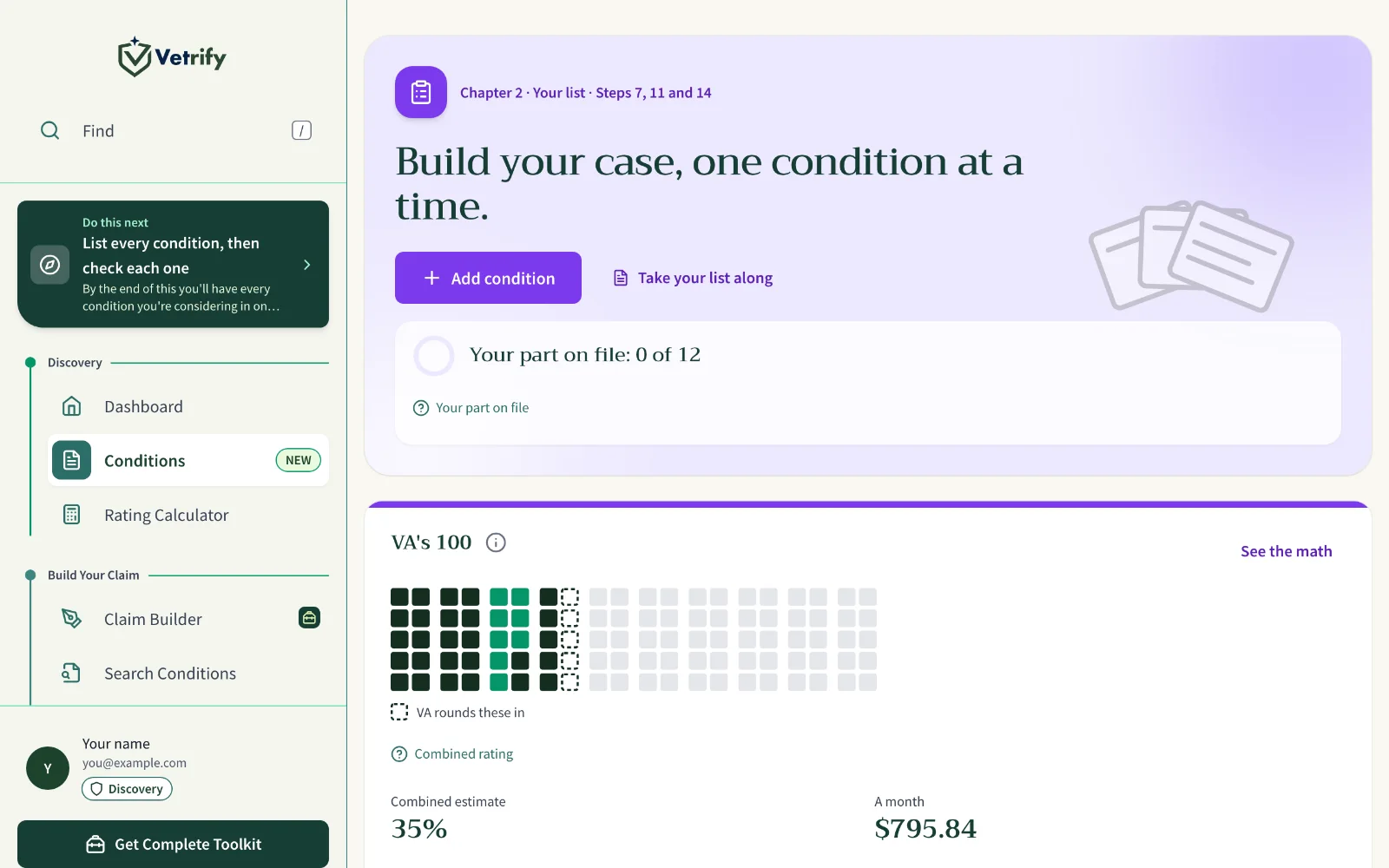
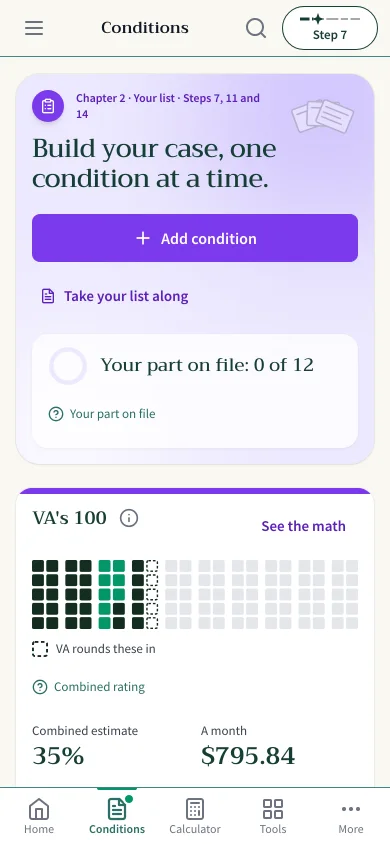
Keep your VA rating at hand.
A free account keeps your conditions in one list and shows your combined rating as you add them. Have it ready when you ask the state about a benefit.
HOW TO READ THIS PAGE
Every row, in the source's own words.
Each benefit says what it is, who qualifies in the source's words, and where it comes from. Open a row to read the passage it quotes.
Find your kind of benefit
The benefits are grouped by kind. Start with the one you came for.
Read who qualifies
Each row quotes the source's own words on who qualifies.
Check with the state
Rules change. Ask the office named in the source before you count on a benefit.
Vetrify is not a state agency and not a law firm. This page points to each state's own words; the state decides who qualifies.
6 BENEFITS
Property tax
A yearly homestead exemption for a veteran with a disability, set by the service-connected disability rating VA has certified as of the date you apply: $2,500 at 30% or more but less than 50%; $5,000 at 50% or more but less than 70%; and at 70% or more, the first $250,000 in equalized assessed value of the property is exempt. The first $250,000 is also exempt for the surviving spouse of a veteran whose death was determined to be service-connected, if the spouse is certified by VA as receiving dependency and indemnity compensation.
Who qualifies, in the source's wordsTied to a VA rating
“if the veteran has a service connected disability of 30% or more but less than 50%, as certified by the United States Department of Veterans Affairs as of the date the application is submitted for the exemption under this Section for the applicable taxable year”
What the source says
“(b-3.1) For taxable year 2023 and thereafter: (1) if the veteran has a service connected disability of 30% or more but less than 50%, as certified by the United States Department of Veterans Affairs as of the date the application is submitted for the exemption under this Section for the applicable taxable year, then the annual exemption is $2,500; (2) if the veteran has a service connected disability of 50% or more but less than 70%, as certified by the United States Department of Veterans Affairs as of the date the application is submitted for the exemption under this Section for the applicable taxable year, then the annual exemption is $5,000; (3) if the veteran has a service connected disability of 70% or more, as certified by the United States Department of Veterans Affairs as of the date the application is submitted for the exemption under this Section for the applicable taxable year, then the first $250,000 in equalized assessed value of the property is exempt from taxation under this Code; and (4) if the taxpayer is the surviving spouse of a veteran whose death was determined to be service-connected and who is certified by the United States Department of Veterans Affairs as a recipient of dependency and indemnity compensation under federal law as of the date the application is submitted for the exemption under this Section for the applicable taxable year, then the first $250,000 in equalized assessed value of the property is also exempt from taxation under this Code.”
Source: 35 ILCS 200/15-169. Homestead exemption for veterans with disabilities and veterans of World War II. Read .
For this exemption, from tax year 2023 a veteran is an Illinois resident who served in the U.S. Armed Forces on active duty or State active duty, in the Illinois National Guard or in the U.S. Reserve Forces, who has a service-connected disability certified by VA and receives disability compensation. The home must be the veteran's primary residence; any part used for commercial purposes is left out, and property rented for more than 6 months is presumed to be used for commercial purposes.
Who qualifies, in the source's wordsOther rule
“For taxable years 2023 and thereafter, "veteran" means an Illinois resident who has served as a member of the United States Armed Forces on active duty or State active duty, a member of the Illinois National Guard, or a member of the United States Reserve Forces and who has a service-connected disability, as certified by the United States Department of Veterans Affairs, and receives disability compensation.”
What the source says
“"Qualified residence" means, for tax year 2023 and thereafter, real property, but less any portion of that property that is used for commercial purposes, that is the primary residence of a veteran with a disability. Property rented for more than 6 months is presumed to be used for commercial purposes. "Service-connected disability" means an illness or injury (i) that was caused by or worsened by active military service, (ii) that is a current disability as of the date of the application for the exemption under this Section for the applicable tax year, as demonstrated by the veteran's United States Department of Veterans Affairs certification, and (iii) for which the veteran receives disability compensation. For tax years 2022 and prior, "veteran" means an Illinois resident who has served as a member of the United States Armed Forces on active duty or State active duty, a member of the Illinois National Guard, or a member of the United States Reserve Forces and who has received an honorable discharge. For taxable years 2023 and thereafter, "veteran" means an Illinois resident who has served as a member of the United States Armed Forces on active duty or State active duty, a member of the Illinois National Guard, or a member of the United States Reserve Forces and who has a service-connected disability, as certified by the United States Department of Veterans Affairs, and receives disability compensation.”
Source: 35 ILCS 200/15-169. Homestead exemption for veterans with disabilities and veterans of World War II. Read .
The exemption carries over to the veteran's surviving spouse as long as the spouse holds legal or beneficial title to the home, permanently lives there and does not remarry. If the spouse sells, an exemption no larger than the one on the most recent tax roll may move to the spouse's new primary residence, as long as the spouse does not remarry. From tax year 2023 a surviving spouse includes the spouse of a veteran who had the exemption before death; of a veteran killed in the line of duty; of a veteran who would have qualified had the veteran survived, if the spouse has lived in Illinois since the death; or of a veteran whose death was determined to be service-connected, if the spouse is certified as receiving dependency and indemnity compensation and stays eligible for it on January 1 of the tax year.
Who qualifies, in the source's wordsOther rule
“The tax exemption under this Section carries over to the benefit of the veteran's surviving spouse as long as the spouse holds the legal or beneficial title to the homestead, permanently resides thereon, and does not remarry.”
What the source says
“(c) The tax exemption under this Section carries over to the benefit of the veteran's surviving spouse as long as the spouse holds the legal or beneficial title to the homestead, permanently resides thereon, and does not remarry. If the surviving spouse sells the property, an exemption not to exceed the amount granted from the most recent ad valorem tax roll may be transferred to his or her new residence as long as it is used as his or her primary residence and he or she does not remarry. As used in this subsection (c): (1) for taxable years prior to 2015, "surviving spouse" means the surviving spouse of a veteran who obtained an exemption under this Section prior to his or her death; (2) for taxable years 2015 through 2022, "surviving spouse" means (i) the surviving spouse of a veteran who obtained an exemption under this Section prior to his or her death and (ii) the surviving spouse of a veteran who was killed in the line of duty at any time prior to the expiration of the application period in effect for the exemption for the taxable year for which the exemption is sought; and (3) for taxable year 2023 and thereafter, "surviving spouse" means: (i) the surviving spouse of a veteran who obtained the exemption under this Section prior to his or her death; (ii) the surviving spouse of a veteran who was killed in the line of duty at any time prior to the expiration of the application period in effect for the exemption for the taxable year for which the exemption is sought; (iii) the surviving spouse of a veteran who did not obtain an exemption under this Section before death, but who would have qualified for the exemption under this Section in the taxable year for which the exemption is sought if he or she had survived, and whose surviving spouse has been a resident of Illinois from the time of the veteran's death through the taxable year for which the exemption is sought; and (iv) the surviving spouse of a veteran whose death was determined to be service-connected, but who would not otherwise qualify under item (i), (ii), or (iii), if the spouse (A) is certified by the United States Department of Veterans Affairs as a recipient of dependency and indemnity compensation under federal law at any time prior to the expiration of the application period in effect for the exemption for the taxable year for which the exemption is sought and (B) remains eligible for that dependency and indemnity compensation as of January 1 of the taxable year for which the exemption is sought.”
Source: 35 ILCS 200/15-169. Homestead exemption for veterans with disabilities and veterans of World War II. Read .
You must reapply for this exemption every year, during your county's application period. A veteran with a combined service-connected disability rating of 100% who is deemed permanently and totally disabled, as certified by VA, no longer has to reapply. A taxpayer who claims the Section 15-165 or 15-168 exemption may not claim this one.
Who qualifies, in the source's wordsPermanent and total
“if a veteran has a combined service connected disability rating of 100% and is deemed to be permanently and totally disabled, as certified by the United States Department of Veterans Affairs”
What the source says
“(d) The exemption under this Section applies for taxable year 2007 and thereafter. A taxpayer who claims an exemption under Section 15-165 or 15-168 may not claim an exemption under this Section. (e) Except as otherwise provided in this subsection (e), each taxpayer who has been granted an exemption under this Section must reapply on an annual basis, except that a veteran who qualifies as a result of his or her service in World War II need not reapply. Application must be made during the application period in effect for the county of his or her residence. The assessor or chief county assessment officer may determine the eligibility of residential property to receive the homestead exemption provided by this Section by application, visual inspection, questionnaire, or other reasonable methods. The determination must be made in accordance with guidelines established by the Department. On and after May 23, 2022 (the effective date of Public Act 102-895), if a veteran has a combined service connected disability rating of 100% and is deemed to be permanently and totally disabled, as certified by the United States Department of Veterans Affairs, the taxpayer who has been granted an exemption under this Section shall no longer be required to reapply for the exemption on an annual basis, and the exemption shall be in effect for as long as the exemption would otherwise be permitted under this Section.”
Source: 35 ILCS 200/15-169. Homestead exemption for veterans with disabilities and veterans of World War II. Read .
Property up to an assessed value of $100,000, owned and used exclusively as a home by a veteran with a disability, or the veteran's spouse or unmarried surviving spouse, is exempt. It applies to housing bought, built or adapted with federal Specially Adapted Housing funds, to adapted housing bought with the proceeds of such a home (the entire proceeds of the sale, casualty loss reimbursement or other transfer must go toward the new specially adapted housing, up to its purchase price), and, from the 2015 tax year, to donated adapted housing that meets the section's rules. The Illinois Department of Veterans Affairs must certify it again every year. A taxpayer who claims the Section 15-168 or 15-169 exemption may not claim this one.
Who qualifies, in the source's wordsOther rule
“a person who has served in the Armed Forces of the United States and whose disability is of such a nature that the Federal Government has authorized payment for purchase or construction of Specially Adapted Housing as set forth in the United States Code, Title 38, Chapter 21, Section 2101”
What the source says
“Property up to an assessed value of $100,000, owned and used exclusively by a veteran with a disability, or the spouse or unmarried surviving spouse of the veteran, as a home, is exempt. As used in this Section, a "veteran with a disability" means a person who has served in the Armed Forces of the United States and whose disability is of such a nature that the Federal Government has authorized payment for purchase or construction of Specially Adapted Housing as set forth in the United States Code, Title 38, Chapter 21, Section 2101. The exemption applies to housing where Federal funds have been used to purchase or construct special adaptations to suit the veteran's disability. The exemption also applies to housing that is specially adapted to suit the veteran's disability, and purchased entirely or in part by the proceeds of a sale, casualty loss reimbursement, or other transfer of a home for which the Federal Government had previously authorized payment for purchase or construction as Specially Adapted Housing. However, the entire proceeds of the sale, casualty loss reimbursement, or other transfer of that housing shall be applied to the acquisition of subsequent specially adapted housing to the extent that the proceeds equal the purchase price of the subsequently acquired housing. Beginning with the 2015 tax year, the exemption also applies to housing that is specifically constructed or adapted to suit a qualifying veteran's disability if the housing or adaptations are donated by a charitable organization, the veteran has been approved to receive funds for the purchase or construction of Specially Adapted Housing under Title 38, Chapter 21, Section 2101 of the United States Code, and the home has been inspected and certified by a licensed home inspector to be in compliance with applicable standards set forth in U.S. Department of Veterans Affairs, Veterans Benefits Administration Pamphlet 26-13 Handbook for Design of Specially Adapted Housing. For purposes of this Section, "charitable organization" means any benevolent, philanthropic, patriotic, or eleemosynary entity that solicits and collects funds for charitable purposes and includes each local, county, or area division of that charitable organization. For purposes of this Section, "unmarried surviving spouse" means the surviving spouse of the veteran at any time after the death of the veteran during which such surviving spouse is not married. This exemption must be reestablished on an annual basis by certification from the Illinois Department of Veterans Affairs to the Department, which shall forward a copy of the certification to local assessing officials. A taxpayer who claims an exemption under Section 15-168 or 15-169 may not claim an exemption under this Section.”
Source: 35 ILCS 200/15-165. Veterans with disabilities. Read .
A $5,000 reduction from the property's value on the principal residence a veteran owns, occupies and pays property taxes on, for the taxable year the veteran returns from active duty in an armed conflict and for the taxable year after. If the veteran first buys the home after January 1 of the return year, the veteran may apply the exemption for the next taxable year, if the home is the principal residence on January 1 of that year. You apply during your county's application period, and it is in addition to any other homestead exemption.
Who qualifies, in the source's wordsOther rule
“"veteran" means an Illinois resident who has served as a member of the United States Armed Forces, a member of the Illinois National Guard, or a member of the United States Reserve Forces”
What the source says
“(a) Beginning with taxable year 2007, a homestead exemption, limited to a reduction set forth under subsection (b), from the property's value, as equalized or assessed by the Department, is granted for property that is owned and occupied as the principal residence of a veteran returning from an armed conflict involving the armed forces of the United States who is liable for paying real estate taxes on the property and is an owner of record of the property or has a legal or equitable interest therein as evidenced by a written instrument, except for a leasehold interest, other than a leasehold interest of land on which a single family residence is located, which is occupied as the principal residence of a veteran returning from an armed conflict involving the armed forces of the United States who has an ownership interest therein, legal, equitable or as a lessee, and on which he or she is liable for the payment of property taxes. For purposes of the exemption under this Section, "veteran" means an Illinois resident who has served as a member of the United States Armed Forces, a member of the Illinois National Guard, or a member of the United States Reserve Forces. (b) In all counties, the reduction is $5,000 for the taxable year in which the veteran returns from active duty in an armed conflict involving the armed forces of the United States; however, if the veteran first acquires his or her principal residence during the taxable year in which he or she returns, but after January 1 of that year, and if the property is owned and occupied by the veteran as a principal residence on January 1 of the next taxable year, he or she may apply the exemption for the next taxable year, and only the next taxable year, after he or she returns. Beginning in taxable year 2010, the reduction shall also be allowed for the taxable year after the taxable year in which the veteran returns from active duty in an armed conflict involving the armed forces of the United States. For land improved with an apartment building owned and operated as a cooperative, the maximum reduction from the value of the property, as equalized by the Department, must be multiplied by the number of apartments or units occupied by a veteran returning from an armed conflict involving the armed forces of the United States who is liable, by contract with the owner or owners of record, for paying property taxes on the property and is an owner of record of a legal or equitable interest in the cooperative apartment building, other than a leasehold interest. In a cooperative where a homestead exemption has been granted, the cooperative association or the management firm of the cooperative or facility shall credit the savings resulting from that exemption only to the apportioned tax liability of the owner or resident who qualified for the exemption. Any person who willfully refuses to so credit the savings is guilty of a Class B misdemeanor. (c) Application must be made during the application period in effect for the county of his or her residence. The assessor or chief county assessment officer may determine the eligibility of residential property to receive the homestead exemption provided by this Section by application, visual inspection, questionnaire, or other reasonable methods. The determination must be made in accordance with guidelines established by the Department. (d) The exemption under this Section is in addition to any other homestead exemption provided in this Article 15.”
Source: 35 ILCS 200/15-167. Returning Veterans' Homestead Exemption. Read .
1 BENEFIT
Vehicles and license plates
A veteran may apply, without paying any registration fee, for plates for veterans with disabilities, for the registration of one motor vehicle of the first division, one motorcycle, or one motor vehicle of the second division weighing not more than 8,000 pounds. A veteran with a VA service-connected disability that a licensed physician, physician assistant or advanced practice registered nurse certifies qualifies for disability plates under Section 3-616 may apply for plates with the international symbol of access. A veteran with a VA service-connected disability of 50% or more that does not qualify under Section 3-616 may apply for a special plate without the symbol. Each renewal needs documentation of eligibility unless the disability is permanent.
Who qualifies, in the source's wordsTied to a VA rating
“Any veteran who holds proof of a service-connected disability from the United States Department of Veterans Affairs, and whose degree of disability has been declared to be 50% or more”
What the source says
“(Text of Section from P.A. 104-682) Sec. 3-609. Plates for veterans with disabilities. (a) Any veteran who holds proof of a service-connected disability from the United States Department of Veterans Affairs, and who has obtained certification from a licensed physician, physician assistant, or advanced practice registered nurse that the service-connected disability qualifies the veteran for issuance of registration plates or digital registration plates or decals to a person with disabilities in accordance with Section 3-616, may, without the payment of any registration fee, make application to the Secretary of State for license plates for veterans with disabilities displaying the international symbol of access, for the registration of one motor vehicle of the first division, one motorcycle, or one motor vehicle of the second division weighing not more than 8,000 pounds. (b) Any veteran who holds proof of a service-connected disability from the United States Department of Veterans Affairs, and whose degree of disability has been declared to be 50% or more, but whose disability does not qualify the veteran for a plate or decal for persons with disabilities under Section 3-616, may, without the payment of any registration fee, make application to the Secretary for a special registration plate or digital registration plate without the international symbol of access for the registration of one motor vehicle of the first division, one motorcycle, or one motor vehicle of the second division weighing not more than 8,000 pounds. (c) Renewal of such registration must be accompanied with documentation for eligibility of registration without fee unless the applicant has a permanent qualifying disability, and such registration plates or digital registration plates may not be issued to any person not eligible therefor.”
Source: 625 ILCS 5/3-609. Plates for veterans with disabilities. Read .
2 BENEFITS
Education and tuition
No tuition or mandatory fees at an Illinois State-controlled university or public community college for the equivalent of 4 years of full-time enrollment, including summer terms (the Illinois Veteran Grant). You must have served in the U.S. Armed Forces, a Reserve component or the Illinois National Guard (not ROTC, and not service academy attendance alone), received an honorable discharge, and served at least one year of federal active duty or met one of the section's exceptions. You must also have been an Illinois resident when you entered federal active duty, or within 6 months, or been enrolled at an Illinois public university or community college, and have returned to Illinois within 6 months after leaving; or be an Illinois resident when you apply and have lived in Illinois at least 15 consecutive years after leaving active duty. A person still on federal active duty who otherwise qualifies, meets the service length rule and can document an honorable service record is also eligible. You must tell your school you have the grant by the end of the term you want it for, and keep minimum grade levels and a satisfactory student loan repayment record.
Who qualifies, in the source's wordsOther rule
“"Qualified applicant" means a person who served in the Armed Forces of the United States, a Reserve component of the Armed Forces, or the Illinois National Guard, excluding members of the Reserve Officers' Training Corps and those whose only service has been attendance at a service academy”
What the source says
“(a) As used in this Section: "Qualified applicant" means a person who served in the Armed Forces of the United States, a Reserve component of the Armed Forces, or the Illinois National Guard, excluding members of the Reserve Officers' Training Corps and those whose only service has been attendance at a service academy, and who meets all of the qualifications of either paragraphs (1) through (4) or paragraphs (2), (3), and (5): (1) At the time of entering federal active duty service the person was one of the following: (A) An Illinois resident. (B) An Illinois resident within 6 months of entering such service. (C) Enrolled at a State-controlled university or public community college in this State. (2) The person meets one of the following requirements: (A) He or she served at least one year of federal active duty. (B) He or she served less than one year of federal active duty and received an honorable discharge for medical reasons directly connected with such service. (C) He or she served less than one year of federal active duty and was discharged prior to August 11, 1967. (D) He or she served less than one year of federal active duty in a foreign country during a time of hostilities in that foreign country. (3) The person received an honorable discharge after leaving federal active duty service. (4) The person returned to this State within 6 months after leaving federal active duty service, or, if married to a person in continued military service stationed outside this State, returned to this State within 6 months after his or her spouse left service or was stationed within this State. (5) The person does not meet the requirements of paragraph (1), but (i) is a resident of Illinois at the time of application to the Commission and (ii) at some point after leaving federal active duty service, was a resident of Illinois for at least 15 consecutive years. "Time of hostilities" means any action by the Armed Forces of the United States that is recognized by the issuance of a Presidential proclamation or a Presidential executive order and in which the Armed Forces expeditionary medal or other campaign service medals are awarded according to Presidential executive order. (b) A person who otherwise qualifies under subsection (a) of this Section but has not left federal active duty service and has served at least one year of federal active duty or has served for less than one year of federal active duty in a foreign country during a time of hostilities in that foreign country and who can provide documentation demonstrating an honorable service record is eligible to receive assistance under this Section. (c) A qualified applicant is not required to pay any tuition or mandatory fees while attending a State-controlled university or public community college in this State for a period that is equivalent to 4 years of full-time enrollment, including summer terms. A qualified applicant who has previously received benefits under this Section for a non-mandatory fee shall continue to receive benefits covering such fees while he or she is enrolled in a continuous program of study. The qualified applicant shall no longer receive a grant covering non-mandatory fees if he or she fails to enroll during an academic term, unless he or she is serving federal active duty service. (d) A qualified applicant who has been or is to be awarded assistance under this Section shall receive that assistance if the qualified applicant notifies his or her postsecondary institution of that fact by the end of the school term for which assistance is requested. (e) Assistance under this Section is considered an entitlement that the State-controlled college or public community college in which the qualified applicant is enrolled shall honor without any condition other than the qualified applicant's maintenance of minimum grade levels and a satisfactory student loan repayment record pursuant to subsection (c) of Section 20 of this Act.”
Source: 110 ILCS 947/40. Illinois Veteran grant program. Read .
A MIA/POW Scholarship: no tuition or mandatory fees at an Illinois State-controlled university or public community college for the equivalent of 4 years of enrollment, including summer terms. It is for the spouse or child (including some adopted, guardianship and step-children the section lists) of a veteran or serviceperson whom the U.S. Department of Defense or VA has declared a prisoner of war or missing in action, who died as the result of a service-connected disability, or who became permanently disabled from service-connected causes with 100% disability. The veteran must have been an Illinois resident when entering service or within 6 months after, or be an Illinois resident at application who lived in Illinois at least 15 consecutive years after entering service. The student must meet the school's examinations and academic standards, including minimum grade levels. A spouse's benefits end after the current term if the surviving spouse remarries or there is a divorce.
Who qualifies, in the source's wordsOther rule
“"Eligible veteran or serviceperson" means any veteran or serviceperson, including an Illinois National Guard member who is on active duty or is active on a training assignment, who has been declared by the U.S. Department of Defense or the U.S. Department of Veterans Affairs to be a prisoner of war or missing in action, or has died as the result of a service-connected disability or has become a person with a permanent disability from service-connected causes with 100% disability”
What the source says
“(a) Any spouse, natural child, legally adopted child under the age of 18 at the time of adoption, minor child younger than 18 who is under a court-ordered guardianship for at least 2 continuous years prior to application, or step-child under the age of 18 at the time of marriage of an eligible veteran or serviceperson who possesses all necessary entrance requirements shall, upon application and proper proof, be awarded a MIA/POW Scholarship consisting of the equivalent of 4 calendar years of full-time enrollment including summer terms, to the state supported Illinois institution of higher learning of his choice, subject to the restrictions listed below. "Eligible veteran or serviceperson" means any veteran or serviceperson, including an Illinois National Guard member who is on active duty or is active on a training assignment, who has been declared by the U.S. Department of Defense or the U.S. Department of Veterans Affairs to be a prisoner of war or missing in action, or has died as the result of a service-connected disability or has become a person with a permanent disability from service-connected causes with 100% disability and who (i) at the time of entering service was an Illinois resident, or (ii) was an Illinois resident within 6 months after entering such service, or (iii) is a resident of Illinois at the time of application for the Scholarship and, at some point after entering such service, was a resident of Illinois for at least 15 consecutive years. "Full-time enrollment" means 12 or more semester hours of courses per semester, or 12 or more quarter hours of courses per quarter, or the equivalent thereof per term. Scholarships utilized by dependents enrolled in less than full-time study shall be computed in the proportion which the number of hours so carried bears to full-time enrollment. Scholarships awarded under this Section may be used by a spouse or child without regard to his or her age. The holder of a Scholarship awarded under this Section shall be subject to all examinations and academic standards, including the maintenance of minimum grade levels, that are applicable generally to other enrolled students at the Illinois institution of higher learning where the Scholarship is being used. If the surviving spouse remarries or if there is a divorce between the veteran or serviceperson and his or her spouse while the dependent is pursuing his or her course of study, Scholarship benefits will be terminated at the end of the term for which he or she is presently enrolled. Such dependents shall also be entitled, upon proper proof and application, to enroll in any extension course offered by a State supported Illinois institution of higher learning without payment of tuition and approved fees. The holder of a MIA/POW Scholarship authorized under this Section shall not be required to pay any tuition or mandatory fees while attending a State-controlled university or public community college in this State for a period equivalent to 4 years of enrollment, including summer terms.”
Source: 105 ILCS 5/30-14.2. Deceased, Disabled, and MIA/POW Veterans' Dependents scholarship. Read .
1 BENEFIT
Other state benefits
A resident sport fishing license at one-half of the current fee. You must give the Department acceptable verification of your service.
Who qualifies, in the source's wordsOther rule
“resident veterans of the United States Armed Forces after returning from service abroad or mobilization by the President of the United States as an active duty member of the United States Armed Forces, the Illinois National Guard, or the Reserves of the United States Armed Forces”
What the source says
“(a) Except as otherwise provided in this Section, for sport fishing devices as defined in Section 10-95 or spearing devices as defined in Section 10-110, the fee is $14.50 for individuals 16 to 64 years old, one-half of the current fishing license fee for individuals age 65 or older, and, commencing with the 2012 license year, one-half of the current fishing license fee for resident veterans of the United States Armed Forces after returning from service abroad or mobilization by the President of the United States as an active duty member of the United States Armed Forces, the Illinois National Guard, or the Reserves of the United States Armed Forces. Veterans must provide to the Department acceptable verification of their service. The Department shall establish by administrative rule the procedure by which such verification of service shall be made to the Department for the purpose of issuing fishing licenses to resident veterans at a reduced fee.”
Source: 515 ILCS 5/20-45. License fees for residents. Read .
Not covered on this page yet
These have no row here yet, so the page is not a full list. Ask the Illinois Department of Veterans' Affairs about them.
- The change to disabled veteran plates that starts July 1, 2027 (Public Act 104-603): the row quotes the text in force now.

On the App Store
Your combined rating and what it pays, on your phone.
VA Calc combines your ratings with VA's whole-person formula and shows what that rating pays at VA's official rates.
Official sources
- 35 ILCS 200/15-169. Homestead exemption for veterans with disabilities and veterans of World War II, www.ilga.gov
- 35 ILCS 200/15-165. Veterans with disabilities, www.ilga.gov
- 35 ILCS 200/15-167. Returning Veterans' Homestead Exemption, www.ilga.gov
- 625 ILCS 5/3-609. Plates for veterans with disabilities, www.ilga.gov
- 110 ILCS 947/40. Illinois Veteran grant program, www.ilga.gov
- 105 ILCS 5/30-14.2. Deceased, Disabled, and MIA/POW Veterans' Dependents scholarship, www.ilga.gov
- 515 ILCS 5/20-45. License fees for residents, www.ilga.gov