
STATE BENEFITS FOR VETERANS · CA
California benefits for veterans
Quoted from the state's own law and agencies
What California law and California agencies say about property tax, vehicles and license plates, education and tuition, and other state benefits. Every row quotes its source and shows the day we read it.
See the benefitsFree · No account needed
Your California benefits list, in your inbox
Email yourself every California benefit on this page, with who qualifies in the source's words, each source and the day we read it.
California
YOUR NEXT STEP
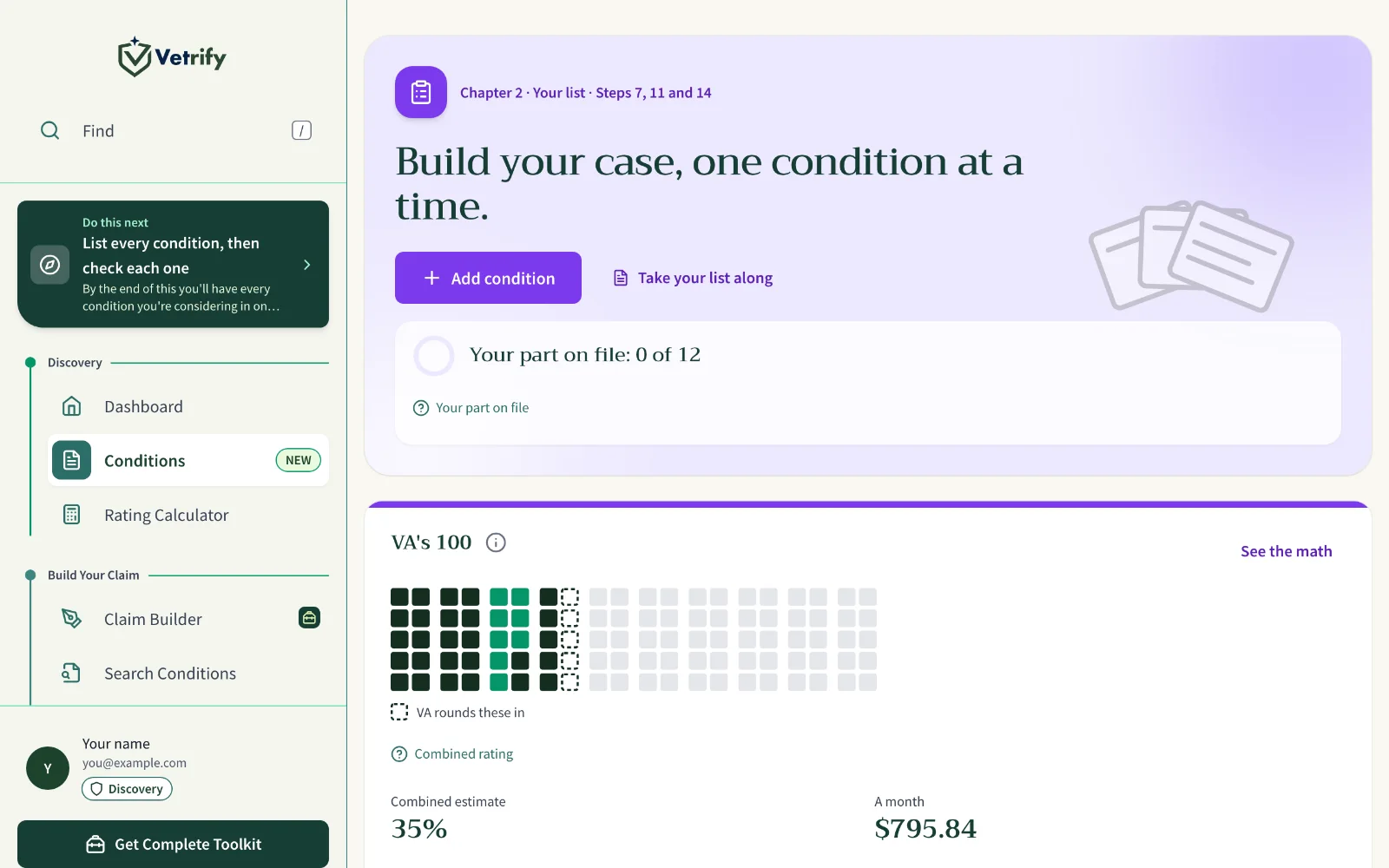
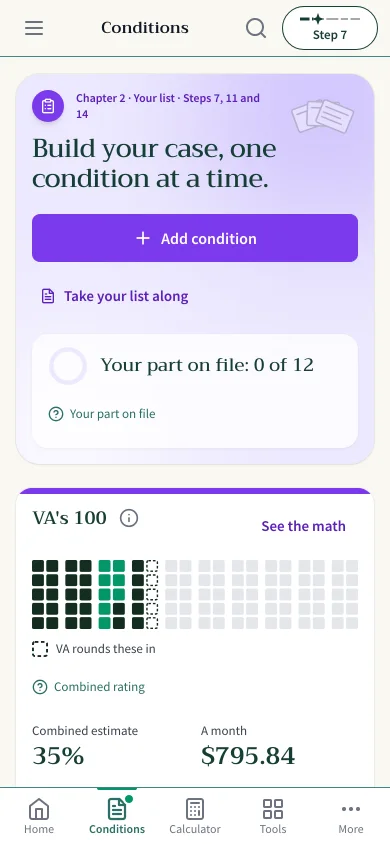
Keep your VA rating at hand.
A free account keeps your conditions in one list and shows your combined rating as you add them. Have it ready when you ask the state about a benefit.
HOW TO READ THIS PAGE
Every row, in the source's own words.
Each benefit says what it is, who qualifies in the source's words, and where it comes from. Open a row to read the passage it quotes.
Find your kind of benefit
The benefits are grouped by kind. Start with the one you came for.
Read who qualifies
Each row quotes the source's own words on who qualifies.
Check with the state
Rules change. Ask the office named in the source before you count on a benefit.
Vetrify is not a state agency and not a law firm. This page points to each state's own words; the state decides who qualifies.
8 BENEFITS
Property tax
The Disabled Veterans' Exemption lowers the property tax on the veteran's principal place of residence.
Who qualifies, in the source's wordsTied to a VA rating
“qualified veterans who, due to a service-connected injury or disease, have been rated 100% disabled or are being compensated at the 100% rate due to unemployability”
What the source says
“The Disabled Veterans' Exemption reduces the property tax liability on the principal place of residence of qualified veterans who, due to a service-connected injury or disease, have been rated 100% disabled or are being compensated at the 100% rate due to unemployability. An unmarried surviving spouse of a qualified veteran may also claim the exemption.”
Source: Disabled Veterans' Exemption. Read .
In general, a Disabled Veterans' Exemption claim also needs the home to be the claimant's principal place of residence, a discharge under other than dishonorable conditions, and service in a time period the law lists.
Who qualifies, in the source's wordsOther rule
“The veteran's character of discharge from military service must have been under "other than dishonorable" conditions. The veteran must have served during one of the time periods listed in Revenue and Taxation Code section 205.5, subdivision (b)(1)(A).”
What the source says
“In general, in order to qualify for the Disabled Veterans' Exemption: The veteran must meet the definition of a disabled veteran, as described below, for the purposes of the exemption. The claimant for the exemption may be the disabled veteran or the unmarried surviving spouse of the veteran. The property on which the exemption is claimed must be the claimant's principal place of residence. The veteran's character of discharge from military service must have been under "other than dishonorable" conditions. The veteran must have served during one of the time periods listed in Revenue and Taxation Code section 205.5, subdivision (b)(1)(A).”
Source: Disabled Veterans' Exemption. Read .
The one exception to the residence rule: the home still counts when the claimant is confined to a hospital or other care facility and would otherwise live there, provided it is not rented or leased to another party.
Who qualifies, in the source's wordsOther rule
“when the claimant is confined to a hospital or other care facility, and the property would be the claimant's principal place of residence were it not for their confinement, provided that the property is not rented or leased to another party”
What the source says
“In order for property to qualify for the Disabled Veterans' Exemption, the property must be used as the claimant's principal place of residence. The property may be owned by the veteran, the veteran's spouse, or the veteran and spouse jointly. If two or more qualified claimants own a property in which they both reside, each claimant is entitled to the Disabled Veterans' Exemption to the extent of his or her interest in the property. The one exception to the requirement that the property be the claimant's principal place of residence is when the claimant is confined to a hospital or other care facility, and the property would be the claimant's principal place of residence were it not for their confinement, provided that the property is not rented or leased to another party.”
Source: Disabled Veterans' Exemption. Read .
The Disabled Veterans' Exemption is also open to a qualified veteran who is blind in both eyes.
Who qualifies, in the source's wordsOther rule
“Is blind in both eyes. Being blind in both eyes means having a visual acuity of 5/200 or less, or concentric contraction of the visual field to 5 degrees or less.”
What the source says
“The Disabled Veterans' Exemption is available to a qualified veteran who: Is blind in both eyes. Being blind in both eyes means having a visual acuity of 5/200 or less, or concentric contraction of the visual field to 5 degrees or less. Has lost the use of two or more limbs. Losing the use of a limb means that the limb has been amputated or its use has been lost by reason of ankylosis, progressive muscular dystrophies, or paralysis.”
Source: Disabled Veterans' Exemption. Read .
The Disabled Veterans' Exemption is also open to a qualified veteran who has lost the use of two or more limbs.
Who qualifies, in the source's wordsOther rule
“Has lost the use of two or more limbs. Losing the use of a limb means that the limb has been amputated or its use has been lost by reason of ankylosis, progressive muscular dystrophies, or paralysis.”
What the source says
“The Disabled Veterans' Exemption is available to a qualified veteran who: Is blind in both eyes. Being blind in both eyes means having a visual acuity of 5/200 or less, or concentric contraction of the visual field to 5 degrees or less. Has lost the use of two or more limbs. Losing the use of a limb means that the limb has been amputated or its use has been lost by reason of ankylosis, progressive muscular dystrophies, or paralysis.”
Source: Disabled Veterans' Exemption. Read .
A low-income level of the Disabled Veterans' Exemption, for qualifying claimants whose annual household income does not exceed a specified income limit. The exemption amount and the income limit change each year by an inflation factor: ask your county assessor or the Board of Equalization for this year's figures.
Who qualifies, in the source's wordsOther rule
“qualifying claimants whose annual household income does not exceed a specified income limit”
What the source says
“The low-income exemption, also referred to as the $150,000 exemption, is available to qualifying claimants whose annual household income does not exceed a specified income limit. The amounts for both the low-income exemption and the annual income limit are compounded annually by an inflation factor.”
Source: Disabled Veterans' Exemption. Read .
The Disabled Veterans' Exemption is also available to an unmarried surviving spouse of a deceased veteran who qualified or who died from a service-connected injury or disease.
Who qualifies, in the source's wordsOther rule
“an unmarried surviving spouse of a deceased veteran who: Qualified for the exemption during their lifetime; or Would have qualified for the exemption if they had been alive on January 1, 1977; or Died from a service-connected injury or disease”
What the source says
“The Disabled Veterans' Exemption is also available to an unmarried surviving spouse of a deceased veteran who: Qualified for the exemption during their lifetime; or Would have qualified for the exemption if they had been alive on January 1, 1977; or Died from a service-connected injury or disease.”
Source: Disabled Veterans' Exemption. Read .
The Veterans' Exemption exempts up to $4,000 of property for a qualified veteran who owns limited property: no more than $5,000 in all if single, or $10,000 if married, and who lived in California on the lien date, January 1. The veteran must have served in time of war, in a peacetime campaign or expedition for which Congress issued a medal, or been released from active duty in peacetime because of a service-connected disability. The latest war on the page's list of wars and campaigns that may still have living claimants is the Vietnam campaign, ending May 8, 1975; the list then adds all other campaigns for which Congress issued the veteran a medal.
Who qualifies, in the source's wordsOther rule
“The Veterans' Exemption may be claimed by a person currently serving in the military service or one who has been honorably discharged, the unmarried surviving spouse or either parent of a deceased veteran meeting the service requirements.”
What the source says
“The Veterans' Exemption provides exemption of property not to exceed $4,000 for qualified veterans who own limited property (see Revenue and Taxation Code section 205). The Veterans' Exemption may be claimed by a person currently serving in the military service or one who has been honorably discharged, the unmarried surviving spouse or either parent of a deceased veteran meeting the service requirements. In order to qualify for this exemption, the claimant may not own property, real or personal, worth more in aggregate than $5,000 if the claimant is single. If married, the couple may not own property worth more than $10,000. In addition, the claimant must have lived in California on the lien date, January 1. In order to qualify for the Veterans' Exemption, a person must first be considered a veteran by the government by meeting certain criteria regarding his or her service as a veteran. A veteran means either of the following: A person serving or has served in and has been discharged under honorable conditions from service, in the United States Army, Navy, Air Force, Marine Corps, Coast Guard, or Revenue Marine (Revenue Cutter) Service; and served in any of the following (Article XIII, section 3, subdivisions (o), (p), and (q) California Constitution): in time of war in time of peace in a campaign or expedition for which a medal has been issued to the veteran by Congress in time of peace and because of a service-connected disability was released from active duty Persons from the National Guard or National Guard Reserve who are called into active service as part of the Armed Forces of the United States may also qualify for the Veterans' Exemption. There are 26 wars and 4 campaigns that qualify for the Veterans' Exemptions under subdivisions (o), (p), and (q) of Section 3 of Article XIII (section 205). The majority of the wars and campaigns listed are over 100 years ago, dating back to the Revolutionary War. Twenty-one of the 26 wars that ended prior to 1892 are not listed below since the likelihood of any qualified veterans, or if deceased, their spouses or parents, are no longer living. The following wars or campaigns are those which may still have living qualified claimants: War with Germany-Austria, April 6, 1917 - November 11, 1918 World War II, December 7, 1941 - January 1, 1947 Campaign against the North Koreans and Chinese Communists in Korea, June 27, 1950 - January 31, 1955 Campaign against the Viet Cong and North Vietnamese Communists in South Vietnam, August 5, 1964 - May 8, 1975 First Nicaraguan campaign, July 29, 1912 - November 14, 1912 Second Nicaraguan campaign, August 27, 1926 - January 2, 1933 Yangtze River campaign in China, September 3, 1926 - October 21, 1927 or March 1, 1930 - December 31, 1932 All other campaigns for service in which a medal has been issued to the veteran by the Congress of the United States”
Source: Veterans' Exemption. Read .
3 BENEFITS
Vehicles and license plates
Disabled Veteran (DV) license plates, which exempt you from paying vehicle registration and license fees.
Who qualifies, in the source's wordsOther rule
“You may qualify for DV License Plates if you’re a veteran who was made permanently disabled as a result of an injury or disease that occurred while on active service with the U.S. Armed Forces. You qualify if any of the following apply: You have a disability rated at 100% by the U.S. Department of Veterans Affairs (or the military service that discharged you) due to a diagnosed disease or disorder that substantially impairs or interferes with mobility. You are unable to move without the aid of an assistive device. You have lost the use of one or more limbs. You are permanently blind as defined in the California Welfare and Institutions Code §19153.”
What the source says
“If you’re a disabled veteran with a qualifying disability, you may be eligible for DV License Plates. DV License Plates exempt you from paying vehicle registration and license fees. You may qualify for DV License Plates if you’re a veteran who was made permanently disabled as a result of an injury or disease that occurred while on active service with the U.S. Armed Forces. You qualify if any of the following apply: You have a disability rated at 100% by the U.S. Department of Veterans Affairs (or the military service that discharged you) due to a diagnosed disease or disorder that substantially impairs or interferes with mobility. You are unable to move without the aid of an assistive device. You have lost the use of one or more limbs. You are permanently blind as defined in the California Welfare and Institutions Code §19153.”
Source: Disabled Veteran License Plates - California DMV. Read .
The fee exemption covers one vehicle the disabled veteran owns that displays DV License Plates: a passenger motor vehicle, a motorcycle, or a commercial vehicle with an unladen weight of 8,000 pounds or less not used for transportation for hire, compensation, or profit.
Who qualifies, in the source's wordsOther rule
“A qualified disabled veteran”
What the source says
“A qualified disabled veteran is exempt from paying all fees (except fees for duplicate DV License Plates, certificates, or cards if they’re lost, stolen, or damaged) on one: Passenger motor vehicle. Motorcycle. Commercial vehicle with an unladen weight of 8,000 pounds or less not used for transportation for hire, compensation, or profit. The vehicle must be owned by the disabled veteran and display DV License Plates. This fee exemption can only be used for one vehicle.”
Source: Disabled Veteran License Plates - California DMV. Read .
With valid DV License Plates you may park in wheelchair symbol spaces, next to blue curbs, next to green curbs for as long as you wish, and at on-street meters at no charge.
Who qualifies, in the source's wordsOther rule
“Once you have valid DV License Plates”
What the source says
“Once you have valid DV License Plates, you may park: In parking spaces with the International Symbol of Access (wheelchair symbol). Next to a blue curb authorized for persons with disabilities parking. Next to a green curb (green curbs indicate limited time parking) for as long as you wish. In an on-street metered parking space at no charge. In an area that indicates it requires a resident or merchant permit.”
Source: Disabled Veteran License Plates - California DMV. Read .
1 BENEFIT
Education and tuition
No nonresident tuition at a community college or CSU, while living in California after discharge and up to the minimum time needed to become a resident, for a veteran stationed in California on active duty for more than one year right before discharge. A dishonorable or bad conduct discharge rules it out.
Who qualifies, in the source's wordsOther rule
“a student of the California Community Colleges or the California State University who was a member of the Armed Forces of the United States stationed in this state on active duty for more than one year immediately prior to being discharged”
What the source says
“Except as provided for in subdivisions (b), (c), and (d), a student of the California Community Colleges or the California State University who was a member of the Armed Forces of the United States stationed in this state on active duty for more than one year immediately prior to being discharged shall be exempt from paying nonresident tuition for the length of time he or she lives in this state after being discharged up to the minimum time necessary to become a resident. 2. (1) Except as provided for in subdivisions (c) and (d), a student enrolled, or intending to enroll, at a campus of the California Community Colleges, or as an undergraduate at a campus of the California State University, who was a member of the Armed Forces of the United States stationed in this state on active duty for more than one year immediately prior to being discharged shall be exempt from paying nonresident tuition for up to one year if he or she files an affidavit with the institution at which he or she is enrolled, or intends to enroll, stating that he or she intends to establish residency in California as soon as possible. (2) The one-year exemption provided in paragraph (1) shall be used by the student within two years of being discharged. 3. Notwithstanding any other law, the California Community Colleges and the California State University shall, and the University of California is requested to, update and adopt policies no later than July 1, 2015, regarding tuition rates for eligible veterans and their eligible dependents to ensure conformity to, and compliance with, the federal Veterans Access, Choice, and Accountability Act of 2014 (Public Law 113-146) and the requirements of this section. 4. A former member of the Armed Forces of the United States who received a dishonorable or bad conduct discharge shall not be eligible for an exemption pursuant to this section.”
3 BENEFITS
Other state benefits
A reduced-fee disabled veteran sport fishing license, sold anywhere licenses are sold after you prequalify the first time.
Who qualifies, in the source's wordsTied to a VA rating
“any resident or nonresident honorably discharged disabled veteran with a 50 percent or greater service-connected disability”
What the source says
“Available for any resident or nonresident honorably discharged disabled veteran with a 50 percent or greater service-connected disability. After you prequalify for your first Disabled Veteran Reduced Fee Sport Fishing License, you can purchase disabled veteran licenses anywhere licenses are sold.”
Source: Sport Fishing Licenses and Report Cards. Read .
A low cost disabled veteran hunting license, sold anywhere licenses are sold once the Department has verified your eligibility. To prequalify you send a letter from the VA, and the page lists the other proof a hunting license needs.
Who qualifies, in the source's wordsTied to a VA rating
“you were honorably discharged from the US military and have a service–connected disability rating of 50% or greater”
What the source says
“To prequalify to purchase a disabled veteran license, submit a letter from the Veteran’s Administration documenting that you were honorably discharged from the US military and have a service–connected disability rating of 50% or greater. After your eligibility has been verified, your customer record will be updated. Once you receive notification from the Department that your customer record has been updated, you will be able to purchase a low cost disabled veteran sport fishing license and/or hunting license anywhere licenses are sold.”
Source: Reduced-Fee Hunting License and Disabled Entitlements. Read .
The Distinguished Veteran Pass for California State Parks.
Who qualifies, in the source's wordsTied to a VA rating
“Honorably discharged war veterans who are residents of California with an overall / combined rating at 50% or greater service-connected disability, or were held as prisoners of war by forces hostile to the United States, or recipients of the Medal of Honor”
What the source says
“Honorably discharged war veterans who are residents of California with an overall / combined rating at 50% or greater service-connected disability, or were held as prisoners of war by forces hostile to the United States, or recipients of the Medal of Honor are eligible to receive the Distinguished Veteran Pass.”
Source: Distinguished Veteran Pass Application Requirements | California State Parks. Read .
Not covered on this page yet
These have no row here yet, so the page is not a full list. Ask the California Department of Veterans Affairs (CalVet) about them.
- California's statutes themselves: the Legislature's statute site refused automated reading on 2026-11-25, so every row rests on a state agency page.
- CalVet's own pages: its site refused automated reading on 2026-11-25, so no row quotes it.

On the App Store
Your combined rating and what it pays, on your phone.
VA Calc combines your ratings with VA's whole-person formula and shows what that rating pays at VA's official rates.
Official sources
- Disabled Veterans' Exemption, www.boe.ca.gov
- Veterans' Exemption, www.boe.ca.gov
- Disabled Veteran License Plates - California DMV, www.dmv.ca.gov
- Community College Promise Grant (CCPG) and Financial Aid Special Programs Manual (California Community Colleges Chancellor's Office, September 2026), Ed. Code § 68075.5 as reproduced in Appendix 8 (Military Residency) and Appendix 16 (Military Non-Resident Fees), www.cccco.edu
- Sport Fishing Licenses and Report Cards, wildlife.ca.gov
- Reduced-Fee Hunting License and Disabled Entitlements, wildlife.ca.gov
- Distinguished Veteran Pass Application Requirements | California State Parks, www.parks.ca.gov